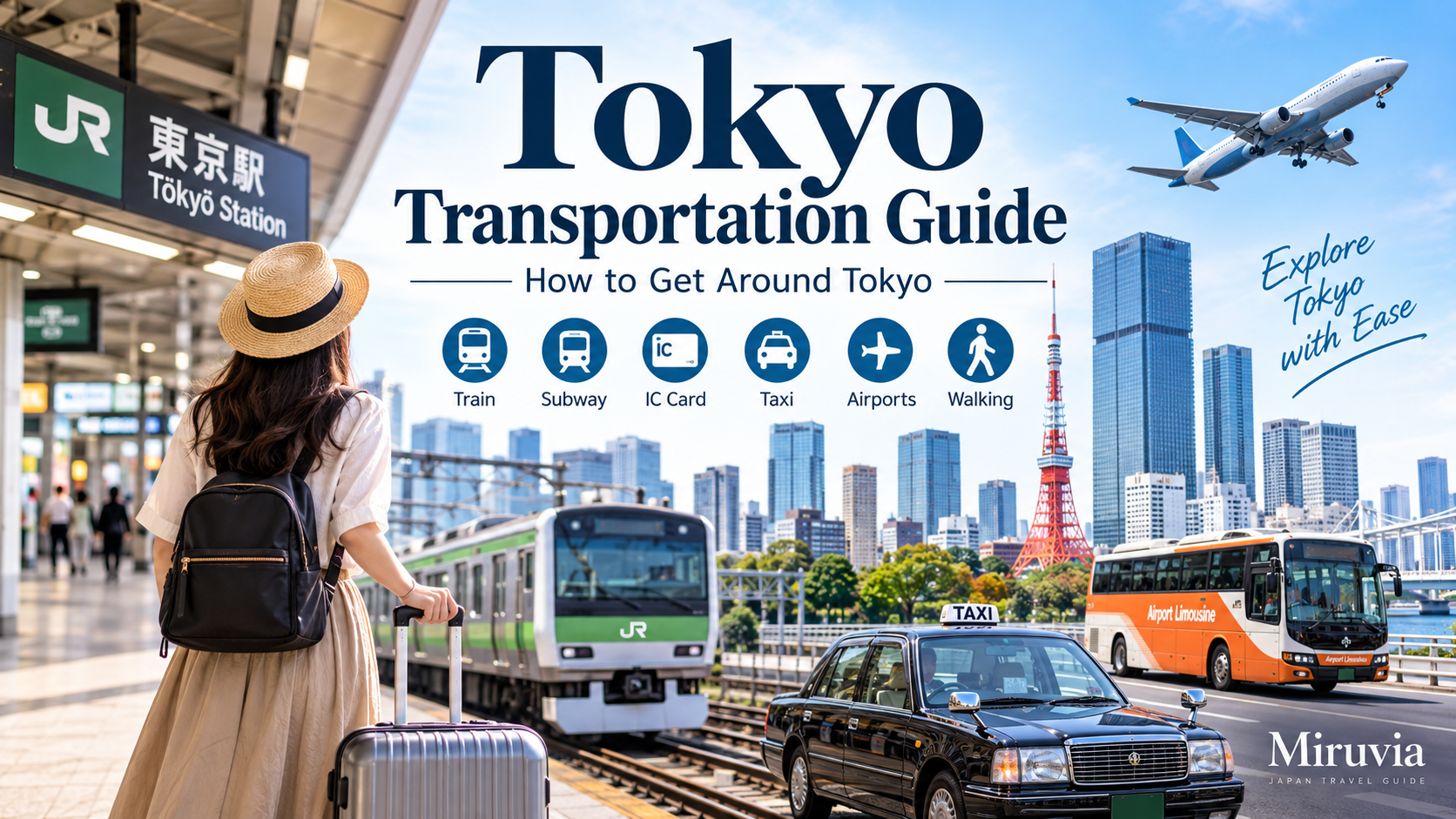
Tokyo has one of the world’s most extensive public transportation networks, but it can look complicated when you see the train map for the first time.
The city is served by JR trains, Tokyo Metro, Toei Subway, private railway companies, buses, taxis, and other transportation options. Different companies operate different lines, which is one reason the system can initially feel confusing.
However, most first-time visitors do not need to understand the entire network. Once you learn how to use an IC card, follow station signs, identify the correct platform, and use a navigation app, getting around Tokyo becomes much easier.
Trains and subways are usually the most practical way to travel between major sightseeing areas such as Shinjuku, Shibuya, Asakusa, Ueno, Ginza, and Tokyo Station.
You should also be prepared for large stations, busy commuter periods, and a significant amount of walking. Some stations have many entrances and exits, so choosing the correct exit can save considerable time.
This guide explains how Tokyo’s trains and subways work, how to pay for transportation, how to use IC cards, how to navigate stations, what to expect during rush hour, how to travel with luggage, and how to get into the city from Haneda and Narita airports.
You do not need to memorize Tokyo’s transportation system before your trip. Understanding a few basic principles will be enough to travel around the city with confidence.
Is Tokyo Easy to Get Around?
Yes. Tokyo can look complicated at first, but it is relatively easy to get around once you understand the basic system.
Trains and subways connect most areas that international visitors are likely to explore. Major stations and tourist areas generally have signs in both Japanese and English, and station numbering can also help travelers identify stops.
Navigation apps make the system much easier to use because they can show which line to take, where to transfer, which platform to use, and approximately how long the journey will take.
The most confusing part for many first-time visitors is that Tokyo’s railway network is operated by several different companies. JR lines, Tokyo Metro, Toei Subway, and private railways are separate systems, even though they connect with one another at many stations.
Large stations can also be challenging. Shinjuku, Tokyo, Shibuya, and other major stations may have numerous platforms, underground passages, and exits. Reaching the correct station is therefore only part of the journey — choosing the right exit can also save time.
Fortunately, you do not need to memorize train lines or station layouts. Use a navigation app for each journey, follow signs inside the station, and allow a little extra time when using an unfamiliar station.
After a few trips, most visitors become much more comfortable with Tokyo’s transportation system.
For more practical advice on transportation, money, etiquette, luggage, and other essentials, see our Tokyo Travel Tips for First-Time Visitors.
Tokyo Trains and Subways Explained
Tokyo’s railway network is made up of several different systems operated by different companies.
For most visitors, the four categories worth understanding are JR lines, Tokyo Metro, Toei Subway, and private railway lines.
You do not need to memorize which company operates every line. The important thing is to follow the route shown by your navigation app and understand that transferring between different operators may sometimes involve passing through separate ticket gates.
JR Lines
JR operates several important train lines in central Tokyo and also connects the city with destinations throughout the greater Tokyo area and the rest of Japan.
The JR Yamanote Line is particularly useful for first-time visitors. It forms a loop through major areas including Tokyo, Ueno, Shinjuku, Shibuya, and other important stations.
Other JR lines can provide faster or more direct routes depending on your destination, so do not assume that the Yamanote Line is always the best option.
Use a navigation app to compare routes rather than trying to memorize the JR network.
Tokyo Metro
Tokyo Metro operates an extensive subway network across central Tokyo.
Its lines provide convenient access to many major sightseeing and business areas, including Ginza, Shibuya, Asakusa, Ueno, and areas around central Tokyo.
Each Tokyo Metro line has its own name and identifying symbol, while stations are also numbered. These identifiers can make navigation easier if you are unfamiliar with Japanese station names.
Toei Subway
Toei Subway is a separate subway system operated by the Tokyo Metropolitan Government.
Its lines connect with many important areas and interchange stations throughout Tokyo.
From a traveler’s perspective, using Toei Subway is similar to using Tokyo Metro. However, because they are different operators, ticket and pass conditions may differ depending on what you are using.
Private Railway Lines
Several private railway companies also operate important routes in and around Tokyo.
These lines are particularly useful when traveling from central Tokyo toward suburban areas, airports, or destinations outside the city center.
Depending on your itinerary, you may use private railways without needing to learn much about the company itself. Your navigation app will usually show the appropriate operator, line, platform, transfer, and destination.
The key is to follow the specific route shown rather than assuming that every train in Tokyo belongs to the same railway system.
Tip: Pay attention to both the line name and destination direction when boarding a train. Two trains may use nearby platforms while traveling in completely different directions.
How to Pay for Transportation in Tokyo
There are several ways to pay for trains and subways in Tokyo, but most first-time visitors will mainly choose between an IC card and individual tickets.
An IC card is generally the most convenient option because it reduces the need to calculate fares or buy a new ticket for every journey.
However, understanding paper tickets is still useful in case you need one during your trip.
IC Cards
IC cards are rechargeable transportation cards that can be used on many trains, subways, and buses in Tokyo and other parts of Japan.
Suica and PASMO are the two names travelers are most likely to encounter in Tokyo.
Instead of purchasing a ticket for each journey, you generally touch the card or compatible device to the ticket gate when entering and again when leaving. The appropriate fare is then deducted from the stored balance.
IC cards can also be used for payments at many convenience stores, vending machines, shops, and other participating businesses.
Availability, purchase methods, mobile compatibility, and visitor-oriented versions can change, so check current official information before your trip.
Paper Tickets
Paper tickets can still be purchased for individual train and subway journeys.
You normally select or determine the required fare, purchase the ticket from a ticket machine, insert or scan it at the appropriate gate, and keep it until you exit at your destination.
Paper tickets are useful if you do not have an IC card, but buying individual tickets for every journey can be less convenient for travelers making several trips each day.
If you are unsure which ticket to purchase, station staff can help.
Which Is Better for First-Time Visitors?
For most first-time visitors, an IC card is the simpler option for everyday transportation in Tokyo.
It reduces the need to purchase individual tickets and makes transferring between many participating railway and subway systems easier.
However, an IC card is primarily a convenient payment method. It should not automatically be treated as an unlimited transportation pass or a way to make every journey cheaper.
Some special trains, reserved seats, limited express services, or other journeys may require an additional ticket or separate reservation.
Before traveling, check the latest official information about the specific IC card or transportation service you plan to use.
Tip: Keep enough balance on your IC card for your next journey. If the balance is insufficient when you arrive, you may need to add value before exiting the station.
How to Use an IC Card in Tokyo
Using an IC card in Tokyo is straightforward once you understand the basic process.
For a typical train or subway journey:
- Make sure your IC card has sufficient balance.
- Touch the card or compatible device to the reader at the ticket gate.
- Follow signs to the correct line and platform.
- Take the train to your destination, transferring if necessary.
- Touch the same card or device to the reader when exiting.
- The fare is automatically deducted from your balance.
You do not normally need to calculate the exact fare before each standard journey when using an IC card.
If your balance becomes low, you can add value at compatible ticket machines and other supported locations. Available payment methods can vary, so check the instructions shown on the machine.
When transferring between railway operators, follow the route shown by station signs and your navigation app. Depending on the station and journey, you may need to pass through transfer gates or exit and enter another set of gates.
Always use the same IC card or device for both entry and exit. Mixing different cards or devices during the same journey can cause problems at the ticket gate.
If the gate does not open or you encounter a fare problem, do not force your way through. Look for a station staff member, who can check the journey and help correct the issue.
Tip: Check your IC card balance occasionally, particularly before traveling to the airport or making a longer journey, so you do not have to recharge it when you are in a hurry.
How to Use Tokyo Trains and Subways Step by Step
Using Tokyo’s trains and subways becomes much easier when you follow the same basic process for each journey.
Here is a simple step-by-step approach for first-time visitors:
1. Search for your destination
Use a navigation app to search from your current location or station to your destination. Check the recommended line, departure time, platform, transfers, and destination station.
2. Confirm the station and line
Tokyo stations may serve several railway companies and lines. Look for the correct line name, symbol, and station signs rather than simply following signs that say “train.”
3. Enter through the ticket gate
Use your IC card or valid ticket to enter the appropriate gate. Make sure you are entering the area for the railway operator or line shown in your route.
4. Find the correct platform
Follow signs showing the line and direction of travel. Check the destination or major stations listed for each direction to confirm that you are on the correct side.
5. Check the train before boarding
Some lines operate different service types, such as local, rapid, express, or limited express trains. Not every train necessarily stops at every station, so confirm that your train stops at your destination.
6. Transfer when necessary
If your route requires a transfer, follow station signs for the next line. Large stations can require several minutes of walking between platforms, so do not assume every transfer is immediate.
7. Get off at your destination
Listen to announcements and watch the information displays inside the train. Station names and numbers can help you confirm when you have arrived.
8. Choose the correct exit
Before leaving the station, check which exit is closest to your destination. Large stations may have many exits, and choosing the wrong one can add considerable walking time.
9. Exit through the ticket gate
Touch your IC card or use your ticket at the gate. If there is a fare or ticket problem, ask station staff for assistance.
Tip: Do not focus only on the train departure time. In large stations, allow extra time to find the correct platform, make transfers, and reach the right exit.
Understanding Tokyo Train Stations
Tokyo’s largest train stations can feel like small cities. Major stations may contain multiple railway lines, underground passages, shopping areas, restaurants, and many different exits.
Understanding a few basic features can make navigating them much easier.
Station exits
Large stations often have multiple exits identified by names, numbers, or letters. Before leaving the ticket gate, check which exit is closest to your destination.
At stations such as Shinjuku or Tokyo, using the wrong exit can place you on a completely different side of the station and add significant walking time.
Platform numbers
Navigation apps and station signs may show a platform number for your train. Follow the signs carefully, but check station displays as well because platform information can occasionally change.
Line colors, symbols, and station numbers
Subway lines use identifying colors, letters, or symbols, and many stations have numbers. These can be especially useful when Japanese station names are unfamiliar.
Ticket gates
Large stations may have several groups of ticket gates. The gate you use can affect which exit or part of the station is easiest to reach.
Transfers
A transfer does not always mean that the next platform is nearby. At large interchange stations, you may need to walk through long corridors, use stairs or escalators, or pass through designated transfer gates.
Signs and information displays
Follow official station signs rather than relying only on your sense of direction. English-language information is commonly available at major stations, and electronic displays can help confirm destinations and departure information.
If you become confused, stop and check your navigation app or ask station staff rather than continuing in the wrong direction.
Tip: When searching for a restaurant, hotel, or attraction near a large station, save the recommended station exit as well as the station name. This small detail can save a surprising amount of time.
Rush Hour in Tokyo
Tokyo’s trains can become extremely busy during commuter periods, particularly on weekday mornings and evenings.
First-time visitors do not need to avoid trains completely during these times, but traveling outside the busiest periods can make sightseeing significantly more comfortable.
Crowding varies by line, direction, station, day, and service, so there is no single time when every train in Tokyo is equally busy.
When Is Rush Hour?
As a general guide, weekday morning rush hour is concentrated around 7:30–9:30 a.m., while evening commuter traffic often increases from around 5:00–8:00 p.m.
These times are approximate. Some lines and directions become crowded earlier or remain busy later.
Weekends and public holidays have different travel patterns and generally do not follow the same commuter rush as ordinary weekdays.
If you are carrying large luggage or traveling with young children, avoiding the busiest weekday commuter periods can make the journey considerably easier.
How to Avoid the Busiest Trains
If your sightseeing schedule is flexible, consider starting your first train journey before the morning rush becomes busy or waiting until later in the morning.
Other useful strategies include:
- Avoid traveling through major commuter stations at peak times when possible
- Allow extra time instead of choosing the fastest possible connection
- Avoid carrying large suitcases on crowded commuter trains
- Follow platform markings and wait for passengers to exit before boarding
- Keep bags close to your body and avoid blocking doors
- Use a navigation app to compare alternative routes
If you find that a train is extremely crowded, waiting for a later service may sometimes provide a more comfortable journey, although the next train can also be busy during peak periods.
Tip: Do not design your sightseeing itinerary around exact rush-hour boundaries. Treat them as approximate periods and expect conditions to vary depending on the route.
Getting Around Tokyo with Luggage
Traveling around Tokyo with luggage is possible, but large suitcases can make trains, stations, and transfers considerably more difficult.
Major stations can involve long walks, stairs, escalators, elevators, and crowded passages. If possible, avoid carrying large luggage during weekday rush hours.
Keep these practical tips in mind:
- Avoid rush hour when carrying large suitcases. Crowded commuter trains leave limited space for bulky luggage.
- Use elevators when necessary. Large stations generally provide accessible routes, but the elevator may not be located near your preferred exit or platform.
- Allow extra transfer time. Moving between platforms with luggage can take longer than navigation apps suggest.
- Keep luggage out of doorways and busy passages. Avoid blocking other passengers whenever possible.
- Check luggage storage options. Coin lockers and other storage services can be useful when sightseeing before check-in or after check-out.
- Ask your hotel about luggage storage. Policies vary, but some accommodations can hold luggage around your stay.
- Consider luggage forwarding. Delivery services can be useful when traveling between airports, hotels, and other destinations.
Luggage forwarding can be particularly helpful if your Japan itinerary includes several cities. Instead of carrying a large suitcase on every train, you may be able to send it to your next accommodation and travel with a smaller bag.
Delivery times, acceptance rules, size limits, fees, and hotel participation can vary, so confirm the details before relying on a forwarding service.
Keep passports, medication, valuables, electronics, and anything you may need immediately with you rather than placing them in luggage that will be delivered separately.
Still deciding what luggage and travel essentials to bring? See our Tokyo Packing List: What to Bring for Your First Trip to Japan for a complete packing checklist.
Taxis in Tokyo
Taxis are widely available in Tokyo and can be useful when trains are inconvenient, you are carrying luggage, the weather is poor, or you are traveling late at night.
However, taxis are generally more expensive than trains and subways, so most visitors use them selectively rather than as their main form of transportation.
Taxis can be particularly useful for:
- Traveling with large or heavy luggage
- Short trips between locations that are inconvenient by train
- Reaching a hotel or attraction from a station
- Traveling during heavy rain or uncomfortable weather
- Traveling with several people when splitting the fare
- Late-night transportation when regular train services are limited
Many taxis accept cash, credit cards, and other cashless payment methods, but available payment options can vary. Check the payment information inside the taxi if necessary.
Taxi doors are often opened and closed automatically by the driver, so passengers generally do not need to operate the rear door themselves.
Showing the destination on your phone can also be helpful. For hotels, restaurants, or smaller locations, having the name and address available can reduce confusion.
Taxi fares depend on distance, time, traffic conditions, and applicable surcharges. Rather than relying on a fixed fare quoted in an older travel guide, check current information when planning an important journey.
For most sightseeing days, trains and subways remain the more economical choice, while taxis work well as a convenient backup option.
Tip: If you need to reach an airport or another destination by a specific time, allow extra time for road traffic rather than assuming a taxi will always be faster than the train.
Walking Around Tokyo
Walking is an essential part of sightseeing in Tokyo, even if you use trains and subways throughout the day.
Many attractions, restaurants, shops, temples, and neighborhoods are located within walking distance of stations. You may also walk considerable distances inside large stations before you even reach the street.
For this reason, comfortable walking shoes are one of the most important things to bring to Tokyo.
Walking can also be one of the best ways to experience the city. Instead of taking a train for every short journey, exploring nearby areas on foot allows you to discover smaller streets, cafés, shops, parks, and neighborhoods that you might otherwise miss.
Keep these practical points in mind:
- Wear comfortable shoes that you have already used for long walks
- Check walking distances before assuming two attractions are close
- Use the correct station exit to reduce unnecessary walking
- Carry water during hot weather
- Bring rain protection when necessary
- Allow more time when walking with luggage
- Be prepared for considerably more walking than you might expect
Tokyo is large, so walking should complement public transportation rather than replace it. A practical approach is to take a train or subway between major areas and then explore each neighborhood on foot.
For example, you can travel by train to areas such as Asakusa, Ueno, Shibuya, or Shinjuku and then spend several hours exploring nearby attractions on foot before taking another train to your next area.
Want to compare Tokyo’s main sightseeing neighborhoods? See our Best Areas to Visit in Tokyo for First-Time Visitors to decide which areas to explore on foot.
Getting from Tokyo Airports to the City
Tokyo is mainly served by two international airports: Haneda Airport (HND) and Narita International Airport (NRT).
Both airports have public transportation connections to central Tokyo, but their locations are very different. Haneda is much closer to central Tokyo, while Narita is located farther outside the city.
The best transportation option depends on where you are staying, your arrival time, luggage, budget, and whether you prefer fewer transfers or the fastest possible journey.
Before traveling, use a navigation app and check the latest official schedules because train and bus services can change.
From Haneda Airport
Haneda Airport is relatively close to central Tokyo and offers convenient train, monorail, bus, and taxi connections.
Common options include:
- Keikyu Line — useful for connections toward Shinagawa and other parts of Tokyo
- Tokyo Monorail — connects Haneda Airport with Hamamatsucho, where you can transfer to JR lines
- Airport buses — useful for some major hotels, stations, and districts
- Taxi — convenient with luggage or for destinations that require inconvenient transfers
There is no single best option for every traveler. For example, a route that is convenient for someone staying near Shinagawa may not be the best choice for someone staying in Shinjuku.
Check the route from the airport directly to your accommodation rather than choosing transportation based only on general recommendations.
From Narita Airport
Narita Airport is farther from central Tokyo, so airport transportation usually takes longer than traveling from Haneda.
Common options include:
- Narita Express (N’EX) — a JR limited express service connecting Narita Airport with major stations in the Tokyo area
- Keisei Skyliner — a fast option toward areas such as Ueno and Nippori
- Airport buses — useful for selected stations, hotels, and other destinations
- Other train services — potentially useful depending on your destination and budget
- Taxi — available, but the long distance can make it considerably more expensive than public transportation
The best option depends heavily on where you are staying. A fast airport train is not necessarily the fastest overall route if it requires inconvenient transfers after reaching central Tokyo.
Compare the complete journey from Narita Airport to your accommodation, including transfers and walking with luggage.
Tip: Save your hotel name, address, and nearest station before your flight. After a long international journey, having your complete route ready can make arriving in Tokyo much easier.
Are Tokyo Transportation Passes Worth It?
Transportation passes can save money in Tokyo, but they are not automatically the best choice for every traveler.
Whether a pass is worthwhile depends on which railway operators you use, how many journeys you make, where you are staying, and what you plan to visit during the validity period.
Some passes cover specific subway networks or railway services rather than every train in Tokyo. This is important because a pass that works on Tokyo Metro or Toei Subway, for example, may not cover a JR line or private railway you want to use.
Before buying a transportation pass:
- Check exactly which lines and operators are included
- Compare the pass price with the journeys you realistically expect to make
- Check the validity period
- Consider whether your itinerary requires JR or private railway lines that are not covered
- Avoid changing a convenient route simply to make use of a pass
For many first-time visitors, using an IC card and paying for individual journeys is the simplest approach. It provides flexibility and removes the need to design each sightseeing day around the coverage of a particular pass.
A transportation pass becomes more attractive when your planned journeys fit its coverage well and the total regular fares would exceed the cost of the pass.
Remember that an IC card and a transportation pass serve different purposes. An IC card is primarily a convenient payment method, while a pass may provide unlimited or specified travel within its particular conditions.
Pass prices, eligibility requirements, coverage, and sales conditions can change, so check the current official information before purchasing one.
Tip: Plan your sightseeing itinerary first and evaluate transportation passes afterward. Buying a pass before deciding where you will actually travel can result in paying for coverage you do not use.
Common Transportation Mistakes to Avoid
Tokyo’s transportation system becomes much easier once you understand the basics, but a few common mistakes can make journeys unnecessarily confusing or time-consuming.
Try to avoid these mistakes:
- Following only the station name — large stations may serve many different lines and railway operators, so always check the line as well.
- Using the wrong station exit — at major stations, the wrong exit can add significant walking time.
- Boarding without checking the direction — confirm the destination direction or major stations shown on the platform before boarding.
- Assuming every train stops at every station — local, rapid, express, and other service types may have different stopping patterns.
- Allowing too little time for transfers — changing trains at a large station can involve long walks between platforms.
- Traveling with large luggage during rush hour — crowded commuter trains can make moving with suitcases difficult.
- Assuming one transportation pass covers everything — JR, subway, and private railway services may have different ticket and pass conditions.
- Using different IC cards or devices for entry and exit — use the same payment method throughout the journey.
- Letting your phone battery run low — navigation apps are extremely useful, so carry a portable charger on long sightseeing days.
- Relying on old fare or timetable information — transportation services, prices, and schedules can change.
If you make a mistake, do not panic. Tokyo stations have staff who can help with tickets, fares, transfers, and gate problems.
Taking an extra minute to check your route before entering the station can often prevent a much longer detour later.
Tip: Before every journey, confirm these four things: station, line, direction, and exit. This simple habit prevents many of the most common transportation mistakes.
Tokyo Transportation Tips for First-Time Visitors
Tokyo’s transportation system may seem complicated at first, but a few simple habits can make getting around the city much easier.
Keep these practical tips in mind:
- Use a navigation app for each journey. Check the line, platform, transfers, and destination before entering the station.
- Use an IC card for convenience. For most everyday journeys, it reduces the need to purchase individual tickets.
- Check the train direction before boarding. Look at the destination or major stations shown on platform signs.
- Pay attention to service types. Rapid or express trains may skip stations served by local trains.
- Save the correct station exit. This is especially useful at large stations such as Shinjuku, Shibuya, and Tokyo.
- Allow extra time at unfamiliar stations. Transfers and station exits may involve more walking than expected.
- Avoid rush hour with large luggage when possible.
- Keep your phone charged. Maps and transportation apps are extremely useful throughout the day.
- Ask station staff when you are unsure. It is better to confirm your route than continue in the wrong direction.
- Check current information for airport transfers and special trains. Timetables, fares, and service conditions can change.
For sightseeing, a simple strategy works well: use trains or subways to travel between major areas, then explore each neighborhood on foot.
You do not need to find the absolute fastest route every time. A journey with fewer transfers can sometimes be easier, particularly when traveling with luggage or using Tokyo’s transportation system for the first time.
After several journeys, reading station signs, using ticket gates, making transfers, and choosing exits will usually begin to feel much more natural.
Tip: Before leaving your hotel each morning, check your first route and charge your phone. Those two simple preparations can make the entire sightseeing day easier.
Final Thoughts
Tokyo’s transportation system may look overwhelming at first, but most first-time visitors quickly become comfortable using it.
You do not need to memorize every train line or understand every railway company before your trip. Learning how to use an IC card, following station signs, checking your route with a navigation app, and confirming the correct platform and direction will cover most everyday journeys.
Trains and subways are usually the most practical way to move between Tokyo’s major sightseeing areas, while walking is ideal for exploring individual neighborhoods. Taxis can also be useful when traveling with luggage, during poor weather, or when public transportation is less convenient.
Large stations and rush-hour crowds may require some extra patience, particularly during your first few days. Allow additional time for transfers, pay attention to station exits, and avoid carrying large luggage on crowded commuter trains when possible.
When arriving at Haneda or Narita Airport, choose your transportation based on your actual accommodation rather than assuming that one airport train or bus is best for everyone.
Most importantly, use current route and transportation information during your trip. Timetables, fares, passes, and service conditions can change, so real-time information should take priority over older travel guides.
Once you understand the basics, Tokyo’s extensive transportation network becomes one of the city’s greatest advantages, allowing you to explore many different neighborhoods efficiently.
Ready to plan the rest of your trip? Start with our Tokyo Travel Guide for First-Time Visitors for an overview of where to stay, what to do, food, transportation, and other essential information.
