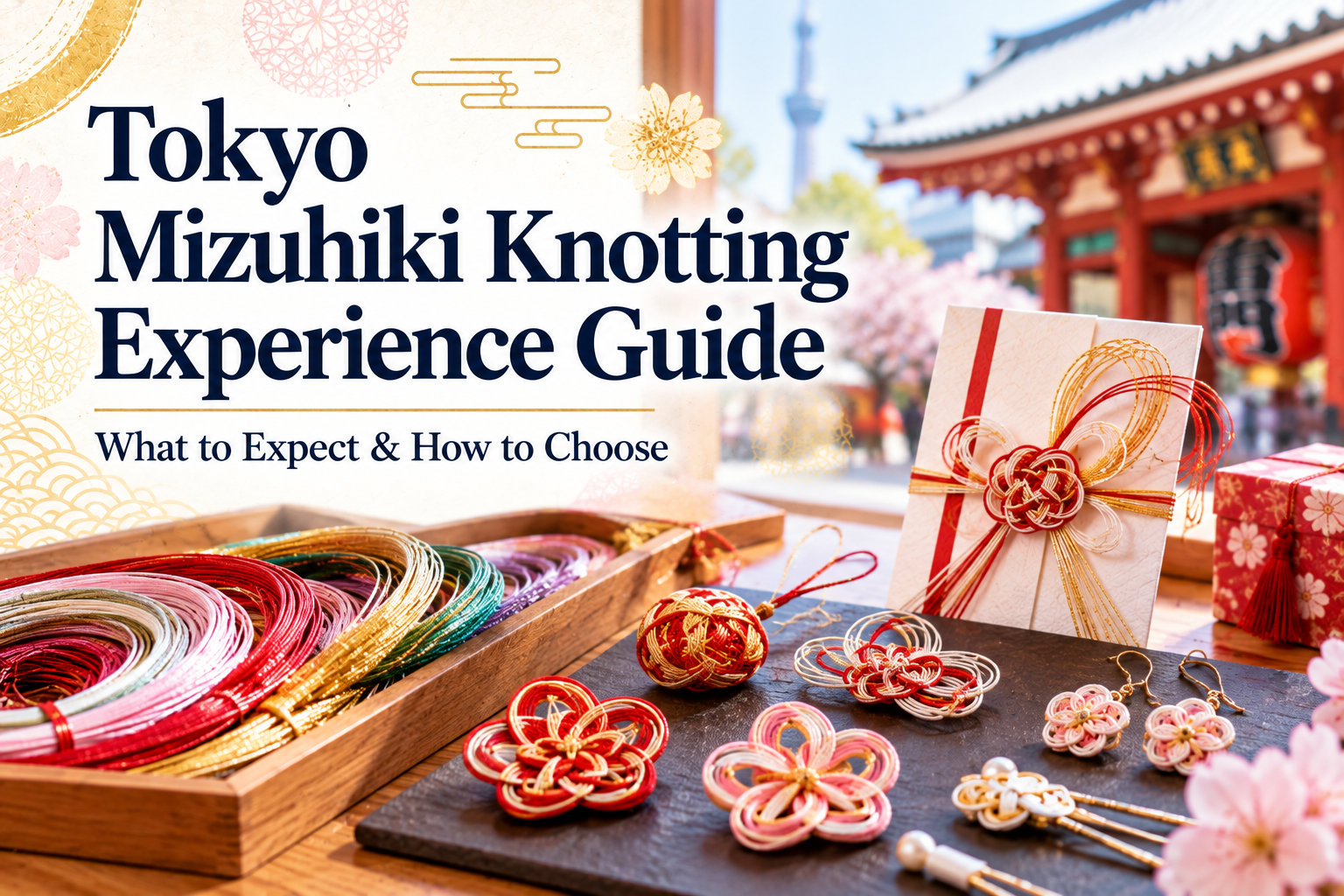
Discover Mizuhiki: The Japanese Art of Decorative Knotting
Mizuhiki is a traditional Japanese decorative craft that uses colorful cords to create elegant knots, ornaments, and gift decorations.
These distinctive cords are commonly seen on Japanese gift envelopes and ceremonial packages, where the colors and knot styles can communicate different meanings.
Today, mizuhiki is also used to create accessories, decorative objects, and contemporary handmade gifts.
For travelers visiting Tokyo, a mizuhiki knotting workshop offers an opportunity to explore Japanese culture through a hands-on activity.
You can learn basic knotting techniques, work with traditional materials, and create a small item to take home.
Unlike simply purchasing a finished souvenir, a workshop allows you to understand the craftsmanship and symbolism behind mizuhiki.
This guide explains what mizuhiki is, what happens during a workshop, typical prices and durations, and how to choose a beginner-friendly mizuhiki experience in Tokyo.
What Is Mizuhiki?
Mizuhiki refers to decorative cords traditionally used in Japanese gift wrapping and ceremonial presentation.
The cords are typically made from paper that has been twisted into thin strands and strengthened with coatings or decorative coverings.
They are available in many colors, including red, white, gold, silver, and modern combinations.
By arranging and tying the cords, craftspeople create patterns that range from simple knots to elaborate decorative designs.
A Brief History of Mizuhiki
Mizuhiki has a long history in Japanese gift-giving and ceremonial customs.
Its development is connected with traditions of presenting gifts and attaching decorative cords to packages.
Over time, different knot styles and color combinations became associated with particular occasions.
Today, mizuhiki remains common on formal gift envelopes and ceremonial packages.
It has also developed into a contemporary craft used in jewelry, home decorations, and handmade accessories.
What Makes Mizuhiki Special?
Mizuhiki combines decorative beauty with cultural meaning.
The arrangement of cords can represent ideas such as celebration, connection, and respect.
Some knots are designed to be easily untied and retied, while others are associated with occasions that should ideally happen only once.
Understanding these differences adds cultural depth to the craft.
Why Try a Mizuhiki Knotting Experience in Tokyo?
A mizuhiki workshop offers a creative introduction to Japanese traditions.
Learn a Traditional Japanese Craft
Participants can discover how simple cords are transformed into intricate decorations.
Even basic knotting techniques require attention to shape, balance, and tension.
Learning these skills provides a greater appreciation of handmade Japanese crafts.
Create a Personalized Souvenir
Many workshops allow participants to choose cord colors and create a small finished item.
Depending on the experience, you may make a decorative knot, charm, bookmark, accessory, or gift ornament.
A handmade mizuhiki item can become a meaningful souvenir from your visit to Tokyo.
Explore Japanese Gift-Giving Culture
Mizuhiki is closely associated with traditional gift presentation.
A workshop may introduce the meanings behind common knots and color combinations.
This can help you understand decorative cords that you encounter on gift envelopes and ceremonial packages in Japan.
Enjoy an Indoor Cultural Activity
Mizuhiki workshops are usually held indoors.
They can be a convenient option during rainy weather or when you want a break from sightseeing.
Some introductory sessions are short enough to fit into a half-day itinerary.
Types of Mizuhiki Workshops in Tokyo
Not every mizuhiki workshop teaches the same techniques or produces the same finished item.
Understanding the main formats can help you choose an experience that matches your interests.
Basic Mizuhiki Knotting Workshops
These workshops focus on learning traditional knotting techniques.
Participants practice arranging cords and forming recognizable shapes.
The instructor may begin with a simple knot before introducing more decorative patterns.
This format is suitable for travelers who want to understand the fundamentals of mizuhiki.
Mizuhiki Accessory Making
Some workshops use mizuhiki knots to create wearable accessories.
Depending on the provider, participants may make earrings, brooches, hair ornaments, or other small items.
These workshops combine traditional knotting with modern accessory design.
Check whether all required fittings and materials are included.
Mizuhiki Gift Decoration Workshops
These experiences focus on using mizuhiki to decorate gifts or envelopes.
Participants may learn how to attach cords to packages or create decorative elements for gift presentation.
This format can be especially interesting for travelers who want to understand Japanese gift-giving customs.
Seasonal Mizuhiki Workshops
Some providers offer seasonal designs inspired by Japanese celebrations or annual events.
Projects may include decorative ornaments for New Year or other festive occasions.
Availability and designs vary by workshop and season.
Private Mizuhiki Lessons
Private sessions may offer more personalized instruction.
They can be useful for travelers who want to focus on a particular technique or create a specific item.
Private workshops may cost more than group sessions.
Popular Mizuhiki Knots and Their Meanings
Mizuhiki includes several traditional knot styles.
The exact meaning can depend on the occasion, regional customs, and how the cords are arranged.
Awaji Musubi
Awaji musubi is a well-known mizuhiki knot featuring an elegant interlocking design.
It is often associated with the idea of a lasting connection.
Because the knot tightens when its ends are pulled, it can symbolize a bond that grows stronger.
It is commonly taught in decorative mizuhiki workshops.
Chō Musubi
Chō musubi is a bow-style knot that can be untied and tied again.
In traditional gift-giving customs, it is associated with happy occasions that may be repeated.
The design is visually familiar and relatively simple.
Musubi-kiri
Musubi-kiri is a knot style that is not intended to be easily untied.
In Japanese ceremonial customs, it is used for occasions that should not be repeated.
Its meaning differs from that of a reusable bow-style knot.
Ume Musubi
Ume musubi is a decorative knot inspired by the shape of a plum blossom.
It is popular in modern mizuhiki accessories and craft workshops.
The flower-like appearance makes it suitable for charms, ornaments, and small decorative items.
Not every beginner workshop teaches all of these knots.
Check the workshop description to see which techniques are included.
What Happens During a Mizuhiki Workshop?
The exact activities depend on the instructor and the type of item being created.
A typical beginner-friendly experience may include the following stages.
Step 1: Introduction to Mizuhiki
The instructor explains what mizuhiki is and how it is used in Japanese culture.
You may learn about the history of decorative cords and their connection to gift-giving traditions.
Some workshops introduce the meanings of common knot styles.
Step 2: Choose Your Cord Colors
Participants may select from several mizuhiki cord colors.
The instructor can explain how colors are used in traditional and modern designs.
Some workshops provide predetermined color combinations, while others allow more personal choice.
Step 3: Learn Basic Cord Handling
Before making a decorative knot, you may practice handling the cords.
Mizuhiki requires careful control of tension and positioning.
The instructor may demonstrate how to bend and arrange the cords without damaging them.
Step 4: Practice a Basic Knot
Many introductory workshops begin with a relatively simple knot.
The instructor demonstrates each movement step by step.
You may practice the technique several times before creating your final item.
Step 5: Create Your Mizuhiki Design
Once you understand the basic technique, you can begin making your chosen project.
Depending on the workshop, this may involve:
- Arranging multiple cords
- Forming decorative loops
- Adjusting the knot’s shape
- Securing the ends
- Adding accessory fittings
- Attaching the design to a decorative item
The instructor may help you refine the final shape.
Step 6: Finish Your Handmade Item
After completing the knot, you may trim or secure the cord ends.
Some projects require adhesive, wire, or accessory components.
The instructor will explain how to finish the item appropriately.
Step 7: Take Home Your Creation
Many workshops allow participants to take their completed mizuhiki item home.
Some providers may offer protective packaging.
Before leaving, ask how to store and handle your creation to preserve its shape.
How Long Does a Mizuhiki Workshop Take?
Workshop duration depends on the complexity of the knot and the finished project.
Simple decorative knots generally require less time than elaborate accessories or multi-part designs.
| Workshop Type | Approximate Duration | What to Expect |
|---|---|---|
| Short introductory workshop | 30–60 minutes | Basic cord handling and a simple knot |
| Beginner knotting workshop | 60–90 minutes | Guided practice and a small finished item |
| Mizuhiki accessory workshop | 60–120 minutes | Decorative knotting and accessory assembly |
| Extended craft workshop | 90 minutes–2 hours or longer | Multiple techniques or more elaborate designs |
| Private lesson | Varies | Instruction adapted to individual interests |
These durations are general planning estimates rather than confirmed schedules for specific providers.
For travelers with limited time, a one-hour introductory workshop may be convenient.
If you want to make accessories or learn several knots, consider a longer session.
How Much Does a Mizuhiki Experience Cost in Tokyo?
Prices depend on the provider, session duration, group size, materials, and finished project.
For general budgeting, introductory mizuhiki workshops may cost approximately ¥3,000–¥7,000 per person.
Private lessons, premium materials, and more elaborate accessory projects may cost more.
These figures are indicative estimates and should not be treated as verified prices for individual workshops.
What Affects the Workshop Price?
Several factors may influence the cost:
- Workshop duration
- Group size
- Private or group instruction
- English-language support
- Number of knots taught
- Type of finished item
- Quality and quantity of cords
- Accessory fittings
- Additional decorative materials
- Packaging for the finished product
Check the latest workshop details before booking.
Are Materials Included?
Many beginner-friendly workshops provide the materials needed for the activity.
However, inclusions vary by provider.
Confirm whether the price covers:
- Mizuhiki cords
- Tools
- Accessory fittings
- Decorative components
- Adhesives or finishing materials
- Packaging
- Finished items to take home
Some workshops may charge extra for additional projects or premium components.
Can Beginners Join a Mizuhiki Workshop?
Yes. Many introductory mizuhiki workshops are designed for people with no previous knotting experience.
The instructor typically demonstrates each step and helps participants adjust the shape of their knots.
However, mizuhiki requires patience and fine hand movements.
Some decorative knots may be challenging at first.
What Makes a Workshop Beginner-Friendly?
Look for an experience that offers:
- Step-by-step demonstrations
- Simple introductory knots
- Enough time for practice
- Individual guidance
- All necessary materials
- Clear instructions
- A manageable project
- Opportunities to ask questions
A well-structured beginner workshop should allow participants to complete a small item without needing previous craft experience.
Are English-Language Mizuhiki Workshops Available?
Some cultural experience providers in Tokyo offer mizuhiki workshops with English-language instruction.
Other providers may offer Japanese-language lessons with interpretation or translated materials.
Language support can vary depending on the instructor and workshop date.
Before booking, confirm:
- Whether the instructor speaks English
- Whether the entire workshop is conducted in English
- Whether English-language materials are available
- Whether interpretation is included
- Whether private English-language sessions can be arranged
Because mizuhiki involves visual demonstrations, it can be easier to follow than some explanation-heavy activities.
However, clear communication is still important when learning detailed knotting techniques.
Where Can You Experience Mizuhiki in Tokyo?
Mizuhiki workshops may be offered by craft studios, cultural experience providers, specialty shops, and independent instructors.
Availability changes, so confirm current schedules and locations before booking.
Asakusa
Asakusa is a popular destination for travelers interested in traditional Japanese culture.
A mizuhiki workshop in or near Asakusa can fit into a day exploring Senso-ji Temple, traditional shopping streets, and nearby cultural attractions.
The area is convenient for combining sightseeing with a hands-on craft experience.
Ginza and Central Tokyo
Central Tokyo offers convenient transportation and access to shopping districts.
A mizuhiki workshop may fit naturally into a day that includes department stores, souvenir shopping, or cultural attractions.
Check the exact workshop location before making travel plans.
Other Tokyo Neighborhoods
Independent instructors may offer workshops in residential or creative neighborhoods.
These experiences can be appealing to travelers who prefer smaller groups or personalized instruction.
Compare transportation access, workshop duration, and language support before booking.
How to Choose the Right Mizuhiki Workshop
The best workshop depends on your interests, experience level, and travel schedule.
1. Decide What You Want to Make
Some workshops focus on traditional knots.
Others involve creating earrings, charms, brooches, or gift decorations.
Choose an experience that matches the type of item you want to take home.
2. Check Which Knots Are Taught
Not every workshop covers the same techniques.
If you are interested in a specific knot, confirm that it is included.
Beginners may prefer a workshop that focuses on one or two basic designs.
3. Review the Workshop Duration
Short workshops are convenient for busy sightseeing days.
Longer sessions may provide more time to practice and complete elaborate projects.
4. Confirm Language Support
If you prefer English-language instruction, check availability for your selected date.
Do not assume that every session offered by a provider includes English support.
5. Check the Materials and Finished Product
Confirm what is included in the price.
Ask whether you can select colors and whether the finished item can be taken home immediately.
6. Consider Group Size
Small groups may provide more opportunities for individual guidance.
Private workshops may be useful if you want to focus on a particular technique.
7. Review Accessibility and Physical Requirements
Mizuhiki involves fine finger movements and close visual attention.
If you have concerns about hand dexterity, vision, or accessibility, contact the provider before booking.
Ask whether tools, additional assistance, or adapted instruction are available.
8. Check the Cancellation Policy
Review cancellation deadlines, refund conditions, and rescheduling options.
This is especially important when booking a workshop with limited availability.
Mizuhiki Colors and Cultural Meanings
Mizuhiki cords come in many colors.
Traditional color combinations may be associated with particular ceremonial occasions.
Red and White
Red and white are commonly associated with celebrations in Japan.
They are often seen in decorative cords used for congratulatory gifts.
Gold and Silver
Gold and silver cords are frequently used for formal or celebratory presentations.
Their appearance can add an elegant finish to gift decorations.
Black and White
Black and white combinations are traditionally associated with mourning in many Japanese contexts.
However, ceremonial customs can vary by region and occasion.
Modern Color Combinations
Contemporary mizuhiki crafts use a wide range of colors.
Accessories and decorative items may feature pastel shades, bright colors, or combinations chosen primarily for their appearance.
When creating a personal accessory, you may have greater freedom to choose colors based on your preferences.
If you plan to use mizuhiki for a formal Japanese gift, ask the instructor about appropriate knot styles and colors.
Mizuhiki as a Handmade Travel Souvenir
A mizuhiki workshop can provide a souvenir that reflects your own creativity.
Unlike a mass-produced item, your finished piece records the techniques you learned during the experience.
Popular Mizuhiki Souvenirs
Depending on the workshop, you may create:
- Earrings
- Brooches
- Hair accessories
- Bookmarks
- Bag charms
- Gift ornaments
- Decorative knots
- Small seasonal decorations
The available projects depend on the provider.
How to Care for Mizuhiki Crafts
Mizuhiki is often made with paper-based cords.
Although the cords may have protective coatings, finished pieces can still be sensitive to moisture, bending, and crushing.
To protect your souvenir:
- Keep it dry unless the maker confirms it is water-resistant
- Avoid placing heavy objects on top
- Store delicate items in a protective box
- Handle decorative loops carefully
- Follow the instructor’s care instructions
Accessories may also contain metal components or adhesives that require additional care.
Mizuhiki vs Other Traditional Japanese Experiences
Tokyo offers many hands-on cultural activities.
Comparing them can help you choose the right experience for your interests.
Mizuhiki vs Furoshiki Wrapping
Furoshiki wrapping uses square pieces of cloth to wrap gifts and carry objects.
It focuses on practical folding and tying techniques.
Mizuhiki uses decorative cords to create knots and ornaments.
Choose furoshiki if you want to learn reusable wrapping methods.
Choose mizuhiki if you enjoy detailed decorative crafts and small handmade accessories.
Mizuhiki vs Washi Paper Making
Washi paper making introduces the traditional process of creating Japanese paper from plant fibers.
Participants may learn how paper sheets are formed and decorated.
Mizuhiki involves arranging and tying paper-based cords rather than making paper sheets.
Both activities can provide an introduction to Japanese paper-related craftsmanship.
Mizuhiki vs Traditional Craft Workshops
Traditional craft workshops in Tokyo may include pottery, textile work, printing, paper crafts, and other activities.
Mizuhiki is distinctive because it combines decorative knotting with traditional symbolism.
It may appeal to travelers who enjoy small, detailed projects.
Mizuhiki vs Japanese Souvenir Shopping
Shopping for Japanese souvenirs allows travelers to discover local products and traditional designs.
A mizuhiki workshop offers an opportunity to create a handmade item and learn the techniques behind it.
Both activities can be combined during a visit to Tokyo.
Practical Tips for Your First Mizuhiki Workshop
A few preparations can make the experience more enjoyable.
Book in Advance
Workshops may have limited capacity.
Advance booking is especially useful if you need English-language instruction or want a private session.
Choose a Beginner-Level Project
If you have never worked with mizuhiki, start with a simple knot or small ornament.
More complicated designs may require additional time and practice.
Arrive on Time
The instructor may begin with essential demonstrations.
Arriving on time allows you to follow the full process.
Take Your Time with the Knots
Mizuhiki requires careful movements.
Focus on accuracy rather than speed.
Ask About Traditional Meanings
If you are interested in Japanese culture, ask the instructor about the symbolism of the knots and colors.
This can make the experience more meaningful.
Protect Your Finished Item
Carry delicate mizuhiki crafts in suitable packaging.
Avoid bending or crushing the finished decoration during travel.
Take Photos When Permitted
Photographs can help you remember the steps.
Ask the instructor before taking pictures or recording videos.
Frequently Asked Questions About Mizuhiki Experiences in Tokyo
What is mizuhiki?
Mizuhiki is a traditional Japanese decorative craft that uses colorful cords to create knots, ornaments, and gift decorations.
Can beginners join a mizuhiki workshop?
Yes. Many introductory workshops are suitable for beginners and provide step-by-step instruction.
How long does a mizuhiki workshop take?
Some introductory workshops take approximately 30–90 minutes, while more elaborate projects may require two hours or longer.
How much does a mizuhiki workshop cost?
For general planning, introductory experiences may cost approximately ¥3,000–¥7,000 per person. Actual prices vary by provider.
Can I take my mizuhiki creation home?
Many workshops allow participants to take home their finished items. Confirm what is included before booking.
Are English-language mizuhiki workshops available?
Some providers offer English-language instruction or interpretation. Availability depends on the workshop and date.
Is mizuhiki difficult?
Basic techniques can be learned by beginners, but more elaborate knots require patience and practice.
Can children participate?
Some workshops may be suitable for children, but age restrictions and supervision requirements vary.
What can I make with mizuhiki?
Depending on the workshop, you may create decorative knots, accessories, bookmarks, charms, or gift ornaments.
Is mizuhiki waterproof?
Not necessarily. Many mizuhiki cords are paper-based, and finished items may be sensitive to moisture. Follow the provider’s care instructions.
Final Thoughts: Is a Mizuhiki Experience Worth Trying in Tokyo?
A mizuhiki knotting workshop offers a creative way to explore Japanese gift-giving traditions and decorative craftsmanship.
It is particularly suitable for travelers who enjoy hands-on activities, detailed crafts, and personalized souvenirs.
Whether you choose to make a traditional knot, decorative ornament, or modern accessory, the experience can introduce you to the techniques and cultural meanings behind mizuhiki.
Before booking, compare the workshop format, duration, price, English-language support, and finished products.
With the right workshop, you can leave Tokyo with a handmade souvenir and a deeper appreciation of Japanese decorative arts.
