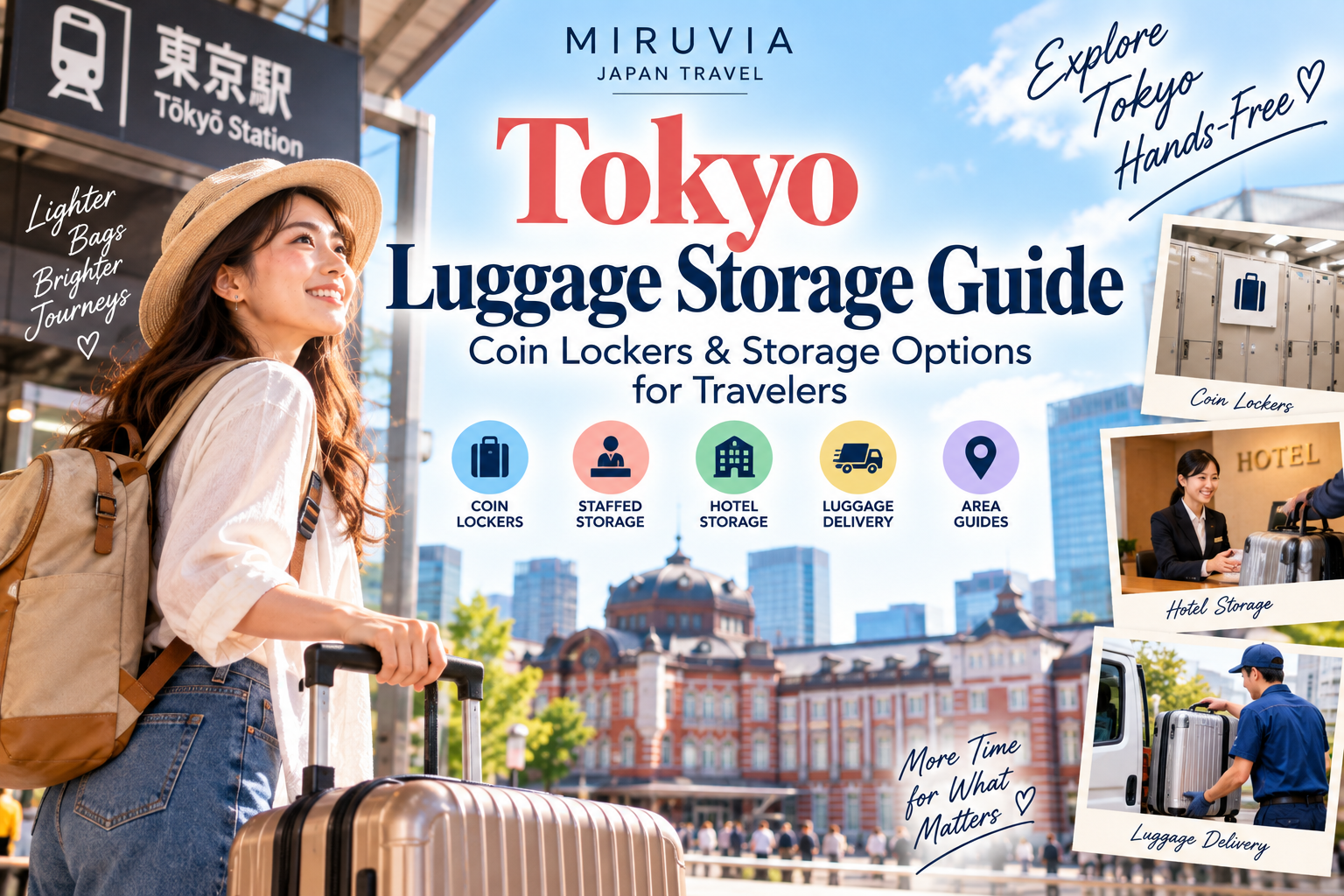
Traveling around Tokyo with a large suitcase can quickly become frustrating.
Train stations are busy, some station exits have long staircases, and popular neighborhoods can be crowded. Carrying luggage through places such as Shibuya, Shinjuku, Asakusa, or Tokyo Station can make sightseeing much more difficult than necessary.
Fortunately, Tokyo offers several ways to store your luggage while you explore the city.
From station coin lockers and staffed luggage counters to hotel storage and luggage delivery services, there is usually an option for travelers who need to leave their bags somewhere temporarily.
This Tokyo luggage storage guide explains the main options, how coin lockers work, what to do with large suitcases, and how to plan your luggage around your Tokyo itinerary.
Tokyo Luggage Storage at a Glance
| Option | Best For | Main Advantage |
|---|---|---|
| Coin lockers | Short-term storage | Convenient and widely available |
| Staffed storage | Large luggage | More suitable for bulky bags |
| Hotel storage | Hotel guests | Simple and convenient |
| Luggage delivery | Moving between hotels or airports | Avoid carrying luggage |
| Station storage services | Sightseeing between journeys | Useful at major transport hubs |
Availability, prices, operating hours, and accepted luggage sizes vary by location and service.
Why Store Your Luggage in Tokyo?
There are several situations where luggage storage can make your trip much easier.
For example:
- You arrive before hotel check-in.
- You have several hours after hotel check-out.
- You want to explore Tokyo before an evening flight.
- You are changing hotels.
- You are taking a short trip outside Tokyo.
- You want to visit a busy neighborhood without a suitcase.
- You have large shopping bags before continuing your journey.
Tokyo’s transportation system makes it easy to travel long distances around the city, but that does not mean traveling with large luggage is always comfortable.
Storing your suitcase can give you much more freedom.
For more advice on trains, IC cards, subway systems, and getting around the city, see our Tokyo Transportation Guide.
1. Use Coin Lockers at Train Stations
Coin lockers are one of the most convenient luggage storage options in Tokyo.
They are commonly found at train stations and other transportation hubs.
Despite the name, many modern lockers may support payment methods beyond physical coins, depending on the location and locker system.
The basic process is usually straightforward:
- Find an available locker.
- Place your luggage inside.
- Close the locker.
- Follow the payment instructions.
- Keep the key, receipt, password, or other information needed to reopen it.
The exact process varies depending on the locker.
Always read the instructions before leaving your luggage.
Coin Locker Sizes
Coin lockers generally come in several sizes.
Smaller lockers may be suitable for:
- Handbags
- Backpacks
- Small shopping bags
Medium lockers may accommodate:
- Larger backpacks
- Small suitcases
- Carry-on luggage
Larger lockers may fit some full-size suitcases.
However, large lockers are fewer than small lockers and can be harder to find during busy periods.
If you are traveling with a very large suitcase, do not assume that every station locker will fit it.
How Long Can You Use a Coin Locker?
Storage rules vary depending on the locker operator and location.
Some lockers allow storage beyond the initial day, but additional charges or maximum storage periods may apply.
If you need to leave luggage for more than a short sightseeing period, check the instructions carefully before paying.
For longer storage, a staffed facility or another luggage service may be more appropriate.
How to Find Coin Lockers
At larger stations, coin lockers may be located in several different areas.
Look around:
- Ticket gates
- Station concourses
- Underground passages
- Shopping areas connected to stations
- Major station exits
Station signs may include a locker symbol or English information.
At enormous stations such as Shinjuku or Tokyo Station, remembering the location of your locker is extremely important.
Take a photo of:
- The locker number
- Nearby signs
- The station exit
- The surrounding area
This simple habit can save significant time later.
2. Use Staffed Luggage Storage
If coin lockers are full or your suitcase is too large, staffed luggage storage can be a better option.
These services may be available at major stations, transportation hubs, shopping areas, tourist facilities, or dedicated luggage storage locations.
A staffed counter can be particularly useful for:
- Large suitcases
- Multiple bags
- Travelers uncomfortable using lockers
- Longer storage periods
- Busy stations where large lockers are unavailable
Rules, prices, accepted luggage, and operating hours differ by provider.
Check the specific service before relying on it.
3. Ask Your Hotel to Store Your Luggage
If you are staying at a hotel, this may be the easiest solution.
Many hotels can hold luggage for guests before check-in or after check-out.
For example, you might arrive in Tokyo in the morning while your room is not available until later.
Instead of carrying your suitcase around the city, you can go to your hotel first, ask whether luggage storage is available, and begin sightseeing without your bags.
The same strategy can work after check-out.
However, luggage policies vary.
Some properties may have restrictions based on storage time, luggage type, reservation status, or available space.
Ask your accommodation directly if you are unsure.
If you are still deciding where to base yourself, see our guide to the best areas to stay in Tokyo for first-time visitors.
4. Consider Luggage Delivery
Japan also has luggage delivery services that can transport bags between certain locations.
Depending on the service, this may include delivery between:
- Hotels
- Airports
- Other supported destinations
This can be particularly useful if you have several large suitcases or want to avoid bringing heavy luggage onto trains.
For example, a traveler leaving Tokyo for another city may choose to send a large suitcase ahead while traveling with only a smaller overnight bag.
This can make train travel considerably easier.
Luggage Delivery vs Luggage Storage
These services solve different problems.
Luggage storage means leaving your bag somewhere and returning to collect it.
Luggage delivery means sending your bag to another location.
Choose storage when you simply want to explore Tokyo for several hours.
Choose delivery when your luggage needs to move to your next destination.
5. Store Luggage Around Tokyo Station
Tokyo Station is one of the most important transportation hubs in the city.
It is commonly used by travelers taking:
- Shinkansen trains
- Local trains
- Airport connections
- Regional journeys
Because of this, luggage storage can be extremely useful here.
You may find coin lockers and other storage options in and around the station complex.
However, Tokyo Station is large.
If you use a locker, pay close attention to its exact location.
A locker on the opposite side of the station from your departure platform can create unnecessary stress when you return.
Plan your storage location around where you need to go next.
6. Store Luggage Around Shinjuku
Shinjuku is another enormous transport hub.
Many travelers stay in the area or pass through it while sightseeing.
Coin lockers and luggage storage options may be available around the station and surrounding facilities.
But Shinjuku Station can be confusing for first-time visitors.
If you leave your luggage there, record:
- Which station area you used
- Which exit is nearby
- The locker number
- A photo of the surroundings
Do not rely only on memory.
7. Store Luggage Around Shibuya
Shibuya is one of Tokyo’s busiest sightseeing areas.
Exploring Shibuya Crossing, shopping streets, department stores, and surrounding neighborhoods with a large suitcase can be uncomfortable.
If you are visiting Shibuya between hotel stays or before traveling elsewhere, consider storing your luggage first.
This allows you to move more easily through crowded streets and shops.
8. Store Luggage Around Ueno
Ueno can be a practical luggage storage location for travelers exploring eastern Tokyo.
The area provides access to attractions such as Ueno Park, museums, Ameyoko, and other nearby neighborhoods.
It is also an important transportation area for many visitors.
If you have several hours between journeys, storing your luggage around Ueno can make sightseeing significantly easier.
9. What About Asakusa?
Asakusa is extremely popular with first-time visitors, but sightseeing around Senso-ji and the surrounding shopping streets with large luggage is not ideal.
Crowded pedestrian areas can make rolling a suitcase inconvenient.
If you are arriving before hotel check-in or visiting Asakusa on the way to another destination, look for an appropriate storage option before exploring.
What If the Coin Lockers Are Full?
This is one of the most important situations to prepare for.
Large lockers at popular stations can fill up, especially during busy travel periods.
If your first locker area is full:
- Look for another locker area within the station.
- Check nearby station sections or connected facilities.
- Look for staffed luggage storage.
- Ask your hotel if storage is possible.
- Consider a dedicated luggage storage service nearby.
Do not build an extremely tight itinerary that depends on finding one specific locker immediately.
Allow some extra time.
Large Suitcases in Tokyo
Large suitcases create additional challenges.
They may not fit into many coin lockers, and moving them through busy stations can be difficult.
If you are traveling with large luggage, consider:
- Hotel storage
- Staffed luggage counters
- Luggage delivery
- Larger lockers where available
It can also help to pack a smaller day bag.
Keep essential items with you while storing or sending your main suitcase.
What Should You Keep With You?
Avoid storing anything you may urgently need.
Keep important items with you, such as:
- Passport
- Wallet
- Phone
- Medication
- Travel documents
- Valuable electronics
- Essential tickets
- Items needed during the day
Storage rules may also prohibit certain items.
Always check the conditions of the specific locker or service you use.
Luggage Storage Before Hotel Check-In
Arriving before check-in is one of the most common reasons travelers need luggage storage.
A practical order is:
Arrive in Tokyo → Go to your hotel → Ask about luggage storage → Leave your suitcase → Begin sightseeing → Return for check-in
This is often simpler than finding a station locker first.
If your hotel is far from your first sightseeing destination, however, station storage may save time.
Choose based on your route.
Luggage Storage After Hotel Check-Out
The same principle applies on your departure day.
If your flight or train leaves later in the day, ask whether your hotel can hold your luggage after check-out.
You can then enjoy several more hours in Tokyo before returning to collect it.
Alternatively, storing your luggage near your departure station may be more efficient.
Best Strategy Before an Evening Flight
Suppose you check out in the morning but your flight leaves in the evening.
You have several options.
Option 1: Leave Luggage at Your Hotel
Best when you plan to continue sightseeing near the hotel.
Option 2: Store Luggage Near Your Airport Departure Route
Best when you want to finish sightseeing near a major station before heading to the airport.
Option 3: Use a Delivery Service
Useful when an appropriate airport luggage delivery option fits your schedule.
Always check delivery deadlines and conditions in advance.
For help planning your arrival or departure, read our Tokyo Airport Guide covering Haneda and Narita.
Luggage Storage During a Day Trip
If you are taking a day trip from Tokyo, you usually do not need to bring your main suitcase.
Leave it at your Tokyo accommodation when possible.
If you are changing hotels or cities on the same day, consider station storage or luggage delivery.
Traveling with only a small day bag can make day trips much more comfortable.
Coin Lockers vs Hotel Storage
Both can be useful.
Choose Coin Lockers When:
- Your hotel is inconveniently located.
- You are sightseeing near a major station.
- You only need storage for several hours.
- You want to collect your luggage before taking a train.
Choose Hotel Storage When:
- You are already staying there.
- You arrive before check-in.
- You have time after check-out.
- You have a large suitcase.
- You want the simplest option.
Coin Lockers vs Staffed Storage
Coin lockers are convenient and allow travelers to store bags without waiting for staff.
Staffed storage may be better when:
- Your suitcase is too large.
- Lockers are full.
- You have multiple bags.
- You prefer assistance from staff.
It is useful to know both options rather than relying entirely on lockers.
How to Avoid Luggage Problems in Tokyo
A few planning habits can make a major difference.
Pack a Small Day Bag
Keep the items you need for sightseeing separate from your suitcase.
Do Not Overpack
Tokyo involves a lot of walking and public transportation.
Smaller luggage is easier to manage.
Know Your Next Destination
Store luggage somewhere that makes sense for your route.
Take Photos of Locker Locations
Large Japanese stations can be complicated.
A photo is much more reliable than trying to remember a corridor or exit.
Allow Extra Time
Finding a locker, navigating a station, or collecting luggage may take longer than expected.
Do not schedule luggage collection immediately before an important train or flight.
Common Luggage Storage Mistakes
First-time visitors should avoid these common mistakes:
- Assuming every suitcase will fit in a locker
- Expecting large lockers to always be available
- Forgetting where the locker is located
- Leaving essential items inside stored luggage
- Ignoring maximum storage periods
- Not checking staffed storage opening hours
- Choosing a locker far from the next train or exit
- Returning for luggage too close to departure time
- Carrying a large suitcase through sightseeing areas unnecessarily
Most of these problems can be avoided with a few minutes of planning.
Practical Luggage Storage Tips
Before storing your bags:
- Check the size of your luggage.
- Keep valuables and essential documents with you.
- Read the storage rules.
- Confirm when you need to collect your luggage.
- Take a photo of the locker or storage location.
- Save the location on your phone if useful.
- Keep any key, receipt, password, or collection information safe.
- Leave extra time before trains and flights.
- Have a backup plan if lockers are full.
Which Luggage Storage Option Is Best?
There is no single best option for every traveler.
For a few hours near a station, a coin locker may be ideal.
Before hotel check-in or after check-out, hotel storage may be easier.
For large suitcases, staffed storage may be more practical.
When traveling between destinations, luggage delivery can reduce the amount of baggage you need to carry.
The best choice depends on where you are, where you are going next, and how long you need to store your luggage.
Final Thoughts
Tokyo becomes much easier to explore when you are not pulling a suitcase behind you.
Coin lockers are convenient for short-term storage, hotels can often help around check-in and check-out, staffed facilities provide another option for larger bags, and luggage delivery can simplify longer journeys.
The most important thing is to plan your luggage around your itinerary.
Think about where you will arrive, where you want to explore, and where you need to go afterward.
With the right storage strategy, you can spend less time worrying about your suitcase and more time enjoying Tokyo.
Continue planning your trip with our complete Tokyo Travel Guide for First-Time Visitors.
