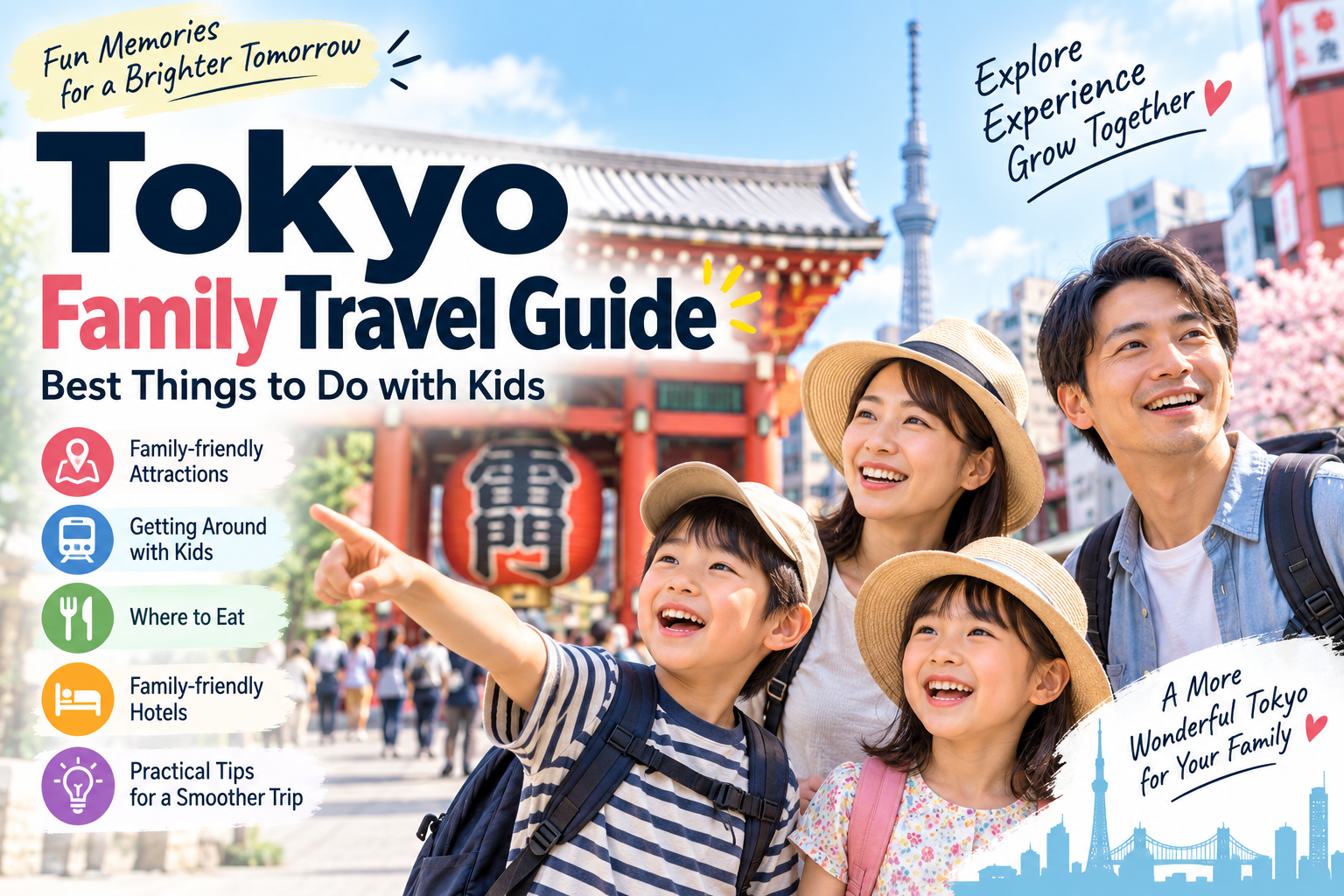
Traveling to Tokyo with children can be an unforgettable family adventure.
The city offers everything from interactive museums and observation decks to character attractions, spacious parks, aquariums, and exciting neighborhoods. At the same time, Tokyo is one of the largest cities in the world, so traveling with kids requires a little more planning than traveling alone or as a couple.
Crowded trains, long walking distances, restaurant choices, stroller access, and busy sightseeing schedules can all affect your experience.
The good news is that Tokyo is generally well organized for families. With realistic daily plans and a few practical strategies, parents can explore the city without making every day exhausting.
This Tokyo family travel guide explains what to do with kids, how to get around, where to take breaks, what to consider when choosing accommodation, and how to build a comfortable family itinerary.
Tokyo Family Travel at a Glance
For most families visiting Tokyo for the first time:
- Plan fewer attractions each day than you normally would.
- Stay near a convenient train or subway station.
- Avoid rush hour whenever possible.
- Use convenience stores for quick snacks and drinks.
- Choose neighborhoods with several attractions close together.
- Allow time for parks, cafés, and other breaks.
- Check age and height restrictions before visiting attractions.
- Consider your children’s normal sleep and meal schedules.
Tokyo rewards flexible travelers.
Instead of trying to see everything, focus on creating days that both adults and children can enjoy.
Is Tokyo Good for Families?
Yes. Tokyo can be an excellent destination for families.
Public transportation is extensive, convenience stores are everywhere, public spaces are generally well maintained, and many major attractions have facilities designed for families.
Children can also experience an interesting mixture of traditional and modern Japan.
One day might include visiting a historic temple and eating Japanese sweets. Another could involve an aquarium, interactive museum, or futuristic entertainment district.
The biggest challenge is usually not finding things to do.
It is managing the city’s enormous size.
Tokyo attractions that look close together on a map may still require significant walking, train transfers, or time inside large stations.
For families, efficient planning matters more than trying to maximize the number of attractions.
Best Things to Do in Tokyo with Kids
Tokyo has family attractions for many different ages and interests.
Rather than visiting attractions simply because they are famous, choose experiences that match your children’s interests and energy levels.
Explore Asakusa
Asakusa is one of the easiest places to introduce children to traditional Tokyo.
Families can walk through the Kaminarimon Gate, explore Nakamise shopping street, and visit Senso-ji Temple.
The area provides plenty of visual interest without requiring a complicated itinerary.
Children may enjoy seeing colorful souvenirs, trying Japanese snacks, and experiencing the atmosphere around the temple.
Asakusa can also be combined with nearby attractions around Tokyo Skytree.
Because the area can become crowded, visiting earlier in the day is often more comfortable for families.
Visit Tokyo Skytree
Tokyo Skytree can be exciting for children because it gives them a completely different perspective of the city.
From the observation decks, families can see just how enormous Tokyo really is.
The surrounding Tokyo Solamachi complex also contains shops, restaurants, and indoor facilities, making the area useful when the weather is poor.
Families can spend several hours here without constantly moving between different neighborhoods.
This makes it especially useful on days when children need a slower sightseeing pace.
Discover Ueno
Ueno is one of Tokyo’s most useful family sightseeing areas because several attractions are concentrated around Ueno Park.
Depending on your children’s interests, the area offers museums, cultural attractions, open spaces, and easy access to nearby shopping streets.
Having multiple possibilities in one neighborhood gives parents flexibility.
If children become tired of an indoor attraction, you can spend some time outside instead of traveling across the city to another destination.
That flexibility can make family sightseeing much easier.
Experience Odaiba
Odaiba is another convenient area for families.
The waterfront district has large shopping complexes, entertainment facilities, open spaces, and indoor attractions.
Its relatively spacious environment can also feel easier with children than some of Tokyo’s busiest central neighborhoods.
Odaiba works particularly well when families want to combine sightseeing with entertainment, shopping, meals, and rest periods without making many train journeys.
Explore Tokyo’s Parks
Not every activity needs to be a major tourist attraction.
Parks can be extremely valuable during a family trip.
After spending hours walking through stations, shops, and crowded attractions, children may simply need somewhere to move around freely.
Tokyo has parks ranging from small neighborhood spaces to large green areas.
Adding park time between major attractions can make the entire day more enjoyable.
It also gives parents an opportunity to slow down instead of continuously moving from one reservation to another.
Visit an Aquarium
Aquariums can be useful family attractions because they provide indoor entertainment regardless of the weather.
Tokyo and the surrounding metropolitan area have several aquarium options that can fit into different sightseeing routes.
They can be particularly useful during hot summer afternoons or rainy days.
For younger children, an aquarium can also provide a calmer alternative to a full day of crowded city sightseeing.
Try Interactive Museums and Experiences
Tokyo has many museums and attractions designed around interactive experiences.
These can be particularly appealing to school-age children and teenagers.
However, popular attractions may require advance reservations.
Always check:
- ticket requirements
- age restrictions
- opening hours
- reservation rules
- photography rules
- expected visit duration
before building the rest of your day around a specific attraction.
Character and Pop Culture Experiences
For children who enjoy Japanese characters, games, anime, or toys, Tokyo can feel like an enormous playground.
Character shops and themed attractions can be found throughout major shopping districts.
Tokyo Station, Ikebukuro, Shibuya, and other major commercial areas have plenty of options.
Teenagers may also enjoy exploring Akihabara, Harajuku, or Shibuya depending on their interests.
Parents should remember that these districts can become extremely crowded, particularly on weekends.
Do Not Overload Your Family Itinerary
One of the most common mistakes when visiting Tokyo with children is planning too much.
A schedule that looks reasonable on a map can become exhausting after accounting for:
- walking to stations
- navigating large stations
- train transfers
- restroom breaks
- meals
- queues
- shopping
- unexpected stops
For many families, two major activities in one day can be enough.
You can then add smaller experiences around them.
For example:
Morning: Senso-ji and Asakusa
Lunch: Asakusa
Afternoon: Tokyo Skytree area
Dinner: Near your hotel
This is usually more manageable than crossing Tokyo several times in one day.
Choose One Main Area for Each Half-Day
A useful family travel strategy is dividing the day into two geographical zones.
Spend the morning in one neighborhood and the afternoon in another nearby area.
For example:
Asakusa + Tokyo Skytree
Ueno + Akihabara
Harajuku + Shibuya
Tokyo Station + Ginza
This reduces unnecessary transportation and gives children more time to actually enjoy each place.
Getting Around Tokyo with Kids
Tokyo’s train and subway system is extremely useful, but it can feel complicated during the first few days.
With children, simplicity is more important than finding the theoretically fastest route.
A journey with fewer transfers may be preferable even if it takes several minutes longer.
Changing trains often means additional stairs, elevators, corridors, platforms, and walking.
Navigation apps are extremely useful for checking routes before leaving.
For a complete explanation of trains, subways, IC cards, transfers, and getting around the city, see our Tokyo Transportation Guide.
Avoid Rush Hour When Possible
Tokyo commuter trains can become extremely crowded during weekday rush periods.
Traveling with young children, luggage, or strollers can be uncomfortable during these times.
When possible, avoid major commuter routes during the busiest morning and evening periods.
Starting sightseeing slightly later can sometimes make transportation significantly easier.
Similarly, consider eating dinner before or after the busiest travel period if your route involves major commuter lines.
Using a Stroller in Tokyo
Strollers can be useful, but Tokyo presents some challenges.
Many major stations have elevators, but the elevator may not be close to the exit or platform you want.
Finding the correct elevator route can add considerable time.
Some smaller stations or older buildings may also have less convenient accessibility.
Parents using strollers should allow extra time for transportation.
A lightweight, foldable stroller can be easier to manage than a large model.
Large Train Stations Can Take Time
Stations such as Shinjuku, Tokyo, Shibuya, and Ikebukuro are enormous.
Simply changing lines or reaching the correct exit can involve a surprising amount of walking.
Do not assume that arriving at a station means you have arrived at your destination.
With children, allow additional time for station navigation.
Checking the correct exit number before arriving can save a lot of unnecessary walking.
Eating in Tokyo with Kids
Tokyo has an enormous variety of food, but restaurants can differ greatly in size and atmosphere.
Some small restaurants have only counter seating or limited space.
This can be difficult with young children or strollers.
Larger restaurants, shopping malls, department stores, and family restaurant chains can be easier when you need more space.
Food courts can also be convenient because family members can choose different meals.
Convenience Stores Are Extremely Useful
Japanese convenience stores can become one of the most useful resources for families.
They sell:
- bottled drinks
- rice balls
- sandwiches
- bread
- fruit
- yogurt
- desserts
- snacks
- simple meals
Having a few familiar snacks available can help when children become hungry between meals.
Convenience stores are also useful when everyone is too tired for a long restaurant dinner.
For more information about convenience store food, drinks, shopping, and useful services, see our Tokyo Convenience Store Guide.
Supermarkets Can Save Time and Money
Supermarkets are another useful option.
Many sell prepared meals, sushi, fruit, bread, drinks, and snacks.
Visiting a supermarket near your hotel can make breakfast or a relaxed evening meal much easier.
This can be particularly helpful during longer Tokyo stays when eating every meal at restaurants becomes tiring.
Be Careful with Food Allergies
Travelers with food allergies should research ingredients carefully.
Japanese dishes may contain ingredients that are not obvious from their appearance.
Broths, sauces, dressings, and seasonings can contain allergens.
Translation cards explaining specific allergies in Japanese can be useful.
For serious allergies, research suitable restaurants before your trip instead of relying entirely on spontaneous restaurant choices.
Choosing a Family-Friendly Hotel
Hotel location can have a major impact on a family trip.
A cheaper hotel far from major transportation may save money but increase travel time every day.
For families, being close to a useful station can be worth paying more.
Consider:
- distance from the station
- elevator access
- room size
- bed configuration
- laundry facilities
- nearby convenience stores
- nearby restaurants
- breakfast options
Tokyo hotel rooms can be smaller than some international visitors expect, so always check room dimensions and bed arrangements before booking.
Consider Apartment-Style Accommodation
For longer family stays, accommodation with extra space, laundry facilities, or a small kitchen can be convenient.
Being able to prepare a simple breakfast or wash children’s clothes can reduce daily travel stress.
However, always check the property’s rules, location, and transportation access carefully.
Extra space is less useful if reaching major attractions requires complicated transportation every day.
Laundry Matters More on Family Trips
Children can go through clothing quickly, especially during hot or rainy weather.
Access to a washing machine can allow families to pack fewer clothes.
Many hotels have coin-operated washing machines, while coin laundries can also be found throughout Tokyo.
Checking laundry facilities before booking accommodation can be surprisingly useful.
Plan Regular Rest Breaks
Adults often underestimate how tiring Tokyo can be.
Even when trains handle most long-distance transportation, travelers may still walk many kilometers every day.
Children can become tired much earlier.
Build natural rest opportunities into your itinerary.
Good options include:
- cafés
- parks
- department stores
- shopping centers
- observation facilities
- hotel breaks
Returning to your hotel for an hour in the afternoon can sometimes make the evening much more enjoyable.
Department Stores Can Be Useful Family Bases
Japanese department stores are useful for more than shopping.
Many have:
- restaurants
- cafés
- restrooms
- elevators
- seating areas
- food halls
- baby-related facilities
When sightseeing with children, knowing where the nearest large department store or shopping complex is can be useful.
They provide a reliable indoor place to regroup.
Finding Toilets with Children
Public restrooms are widely available in Tokyo, particularly in stations, shopping centers, department stores, parks, and major attractions.
However, finding a restroom quickly inside a large station can still take time.
Encourage younger children to use restrooms when convenient instead of waiting until the last possible moment.
Major family-oriented facilities may also provide changing tables and multipurpose restrooms.
Traveling with Babies and Toddlers
Families with babies or toddlers should build particularly flexible itineraries.
Nap schedules, feeding, diaper changes, and stroller access can all affect the day.
Instead of making multiple timed reservations, consider having one main scheduled attraction and keeping the rest of the day flexible.
Shopping centers and department stores can be useful because they often provide several services in one building.
Traveling with School-Age Children
School-age children can usually handle more sightseeing but still benefit from variety.
A full day of temples and museums may not keep every child interested.
Mix different types of activities.
For example:
Traditional attraction → lunch → interactive experience → shopping → park
This creates natural changes in pace throughout the day.
Traveling with Teenagers
Teenagers may enjoy Tokyo differently from younger children.
Depending on their interests, they might prefer:
- anime and manga
- fashion
- gaming
- technology
- photography
- cafés
- shopping
- music
- pop culture
Giving teenagers some input when building the itinerary can make the trip more enjoyable for everyone.
Tokyo has enough variety that family members do not need to enjoy exactly the same activities.
Tokyo in Summer with Kids
Tokyo summers can be extremely hot and humid.
Families should avoid spending the entire day outdoors during the hottest periods.
Carry water regularly and schedule indoor attractions during the afternoon.
Shopping centers, museums, aquariums, and indoor attractions can provide useful breaks from the heat.
Young children may become tired more quickly than expected in humid weather.
Tokyo in Winter with Kids
Winter sightseeing can be comfortable because Tokyo is often relatively dry, but mornings and evenings can be cold.
Layered clothing makes it easier to move between heated indoor spaces and outdoor attractions.
Because daylight hours are shorter, families may want to start outdoor sightseeing earlier.
Winter illuminations can also provide enjoyable evening activities.
Tokyo During Rainy Weather
Rain does not need to ruin a family sightseeing day.
Tokyo has many indoor attractions, shopping complexes, museums, aquariums, and entertainment facilities.
However, moving between stations with umbrellas and children can slow everything down.
On rainy days, choose neighborhoods where several indoor activities are located close together.
This minimizes unnecessary travel.
Keep Internet Access Available
Reliable mobile internet is extremely useful when traveling with children.
You may need to:
- check train routes
- find elevators
- search for restaurants
- translate Japanese
- locate restrooms
- check attraction hours
- change plans quickly
An eSIM, SIM card, or pocket Wi-Fi can make these tasks much easier.
Keep a portable battery available because navigation and translation apps can drain your phone quickly.
For help choosing between an eSIM, SIM card, and pocket Wi-Fi, see our Tokyo Internet Guide.
Carry a Small Family Day Bag
A practical day bag might include:
- water
- small snacks
- tissues
- wet wipes
- hand sanitizer
- portable battery
- small plastic bags
- basic medicine
- umbrella
- extra clothing for young children
Avoid carrying too much.
You will already be walking and navigating public transportation throughout the day.
Keep a Small Trash Bag
Public trash cans are less common in Tokyo than some international travelers expect.
You may occasionally need to carry snack wrappers or other small waste until you find an appropriate disposal point.
A small plastic bag inside your day bag can be very useful for families.
Prepare for Jet Lag
Children may struggle with time differences during the first few days.
Avoid making the first day your busiest sightseeing day.
A relaxed neighborhood walk, early meal, and early night can help everyone adjust.
If possible, schedule attractions requiring advance reservations after your family has had some time to adapt.
Have a Plan If You Get Separated
Tokyo is generally orderly, but crowded stations and attractions can make it easy for family members to become separated.
Older children should know:
- their hotel name
- a parent’s phone number
- what to do if separated
- not to leave the agreed area
Parents can also keep hotel information saved on their phones.
For younger children, carrying basic contact information can provide additional reassurance.
Do Not Depend on a Perfect Schedule
Family travel rarely follows the exact itinerary.
A child may become tired.
An attraction may take longer than expected.
Someone may need an unexpected meal or restroom break.
Tokyo offers so many alternatives that changing plans is usually easy.
Treat your itinerary as a framework rather than a strict timetable.
Example of a Comfortable Family Day
A realistic family day might look like this:
Morning
Visit one major sightseeing attraction before crowds become heavy.
Lunch
Eat in the same neighborhood rather than traveling somewhere specifically for lunch.
Early Afternoon
Visit an indoor attraction or shopping complex.
Late Afternoon
Take a café, park, or hotel break.
Evening
Have dinner near your hotel or explore one nearby area.
This type of schedule leaves enough flexibility for unexpected changes.
Common Mistakes Families Make in Tokyo
Planning Too Many Attractions
Tokyo is larger and more tiring than it appears on a map.
Crossing the City Repeatedly
Group nearby attractions together.
Ignoring Rush Hour
Crowded commuter trains can make family travel much more difficult.
Choosing a Hotel Only by Price
Location can significantly affect the quality of your trip.
Not Checking Attraction Reservations
Popular attractions may sell out.
Underestimating Walking
Stations, shopping centers, and attractions can involve substantial walking.
Forgetting Breaks
Rest time is part of a successful family itinerary.
Simple Strategy for a Family Trip to Tokyo
For each day, choose:
- One main neighborhood.
- One major attraction.
- One optional secondary attraction.
- A flexible lunch location.
- At least one rest period.
- An easy evening plan.
This structure provides direction without making the day too rigid.
For example:
Main area: Ueno
Major attraction: Museum or family attraction
Secondary activity: Ueno Park
Lunch: Nearby restaurant or department store
Break: Café
Evening: Dinner near the hotel
The exact attractions matter less than keeping the schedule manageable.
Is Tokyo Difficult with Children?
Tokyo can initially feel overwhelming because of its size and transportation system.
But families usually become more comfortable after learning how the stations, trains, and neighborhoods work.
The key is not trying to travel through Tokyo like a checklist.
Spend more time in fewer areas.
Keep food and transportation simple.
Allow children to rest.
And leave enough flexibility to change your plans.
Final Thoughts
Tokyo can be one of the most exciting cities in the world for a family trip.
Children can experience traditional temples, modern technology, Japanese food, parks, character culture, observation decks, museums, shopping districts, and countless small discoveries.
The most successful family trips are usually not the ones with the longest list of attractions.
They are the ones with a comfortable rhythm.
Choose convenient neighborhoods, minimize unnecessary transportation, schedule regular breaks, and leave space for spontaneous experiences.
With realistic planning, Tokyo becomes much easier to explore with children—and much more enjoyable for the entire family.
For more help planning your first trip, including sightseeing, food, transportation, and practical advice, continue with our Tokyo Travel Guide for First-Time Visitors.
