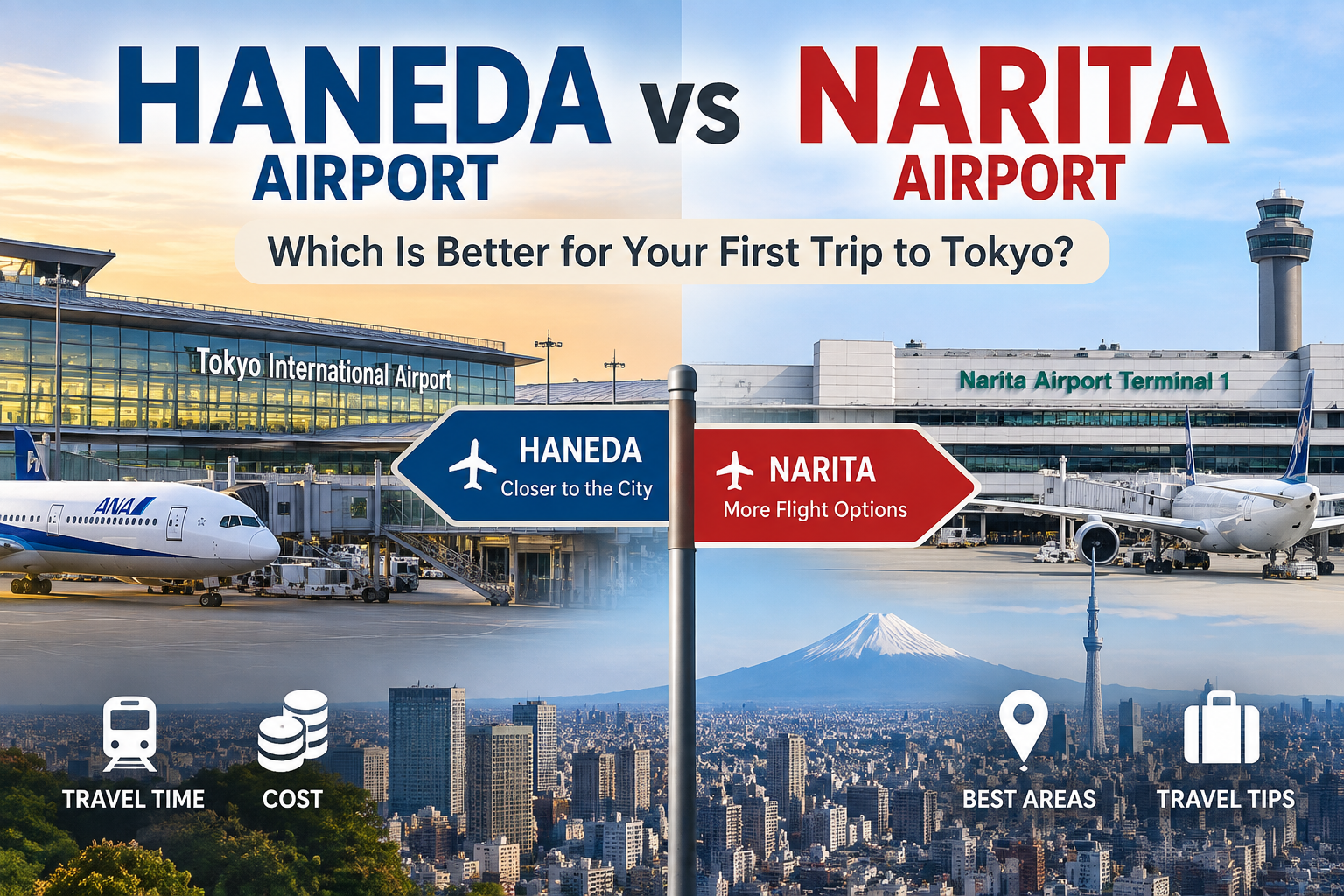
Tokyo has two major airports: Haneda Airport (HND) and Narita International Airport (NRT). Both handle international flights and provide multiple transportation options to central Tokyo, but their locations and convenience can be quite different.
For first-time visitors, choosing between Haneda and Narita can be confusing. Haneda is much closer to central Tokyo, while Narita is located farther outside the city but serves a wide range of international flights.
In many cases, Haneda is the more convenient option when flight prices and schedules are similar. However, Narita can still be an excellent choice if it offers a better flight, lower fare, or more convenient arrival and departure times.
This guide compares Haneda and Narita airports and explains how to travel from each airport to popular areas such as Shinjuku, Shibuya, Asakusa, Tokyo Station, and Ueno. It also covers transportation options, travel times, costs, late-night arrivals, and practical airport tips for first-time visitors.
Your airport is only the starting point of your trip. The best choice depends on your flight as well as where you plan to stay and what you want to do in Tokyo.
Haneda or Narita: Which Tokyo Airport Should You Choose?
For most first-time visitors, Haneda Airport is the more convenient choice when flight prices, schedules, and other conditions are similar.
The main reason is location. Haneda is much closer to central Tokyo, which generally means a shorter and simpler journey between the airport and your hotel. This can be particularly helpful after a long international flight or when you need to reach the airport early on your departure day.
However, this does not mean you should avoid Narita. Narita Airport has excellent transportation connections to central Tokyo, including direct trains and buses to major areas. If Narita offers a better airfare, a direct flight, or a more convenient schedule, it can still be the better overall choice for your trip.
Instead of choosing an airport based on its name alone, compare the complete journey: flight price, departure and arrival times, transfers, baggage, airport transportation, and the location of your accommodation.
Quick Answer for First-Time Visitors
If both airports offer similar flights, choose Haneda for convenience.
Choose Narita instead when it offers a significantly better flight option, such as:
- A lower airfare
- A direct flight instead of a connection
- Better departure or arrival times
- A preferred airline or route
- A flight that better fits the rest of your Japan itinerary
For most travelers, the airport should be one factor in the decision—not the only factor.
Haneda Airport vs Narita Airport at a Glance
Haneda and Narita are both major international airports with good transportation connections, but they serve Tokyo from very different locations.
The biggest practical difference for most travelers is how long and how complicated the journey to their accommodation will be.
| Haneda Airport (HND) | Narita Airport (NRT) | |
|---|---|---|
| Location | Ota City, Tokyo | Narita City, Chiba |
| Distance from central Tokyo | Approx. 15 km | Approx. 50–60 km |
| Main rail options | Keikyu Line, Tokyo Monorail | Narita Express, Keisei Skyliner and other Keisei/JR services |
| Typical access to central Tokyo | Generally shorter | Generally longer |
| International flights | Extensive | Extensive |
| Convenience for central Tokyo | Excellent | Good |
| Best for | Travelers prioritizing easy city access | Travelers prioritizing flight options, fares or schedules |
The Biggest Difference Is Location
The most important difference between Haneda and Narita is their location.
Haneda Airport is located within Tokyo and is much closer to the city center. This makes it particularly convenient for travelers staying in central Tokyo and can reduce the amount of time spent traveling after arrival or before departure.
Narita Airport is located in Chiba Prefecture, farther from central Tokyo. However, dedicated airport trains provide direct connections to major areas. The Narita Express serves destinations including Tokyo, Shibuya, and Shinjuku, while the Keisei Skyliner provides convenient access toward Nippori and Ueno.
For this reason, Haneda generally has the advantage for convenience, while Narita can still be the better choice when its flight options, fares, or schedules suit your trip better.
Haneda Airport (HND)
Haneda Airport (HND) is located within Tokyo and is generally the most convenient airport for travelers whose main destination is central Tokyo.
Its biggest advantage is the relatively short journey into the city. Haneda is directly connected to both the Keikyu Line and Tokyo Monorail, and airport buses and taxis provide additional options for travelers with different destinations or amounts of luggage.
This convenience can be especially valuable after a long international flight. Spending less time traveling from the airport means you can reach your hotel sooner and begin your Tokyo trip with a simpler journey.
Haneda is also convenient on departure day, particularly if you have an early flight or want to spend more of your final day in Tokyo before heading to the airport.
Advantages of Haneda Airport
The main advantages of Haneda Airport include:
- Convenient location within Tokyo
- Shorter travel time to many central Tokyo areas
- Direct access to the Keikyu Line and Tokyo Monorail
- Airport bus connections to major destinations
- Easier airport transfers for many first-time visitors
- More convenient access for early departures or after long flights
If your Haneda and Narita flight options are otherwise similar, these advantages often make Haneda the easier choice.
Disadvantages of Haneda Airport
Haneda is not automatically the best option for every traveler.
Depending on your departure city, airline, travel dates, and flight schedule, Narita may offer a more convenient route or a better airfare. Choosing Haneda simply to save time on airport transportation may not be worthwhile if it requires a significantly more expensive flight or an inconvenient connection.
Your final destination also matters. The difference between the two airports may be more important for some parts of Tokyo than others.
Who Should Choose Haneda?
Haneda is particularly suitable for:
- First-time visitors who want the simplest possible arrival
- Travelers staying in central Tokyo
- Travelers with heavy luggage
- Families who want to minimize airport transportation
- Travelers arriving after a long international journey
- Travelers with relatively early departure times
If the flight price and schedule are similar to Narita, Haneda will generally be the more convenient choice for a Tokyo-focused trip.
How to Get from Haneda Airport to Tokyo
Haneda Airport offers several convenient ways to reach central Tokyo. The best option depends mainly on where you are staying, how much luggage you have, and whether you prefer speed, simplicity, or door-to-door transportation.
For most first-time visitors, the Keikyu Line or Tokyo Monorail will be the most practical choices. Airport buses can be useful when they serve your hotel or destination directly, while taxis provide the greatest convenience at a significantly higher cost.
Tokyo Monorail
The Tokyo Monorail connects Haneda Airport with Hamamatsucho Station, where you can transfer to JR lines for other parts of Tokyo.
It is particularly convenient for travelers heading toward areas that are easily reached from Hamamatsucho or the JR Yamanote Line. The journey also provides elevated views along parts of the route, making it an interesting introduction to Tokyo.
If your hotel requires several additional transfers from Hamamatsucho, however, another option may be simpler.
Keikyu Line
The Keikyu Line connects Haneda Airport with Shinagawa and continues through services toward central and eastern Tokyo.
It is a convenient option for travelers heading toward Shinagawa and areas connected through the wider rail and subway network. Depending on the service, some trains also continue toward destinations such as Asakusa without requiring a transfer.
Pay attention to the train type and destination displayed before boarding, as different Keikyu services may follow different routes.
Airport Bus
Airport buses connect Haneda with major stations, hotels, and other destinations around Tokyo.
A bus can be particularly convenient when it stops close to your accommodation because you may avoid carrying luggage through large stations or making multiple train transfers.
Travel time can vary depending on road traffic, so check the latest timetable and estimated journey before choosing this option.
Taxi
A taxi offers direct transportation from Haneda Airport to your destination and can be useful when traveling with several people, carrying large amounts of luggage, or arriving when public transportation is less convenient.
The main disadvantage is cost. A taxi into central Tokyo is generally much more expensive than taking a train, monorail, or airport bus.
If you are considering a taxi, check the current fare information and whether a fixed-fare airport taxi is available for your destination.
Which Haneda Transportation Option Is Best?
As a simple rule:
- Tokyo Monorail: convenient for Hamamatsucho and connections to JR lines
- Keikyu Line: convenient for Shinagawa and many rail or subway connections
- Airport bus: useful when it provides convenient access to your hotel or destination
- Taxi: best for maximum convenience, heavy luggage, groups, or difficult arrival times
Do not automatically choose the fastest option on paper. A slightly longer journey with fewer transfers can be much easier after an international flight, especially when traveling with luggage.
Narita International Airport (NRT)
Narita International Airport (NRT) is located in Chiba Prefecture, east of Tokyo. It is farther from central Tokyo than Haneda, but it remains one of the main international gateways to the Tokyo area.
Narita is well connected to central Tokyo by dedicated airport trains, regular rail services, airport buses, and taxis. Major options include the Narita Express and Keisei Skyliner, which provide convenient connections to different parts of the city.
The longer distance from central Tokyo means you should allow more time for airport transportation than you would from Haneda. However, the journey is straightforward when you choose a service that matches the location of your accommodation.
Narita should not be considered a poor choice simply because it is farther away. A better airfare, direct international flight, or more convenient flight schedule can easily outweigh the additional ground transportation.
Advantages of Narita Airport
The main advantages of Narita Airport include:
- A wide range of international flight options
- Direct airport train services to major parts of Tokyo
- Convenient access toward Ueno and Nippori via the Keisei Skyliner
- Direct Narita Express services to destinations including Tokyo, Shibuya, and Shinjuku
- Airport bus connections to various stations, hotels, and other destinations
- Potentially better flight prices or schedules depending on your route
For some travelers, these flight options can be more important than the additional travel time between the airport and central Tokyo.
Disadvantages of Narita Airport
The main disadvantage is its distance from central Tokyo.
Compared with Haneda, reaching your accommodation will generally require more travel time. This is particularly important after a long flight, when traveling with children or heavy luggage, or when arriving late in the evening.
Transportation costs can also be higher depending on the service you choose, particularly if you use a premium train service or taxi.
Who Should Choose Narita?
Narita can be a good choice for:
- Travelers who find a significantly better airfare
- Travelers who can take a convenient direct flight to Narita
- Travelers whose preferred airline or schedule uses Narita
- Travelers staying near Ueno or other areas with convenient Narita connections
- Travelers whose arrival time allows comfortable use of public transportation
If Narita provides the better overall flight, there is usually no reason to avoid it solely because it is farther from central Tokyo.
How to Get from Narita Airport to Tokyo
Narita Airport offers several transportation options to central Tokyo. Because the airport is farther from the city than Haneda, choosing a service that matches your destination can make a significant difference to the convenience of your arrival.
For many first-time visitors, the Narita Express or Keisei Skyliner will be the easiest rail options. Airport buses can be convenient when they serve your destination directly, while taxis generally make more sense when convenience is more important than cost.
Narita Express
The Narita Express, often called the N’EX, is operated by JR East and connects Narita Airport with major stations in Tokyo.
Direct services can be particularly convenient for travelers heading toward Tokyo Station, Shibuya, or Shinjuku because they can reduce the need to navigate transfers with luggage.
Seats are reserved, which can also make the journey more comfortable after a long international flight.
The best option depends on your destination and the service schedule, so check the latest timetable before traveling.
Keisei Skyliner
The Keisei Skyliner is a fast reserved-seat train connecting Narita Airport with Nippori and Ueno.
It is particularly useful for travelers staying around Ueno or for those who can easily transfer at Nippori to the JR Yamanote Line and other rail services.
For accommodation in eastern or northern parts of central Tokyo, the Skyliner can be one of the most convenient ways to travel from Narita Airport.
Airport Bus
Airport buses connect Narita Airport with major stations, hotels, and other destinations in the Tokyo area.
A bus can be a good option when it stops close to your accommodation, especially if you want to avoid carrying luggage through stations or making multiple train transfers.
However, journey times can vary with traffic. Check the current route, timetable, and stop location before deciding whether a bus is the most practical choice.
Taxi
Taxis provide direct transportation from Narita Airport, but the long distance to central Tokyo makes them considerably more expensive than most train or bus options.
They may still be useful for groups, travelers with significant luggage, or situations where public transportation is inconvenient.
Before choosing a taxi, check the current fare information and whether a fixed-fare service is available for your destination.
Which Narita Transportation Option Is Best?
As a simple guide:
- Narita Express: convenient for Tokyo Station, Shibuya, Shinjuku, and other destinations served directly
- Keisei Skyliner: particularly convenient for Nippori and Ueno
- Airport bus: useful when it stops close to your hotel or destination
- Taxi: useful when door-to-door convenience is worth the significantly higher cost
When traveling with luggage, consider the number of transfers as well as the journey time. A direct train or bus can sometimes be more comfortable than a theoretically faster route that requires several transfers.
Haneda vs Narita: Travel Time and Cost
Haneda generally provides faster and less expensive access to central Tokyo because it is much closer to the city.
Narita requires a longer journey, and dedicated airport trains can cost more than the typical rail journey from Haneda. However, the exact difference depends on your destination and the transportation option you choose.
The figures below are general planning estimates. Fares, schedules, and journey times can change, so always check the latest information from the transportation operator before traveling.
| Haneda Airport | Narita Airport | |
|---|---|---|
| Central Tokyo access | Generally faster | Generally longer |
| Tokyo Station example | Around 30 min by rail | From about 53 min by N’EX |
| Typical rail cost | Usually under ¥1,000 to many central areas | Roughly ¥2,500–¥3,500 for major express options |
| Budget options | Train / monorail | Regular Keisei or JR services, buses |
| Premium options | Taxi / direct bus | N’EX, Skyliner, taxi |
| Overall convenience | Excellent for central Tokyo | Good, but allow more time |
Do Not Choose an Airport Based on Transportation Cost Alone
Airport transportation cost is worth considering, but it should not determine your flight choice by itself.
For example, saving money on transportation from Haneda may not be worthwhile if the flight costs significantly more than a comparable flight to Narita. Likewise, a cheaper Narita flight may become less attractive if it arrives very late and requires expensive or inconvenient transportation to your hotel.
Compare the total cost and convenience of the journey rather than focusing only on the train fare.
In many cases, factors such as a direct flight, a better schedule, easier connections, or a lower airfare will have a greater impact on your trip than the difference in airport transportation cost.
Which Airport Is Better for Shinjuku, Shibuya, Asakusa and Other Areas?
The most convenient airport can also depend on where you plan to stay in Tokyo.
Haneda generally has the advantage because it is closer to central Tokyo, but Narita has direct airport services to several major neighborhoods. In some areas, choosing the right train can make a Narita arrival surprisingly straightforward.
The recommendations below are general guidelines. Always check the latest route and timetable for your specific hotel before traveling.
Shinjuku
Haneda is generally more convenient for Shinjuku because of the shorter overall distance from the airport.
However, Narita Express trains serve Shinjuku directly, which can make Narita a comfortable option for travelers with luggage who prefer to avoid transfers.
If your Narita flight is significantly better in price or schedule, the direct Narita Express connection means Shinjuku is still a practical destination.
Shibuya
Haneda generally has the advantage for Shibuya, particularly when comparing overall travel distance.
Narita is also relatively convenient because Narita Express services connect the airport directly with Shibuya.
For travelers carrying luggage, a direct Narita Express journey may be preferable to a route that looks slightly faster but requires multiple transfers.
Asakusa
Haneda is generally very convenient for Asakusa, with rail connections through the Keikyu and Toei Asakusa Line network depending on the service.
Narita also has useful connections toward eastern Tokyo, including Keisei services. This means Asakusa is one of the areas where both airports can work reasonably well.
Check the specific train before boarding, as routes and through-services vary by service.
Tokyo Station and Ginza
Haneda is generally more convenient for the Tokyo Station and Ginza area because of its proximity to central Tokyo.
From Narita, the Narita Express provides a direct connection to Tokyo Station, making it one of the simplest options for travelers staying nearby.
Airport buses can also be useful for both Tokyo Station and Ginza depending on your hotel and arrival time.
Ueno
Ueno is an important exception where Narita can be particularly convenient.
The Keisei Skyliner connects Narita Airport directly with Keisei Ueno, while also stopping at Nippori, making the area especially easy to reach from Narita.
Haneda is still closer to central Tokyo overall, but if you are staying in Ueno and your Narita flight is better, there is little reason to choose Haneda solely because of airport location.
Still deciding which part of Tokyo to explore or use as a base? See our Best Areas to Visit in Tokyo for First-Time Visitors to compare the city’s major neighborhoods and find the areas that best match your trip.
What If Your Flight Arrives Late at Night or Early in the Morning?
Flight arrival and departure times can significantly affect which Tokyo airport is more convenient.
Trains, monorails, and airport buses do not operate 24 hours a day. If your flight arrives late at night, you also need to allow time for immigration, baggage collection, customs, and finding your transportation after leaving the arrivals area.
Similarly, an early-morning departure may require you to leave central Tokyo before normal public transportation is operating.
For this reason, always consider the complete journey between the airport and your accommodation when comparing flights—not just the scheduled flight time.
Check Your Final Transportation Before Booking
Before booking a late-arriving or early-departing flight, check whether public transportation will actually be available when you need it.
Do not plan around the final train or bus with only a few minutes to spare. International arrivals can be delayed, and immigration or baggage collection may take longer than expected.
Check the latest official timetable for your travel date and identify a backup option in case you miss your planned service.
If two flights are otherwise similar, a flight that arrives while regular transportation is still operating can be more convenient than a cheaper flight that requires an expensive late-night transfer.
Consider Staying Near the Airport
For very late arrivals or very early departures, staying near the airport can sometimes be the simplest option.
Instead of traveling across Tokyo immediately after landing, you can stay at an airport or nearby hotel and travel into the city the following morning. The same approach can work before an early departure.
This can be particularly useful for families, travelers with heavy luggage, or anyone who prefers to avoid complicated transportation at the beginning or end of a long journey.
Whether this is worthwhile depends on your flight time, hotel plans, transportation options, and budget, so compare the complete cost rather than the hotel price alone.
Haneda vs Narita for International Flights
Both Haneda and Narita handle international flights, so you should not assume that one airport is automatically better simply because you are traveling from overseas.
The routes available to you will depend on your departure city, airline, travel dates, and flight schedule. In some cases, Haneda may offer the most convenient flight. In others, Narita may provide a direct route, better departure time, or significantly lower fare.
For first-time visitors, Haneda’s location is an important advantage, but the convenience of the airport should be considered together with the flight itself.
A direct flight to Narita can easily be a better overall choice than an inconvenient connecting flight to Haneda.
Flight Price and Schedule May Matter More Than the Airport
When comparing flights, look at the complete journey rather than the airport alone.
Consider:
- Total airfare
- Whether the flight is direct or requires a connection
- Departure and arrival times
- Total travel time
- Baggage allowance
- Airline and route preferences
- Transportation from the airport to your accommodation
For example, paying significantly more simply to arrive at Haneda may not make sense if Narita offers a convenient direct flight at a much better price.
On the other hand, if the fares and flight schedules are similar, Haneda’s shorter journey to central Tokyo will usually make it the more convenient choice.
Think of Haneda as a valuable convenience advantage—not a requirement for having an easy Tokyo trip.
What If You Arrive at One Airport and Depart from the Other?
It is completely possible to arrive at Haneda and depart from Narita, or arrive at Narita and depart from Haneda.
You do not need to use the same Tokyo airport for both directions. In fact, choosing different airports can sometimes give you better flight schedules, fares, or airline options.
If Tokyo is your main destination, this usually does not create a major problem because you will travel between the airport and the city separately at the beginning and end of your trip.
However, if you need to transfer directly between Haneda and Narita for connecting flights, the situation requires much more careful planning. The airports are far apart, and you need to account for transportation time as well as check-in, security, immigration, baggage, and possible delays.
Traveling Between Haneda and Narita
Transportation between Haneda and Narita is available by airport bus and rail, including routes that may provide through-service depending on the time and train.
However, transferring between the two airports should not be treated like a simple terminal change. The journey can take considerable time, and transportation schedules or traffic conditions may affect your connection.
If you book separate flights that require changing airports, allow a generous amount of time between them. You should also confirm whether you need to collect and recheck your baggage and complete any immigration or other entry procedures.
For a same-day airport transfer, check the latest official transportation information before your trip rather than relying on a fixed travel-time estimate.
If the connection appears tight, choosing flights that use the same airport—or allowing an overnight stay—may provide a much safer and less stressful itinerary.
Airport Transportation Tips for First-Time Visitors
Airport transportation in Tokyo is generally straightforward once you know which route you plan to use. However, large stations, different train services, and unfamiliar ticket systems can make the first journey feel more complicated than it actually is.
A little preparation before arrival can make the trip from the airport to your accommodation much easier.
Check Your Terminal
Haneda and Narita both have multiple passenger terminals.
Before traveling to or from the airport, confirm which terminal your airline uses. Train stations, bus stops, check-in areas, and walking routes can differ between terminals.
On departure day, checking the terminal in advance can help you avoid unnecessary transfers inside the airport.
Allow Extra Time After Arrival
Do not assume that you will be ready to leave the airport immediately after your flight lands.
International travelers may need time for immigration, baggage collection, customs, exchanging or withdrawing money, purchasing tickets, and finding the correct transportation platform or bus stop.
Avoid planning a tightly timed activity or reservation immediately after your scheduled arrival.
Prepare an IC Card
An IC card can make everyday transportation around Tokyo more convenient after you leave the airport.
Depending on your device and the services available to you, you may be able to use a physical or mobile IC card for trains, subways, buses, and many small purchases.
You do not need an IC card for every airport express service, so check the ticket requirements for the specific train you plan to use.
For a complete explanation of Tokyo’s trains, subways, IC cards, and navigation, see our Tokyo Transportation Guide for First-Time Visitors.
Keep Your Hotel Address Accessible
Save the name and address of your accommodation before arriving in Japan.
It is useful to keep both the English address and, when available, the Japanese address on your phone. This can help when checking train routes, finding the correct station exit, using a taxi, or asking for assistance.
Saving the location in your map app before your flight can also make navigation easier after arrival.
Do Not Overcomplicate Your First Journey
The fastest route is not always the easiest route.
After a long flight, a direct train or bus may be more comfortable than a slightly faster journey involving several transfers and long walks through unfamiliar stations.
When comparing routes, consider your luggage, number of transfers, destination, arrival time, and how comfortable you are navigating public transportation.
For many first-time visitors, choosing a simple route with fewer transfers is worth a few additional minutes.
Haneda or Narita: Final Recommendation
For most first-time visitors to Tokyo, Haneda Airport is the more convenient choice when the flight options are otherwise similar.
Its location within Tokyo generally means a shorter journey to central areas, which can make both your arrival and departure easier.
However, Narita remains a perfectly practical airport for visiting Tokyo. If Narita offers a better flight, lower airfare, direct route, or more convenient schedule, the additional airport transportation should not automatically discourage you from choosing it.
The best airport is ultimately the one that provides the best combination of flight convenience, price, schedule, and transportation to your accommodation.
Choose Haneda If…
Haneda will generally be the better choice if:
- Flight prices and schedules are similar between the two airports
- You want the shortest and simplest journey to central Tokyo
- You are staying in an area with convenient Haneda connections
- You are traveling with children or significant luggage
- You want to minimize transportation after a long flight
- Your departure time makes proximity to central Tokyo valuable
When there is no major advantage to choosing Narita, Haneda’s location usually makes it the easier option.
Choose Narita If…
Narita may be the better choice if:
- It offers a significantly lower airfare
- You can take a convenient direct flight
- The departure or arrival time works better for your itinerary
- Your preferred airline or route uses Narita
- You are staying somewhere with a convenient Narita connection, such as Ueno
- The overall flight itinerary is better than the available Haneda options
Do not pay a large premium or accept an inconvenient flight simply to use Haneda. A good Narita flight combined with the right airport transportation can still provide a smooth start to your Tokyo trip.
Final Thoughts
Haneda and Narita are both excellent gateways to Tokyo, and either airport can work well for a first trip to Japan.
If flight prices and schedules are similar, Haneda is generally the more convenient choice because of its location closer to central Tokyo. The shorter airport transfer can be especially valuable after a long international flight or before an early departure.
However, Narita should not be avoided simply because it is farther away. Its direct train and bus connections make reaching central Tokyo straightforward, and a better airfare, direct flight, or more convenient schedule can easily make Narita the better overall choice.
Before booking your flight, compare the complete journey: airfare, flight times, connections, baggage, airport transportation, and the location of your accommodation. Choosing the option that works best for your entire trip is more important than choosing one airport by default.
Once your flight is booked, check the latest official transportation information shortly before departure so you know exactly how you will travel between the airport and your accommodation.
Ready to plan the rest of your visit? Our Tokyo Travel Guide for First-Time Visitors covers sightseeing, accommodation, transportation, food, seasons, and other essentials for planning your first trip to Tokyo.
