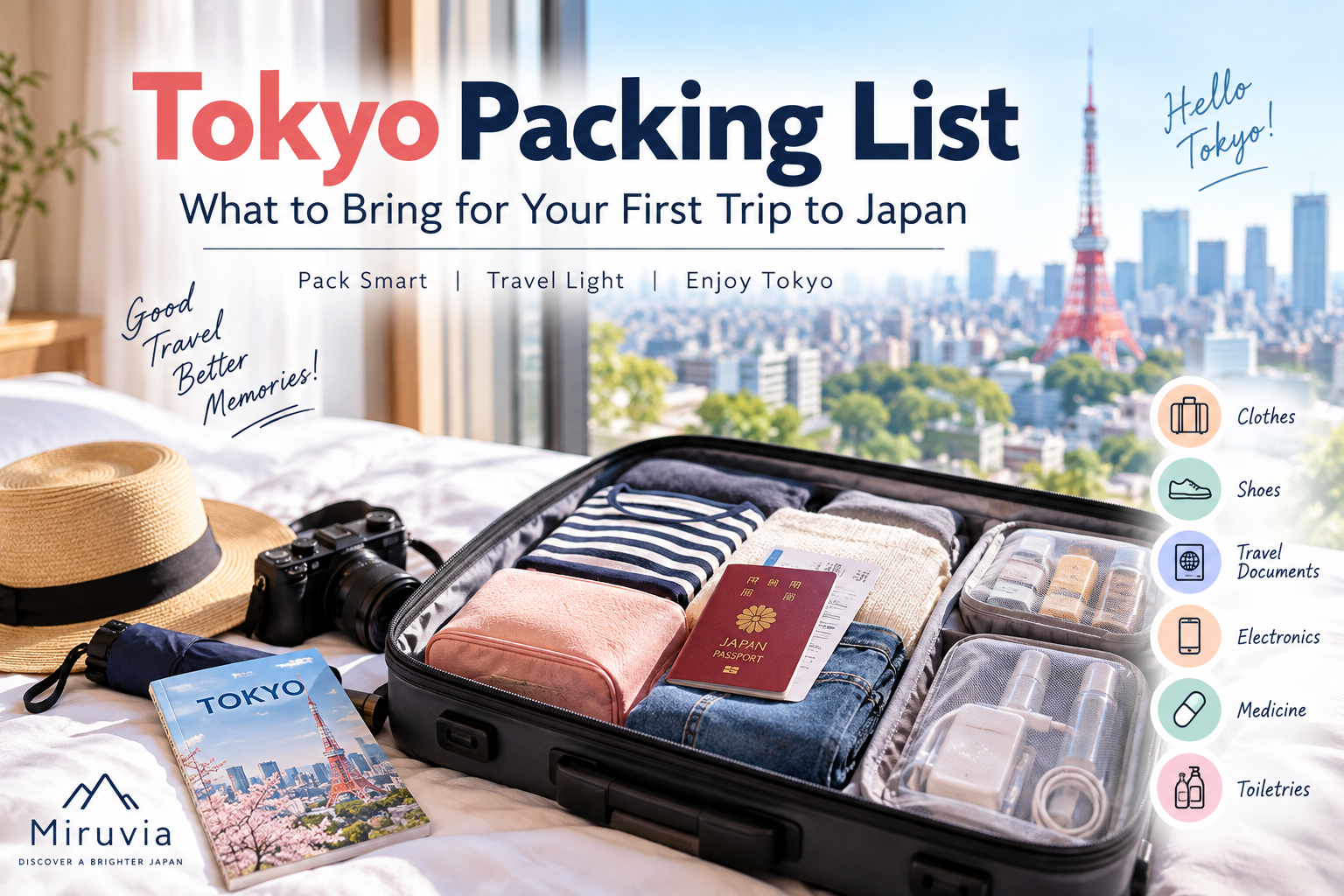
Packing for your first trip to Tokyo can feel complicated. You need to think about the weather, comfortable shoes, electronics, travel documents, money, toiletries, and everything you will carry while exploring the city.
The good news is that you do not need to bring everything from home. Tokyo has convenience stores, pharmacies, electronics stores, department stores, and clothing shops where many everyday items can be purchased after you arrive.
The most important thing is to pack for the season and prioritize items that make sightseeing easier. Tokyo has an excellent public transportation system, but travelers often walk much more than expected between stations, neighborhoods, temples, shops, restaurants, and attractions.
Your packing list will also depend on when you visit. Spring and autumn usually require flexible layers, summer calls for lightweight clothing and protection from heat and rain, while winter requires warmer clothing.
This Tokyo packing list covers essential documents, clothing, shoes, electronics, money, toiletries, medicine, day-bag essentials, and practical items for first-time visitors to Japan.
Use it as a starting point and adjust the checklist according to your travel dates, personal needs, accommodation, and planned activities.
Tokyo Packing List: Quick Checklist
If you want a quick overview before packing, start with this checklist. The exact items you need will depend on the season, length of your trip, and personal preferences.
Essential items for most Tokyo trips include:
- Passport and required travel documents
- Wallet, credit or debit cards, and some Japanese yen
- Smartphone
- Charging cables
- Power adapter if required for your devices
- Portable charger
- Internet access through an eSIM, SIM card, or pocket Wi-Fi
- Comfortable walking shoes
- Season-appropriate clothing
- Small day bag
- Any personal medications you need
- Basic toiletries
- Reusable water bottle
- Compact umbrella
- Copies or digital records of important travel information
You do not need to pack large quantities of everyday supplies. Many basic items can be purchased easily after arriving in Tokyo.
Instead, prioritize anything that would be difficult or inconvenient to replace during your trip, such as your passport, prescription medication, specific electronics, and items you personally rely on every day.
Also leave some extra space in your luggage if you plan to shop. Souvenirs, snacks, clothing, cosmetics, and other purchases can quickly take up more room than expected.
The sections below explain each category in more detail so you can decide what is actually necessary for your trip.
Essential Travel Documents
Travel documents should be the first items you confirm before packing anything else.
Entry requirements depend on your nationality, travel purpose, and length of stay, and immigration rules can change. Check the latest official Japanese government information before departure rather than relying only on older travel guides or social media posts.
Passport and Entry Documents
Your passport is the most important document for an international trip to Japan.
Before traveling, check:
- Your passport is valid for your trip
- You meet the current entry requirements for your nationality
- You have any visa or other documentation required for your circumstances
- Your flight and accommodation information is accessible when needed
- Your emergency contact information is stored somewhere secure
Keep your passport in a secure and easily accessible place while traveling.
It is also useful to keep a digital copy of important documents in a secure location separate from the originals. A copy does not replace your passport, but it may be useful if the original is lost or stolen.
Because entry requirements can change, always verify current rules through official sources before departure.
Travel Insurance and Important Information
Travel insurance is worth considering before an international trip, particularly for unexpected medical expenses, cancellations, delays, lost luggage, or other disruptions.
If you purchase insurance, keep the policy information and emergency contact details accessible on your phone or in another secure location.
It is also useful to keep records of:
- Accommodation names and addresses
- Flight information
- Important reservations
- Emergency contacts
- Travel insurance details
- Copies of essential travel documents
Avoid keeping your only copy of every important document in the same bag. Having secure digital backups can provide additional protection if your luggage or phone is lost.
Tip: Check official entry requirements again shortly before departure, even if you reviewed them when you originally booked your trip.
Clothes to Pack for Tokyo
The clothes you should pack for Tokyo depend heavily on the season. Tokyo experiences hot and humid summers, cool winters, and transitional weather during spring and autumn.
Instead of packing for Japan in general, check the forecast for Tokyo shortly before departure and choose clothing appropriate for your specific travel dates.
Spring
Spring temperatures can change considerably between March and May.
Useful clothing includes:
- Light-to-medium jackets
- Sweaters or cardigans
- Long-sleeved shirts
- Comfortable pants or other walking clothes
- Layers that can be removed during warmer afternoons
March can still feel cold, while May is generally much warmer. Layering gives you the flexibility to adjust throughout the season.
Visiting between March and May? See our Tokyo in Spring: Weather, Cherry Blossoms & Travel Tips for detailed seasonal advice.
Summer
Tokyo summers can be extremely hot and humid, particularly in July and August.
Consider packing:
- Lightweight and breathable shirts
- Light pants, skirts, or shorts
- Clothing that dries relatively quickly
- A hat
- Sunglasses
- A very light layer for air-conditioned indoor spaces
June often brings more rain, so clothing and footwear that can handle wet conditions are useful.
Traveling between June and August? See our Tokyo in Summer: Weather, Festivals & Travel Tips for heat, humidity, rainy-season, and summer sightseeing advice.
Autumn
Autumn conditions change significantly between September and November.
Consider packing:
- Lightweight clothing for September
- Long-sleeved shirts
- Sweaters or cardigans
- A light jacket
- A warmer outer layer for November
September can still feel like summer, while November is considerably cooler. Layers are particularly useful during October and November.
Visiting between September and November? See our Tokyo in Autumn: Weather, Fall Colors & Travel Tips for detailed seasonal advice.
Winter
Winter requires warmer clothing, particularly during January and February.
Consider packing:
- A warm coat or insulated jacket
- Sweaters or fleece
- Thermal base layers if needed
- Long pants
- Gloves and a scarf
Indoor spaces and trains are often heated, so removable layers are more practical than relying entirely on one extremely heavy layer.
Traveling between December and February? See our Tokyo in Winter: Weather, Snow & Travel Tips for winter weather, clothing, snow, and sightseeing advice.
Shoes for Tokyo
Comfortable shoes are one of the most important things to pack for Tokyo.
Tokyo has an extensive train and subway network, but sightseeing still involves a surprising amount of walking. You may walk through large stations, between train platforms, around neighborhoods, through parks and temples, and between attractions throughout the day.
For most travelers, comfortable walking shoes or sneakers are the best choice.
When choosing shoes, prioritize:
- Comfort for long periods of walking
- Shoes you have already worn before your trip
- Good support for your feet
- A secure fit
- Weather resistance when traveling during rainy periods
- Easy removal when appropriate
Avoid bringing only brand-new shoes that you have never worn for a full day. Even shoes that feel comfortable at first can cause discomfort or blisters after several hours of sightseeing.
Depending on your itinerary, you may occasionally need to remove your shoes at traditional accommodations, temples, restaurants, or other indoor spaces. Wearing clean and comfortable socks can therefore be useful.
During Tokyo’s rainy season or wet weather, shoes that dry reasonably quickly or provide some water resistance can make sightseeing more comfortable.
In winter, closed-toe shoes are generally more practical, while lightweight and breathable footwear can be more comfortable during the hot and humid summer.
Tip: If you have limited luggage space, prioritize one reliable pair of comfortable walking shoes over bringing several pairs for different outfits.
Electronics and Phone Essentials
A smartphone is one of the most useful tools you can bring to Tokyo. You can use it for maps, train routes, translation, reservations, weather forecasts, and travel information throughout your trip.
Before departure, make sure your devices can be charged and connected while you are in Japan.
Power Adapter and Voltage
Japan uses Type A electrical outlets, which have two flat parallel pins. The standard electricity supply is 100 volts.
Travelers from countries that use different plug shapes may need a plug adapter.
Before connecting devices such as hair dryers, straighteners, or other high-powered appliances, check the voltage information printed on the device or charger. A plug adapter changes the shape of the plug but does not convert voltage.
Many modern phone, laptop, and camera chargers support a range such as 100–240V, but you should always check your own equipment rather than assume it is compatible.
Portable Charger
A portable charger can be extremely useful during long sightseeing days.
Navigation, photography, translation, transportation apps, and internet use can drain your phone battery more quickly than expected.
Charge your portable battery before leaving your accommodation and keep the appropriate cable in your day bag.
If you are flying with a power bank, check your airline’s current rules before departure. Lithium-battery restrictions can affect where and how portable chargers may be carried.
Internet Access
Reliable internet access makes navigating Tokyo significantly easier.
Common options for international travelers include:
- eSIM
- Physical SIM card
- Pocket Wi-Fi
- International roaming from your mobile provider
The best option depends on your phone, trip length, data needs, and whether several travelers need to connect at the same time.
If you plan to use an eSIM, check that your phone supports eSIM technology and is compatible with the service before purchasing.
Public Wi-Fi is available in some locations, but relying entirely on free Wi-Fi can make navigation less convenient.
Tip: Download essential information and save your accommodation address before arriving in Japan so you can access it even if your internet connection is temporarily unavailable.
Money and Payment Essentials
Japan has become increasingly convenient for cashless payments, but carrying some Japanese yen is still useful when traveling in Tokyo.
Credit cards and other cashless payment methods are widely accepted at many hotels, department stores, convenience stores, restaurants, and major attractions. However, some smaller restaurants, traditional shops, ticket machines, temples, and other businesses may still require cash or have limited payment options.
For this reason, it is practical to carry both cash and at least one payment card.
Consider bringing:
- A credit or debit card that can be used internationally
- Some Japanese yen for cash-only situations
- A backup payment method stored separately
- A wallet or coin purse for Japanese cash
Before departure, check whether your bank or card issuer charges foreign transaction or overseas ATM fees. It is also useful to make sure you know what to do if your card is lost or blocked while traveling.
ATMs that accept international cards are available in many locations in Tokyo, including convenience stores and other major facilities. However, card compatibility, fees, and withdrawal limits can vary.
Japan also uses transportation IC cards for convenient travel on many trains and buses. Depending on the card and your device, they may also be useful for small purchases at participating stores, vending machines, and other locations.
Do not rely on only one payment method. Having a combination of cash and cards gives you more flexibility if a particular payment option is unavailable.
For more information about budgeting, cash, cards, and typical travel expenses, see our Tokyo Travel Budget: How Much Does a Trip to Tokyo Cost?
Toiletries and Personal Items
You do not need to bring a large supply of basic toiletries to Tokyo. Convenience stores, pharmacies, supermarkets, and department stores sell a wide range of everyday personal-care products.
However, bringing a small supply of the products you normally use can make the first few days of your trip easier.
Consider packing:
- Toothbrush and toothpaste
- Deodorant
- Skincare products
- Sunscreen
- Hair-care products
- Razor or other grooming items
- Contact lenses and lens solution if needed
- Feminine hygiene products if needed
- Tissues or a small handkerchief
- Any personal-care products you strongly prefer
Many hotels provide basic amenities, but what is included varies by accommodation. Check your hotel’s amenity list before packing if you want to reduce luggage.
Travelers with specific skincare, hair-care, allergy, or fragrance requirements may prefer to bring familiar products from home rather than relying on finding an exact replacement in Japan.
Sunscreen is particularly useful during warmer months, but sun protection can be helpful throughout the year when spending long periods outdoors.
A small handkerchief or towel can also be convenient. Public restrooms are widely available, but having your own small towel can still be useful during sightseeing.
Tip: Pack liquids carefully and check your airline’s current carry-on restrictions before departure, particularly if you plan to travel with larger bottles.
Medicine and Health Essentials
If you regularly take medication, make it one of the first things you check when preparing for your trip to Japan.
Japan has rules governing which medicines can be brought into the country and how much travelers may carry. A medicine that is legally available in your home country is not automatically permitted under the same conditions in Japan.
Before departure:
- Check whether your medication can legally be brought into Japan
- Check the permitted quantity
- Confirm whether advance permission or an Import Confirmation is required
- Keep medication in clearly identifiable packaging when practical
- Bring enough medication for your trip, within applicable Japanese rules
- Keep essential medication accessible during your journey
- Consider carrying relevant prescription or medical information when appropriate
Do not assume that prescription medicines, over-the-counter medicines, or their ingredients are regulated in the same way as in your home country.
Some controlled substances are subject to additional restrictions or advance permission requirements. If you are unsure about a particular medicine, check the latest information from Japan’s Ministry of Health, Labour and Welfare before traveling.
Basic health items such as masks, bandages, and common personal-care products can generally be purchased after arrival, so you do not need to fill your luggage with items that are easy to replace.
Important: Medication regulations can change and depend on the specific drug and quantity. Always verify the latest official Japanese requirements before departure.
What to Carry in Your Day Bag
You do not need to carry everything you packed while sightseeing in Tokyo. A small, lightweight day bag with a few essentials is usually enough.
Useful items to carry during the day include:
- Smartphone
- Wallet and some Japanese yen
- Credit or debit card
- Passport and any documents you are required to carry
- Portable charger and charging cable
- Reusable water bottle
- Compact umbrella
- Tissues or a small handkerchief
- Any medication you may need during the day
- Seasonal items such as sunscreen, a hat, gloves, or a scarf
- A small reusable shopping bag
Keep your bag light whenever possible. Tokyo sightseeing can involve many hours of walking, and carrying unnecessary items can become tiring by the end of the day.
Your day-bag contents should also change with the season. During summer, water, sun protection, and heat-related items become more important. During winter, gloves and other cold-weather accessories may be useful. A compact umbrella can be helpful during rainy periods throughout the year.
Keep valuables secure and avoid placing important items somewhere they could easily fall out or be left behind when moving between trains, restaurants, shops, and attractions.
Before leaving your accommodation each morning, check the weather and your itinerary. This makes it easier to carry only what you are likely to need that day.
Tip: Leave some empty space in your day bag for small purchases and souvenirs so you do not need to carry additional bags throughout the day.
What You Can Buy After Arriving in Tokyo
Tokyo is one of the easiest cities in which to buy everyday travel essentials after you arrive. If you forget something or want to keep your luggage light, many basic items are readily available.
Convenience stores, pharmacies, supermarkets, electronics stores, clothing shops, and department stores can be found throughout the city.
Items that are generally easy to find include:
- Toothbrushes and toothpaste
- Shampoo and other basic toiletries
- Skincare products
- Sunscreen
- Tissues and small towels
- Umbrellas
- Masks
- Charging cables and basic phone accessories
- Batteries
- Socks and basic clothing
- Drinks and snacks
- Reusable shopping bags
- Seasonal items such as cooling products or disposable pocket warmers
Convenience stores are particularly useful for simple items such as umbrellas, toiletries, drinks, snacks, and charging accessories. Pharmacies offer a wider selection of personal-care products, while electronics and clothing stores can help if you need something more specific.
However, do not rely on buying an exact replacement for an important personal item after arrival. Sizes, brands, ingredients, compatibility, and product availability may differ from what you use at home.
Prescription medication, specialized medical items, essential electronics, and products you strongly depend on should be researched or prepared before your trip rather than left until after arrival.
Packing with this distinction in mind can help you reduce unnecessary luggage without risking being without something essential.
Tip: If an item is inexpensive, widely available, and not essential during your journey to Japan, consider buying it after arrival instead of using valuable luggage space.
What Not to Pack for Tokyo
Packing light can make traveling around Tokyo much easier, especially if you plan to use trains, change hotels, or travel to other parts of Japan.
In many cases, you can avoid packing:
- Too many pairs of shoes — one reliable pair of comfortable walking shoes is more useful than several unnecessary options
- Large quantities of toiletries — basic products are widely available in Tokyo
- Too many clothes — choose versatile items that can be layered and reused
- Bulky towels — most hotels provide towels
- Large amounts of cash — carrying some yen is useful, but you do not need to keep your entire travel budget in cash
- Unnecessary electronics — bring only devices you realistically expect to use
- Heavy guidebooks — maps and travel information can usually be accessed on your phone
- Items you can easily purchase after arrival — umbrellas, basic toiletries, snacks, and simple travel supplies are widely available
Be especially careful with items that may be restricted when entering Japan or when traveling by air. Rules can apply to certain foods, plants, medicines, batteries, liquids, and other products.
Do not assume that an item is permitted simply because you can legally carry or purchase it in your home country. If you are unsure about something, check current Japanese customs, quarantine, airline, or other relevant official regulations before packing it.
The goal is not to pack as little as possible. Instead, bring the items that are difficult to replace or genuinely useful while leaving behind unnecessary weight and bulk.
Tip: Leave extra luggage space for the return journey. Shopping is a common part of visiting Tokyo, and souvenirs can take up considerably more space than expected.
Packing Tips for Tokyo Trains and Hotels
Packing efficiently can make traveling around Tokyo much easier, especially when using trains, navigating large stations, or staying in compact hotel rooms.
Tokyo’s public transportation system is convenient, but carrying large or heavy luggage through busy stations, stairs, platforms, and crowded trains can be difficult.
Keep these practical tips in mind:
- Choose luggage you can handle yourself. You may need to lift or move it through stations and accommodation facilities.
- Avoid overpacking. Leaving extra space also makes it easier to organize souvenirs and purchases later in your trip.
- Use a smaller day bag for sightseeing. Leave your main luggage at your accommodation whenever possible.
- Avoid crowded commuter periods with large luggage when possible. Moving through busy stations can be more difficult with suitcases.
- Check your hotel’s luggage policy. Some accommodations can store luggage before check-in or after check-out, but policies vary.
- Consider luggage delivery services. If you are moving between hotels, airports, or cities, luggage forwarding can sometimes be more convenient than carrying large suitcases yourself.
- Keep valuables and essential items with you. Passports, medication, electronics, and other important belongings should not be placed somewhere difficult to access.
Hotel rooms in Tokyo can also be more compact than some international travelers expect. Large suitcases may take up significant floor space, so luggage that is easy to open, close, and store can make your stay more comfortable.
If you plan to travel beyond Tokyo, think about luggage before choosing your transportation. A smaller and more manageable suitcase can make multi-city travel significantly easier.
For more practical advice on trains, transportation, luggage, and getting around the city, see our Tokyo Travel Tips for First-Time Visitors.
Tokyo Packing Checklist Before You Leave
Before leaving for Tokyo, use this final checklist to make sure you have covered the essentials.
You may not need every item listed below, so adjust it according to the season, length of your trip, accommodation, and personal needs.
Travel Documents and Money
- Passport
- Required visa or entry documents, if applicable
- Flight and accommodation information
- Travel insurance information
- Emergency contact details
- Credit or debit cards
- Some Japanese yen
- Backup payment method
Clothing and Shoes
- Season-appropriate clothing
- Comfortable walking shoes
- Extra socks and underwear
- Jacket, cardigan, or other layers when needed
- Rain protection
- Seasonal accessories such as a hat, sunglasses, gloves, or scarf
Electronics
- Smartphone
- Phone charger and cables
- Power adapter if required
- Portable charger
- Camera and accessories if needed
- eSIM, SIM card, pocket Wi-Fi, or roaming plan
Personal Essentials
- Regular medication
- Basic toiletries
- Skincare products
- Sunscreen
- Contact lenses or glasses if needed
- Small towel or handkerchief
- Reusable water bottle
- Compact umbrella
- Small day bag
Before Leaving Home
- Check Tokyo’s latest weather forecast
- Confirm your flight details
- Confirm your first accommodation
- Check current entry requirements
- Verify any medication restrictions
- Check airline baggage and battery rules
- Make sure your phone can access the internet in Japan
- Save important addresses and reservations
- Charge your phone and portable battery
- Leave some luggage space for souvenirs
You do not need to prepare for every possible situation. Focus on the essentials, check the latest official requirements, and remember that many everyday items can be purchased after you arrive in Tokyo.
A lighter, well-organized suitcase is usually more useful than bringing extra items “just in case.”
Final Thoughts
Packing for your first trip to Tokyo does not need to be complicated. The key is to focus on essential items, prepare for the season, and avoid filling your luggage with things that can easily be purchased after arrival.
Your passport, required travel documents, medication, payment methods, smartphone, and comfortable walking shoes should receive the highest priority. Everything else can be adjusted according to your travel style and itinerary.
Clothing requirements change significantly throughout the year. Spring and autumn are well suited to layers, summer requires preparation for heat and humidity, and winter calls for warmer clothing.
Remember that Tokyo sightseeing often involves more walking than expected, even when you use trains and subways frequently. Comfortable shoes, a lightweight day bag, and a portable charger can make a noticeable difference during long sightseeing days.
Packing light can also make it easier to navigate stations, stay in compact hotel rooms, travel between cities, and bring souvenirs home.
Finally, check current entry requirements, medication regulations, airline baggage rules, and the weather shortly before departure. These details can change, so current official information should always take priority over an older packing list.
With the essentials prepared and some extra space left in your suitcase, you will be ready to focus on enjoying your first trip to Tokyo.
Ready to plan your trip? Start with our Tokyo Travel Guide for First-Time Visitors for an overview of where to stay, what to do, transportation, food, and other essential information.
