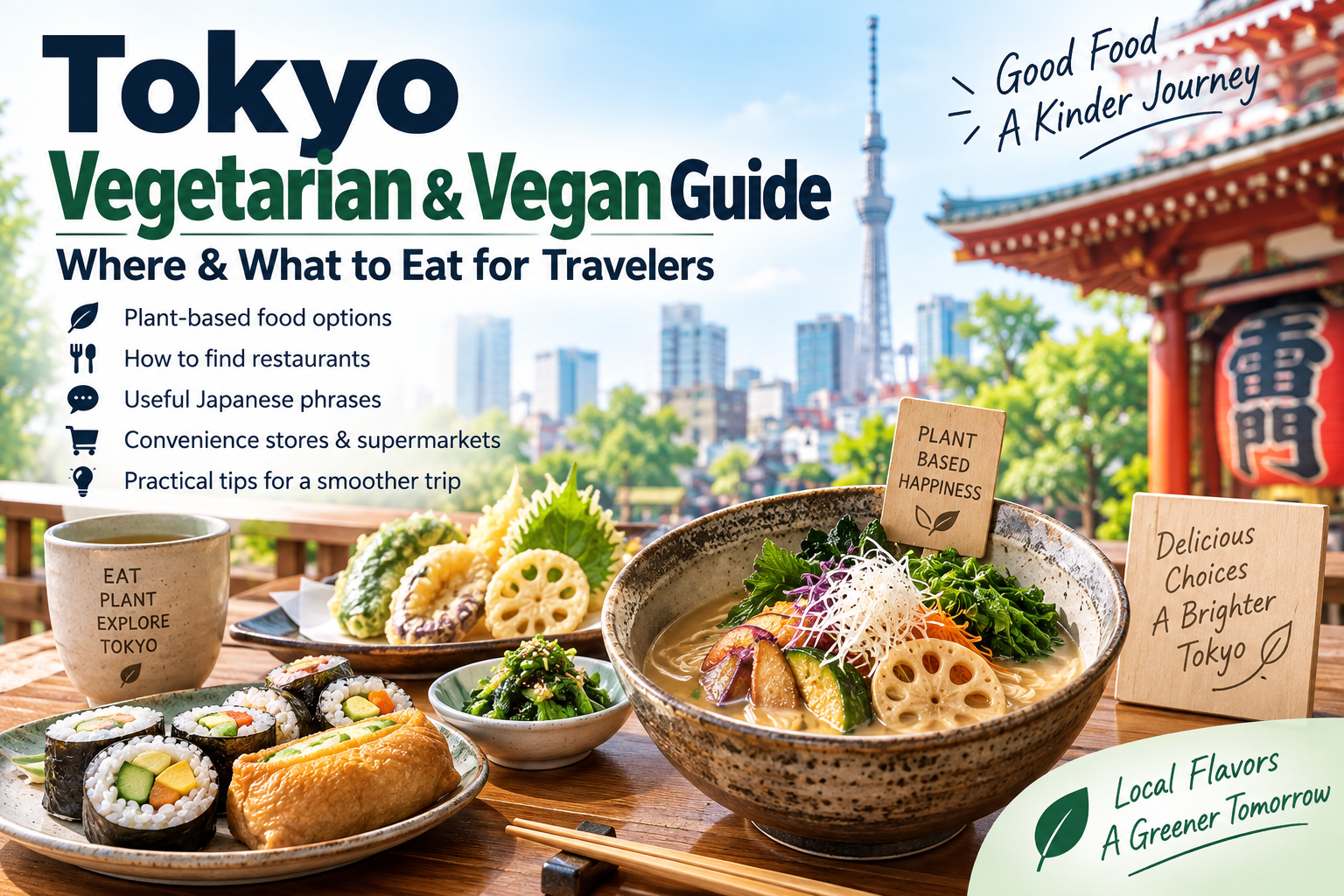
Tokyo is one of the world’s great food cities, but vegetarian and vegan travelers may find eating in Japan slightly more complicated than expected.
The challenge is not necessarily finding vegetables.
Many Japanese dishes that look vegetarian can contain fish-based dashi, meat broth, bonito flakes, or other animal-derived ingredients that are not immediately visible.
Fortunately, Tokyo’s enormous restaurant scene means there are plenty of vegetarian and vegan options once you know what to look for.
This guide explains what vegetarian and vegan travelers can eat in Tokyo, how to find suitable restaurants, which Japanese ingredients require extra attention, and how to communicate your dietary needs while traveling.
Vegetarian & Vegan Dining in Tokyo at a Glance
Vegetarian and vegan travel in Tokyo is entirely possible, but a little preparation makes the experience much easier.
Keep these points in mind:
- Dedicated vegetarian and vegan restaurants are available.
- Major tourist areas generally offer more options.
- Fish-based dashi is common in Japanese cooking.
- Some apparently vegetable-based dishes contain animal products.
- English menus are increasingly common in tourist areas.
- Restaurant-search apps and maps can save significant time.
- Learning a few Japanese phrases can help.
- Convenience stores and supermarkets can provide useful backup options.
The biggest mistake is assuming that a dish is vegetarian simply because you cannot see meat or fish.
Is Tokyo Vegetarian-Friendly?
Tokyo has become considerably easier for vegetarian travelers thanks to its huge variety of restaurants.
You can find:
- Vegetarian restaurants
- Vegan restaurants
- Plant-based cafés
- Buddhist cuisine
- Indian restaurants
- International restaurants
- Restaurants with vegetarian menu options
Areas with large numbers of tourists and restaurants usually provide the greatest choice.
However, traditional Japanese restaurants may not always have clearly labeled vegetarian options.
Planning ahead is particularly useful if you follow a strict vegan diet.
Is Tokyo Vegan-Friendly?
Vegan dining requires more attention because Japanese cooking frequently uses ingredients derived from fish or other animal products.
A dish containing tofu, vegetables, mushrooms, or noodles is not automatically vegan.
Possible hidden ingredients include:
- Fish-based dashi
- Bonito flakes
- Meat broth
- Eggs
- Dairy products
- Mayonnaise
- Fish sauce
- Gelatin
Dedicated vegan restaurants are generally the easiest option when you want greater confidence about ingredients.
Understanding Dashi
One of the most important ingredients for vegetarian and vegan travelers to understand is dashi.
Dashi is a Japanese soup stock used as the foundation of many dishes.
It may appear in:
- Miso soup
- Noodle broth
- Sauces
- Simmered vegetables
- Hot pots
- Dipping sauces
- Rice dishes
Traditional dashi is often made with katsuobushi, dried bonito flakes.
This means a vegetable dish may still contain fish.
However, some dashi is made entirely from plant-based ingredients such as:
- Kombu seaweed
- Shiitake mushrooms
If you follow a strict vegetarian or vegan diet, do not assume that a clear broth or vegetable soup is plant-based.
What Japanese Foods Can Vegetarians Eat?
There are many Japanese foods that can potentially be vegetarian, depending on how they are prepared.
Options may include:
- Vegetable sushi
- Inari sushi
- Tofu dishes
- Vegetable tempura
- Soba
- Udon
- Onigiri
- Rice bowls
- Vegetable curry
- Shojin ryori
- Plant-based ramen
However, preparation matters.
For example, vegetable tempura may be served with a dipping sauce containing fish-based dashi.
Soba and udon broths frequently contain fish stock.
Always check when necessary.
For a broader introduction to Japanese dishes and Tokyo’s food culture, see our Tokyo Food Guide for First-Time Visitors.
Vegetable Sushi
Sushi does not always mean raw fish.
Vegetarian sushi options can include ingredients such as:
- Cucumber
- Pickled vegetables
- Natto
- Avocado
- Tofu
- Inari
Inari sushi consists of vinegared rice inside seasoned fried tofu pockets and can be a convenient option.
However, recipes vary, so strict vegans should still confirm ingredients when necessary.
Tofu
Tofu is widely available in Japan and appears in many traditional dishes.
You may encounter:
- Cold tofu
- Grilled tofu
- Fried tofu
- Tofu hot pots
- Tofu-based desserts
But tofu itself being plant-based does not guarantee that the entire dish is vegetarian.
Toppings and sauces may contain bonito flakes or fish-based dashi.
Vegetable Tempura
Vegetable tempura can include:
- Sweet potato
- Pumpkin
- Eggplant
- Lotus root
- Mushrooms
- Green beans
- Shiso leaves
The vegetables themselves may be suitable for vegetarians, but the batter or dipping sauce can be an issue depending on your dietary requirements.
Some tempura batter contains egg.
The dipping sauce may contain fish-based dashi.
Ask before ordering if you need to avoid these ingredients completely.
Soba and Udon
Soba and udon are popular noodle dishes that travelers often assume are vegetarian.
The noodles themselves may be suitable, but the broth and dipping sauces commonly contain fish-based dashi.
Cold noodles served with dipping sauce can therefore still contain fish ingredients.
Look for restaurants that specifically advertise vegetarian or vegan noodle dishes.
Ramen
Traditional ramen broth frequently contains:
- Pork
- Chicken
- Fish
- Seafood
However, Tokyo also has restaurants serving dedicated vegan ramen.
Plant-based ramen may use ingredients such as:
- Soy milk
- Sesame
- Mushrooms
- Vegetables
- Miso
- Kombu
Vegan ramen can be one of the easiest ways to enjoy a classic Japanese-style meal without worrying about hidden meat or fish broth when ordered from a dedicated plant-based menu.
Japanese Curry
Japanese curry is another dish where appearances can be misleading.
Even vegetable curry may use curry roux or stock containing animal-derived ingredients.
Some restaurants now offer clearly labeled vegetarian or vegan curry.
Check the menu carefully rather than assuming a curry without visible meat is plant-based.
Onigiri
Onigiri, or Japanese rice balls, are widely available and can be useful for quick meals.
Possible fillings include:
- Pickled plum
- Kombu
- Seaweed
- Vegetable-based fillings
But many popular fillings contain:
- Salmon
- Tuna
- Fish roe
- Mayonnaise
- Meat
Packaged onigiri can also contain seasonings that are difficult to identify without reading the ingredient label.
When uncertain, choose clearly labeled plant-based products or ask for assistance.
Shojin Ryori
Shojin ryori is traditional Buddhist cuisine and can be one of the most interesting dining experiences for vegetarian travelers in Japan.
It traditionally focuses on plant-based ingredients such as:
- Tofu
- Vegetables
- Mushrooms
- Seaweed
- Sesame
- Seasonal ingredients
The cuisine emphasizes simplicity, balance, and careful preparation.
For travelers interested in Japanese food culture, shojin ryori can offer a different experience from modern vegan cafés and restaurants.
However, individual restaurant practices can vary, so check dietary requirements when making a reservation.
Convenience Stores for Vegetarian Travelers
Tokyo’s convenience stores are useful for drinks, snacks, breakfast items, and emergency meals.
Potential options may include:
- Plain rice products
- Certain onigiri
- Salads
- Fruit
- Nuts
- Edamame
- Tofu products
- Some breads
- Plant-based snacks
However, convenience-store foods often contain complex seasonings.
A salad, soup, or rice dish that appears vegetarian may include fish or meat ingredients.
Strict vegetarians and vegans should check ingredient information carefully.
For more information about convenience store food, shopping, and useful services, see our Tokyo Convenience Store Guide.
Supermarkets Can Be Useful
Supermarkets can provide more flexibility than convenience stores.
You may find:
- Fresh fruit
- Vegetables
- Rice
- Tofu
- Natto
- Bread
- Plant-based milk
- Nuts
- Salads
- Prepared foods
Larger supermarkets may offer a wider range of products and clearer ingredient information.
Supermarkets are particularly useful if your accommodation has a kitchen or if you want simple breakfast and snack options.
For practical advice on grocery shopping, prepared foods, discounts, and checkout procedures, see our Tokyo Supermarket Guide.
How to Find Vegetarian & Vegan Restaurants
Planning your meals in advance can save considerable time.
Useful search terms include:
- Vegan Tokyo
- Vegetarian Tokyo
- Vegan ramen Tokyo
- Vegan sushi Tokyo
- Plant-based Tokyo
You can also combine these with the neighborhood you are visiting.
For example:
Vegan Shibuya
or:
Vegetarian Shinjuku
Saving several restaurant options on your map before leaving your hotel can make sightseeing much easier.
Do Not Rely Only on the Word “Vegetable”
A menu may describe something as:
Vegetable ramen
or:
Vegetable curry
This does not necessarily mean vegetarian.
The dish may contain vegetable toppings while using meat or fish stock underneath.
Look for explicit terms such as:
- Vegetarian
- Vegan
- Plant-based
If your dietary requirements are strict, confirm the ingredients.
Useful Japanese Words
Knowing a few Japanese words can help when reading menus.
Vegetarian:
ベジタリアン
Bejitarian
Vegan:
ヴィーガン
Vīgan
Meat:
肉
Niku
Fish:
魚
Sakana
Egg:
卵
Tamago
Milk:
牛乳
Gyūnyū
Dairy products:
乳製品
Nyūseihin
Dashi:
だし
Dashi
These words can help you identify basic ingredients, although packaged food labels can still be difficult to interpret.
Useful Japanese Phrases
If you need to explain that you do not eat meat:
肉は食べません。
Niku wa tabemasen.
“I do not eat meat.”
If you do not eat fish:
魚は食べません。
Sakana wa tabemasen.
“I do not eat fish.”
If you are vegan:
ヴィーガンです。
Vīgan desu.
“I am vegan.”
However, simply saying that you are vegetarian may not communicate every ingredient you avoid.
If necessary, explain specific restrictions.
Translation Apps Can Help
A translation app can be extremely useful when discussing dietary requirements.
Before ordering, you can prepare a translated message explaining exactly what you cannot eat.
For example, you may need to specify:
- Meat
- Fish
- Fish stock
- Eggs
- Dairy
Showing a clear written message can be easier than trying to explain complicated dietary restrictions verbally.
Keep the message saved on your phone so you can access it quickly.
Check Menus Before Visiting
One of the easiest ways to avoid problems is to check restaurant menus online before going.
Look for:
- Vegetarian labels
- Vegan labels
- Allergen information
- English menus
- Plant-based menus
If the restaurant does not provide enough information online, consider choosing another restaurant or contacting them in advance.
This is especially useful for reservations and special meals.
Make Reservations When Necessary
Popular vegetarian and vegan restaurants can become busy.
Reservations may be useful for:
- Dinner
- Weekends
- Small restaurants
- Popular plant-based restaurants
- Special dining experiences
- Shojin ryori
Having a confirmed restaurant can also reduce the amount of time spent searching for food during your sightseeing day.
Cross-Contamination
Some travelers avoid animal products as a lifestyle choice, while others have allergies or medical dietary restrictions.
These situations are not the same.
A restaurant may offer a plant-based dish while using shared:
- Cooking equipment
- Frying oil
- Grills
- Utensils
- Preparation areas
If cross-contamination is a serious concern, communicate this clearly with the restaurant before ordering.
Do not assume that a vegan menu automatically meets allergy-safe preparation standards.
Vegetarian vs. Vegan Labels
Pay attention to the exact label used.
A vegetarian dish may still contain:
- Egg
- Milk
- Cheese
- Butter
- Other dairy products
A vegan dish generally excludes animal-derived ingredients, but preparation practices still vary by restaurant.
Choose according to your own dietary requirements.
Breakfast Can Require Planning
Traditional Japanese breakfasts may include:
- Grilled fish
- Miso soup made with fish-based dashi
- Egg
- Rice
- Pickles
Hotel breakfast buffets may provide fruit, salad, bread, rice, and other options, but strict vegans should confirm ingredients when necessary.
If breakfast options near your hotel are limited, buying suitable food from a supermarket the night before can be a useful backup plan.
Build Meals Into Your Itinerary
Do not wait until you are extremely hungry to begin searching for a vegetarian restaurant.
Tokyo is enormous, and the nearest suitable restaurant may not be directly beside the attraction you are visiting.
When planning your day, consider:
Morning attraction → lunch area → afternoon attraction → dinner area
This allows food choices to become part of your route instead of an interruption to it.
Carry an Emergency Snack
Even with good planning, restaurants can be:
- Closed
- Fully booked
- Difficult to find
- Farther away than expected
Carry a simple snack that you know meets your dietary requirements.
This is especially useful during:
- Day trips
- Long train journeys
- Busy sightseeing days
- Late evenings
A small backup snack can prevent you from choosing unsuitable food simply because you are hungry.
Be Extra Prepared Outside Central Tokyo
Vegetarian and vegan choices may become more limited when traveling outside major urban and tourist areas.
If you take a day trip, research food options beforehand.
Consider bringing:
- Snacks
- Onigiri you have already checked
- Fruit
- Nuts
- Other suitable food
Do not assume every destination will have a dedicated vegetarian restaurant.
Common Mistakes Vegetarian & Vegan Travelers Make
Assuming Vegetable Dishes Are Vegetarian
Vegetables may be cooked in fish or meat stock.
Check the broth and seasonings.
Forgetting About Dashi
Fish-based dashi is one of the most common hidden ingredients in Japanese cuisine.
Pay particular attention to soups, sauces, and noodle dishes.
Choosing Restaurants at the Last Minute
Suitable restaurants may not always be immediately nearby.
Save several options before starting your sightseeing day.
Assuming English Labels Tell the Whole Story
A short English menu description may not list every ingredient.
Ask when necessary.
Depending Entirely on Convenience Stores
Convenience stores are useful backups, but they should not be your only strategy if you follow a strict diet.
Not Explaining Specific Restrictions
The definition of vegetarian can vary between people and cultures.
If you cannot eat fish, fish stock, eggs, dairy, or other ingredients, say so clearly.
A Simple Vegetarian & Vegan Food Strategy for Tokyo
For an easier trip, use this approach:
- Save several vegetarian or vegan restaurants before traveling.
- Choose at least one restaurant near each major sightseeing area.
- Learn the importance of dashi.
- Save your dietary requirements in Japanese on your phone.
- Check menus online before visiting.
- Carry an emergency snack.
- Use supermarkets and convenience stores as backup options.
- Confirm ingredients whenever you are unsure.
This preparation gives you much more freedom during the trip.
Can Vegetarian & Vegan Travelers Enjoy Japanese Food?
Absolutely.
Following a vegetarian or vegan diet does not mean you have to avoid Japanese cuisine.
Tokyo offers opportunities to try plant-based versions of:
- Ramen
- Sushi
- Curry
- Tofu dishes
- Noodles
- Traditional Buddhist cuisine
- Japanese desserts
The key is choosing restaurants carefully rather than assuming that every vegetable-based dish is suitable.
With some research, food can still become one of the highlights of your Tokyo trip.
Final Thoughts
Tokyo can be an excellent destination for vegetarian and vegan travelers, especially when you prepare before your trip.
The most important thing to remember is that animal-derived ingredients are not always visible.
Fish-based dashi, broth, sauces, eggs, and dairy can appear in dishes that initially look plant-based.
Choose clearly labeled vegetarian or vegan restaurants when possible, check menus before visiting, and communicate your dietary requirements clearly when necessary.
Keep several suitable restaurants saved on your phone and carry a backup snack for busy sightseeing days.
With these simple precautions, you can explore Tokyo’s food culture with much more confidence and enjoy a wide variety of Japanese meals during your trip.
For more help planning your first trip, including transportation, sightseeing, food, and practical advice, continue with our Tokyo Travel Guide for First-Time Visitors.
