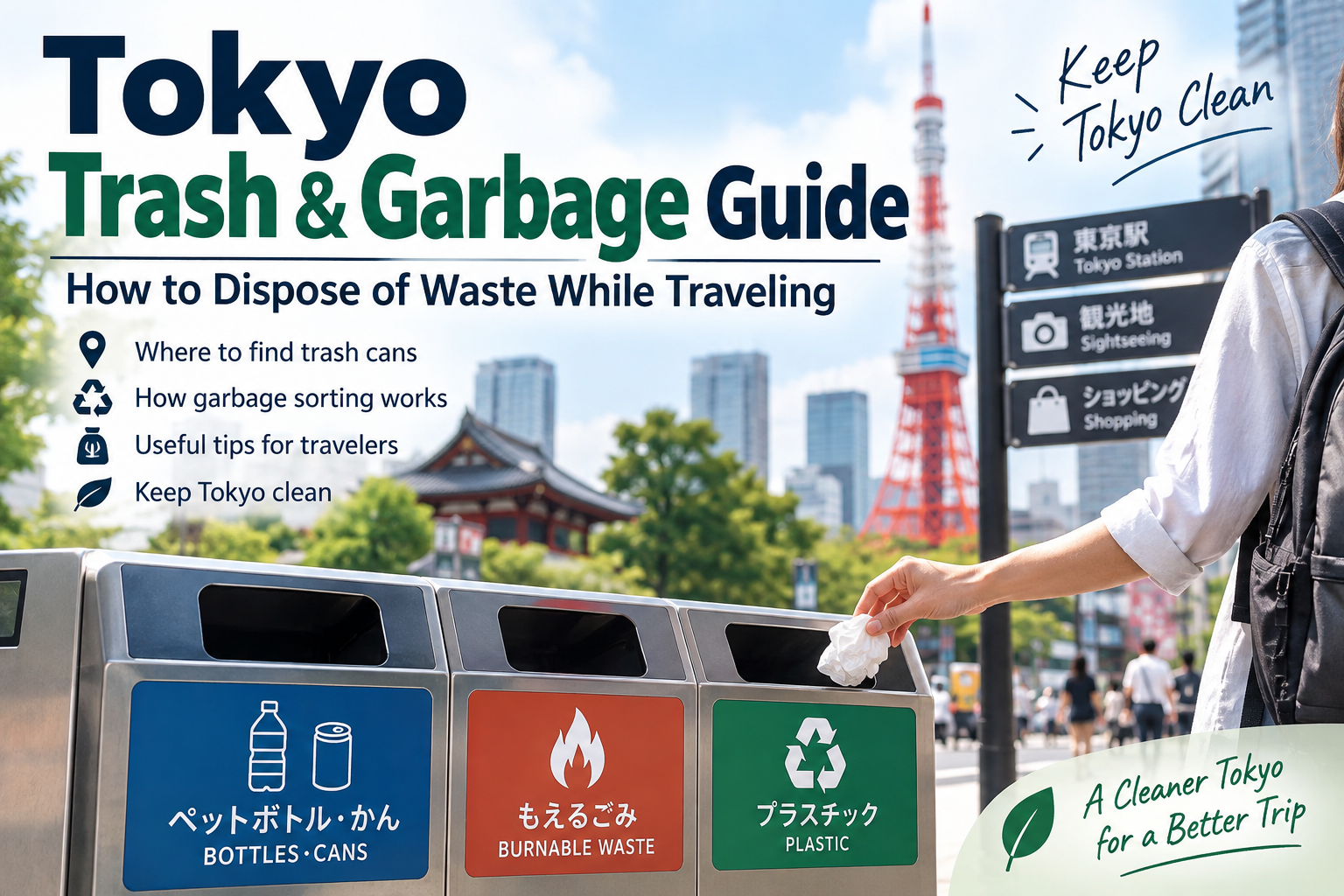
Tokyo is famous for being remarkably clean, but first-time visitors often notice something surprising: public trash cans can be difficult to find.
You may finish a drink, buy a snack from a convenience store, or pick up street food and suddenly realize there is nowhere nearby to throw away the packaging.
So what should you do with your trash while traveling in Tokyo?
This guide explains where travelers can find trash cans, how garbage disposal works in Japan, what to do when no bin is available, and the basic etiquette you should know while exploring Tokyo.
Tokyo Trash & Garbage at a Glance
The most important thing to understand is simple:
Public trash cans are not available everywhere in Tokyo.
When sightseeing, you may need to carry your trash with you until you find an appropriate place to dispose of it.
Useful places to check include:
- Convenience stores
- Train and subway stations
- Vending machine areas
- Shopping malls
- Department stores
- Tourist attractions
- Your hotel
However, availability varies by location.
A small plastic bag in your day bag can be extremely useful for temporarily carrying wrappers, tissues, receipts, and other small items.
Why Are There So Few Public Trash Cans in Tokyo?
Visitors sometimes expect a clean city to have trash cans on almost every street.
Tokyo often works differently.
Public waste bins are less common than many travelers expect, and people frequently carry their own garbage until they reach an appropriate disposal point.
This means that finding a trash can may require a little planning.
The important rule is:
Do not leave trash beside a full bin, on a bench, on the street, or in another public space.
If you cannot find an appropriate bin, keep the trash with you temporarily.
Should You Carry Your Trash With You?
Yes.
This is one of the easiest habits travelers can adopt in Tokyo.
If you buy food or drinks while sightseeing, assume that you may need to carry the packaging for some time afterward.
A small reusable or disposable bag can hold:
- Snack wrappers
- Receipts
- Used tissues
- Small food containers
- Plastic packaging
- Other lightweight waste
You can then dispose of everything appropriately when you reach a suitable location.
Where to Find Trash Cans in Tokyo
Although street bins may be limited, there are several places where travelers can often find waste disposal facilities.
Convenience Stores
Convenience stores may have trash cans, although availability differs between locations.
Some stores place bins inside rather than outside.
If a convenience store provides bins for customers, follow the labels and separate your waste into the correct category.
Do not assume every convenience store will have a publicly accessible trash can.
If you plan to use convenience stores frequently during your trip, see our Tokyo Convenience Store Guide for food, payments, useful services, and practical shopping tips.
Train and Subway Stations
Some stations have trash cans in designated areas.
They may be located:
- Near ticket gates
- On platforms
- Near vending machines
- In waiting areas
Not every station has the same facilities, so availability can vary.
When bins are provided, pay attention to the waste categories shown on them.
Shopping Malls and Department Stores
Large commercial facilities can be useful places to find trash disposal areas.
You may find bins:
- Near food courts
- Near rest areas
- On restaurant floors
- Near vending machines
- In designated recycling areas
If you purchased food inside the facility, it is usually easiest to dispose of the packaging in the designated area before leaving.
Tourist Attractions
Museums, theme parks, observation decks, large gardens, and other managed attractions may provide trash cans for visitors.
Use the designated bins and follow any sorting instructions.
Hotels
Your hotel is one of the easiest places to dispose of ordinary travel waste.
If you cannot find an appropriate public bin during the day, keeping small amounts of trash until you return to your accommodation is often the simplest solution.
For unusual or bulky waste, ask hotel staff before disposing of it.
Trash Cans Near Vending Machines
Tokyo has vending machines throughout the city.
Near some beverage vending machines, you may see collection boxes for:
- Plastic bottles
- Cans
- Glass bottles
These are generally intended for beverage containers.
Do not treat a bottle-recycling container as a general trash can.
Food wrappers, tissues, shopping bags, and unrelated waste should be disposed of elsewhere.
How Trash Sorting Works in Japan
Waste sorting rules in Japan can be detailed, and exact categories vary depending on the facility and municipality.
Travelers usually do not need to understand the full residential garbage collection system.
Instead, focus on the labels provided at the place where you are disposing of your trash.
Common categories may include:
- Burnable waste
- Plastic bottles
- Cans
- Glass bottles
- Other recyclable materials
The categories available depend on the bin.
When in doubt, look at the pictures or symbols displayed on the container.
PET Bottles
Plastic drink bottles are commonly called PET bottles in Japan.
You may see the label:
PET
or
ペットボトル
Dedicated collection bins are often found near vending machines and other beverage areas.
If possible, make sure the bottle is empty before disposing of it.
Follow the instructions shown on the bin rather than assuming all plastic items belong together.
Cans and Bottles
Drink cans and glass bottles may have their own recycling compartments.
Common labels include:
Cans:
缶
Kan
Bottles:
びん
Bin
Some collection boxes combine cans and bottles, while others separate them.
Use the labels and illustrations as your guide.
Burnable Waste
You may occasionally see a category translated as burnable waste.
Japanese labels can include:
燃えるゴミ
Moeru gomi
or similar wording.
Depending on the facility, this category may be used for certain food wrappers, tissues, and other ordinary waste.
However, sorting systems differ.
Always follow the labels on the specific bin you are using.
What About Food Waste?
Food waste can be inconvenient while sightseeing because it may smell or leak.
When buying ready-to-eat food, the easiest option is often to eat it where appropriate and dispose of the packaging at the same facility if bins are provided.
For example, some food courts and eating areas have dedicated return or waste stations.
If you must carry food waste, place it inside a sealed plastic bag until you find an appropriate disposal location.
Eating at Convenience Stores
Some convenience stores provide eating areas, although this varies by branch.
If you eat food at the store, use the store’s waste facilities if they are available for customers.
Separate bottles, cans, and other waste according to the labels.
If there is no customer trash bin, take the waste with you rather than leaving it behind.
Street Food and Markets
Food-focused sightseeing areas, festivals, and markets may have their own disposal rules.
Some vendors provide trash collection for packaging from the food they sell.
Others may expect customers to return containers or dispose of them in designated areas.
Before walking away with empty packaging, look for signs or ask the vendor if necessary.
Avoid placing food containers into unrelated bins simply because they are nearby.
Eating While Walking
Rules and expectations differ by location, but eating while walking is not always the most convenient choice in Tokyo.
One practical problem is waste.
If you finish food while walking, you may have to carry the packaging until you find a bin.
When possible, eating near the shop or in a designated eating area makes both eating and trash disposal easier.
What to Do With Used Tissues
Carry used tissues until you find an appropriate general waste bin.
A small plastic bag is useful for keeping used tissues separate from other belongings.
Do not place tissues into bottle or can recycling containers.
What to Do With Receipts
Convenience stores, restaurants, ticket machines, and shops may give you many receipts during your trip.
If you do not need them, dispose of them in an appropriate general waste bin.
However, consider keeping important receipts for:
- Tax-free purchases
- Travel insurance claims
- Expensive purchases
- Hotel payments
- Transportation issues
Do not accidentally throw away documents you may need later.
What to Do With Umbrellas
Cheap plastic umbrellas are common during rainy weather, but they should not simply be abandoned when you no longer need them.
Do not leave an unwanted umbrella at a station, hotel entrance, or on the street.
If you need to dispose of a damaged umbrella, ask your hotel or another appropriate facility how to handle it.
Large items may follow different disposal rules from ordinary travel waste.
What to Do With Suitcases
Do not leave an unwanted suitcase beside a public trash can or at a station.
Large luggage is not ordinary public-bin waste.
If your suitcase is damaged or you need to dispose of it during your trip, ask your hotel or luggage provider for guidance.
Disposal rules and possible fees can vary.
If you need somewhere to keep your bags before check-in or after check-out, see our Tokyo Luggage Storage Guide for coin lockers and other storage options.
What to Do With Batteries and Electronics
Batteries, portable chargers, electronic devices, and similar items should not automatically be placed into ordinary trash bins.
These products may require special collection or recycling.
If you need to dispose of an electronic item, ask your hotel, the retailer, or an appropriate collection facility for guidance.
This is particularly important for lithium-ion batteries and portable chargers.
Do Not Leave Trash Beside a Full Bin
If a trash can is full, do not place your waste on the ground beside it.
Carry it to another appropriate disposal location.
Trash left beside bins can create litter, attract animals, and make public spaces difficult to maintain.
This simple rule is especially important in crowded tourist areas.
Do Not Use Private Trash Areas
You may occasionally see garbage collection areas belonging to:
- Apartment buildings
- Offices
- Restaurants
- Private businesses
These are not public trash disposal points.
Do not leave your travel waste there.
Use bins clearly intended for customers or members of the public.
Trash on Trains
Do not leave bottles, food packaging, newspapers, or other waste on train seats or inside train cars.
Take your belongings and trash with you when leaving the train.
Some long-distance trains may have waste facilities, but ordinary urban trains often do not provide convenient onboard trash disposal.
Trash at Train Stations
If a station provides trash cans, use them according to the displayed categories.
Do not force oversized items into station bins.
Station waste facilities are intended for ordinary passenger waste, not for disposing of luggage or large quantities of garbage.
Trash at Your Hotel
For normal daily travel waste, your hotel room is often the easiest disposal point.
Housekeeping can generally handle ordinary small amounts of guest waste.
However, if you have:
- Large cardboard boxes
- Broken luggage
- Electronics
- Batteries
- Large quantities of packaging
- Other unusual items
ask hotel staff before leaving them for disposal.
A Small Trash Bag Is Extremely Useful
One of the simplest travel items you can carry in Tokyo is a small plastic bag.
It takes almost no space and solves several common problems.
You can use it to temporarily store:
- Snack wrappers
- Used tissues
- Receipts
- Wet items
- Small food packaging
Consider carrying two bags so you can separate clean recyclables from messy waste.
Keep Food Waste Sealed
If you need to carry food packaging, seal it whenever possible.
This helps prevent:
- Smells
- Leaks
- Stains inside your bag
Small zip-top bags can be particularly useful for this purpose.
Useful Japanese Words for Trash Disposal
Knowing a few Japanese words can make bin labels easier to understand.
Trash / garbage:
ゴミ
Gomi
Trash can:
ゴミ箱
Gomibako
Burnable trash:
燃えるゴミ
Moeru gomi
PET bottle:
ペットボトル
Pettobotoru
Can:
缶
Kan
Bottle:
びん
Bin
You may also see English labels or illustrations in major tourist areas.
Can You Ask Someone Where a Trash Can Is?
Yes.
A useful phrase is:
ゴミ箱はどこですか?
Gomibako wa doko desu ka?
This means:
Where is the trash can?
You can use this at shopping centers, stations, tourist facilities, or other staffed locations.
However, staff may tell you that no public bin is available.
In that case, simply keep your waste until you find another disposal point.
Trash and Cherry Blossom Season
During cherry blossom season, popular parks can become extremely busy.
Temporary waste collection areas may sometimes be provided during major events, but visitors should not assume bins will always be available.
If you bring food or drinks for a picnic, be prepared to carry your waste away.
Leaving trash behind in parks is inappropriate even when the area is crowded.
If you are visiting during spring, see our Tokyo Cherry Blossom Guide for practical tips on enjoying sakura season.
Trash at Festivals and Events
Large festivals and events may provide temporary waste stations.
These can have specific sorting categories for:
- Food containers
- Chopsticks
- Bottles
- Cans
- Other waste
Follow event signs and staff instructions.
If the event asks visitors to return containers to specific vendors or collection points, use those systems.
Trash During Day Trips
If you take a day trip outside central Tokyo, trash cans may be even less predictable.
Carry a small waste bag and avoid relying on finding a public bin immediately.
This is especially useful when visiting:
- Hiking areas
- Rural destinations
- Beaches
- Parks
- Temples and shrines
- Scenic areas
A simple rule works almost everywhere:
If you cannot find the correct place to dispose of something, carry it with you.
Common Mistakes Travelers Should Avoid
Expecting Trash Cans Everywhere
Do not assume every street, park, or station will have a public bin.
Plan to carry small amounts of waste.
Using Recycling Bins for General Trash
Bottle and can collection boxes are not general garbage bins.
Use them only for the categories indicated.
Leaving Trash Next to a Bin
A full trash can does not make the surrounding ground a disposal area.
Find another bin or take the trash with you.
Throwing Away Large Items
Suitcases, umbrellas, electronics, and other bulky items may require different disposal methods.
Ask before disposing of them.
Leaving Waste at Tourist Sites
Do not leave packaging on benches, walls, planters, or other surfaces.
Keep Tokyo clean by taking your waste with you.
Practical Trash Tips for Tokyo Travelers
Here are a few simple habits that make waste disposal easier:
- Carry a small plastic bag every day.
- Dispose of food packaging where you bought or ate the food when appropriate facilities are provided.
- Check near vending machines for beverage recycling.
- Use shopping mall or station bins when available.
- Follow pictures and labels on bins.
- Keep messy food waste sealed.
- Never leave trash beside a full bin.
- Take remaining ordinary waste back to your hotel when necessary.
These habits quickly become part of your normal sightseeing routine.
Is Tokyo Difficult for Travelers Because of the Lack of Trash Cans?
Usually not.
The first day may feel slightly unusual if you are accustomed to public bins on every street.
After that, most travelers adapt quickly.
You simply begin thinking:
“I may need to keep this wrapper for a while.”
Carrying a small waste bag removes most of the inconvenience.
The limited number of public bins is something to prepare for, not something that should make traveling in Tokyo difficult.
Final Thoughts
Tokyo’s limited number of public trash cans can surprise first-time visitors, but waste disposal becomes easy once you understand the basic system.
Use designated bins when they are available, follow the sorting labels, and avoid treating recycling containers as general trash cans.
Most importantly, be prepared to carry your waste until you find an appropriate disposal point.
A small plastic bag in your day bag is one of the simplest ways to make sightseeing more convenient.
By following local waste etiquette and disposing of your trash responsibly, you can help keep Tokyo clean while enjoying your trip.
For more practical advice on transportation, money, etiquette, and everyday travel in the city, continue with our Tokyo Travel Guide for First-Time Visitors.
