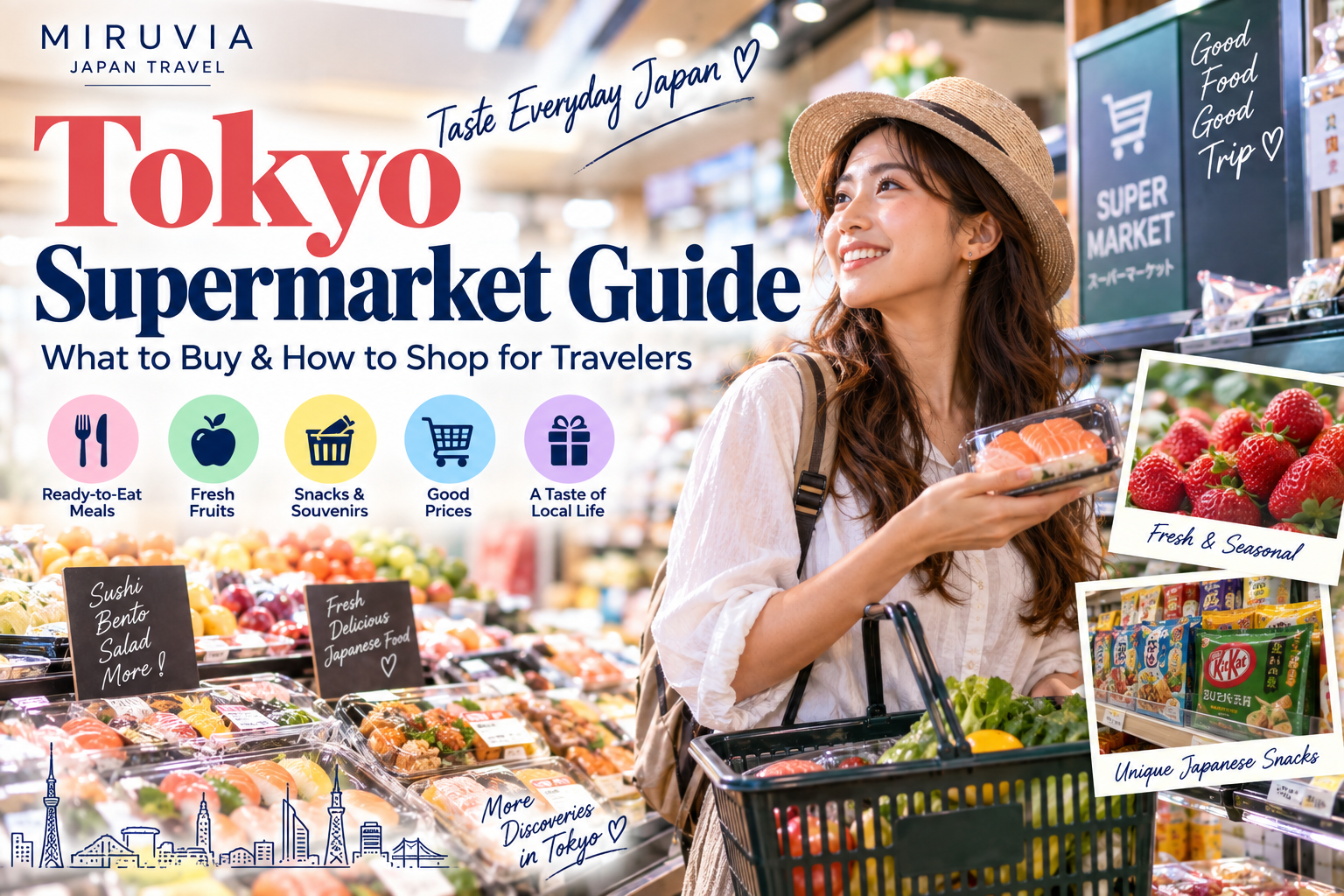
Visiting a supermarket in Tokyo can be surprisingly useful during your trip.
Japanese supermarkets are not only places to buy groceries. For travelers, they can be an affordable place to find ready-to-eat meals, sushi, fruit, drinks, snacks, breakfast items, and food souvenirs.
They also offer an interesting glimpse into everyday life in Japan.
However, shopping at a Japanese supermarket can feel unfamiliar on your first visit. Product labels may be mostly in Japanese, checkout procedures can differ from what you are used to, and it may not always be obvious which foods are ready to eat.
This Tokyo supermarket guide explains what travelers can buy, how supermarkets work, how they compare with convenience stores, and how to use them during your trip.
Tokyo Supermarkets at a Glance
| Topic | What Travelers Should Know |
|---|---|
| Best For | Groceries, ready-to-eat meals, drinks, fruit, snacks and food souvenirs |
| Prices | Often useful for budget-conscious food shopping |
| Ready-to-Eat Food | Sushi, bento, side dishes, salads and more |
| Payment | Methods vary by store |
| Bags | Shopping bags may cost extra |
| Discounts | Some prepared foods may be discounted later in the day |
| Language | Many labels are primarily in Japanese |
| Best Time to Visit | Depends on whether you prioritize selection or possible discounts |
Supermarkets can be especially useful when you want an inexpensive meal, breakfast supplies for your hotel, or Japanese snacks to take home.
What Is a Japanese Supermarket Like?
A typical supermarket in Tokyo may look familiar at first.
You will usually find sections for:
- Fresh vegetables
- Fruit
- Meat
- Seafood
- Rice
- Bread
- Dairy products
- Drinks
- Snacks
- Frozen food
- Seasonings
- Prepared meals
- Household products
What makes Japanese supermarkets particularly interesting for travelers is the variety of prepared food.
You can often find a substantial meal without needing to cook.
This makes supermarkets useful even if your accommodation does not have a kitchen.
Why Travelers Should Visit a Supermarket in Tokyo
Restaurants and convenience stores are often more visible to tourists, but supermarkets serve a different purpose.
They can be useful when you:
- Want an inexpensive meal
- Need breakfast for the next morning
- Want fresh fruit
- Need larger bottles of drinks
- Want Japanese snacks
- Are staying in an apartment with a kitchen
- Want to explore everyday Japanese food
- Need food for a picnic or train journey
- Want edible souvenirs
A supermarket visit can also be an enjoyable activity in itself.
You may discover ingredients, seasonal products, unusual snacks, and regional foods that you would not notice in restaurants.
Supermarket vs Convenience Store in Tokyo
Convenience stores and supermarkets overlap, but they are not interchangeable.
Convenience Stores
Convenience stores are particularly useful when you need something quickly.
They are often convenient for:
- Quick breakfasts
- Onigiri
- Sandwiches
- Drinks
- Snacks
- Late-night purchases
- Travel essentials
- ATMs and other services
Their major advantage is convenience.
Supermarkets
Supermarkets generally offer a broader grocery selection.
They can be better when you want:
- Fresh produce
- Larger quantities
- More prepared-food choices
- Grocery ingredients
- A wider range of household food products
- Multiple snack options
- Food shopping for several people
If you only need one drink and an onigiri, a convenience store may be easier.
If you want to buy dinner, breakfast for tomorrow, fruit, drinks, and snacks at the same time, a supermarket may be more practical.
For a closer look at konbini food, ATMs, useful services, and shopping etiquette, see our Tokyo Convenience Store Guide.
Best Things to Buy at Tokyo Supermarkets
If you want to explore Tokyo’s food beyond supermarkets, see our Tokyo Food Guide for First-Time Visitors.
You do not need to cook to enjoy a Japanese supermarket.
Many of the most useful products for travelers are ready to eat.
Here are some of the best things to look for.
1. Bento
Bento boxes are one of the easiest supermarket meals.
Depending on the store, you may find combinations featuring:
- Rice
- Grilled fish
- Fried chicken
- Pork
- Beef
- Vegetables
- Pickles
- Japanese side dishes
A bento can be useful after a long sightseeing day when you want to eat at your hotel rather than visit another restaurant.
Check whether the meal needs heating before eating.
2. Sushi
Many Japanese supermarkets sell packaged sushi.
Selections may include:
- Nigiri
- Maki rolls
- Inari sushi
- Assorted sushi sets
Supermarket sushi can provide a casual alternative when you do not need a full restaurant experience.
Because it is a perishable product, pay attention to storage and consume it appropriately.
3. Sashimi
Some supermarkets have substantial seafood sections with packaged sashimi.
This can be interesting for travelers who enjoy Japanese seafood and have somewhere suitable to eat it.
Remember that raw seafood requires careful handling.
Do not carry it around Tokyo for hours before eating it.
4. Prepared Side Dishes
The prepared-food section can be one of the most interesting parts of a Japanese supermarket.
You may find:
- Karaage
- Tempura
- Croquettes
- Gyoza
- Grilled fish
- Salads
- Simmered vegetables
- Potato salad
- Yakitori
- Various Japanese side dishes
Buying several small dishes is a good way to try different foods in one meal.
5. Onigiri
Onigiri are available in supermarkets as well as convenience stores.
Common fillings may include:
- Salmon
- Tuna
- Umeboshi
- Kombu
- Other Japanese fillings
They are useful for breakfast, a quick meal, or food to take with you during the day.
6. Bread and Bakery Items
Supermarkets often have packaged bread, while some locations may also have an in-store bakery.
You may find:
- Toast
- Rolls
- Sweet bread
- Savory bread
- Pastries
- Sandwiches
These can make an easy breakfast if you want to leave your hotel early.
7. Japanese Fruit
A supermarket is a good place to explore Japanese fruit.
Depending on the season, you may see:
- Strawberries
- Mandarins
- Apples
- Grapes
- Peaches
- Pears
- Melons
- Persimmons
Some fruit in Japan can be expensive, particularly premium varieties.
Look at the price carefully before buying.
Smaller packages or ordinary everyday fruit may be more practical for travelers.
8. Yogurt and Dairy Products
If your hotel has a refrigerator, supermarkets can be useful for buying:
- Yogurt
- Milk
- Cheese
- Desserts
- Other refrigerated products
These can be helpful for creating a simple breakfast in your room.
9. Drinks
Supermarkets often have a large drink selection.
You may find:
- Water
- Tea
- Coffee
- Juice
- Soft drinks
- Sports drinks
- Other Japanese beverages
Buying larger bottles can be useful if you want drinks for your hotel room.
10. Japanese Snacks
Supermarkets can be excellent places to explore Japanese snacks.
Look for:
- Rice crackers
- Chocolate
- Cookies
- Candy
- Potato snacks
- Matcha-flavored products
- Seasonal sweets
- Regional products
Some products are sold in larger packages than those typically purchased for immediate consumption.
That can make them useful for sharing or taking home.
11. Instant Noodles
Japanese supermarkets usually have a variety of instant noodles.
These can include:
- Ramen
- Udon
- Soba
- Yakisoba
They can be convenient if your accommodation provides hot water and allows you to eat in your room.
Always check preparation instructions before purchasing.
12. Japanese Seasonings and Ingredients
Travelers interested in Japanese cooking may enjoy exploring the grocery aisles.
You may find products such as:
- Furikake
- Curry roux
- Soup products
- Noodle sauces
- Tea
- Dashi-related products
- Seasoning mixes
Some can make interesting food souvenirs.
Before taking food internationally, check the customs and import rules of your destination country.
Using Supermarkets for Breakfast
Buying breakfast the night before can save time in the morning.
A simple supermarket breakfast might include:
- Bread
- Yogurt
- Fruit
- Onigiri
- Juice
- Coffee
This can be particularly useful when you want to start sightseeing early.
Instead of searching for an open café every morning, you can have food ready in your hotel room.
Using Supermarkets for Dinner
Supermarkets can also help after a long sightseeing day.
For example, you could combine:
- A bento
- A few prepared side dishes
- Sushi
- Salad
- Fruit
- Dessert
This can create an easy Japanese-style meal without waiting for a restaurant table.
It is not a replacement for experiencing Tokyo’s restaurants, but it can be a practical option on busy days.
Supermarkets for Budget Travelers
Supermarkets can help travelers manage food costs.
You do not need to eat every meal at a restaurant.
A practical strategy could be:
Breakfast: supermarket food
Lunch: restaurant
Dinner: restaurant or supermarket depending on your schedule
This lets you experience Tokyo’s food culture while controlling everyday spending.
Understanding Japanese Price Labels
Most products have clearly displayed prices, but the surrounding information may be in Japanese.
You may see both a base price and a tax-inclusive price depending on the store and label format.
Pay attention to the final amount shown rather than assuming the largest number is always the amount you will pay.
For products sold by weight or quantity, compare labels carefully.
Translation apps can help when you are unsure.
Understanding Expiration and Best-Before Dates
Food labels in Japan may use different date-related terms depending on the product.
Two important concepts are:
消費期限 — Use-by date
Generally used for foods that should be consumed within a relatively short period.
賞味期限 — Best-before date
Generally indicates the period during which the product is expected to maintain its intended quality when stored appropriately.
For ready-to-eat food, sushi, sashimi, and other perishable products, pay particular attention to the date and storage instructions.
If you cannot understand a label, use a translation app or ask store staff when possible.
Evening Discounts
One feature travelers may notice in Japanese supermarkets is discount stickers on prepared food later in the day.
Items such as:
- Bento
- Sushi
- Prepared dishes
- Bakery products
may sometimes be marked down as the store approaches the end of its selling period.
However, discount timing is not fixed.
It varies by store, location, product, stock level, and day.
Do not plan your entire dinner around receiving a particular discount.
If you see something you genuinely want at an acceptable price, buying it earlier may be better than waiting and discovering it has sold out.
Shopping Bags
Shopping bags may not automatically be free.
If you need a bag, you may have to purchase one at checkout.
Carrying a reusable bag can be convenient during your trip.
It is also useful if you expect to buy groceries several times.
How Checkout Works
Checkout procedures vary between supermarkets.
You may encounter:
- Traditional cashier checkout
- Cashier scanning with separate payment machines
- Self-checkout
- Other semi-automated systems
If you are unsure what to do, watch the customer ahead of you or follow the instructions on the screen.
Staff are generally accustomed to customers taking a moment to complete payment.
Self-Checkout in Japan
Some supermarkets offer self-checkout machines.
The interface and available languages vary.
You may need to:
- Scan each product.
- Confirm the number of bags if applicable.
- Select a payment method.
- Complete payment.
- Take your receipt.
If the system is confusing, look for a staffed checkout instead.
There is no need to make your first supermarket visit unnecessarily difficult.
Payment Methods
Accepted payment methods vary by supermarket.
Depending on the store, you may be able to use:
- Cash
- Credit cards
- Electronic money
- QR-based payments
- Other cashless methods
Do not assume every supermarket accepts every payment method.
Having a backup payment method is useful.
Bagging Your Groceries
In some supermarkets, after paying you move to a separate bagging area and pack your purchases yourself.
This may be different from supermarkets in your home country.
Keep your receipt and move your basket to the designated area if that is how the store operates.
Then return the basket to the appropriate location when finished.
Do You Need to Speak Japanese?
Usually, you can complete basic supermarket shopping without speaking much Japanese.
Prices are displayed, and many transactions require very little conversation.
However, knowing a few basic phrases can help.
Translation apps are also useful for product labels.
If you have a serious food allergy or dietary restriction, do not rely solely on appearance when choosing packaged food.
Ingredient information can be complex.
Food Allergies and Dietary Restrictions
Travelers with allergies or dietary restrictions should take extra care.
Packaged foods may contain ingredients that are not obvious from the front of the package.
If you cannot confidently understand the ingredient list, use appropriate translation resources and seek assistance when necessary.
This is especially important for severe allergies.
Do not assume that a familiar-looking product has the same ingredients as a similar product in your home country.
Can You Eat Supermarket Food at Your Hotel?
In many cases, eating food in your hotel room is possible, but accommodation policies vary.
Be considerate about:
- Strong-smelling foods
- Trash
- Spills
- Refrigeration
- Shared spaces
Use your room’s trash facilities appropriately and follow hotel rules.
For perishable food, check whether your room has a refrigerator.
Be Careful With Refrigerated and Raw Food
Tokyo sightseeing can involve long periods away from your hotel.
Avoid buying refrigerated food early in the day and carrying it around for many hours.
This is particularly important for:
- Sushi
- Sashimi
- Dairy products
- Prepared meals
- Other perishable food
Buy these products when you are reasonably close to the time and place where you plan to eat them.
Supermarkets for Food Souvenirs
Supermarkets can be useful for finding everyday Japanese food products to take home.
Possible options include:
- Packaged snacks
- Tea
- Candy
- Rice crackers
- Seasoning products
- Instant noodles
- Packaged sweets
However, international food import rules vary.
Products containing meat, fresh produce, seeds, or other restricted ingredients may be prohibited in your destination country.
Always check the relevant customs rules before packing food in your luggage.
Supermarket vs Department Store Food Hall
Tokyo department stores often have impressive basement food halls known as depachika.
These are excellent for beautifully presented food, sweets, premium products, and gifts.
Supermarkets generally serve a more everyday purpose.
Choose a supermarket when you want practical groceries and ordinary meals.
Choose a department store food hall when you want premium food, specialty products, or a more curated food-shopping experience.
Both are worth exploring for different reasons.
For department stores, souvenirs, shopping districts, and more, read our Tokyo Shopping Guide for First-Time Visitors.
Supermarket vs Convenience Store: Which Should You Use?
Use a convenience store when:
- You need something quickly.
- You only need a few items.
- It is late at night.
- You need travel-related services.
- Convenience is your main priority.
Use a supermarket when:
- You are buying several food items.
- You want fresh fruit or vegetables.
- You want a larger prepared-food selection.
- You are buying food for multiple people.
- You need breakfast and drinks for your hotel.
- You want to explore everyday Japanese groceries.
Most travelers will find both useful.
When Is the Best Time to Visit a Tokyo Supermarket?
There is no single perfect time.
Visit earlier if your priority is:
- Better selection
- Popular prepared foods
- Specific items
Visit later if you are interested in:
- Seeing whether prepared foods have been discounted
Remember that later visits may mean fewer choices.
For first-time visitors, convenience is more important than trying to optimize every purchase.
Visit when it fits naturally into your itinerary.
How to Find a Supermarket in Tokyo
Use your preferred map application and search for terms such as:
- Supermarket
- Grocery store
- スーパーマーケット
- スーパー
Tokyo has many supermarkets, but their size and product selection vary.
Central tourist areas may also have smaller urban-format stores.
If you want a larger grocery selection, check photos and reviews before making a special trip.
Common Supermarket Mistakes
Avoid these common mistakes:
- Assuming supermarkets and convenience stores are identical
- Buying raw food and carrying it around all day
- Waiting too long for a possible discount
- Forgetting that shopping bags may cost extra
- Assuming every payment method is accepted
- Misunderstanding date labels
- Buying more refrigerated food than your hotel can store
- Taking restricted food products home without checking customs rules
- Assuming every product label has English
- Blocking the checkout or bagging area while organizing belongings
A little preparation makes supermarket shopping much easier.
Practical Tips for First-Time Visitors
Keep these tips in mind:
- Carry a reusable shopping bag.
- Use a translation app for unfamiliar labels.
- Check dates on prepared foods.
- Buy refrigerated products close to when you will eat them.
- Keep a backup payment method.
- Do not depend on evening discounts.
- Check your hotel refrigerator before buying large amounts of food.
- Explore the prepared-food section even if you cannot cook.
- Check customs rules before buying food souvenirs.
- Try something you have never seen before.
A supermarket can be one of the easiest places to discover everyday Japanese food.
Is Visiting a Tokyo Supermarket Worth It?
Yes, especially if you enjoy food or want to experience a more everyday side of Tokyo.
You do not need to spend hours there.
Even a short visit can help you find:
- An inexpensive meal
- Breakfast for tomorrow
- Japanese snacks
- Fresh fruit
- Interesting souvenirs
- New foods to try
Supermarkets are practical, but they can also become a small cultural experience during your trip.
Final Thoughts
Tokyo’s supermarkets can be extremely useful for travelers.
They provide much more than basic groceries. Ready-to-eat meals, sushi, Japanese side dishes, fruit, drinks, snacks, breakfast items, and food souvenirs can all make your trip easier.
They also complement rather than replace Tokyo’s convenience stores and restaurants.
Use convenience stores when speed and accessibility matter. Use restaurants when you want a full dining experience. Use supermarkets when you want variety, everyday groceries, prepared food, or an affordable meal for your hotel.
For first-time visitors, spending even a little time exploring a Japanese supermarket can reveal a side of Tokyo that is easy to miss when moving only between major attractions.
Continue planning your trip with our complete Tokyo Travel Guide for First-Time Visitors.
