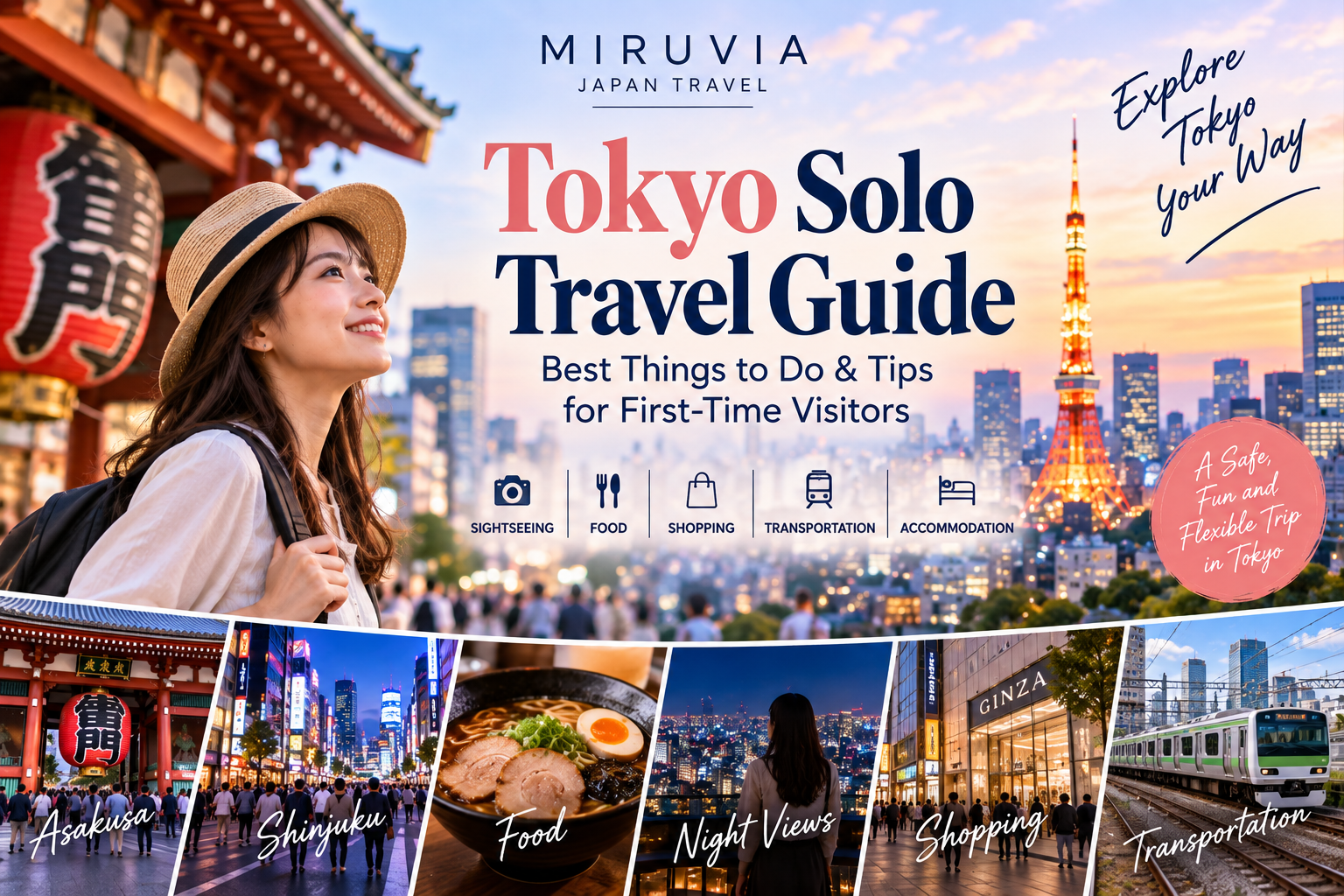
Traveling alone in Tokyo can feel intimidating at first.
Tokyo is enormous, the train network looks complicated, many signs and menus are unfamiliar, and the idea of navigating one of the world’s largest cities without a travel companion may seem overwhelming.
But Tokyo can also be an excellent destination for solo travelers.
Public transportation makes it easy to explore independently, many restaurants are comfortable for individual diners, and there are countless neighborhoods, museums, shops, cafés, observation decks, temples, and parks that you can enjoy at your own pace.
Traveling alone also gives you something especially valuable in Tokyo: flexibility.
You can spend an extra hour exploring a neighborhood you love, change your plans whenever you want, eat exactly where you want, and experience the city without having to coordinate with anyone else.
This Tokyo solo travel guide covers the best things to do alone, where to stay, how to eat alone, transportation, nighttime activities, safety, and practical tips for first-time solo visitors.
If you are still planning the overall structure of your trip, start with our Tokyo Travel Guide for First-Time Visitors for an overview of sightseeing, accommodation, food, transportation, and practical travel advice.
Tokyo Solo Travel at a Glance
| Topic | Recommendation | Why It Works for Solo Travelers |
|---|---|---|
| Best overall area | Shinjuku | Excellent transport & endless activities |
| Best for easy sightseeing | Ueno | Museums, parks & convenient transport |
| Best traditional area | Asakusa | Temples, local streets & relaxed atmosphere |
| Best for modern Tokyo | Shibuya | Shopping, views & entertainment |
| Best solo activity | Neighborhood exploration | Easy to enjoy at your own pace |
| Best solo meal | Ramen / sushi / casual Japanese food | Counter seating is common |
| Best evening activity | Observation deck or city walk | Easy to enjoy independently |
| Best transportation | Trains & subways | Extensive and efficient network |
Is Tokyo Good for Solo Travel?
Yes. Tokyo is particularly well suited to independent travel.
One reason is that many everyday experiences in Japan are already designed to work well for individuals.
Restaurants frequently have counter seating. Cafés are filled with people spending time alone. Trains make it possible to reach almost every major sightseeing district without joining a tour.
You also do not need a companion to enjoy many of Tokyo’s major attractions.
Temples, museums, observation decks, parks, shopping districts, food halls, anime stores, gardens, and neighborhood walks can all be enjoyed independently.
The biggest challenge is usually not finding things to do.
It is deciding what to prioritize in such a large city.
Best Things to Do Alone in Tokyo
Solo travel gives you complete control over your schedule, which works particularly well in a city with as much variety as Tokyo.
Here are some of the easiest experiences to enjoy independently.
For even more sightseeing ideas, see our guide to the best things to do in Tokyo for first-time visitors.
1. Explore Tokyo’s Neighborhoods on Foot
One of the best solo activities in Tokyo is simply choosing a neighborhood and exploring it without a strict schedule.
Tokyo’s districts have very different personalities.
You might spend the morning exploring traditional streets in Asakusa, walk through the fashionable neighborhoods around Harajuku in the afternoon, and experience Shinjuku’s neon streets after sunset.
Walking alone allows you to stop whenever something catches your attention.
You can enter a small shop, spend longer at a temple, take photographs, or sit in a café without worrying about another person’s schedule.
Good neighborhoods for solo exploration:
- Asakusa
- Ueno
- Shibuya
- Shinjuku
- Harajuku
- Ginza
- Yanaka
- Akihabara
Tip: Focus on one or two nearby neighborhoods at a time rather than constantly traveling across Tokyo.
2. Visit Senso-ji and Explore Asakusa
Asakusa is an excellent area for first-time solo travelers.
Senso-ji provides an introduction to traditional Tokyo, while the surrounding neighborhood contains shopping streets, restaurants, cafés, and smaller temples.
The area is straightforward to explore on foot, so you can spend several hours sightseeing without complicated transportation.
Visit early in the morning for a quieter atmosphere or stay into the evening to see the temple illuminated after many daytime visitors have left.
Best for:
- Traditional culture
- Photography
- Walking
- First-time visitors
Tip: Explore beyond Nakamise Shopping Street. The quieter side streets reveal a different side of Asakusa.
3. Visit a Museum at Your Own Pace
Museums are ideal solo-travel activities because you can move entirely at your own pace.
Ueno is one of the easiest areas for museum visits, with several major cultural institutions concentrated around Ueno Park.
Depending on your interests, you can spend a few hours learning about Japanese history, art, science, or culture.
Solo visits also make it easy to skip exhibits that do not interest you and spend more time with those that do.
Best for:
- Culture
- History
- Art
- Rainy days
Tip: Museums are useful backup activities when bad weather changes your original sightseeing plans.
4. See Tokyo from an Observation Deck
An observation deck is one of the easiest major attractions to enjoy alone.
Tokyo’s enormous skyline is impressive during the day, but the experience becomes especially memorable around sunset and after dark.
Shibuya, Shinjuku, and Roppongi all have popular places for panoramic city views.
Bring your camera, take your time, and enjoy seeing the scale of the city from above.
Best for:
- Photography
- City views
- Sunset
- Evening sightseeing
Tip: If possible, arrive before sunset so you can experience both daytime and nighttime views.
5. Explore Akihabara
If you enjoy anime, manga, video games, electronics, or Japanese pop culture, Akihabara is particularly easy to explore alone.
Large stores contain multiple floors of products, and you can spend as much or as little time as you want browsing each section.
Arcades and gaming centers are also easy to visit independently.
Even if you are not deeply interested in anime, the neighborhood’s colorful signs and unusual stores make it an interesting place for a walk.
Best for:
- Anime
- Manga
- Gaming
- Electronics
- Pop culture
Tip: Choose a few stores that genuinely interest you rather than trying to visit everything.
6. Spend Time in a Japanese Café
Solo café visits are completely normal in Tokyo.
This makes cafés useful not only for coffee and desserts but also as places to rest between sightseeing stops.
You can find traditional kissaten, modern specialty coffee shops, dessert cafés, bakery cafés, and major chains throughout the city.
For solo travelers, café time is also useful for reviewing your plans, checking transportation, charging your phone, or deciding what to do next.
Best for:
- Relaxation
- Coffee
- Desserts
- Flexible travel
Tip: Build occasional breaks into your itinerary. Tokyo often involves more walking than first-time visitors expect.
7. Go Shopping Without Rushing
Shopping is another activity that can actually become easier when traveling alone.
You can browse exactly the stores that interest you without compromising with a travel companion.
Shibuya and Harajuku are useful for fashion, Ginza for department stores and premium shopping, Akihabara for electronics and anime goods, and Tokyo Station for souvenirs and character merchandise.
Department stores are especially useful because shopping, restaurants, cafés, and food halls are available inside one building.
Best for:
- Fashion
- Souvenirs
- Electronics
- Japanese products
Tip: Leave some space in your luggage if shopping is an important part of your trip.
Eating Alone in Tokyo
Eating alone is one of the biggest concerns some first-time solo travelers have.
In Tokyo, it is usually much easier than expected.
Many restaurants regularly serve individual customers, particularly ramen shops, sushi restaurants, cafés, fast-casual restaurants, soba and udon shops, curry restaurants, and places with counter seating.
You do not need to avoid restaurants simply because you are traveling alone.
Best Foods for Solo Travelers
Some meals are particularly easy to enjoy independently:
- Ramen
- Sushi
- Soba
- Udon
- Japanese curry
- Tonkatsu
- Gyudon
- Tempura
- Yakitori
- Bento
Food halls and department store restaurant floors are also useful because they provide many choices in one location.
What If the Restaurant Has No English Menu?
Do not panic.
Many restaurants in major tourist areas have English menus, photos, digital ordering systems, or food models.
Translation apps can also help when English information is unavailable.
Pointing politely at a menu item is often enough in casual restaurants.
The most important thing is to remain patient and respectful.
Where to Stay in Tokyo for Solo Travelers
Choosing the right neighborhood can make a major difference when traveling alone.
For a first visit, prioritize transportation convenience and easy access to restaurants and sightseeing.
Shinjuku
Shinjuku is one of the most convenient choices for solo travelers who want excellent transportation and plenty to do.
Restaurants, shops, entertainment, and nightlife are available throughout the area.
The main disadvantage is that Shinjuku Station can be confusing during your first few days.
Ueno
Ueno is a strong option for travelers who prefer a slightly more relaxed base.
Museums, Ueno Park, Ameyoko, restaurants, and convenient transportation are nearby.
It can also work well for travelers interested in traditional eastern Tokyo.
Asakusa
Asakusa is ideal if you prefer traditional atmosphere over intense nightlife.
The neighborhood is pleasant for walking and offers easy access to Senso-ji and other attractions in eastern Tokyo.
Shibuya
Shibuya works well for travelers who want shopping, restaurants, nightlife, and modern Tokyo immediately outside their accommodation.
It is lively and convenient but can also be busy and relatively expensive.
Tokyo Station Area
Staying near Tokyo Station can be particularly convenient if you plan to use the Shinkansen or take several day trips.
The area also provides excellent access to restaurants, shopping, and other parts of central Tokyo.
Not sure which neighborhood fits your travel style? Compare our best areas to stay in Tokyo before choosing your accommodation.
Getting Around Tokyo Alone
Tokyo’s transportation system may look overwhelming, but it becomes much easier once you understand the basic pattern.
Most visitors rely on trains and subways.
Instead of trying to memorize the entire network, use a navigation app and focus only on the route needed for your next journey.
An IC card can also make transportation easier because you can tap in and out of most train and subway systems without buying individual tickets each time.
Station signs in major areas frequently include English.
For a complete explanation of trains, subways, IC cards, station navigation, and airport access, read our Tokyo Transportation Guide.
Solo Travel Tip: Save Important Locations
Before leaving your accommodation, save these locations on your phone:
- Your hotel
- The nearest station
- Your preferred station exit
- Major attractions for the day
- Restaurants you may want to try
This makes it much easier to recover if you take the wrong exit or become disoriented.
Exploring Tokyo Alone at Night
Tokyo is worth experiencing after sunset even when you are traveling alone.
Shibuya Crossing, Shinjuku’s illuminated streets, Asakusa’s temple area, Tokyo Station, and observation decks can all be enjoyable solo evening activities.
A relaxed dinner followed by a city walk or night view is often enough for a memorable evening.
You do not need to participate in nightlife or visit bars to enjoy Tokyo after dark.
Is Tokyo Safe for Solo Travelers?
Tokyo is generally considered a relatively safe major city, but travelers should still use normal precautions.
Keep track of your belongings, remain aware of your surroundings, and understand how you will return to your accommodation.
Entertainment districts may have street touts trying to attract visitors into bars or clubs.
Avoid following aggressive touts into unfamiliar establishments, particularly when prices and charges are unclear.
Late at night, remember that Tokyo’s trains and subways do not operate continuously.
Missing the final train can leave you dependent on a taxi or another late-night option.
Solo Female Travel in Tokyo
Many women travel independently in Tokyo, and the city’s transportation network and large number of solo-friendly restaurants and activities can make independent sightseeing practical.
However, the same general precautions used in other major cities remain important.
Stay aware of your surroundings, especially late at night.
Avoid poorly understood nightlife establishments, keep your accommodation information accessible, and plan your route back before staying out late.
Some commuter trains may offer women-only cars during specific rush-hour periods. Availability and operating times vary by railway company and route, so check current signage and information rather than assuming they are available on every train.
What to Do If You Get Lost
Getting lost in Tokyo is normal, even for experienced visitors.
Large stations can have many exits, underground passages, and connected buildings.
If you become confused:
- Stop and check your navigation app.
- Confirm the station name and exit number.
- Look for English station signs.
- Ask station staff for help.
- Avoid continuing to walk randomly if you are unsure of the direction.
Station staff are accustomed to helping passengers navigate the railway system.
Sample Solo Day in Tokyo
Here is a simple example of how a solo sightseeing day might work.
8:00 AM — Asakusa
Start early at Senso-ji before the largest crowds arrive.
Walk around the temple grounds and surrounding streets.
10:30 AM — Ueno
Travel to Ueno and explore Ueno Park or visit a museum.
1:00 PM — Solo Lunch
Choose a ramen, sushi, soba, or casual Japanese restaurant.
Counter seating makes lunch easy even during a solo trip.
2:30 PM — Akihabara
Spend the afternoon browsing anime stores, electronics shops, arcades, or cafés.
5:30 PM — Shibuya
Travel to Shibuya before sunset.
Explore the crossing and surrounding streets.
7:00 PM — Dinner
Have dinner around Shibuya or Shinjuku.
8:30 PM — Tokyo Night View
Finish the day at an observation deck or with a walk through one of Tokyo’s illuminated neighborhoods.
Because you are traveling alone, you can easily shorten, extend, or completely change the itinerary depending on your energy and interests.
How Many Days Do Solo Travelers Need in Tokyo?
For a first visit, around three to five full sightseeing days gives you enough time to experience several major areas without rushing constantly.
Three days can cover the highlights.
Five days allows more time for museums, shopping, neighborhood exploration, food experiences, and slower travel.
If you have a week or longer, you can also add day trips or explore less touristy neighborhoods.
Solo travelers have an advantage here because changing the schedule is easy.
Common Solo Travel Mistakes to Avoid
A few mistakes can make independent travel unnecessarily stressful.
Avoid:
- Planning too many neighborhoods in one day
- Staying far from convenient transportation just to save a small amount of money
- Forgetting to check the last train
- Carrying too much while sightseeing
- Depending on your phone without a portable charger
- Skipping meals because you feel uncomfortable eating alone
- Following street touts into unfamiliar venues
- Expecting every station exit to lead to the same place
- Filling every hour with scheduled activities
Leave some flexibility in your itinerary.
Tokyo often rewards spontaneous exploration.
Essential Solo Travel Tips for Tokyo
Keep these points in mind during your trip:
- Use an IC card for convenient transportation.
- Save your hotel and important locations on your phone.
- Carry a portable charger.
- Group nearby attractions together.
- Learn the station exit closest to your hotel.
- Do not be afraid to eat alone.
- Check the final train when going out at night.
- Keep some cash available.
- Use convenience stores when you need simple meals or travel essentials.
- Leave room in your schedule for unexpected discoveries.
Most importantly, do not treat solo travel as a disadvantage.
Tokyo is a city where independent exploration can work exceptionally well.
Final Thoughts
Tokyo can seem overwhelming before your first solo trip, but the city becomes much easier to understand once you begin exploring it one neighborhood at a time.
Efficient public transportation, solo-friendly restaurants, countless independent activities, and the freedom to change your plans make Tokyo a rewarding destination for traveling alone.
Start with a manageable itinerary, stay somewhere with convenient transportation, and do not try to see everything.
One of the greatest advantages of solo travel is being able to follow your own curiosity.
In Tokyo, there is always another street, restaurant, shop, temple, viewpoint, or neighborhood waiting to be discovered.
