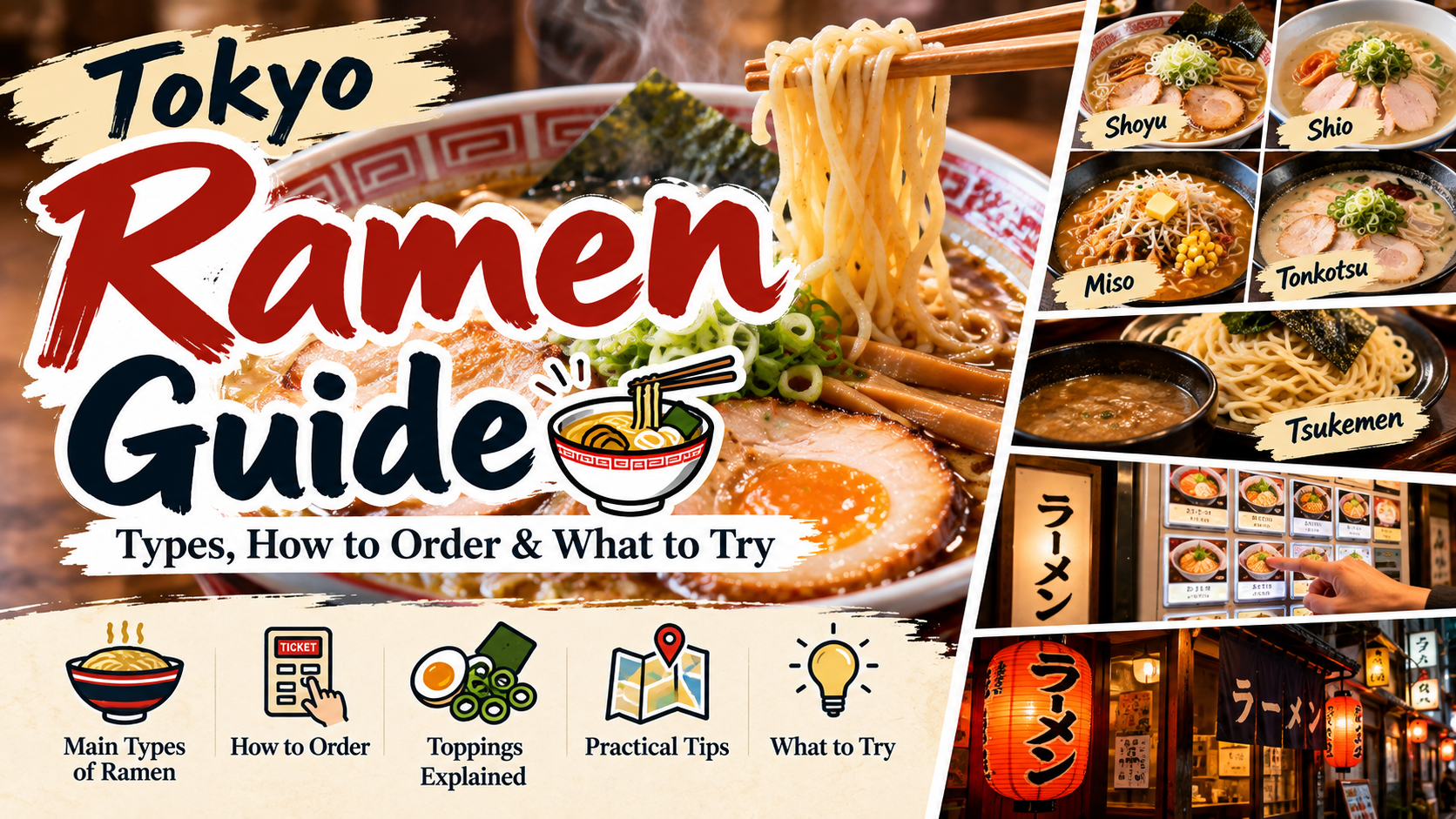
Ramen is one of the most popular foods to try in Tokyo.
For a broader introduction to Japanese food in the city, see our Tokyo Food Guide for First-Time Visitors.
But choosing a bowl can be more complicated than it first appears.
Shoyu, shio, miso, tonkotsu, tsukemen—the options can look confusing, especially if you are visiting Japan for the first time. Then there are ticket machines, different noodle choices, toppings, and small ramen shops where you may not immediately understand how ordering works.
The good news is that eating ramen in Tokyo is usually much easier once you understand a few basics.
Tokyo has an enormous variety of ramen, from light and delicate bowls to rich, intensely flavored styles. You can eat a quick bowl near a train station, search for a famous specialist shop, or simply walk into a neighborhood ramen restaurant that looks interesting.
This guide explains the main types of ramen, how to choose the right bowl, how to order, what common toppings mean, and practical tips for enjoying ramen in Tokyo.
Is Ramen Worth Trying in Tokyo?
Absolutely.
Ramen is affordable compared with many restaurant meals, widely available, and diverse enough that two ramen shops can provide completely different experiences.
It is particularly useful for travelers because ramen can work as:
- A quick lunch between sightseeing stops
- An inexpensive dinner
- A meal for solo travelers
- A late meal after a busy day
- An introduction to everyday Japanese food culture
- A reason to explore neighborhoods beyond major attractions
You also do not need to visit the most famous ramen shop in Tokyo to have a good experience.
Competition is intense, and many neighborhoods have excellent local options.
Miruvia’s Take
Do not approach Tokyo ramen by asking only:
“What is the best ramen shop?”
A more useful question is:
“What kind of ramen do I want to eat?”
Understanding the major styles first makes choosing a restaurant much easier.
Understanding the Main Types of Ramen
Ramen is not one single dish.
The broth, seasoning, noodles, oil, toppings, and preparation methods can vary considerably.
Here are some of the most useful categories for first-time visitors to understand.
Shoyu Ramen
Shoyu means soy sauce.
Shoyu ramen typically uses a soy-sauce-based seasoning that gives the soup a savory character and often a brown or amber appearance.
However, not every shoyu ramen tastes the same.
The underlying broth may use chicken, pork, seafood, vegetables, or combinations of ingredients.
What Does Shoyu Ramen Taste Like?
It can range from light and clean to rich and deeply savory.
Compared with heavier styles, many shoyu bowls allow individual ingredients in the broth to remain relatively easy to distinguish.
Who Should Try It?
Shoyu is an excellent starting point if:
- This is your first ramen experience
- You want a classic Japanese ramen style
- You prefer savory flavors without necessarily choosing the richest broth
- You are unsure what to order
Miruvia’s Take
If you have never eaten ramen in Japan and have no strong preference, shoyu is one of the safest places to begin.
Shio Ramen
Shio means salt.
Shio ramen often has a lighter-looking broth, although appearance alone does not determine how strong or rich it will taste.
Because the seasoning can be relatively delicate, the quality and character of the underlying broth often become particularly noticeable.
What Does Shio Ramen Taste Like?
Many bowls are clean, savory, and comparatively light.
Depending on the shop, chicken, seafood, or other ingredients may play an important role.
Who Should Try It?
Consider shio ramen if:
- You prefer lighter flavors
- You want to appreciate the broth itself
- Rich pork-based ramen sounds too heavy
- You want something relatively delicate
Miruvia’s Take
Shio is a strong option for travelers who want ramen but do not want their first bowl to feel extremely heavy.
Miso Ramen
Miso ramen uses miso as a major component of its seasoning.
It is particularly associated with Hokkaido and Sapporo, but excellent miso ramen can also be found throughout Tokyo.
What Does Miso Ramen Taste Like?
Miso usually creates a fuller, richer flavor than many lighter shoyu or shio styles.
Some bowls may include garlic, vegetables, chili, butter, corn, or other ingredients.
Who Should Try It?
Miso ramen is a good choice if:
- You enjoy bold flavors
- You want a warming meal
- You already like miso
- You prefer a fuller-bodied soup
It can be particularly satisfying during colder weather.
Tonkotsu Ramen
Tonkotsu refers to a broth made using pork bones.
It is strongly associated with Kyushu, particularly Hakata-style ramen, but tonkotsu shops are common in Tokyo.
What Does Tonkotsu Ramen Taste Like?
Tonkotsu is often rich, creamy, and strongly flavored.
Many Hakata-style bowls use relatively thin noodles.
Some restaurants also allow you to select noodle firmness.
Who Should Try It?
Choose tonkotsu if:
- You like rich food
- You want a creamy, pork-focused broth
- You prefer stronger flavors
- You want to try a famous regional ramen style while in Tokyo
Who Might Prefer Something Else?
If you dislike rich or fatty foods, shio or a lighter shoyu ramen may be a better starting point.
Tsukemen
Tsukemen is different from a conventional bowl of ramen.
Instead of noodles sitting inside the soup, the noodles and dipping broth are served separately.
You take some noodles, dip them into the concentrated broth, and eat them.
What Does Tsukemen Taste Like?
The dipping broth is often stronger and more concentrated than normal ramen soup.
The noodles may also be thicker and have a more noticeable texture.
Who Should Try It?
Tsukemen is worth trying if:
- Noodle texture is especially important to you
- You enjoy stronger dipping flavors
- You want something different from a standard ramen bowl
- You have already tried conventional ramen
Miruvia’s Take
For a first-ever ramen meal, a normal bowl of ramen may provide the most straightforward introduction.
After that, tsukemen is one of the best variations to explore.
Which Ramen Should First-Time Visitors Choose?
There is no universal answer, but this simple guide can help.
| If You Want… | Try… |
|---|---|
| A classic first bowl | Shoyu ramen |
| Something lighter | Shio ramen |
| Rich and savory flavors | Miso ramen |
| Creamy pork broth | Tonkotsu ramen |
| Thick noodles and strong dipping broth | Tsukemen |
If you still cannot decide, look at the restaurant’s specialty.
A shop known for one particular bowl is often a better place to start than trying to force your preferred style onto every restaurant.
Miruvia’s Take
Choose the restaurant first if it has a clear specialty.
Choose the ramen style first if you are simply walking around Tokyo and deciding between several nearby shops.
Both approaches work.
Common Ramen Toppings
Understanding a few common toppings makes menus much easier to read.
Chashu
Slices of cooked pork commonly served on ramen.
Preparation varies between restaurants, so chashu can range from leaner slices to very tender and fatty pieces.
Ajitama
A seasoned soft-boiled egg.
The yolk is often soft or jam-like.
If you enjoy eggs, this is one of the easiest additional toppings to recommend.
Menma
Seasoned bamboo shoots.
They add texture and a distinctive flavor to the bowl.
Nori
Dried seaweed.
Nori is common in many ramen styles and can absorb some of the broth as you eat.
Negi
Green onion.
It adds freshness and is one of the most common ramen toppings.
Extra Noodles
Some ramen styles and restaurants allow additional noodles.
In Hakata-style ramen, you may encounter the concept of kaedama, an extra serving of noodles added after you have eaten your first portion.
How to Order Ramen in Tokyo
Ordering procedures vary between restaurants, but several systems are common.
Ordering with a Ticket Machine
Many ramen shops use vending machines near the entrance.
The basic process is usually:
- Choose your ramen
- Select any toppings or side dishes
- Pay at the machine
- Take the ticket
- Give the ticket to staff or follow the restaurant’s instructions
- Sit where directed
Some modern machines provide English or other language options.
Older machines may have mostly Japanese text.
If you are unsure, photographs, translation apps, and staff assistance can help.
Before Using the Machine
Take a few seconds to decide what you want before standing directly in front of the machine during a busy period.
This is especially useful when people are waiting behind you.
Ordering Directly from Staff
Some restaurants use normal table or counter ordering instead.
In that case, look at the menu and order as you would in another restaurant.
Menus in tourist-heavy areas may include English or photographs, but this is not guaranteed everywhere.
Choosing Noodle Firmness
Some ramen shops—particularly those serving Hakata-style tonkotsu ramen—may ask how firm you want your noodles.
If you do not have a preference, choosing the standard recommendation is perfectly fine.
You do not need to customize every part of the meal simply because options are available.
Paying for Ramen
Payment procedures vary.
At ticket-machine restaurants, you normally pay before eating.
At other restaurants, you may pay after the meal.
Cashless payments are increasingly common in Tokyo, but payment options vary by business.
Carrying some cash remains useful, especially when visiting smaller restaurants.
What Happens When You Enter a Small Ramen Shop?
Small ramen shops can feel intimidating to first-time visitors because everything happens quickly.
In reality, the process is usually simple.
You may:
- Enter or join the queue
- Buy a meal ticket if required
- Wait until staff direct you to a seat
- Hand over your ticket
- Answer any customization questions
- Receive your ramen
- Eat
- Leave once you are finished
Many ramen restaurants are designed around relatively fast customer turnover.
You are not expected to treat the meal like a long café visit.
Ramen Shop Etiquette
You do not need to memorize complicated rules, but a few habits help.
Follow the Queue
Popular restaurants may have specific queuing procedures.
Look for signs and follow staff instructions.
Do not assume the end of a visible line is always the correct place if the restaurant has a special system.
Keep Your Group Together
Small restaurants may have limited counter seating.
Large groups can be difficult to seat together.
If staff ask your group to split between seats, being flexible can make the process easier.
Do Not Stay Long After Finishing
Ramen shops—especially small counter restaurants—often operate with quick turnover.
Once you have finished eating, it is generally better to leave rather than remain at the seat for a long conversation.
Follow Photography Rules
Food photography is commonly seen, but restaurant policies differ.
Avoid photographing staff or other customers without permission.
If signs prohibit photography, respect them.
Slurping Is Optional
You may hear people slurping noodles.
You do not have to do it.
Eat in whatever way is comfortable while remaining considerate of people around you.
How Much Does Ramen Cost in Tokyo?
Ramen is generally one of Tokyo’s more accessible restaurant meals.
Prices vary depending on the restaurant, location, ingredients, toppings, and whether you order side dishes.
A basic bowl is usually cheaper than a full meal at many sit-down restaurants, while premium ingredients or multiple toppings can raise the price.
Rather than choosing a restaurant based only on the cheapest price, compare:
- The standard bowl
- Extra toppings
- Side dishes
- Additional noodles
- Special or premium versions
A restaurant’s most expensive bowl may simply include several toppings that you do not actually need.
Miruvia’s Take
For your first visit to a ramen shop, the standard or signature bowl is often the smartest choice.
You can understand what the restaurant specializes in before adding multiple extras.
Do You Need to Visit Famous Ramen Shops?
No.
Tokyo has famous ramen restaurants, award-winning chefs, long queues, and shops that become popular through social media.
They can be excellent.
But they are not the only way to experience ramen.
A less-famous neighborhood shop can also provide a memorable meal.
This creates an important decision for travelers.
Choose a Famous Shop If:
- Ramen is one of the main reasons for your trip
- You enjoy researching restaurants
- You do not mind waiting
- A particular style or chef interests you
Choose a Convenient Local Shop If:
- You want ramen as part of a broader sightseeing day
- You dislike long queues
- You are hungry and already near a promising restaurant
- You want a more spontaneous experience
Miruvia’s Take
Do not spend two hours in line simply because you think famous ramen is the only ramen worth eating.
For most visitors, convenience, preferred ramen style, and waiting time should all influence the decision.
How Long Should You Wait for Ramen?
This depends on how important the restaurant is to you.
A short queue is easy to justify if the shop looks interesting.
A very long queue creates a larger tradeoff because sightseeing time in Tokyo is valuable.
Ask yourself:
“Am I here specifically for this ramen, or do I simply want good ramen?”
If the answer is the second, another nearby restaurant may be the better travel decision.
This becomes especially important on short itineraries.
Best Time to Eat Ramen in Tokyo
Lunch
Ramen is convenient for lunch because service can be relatively quick.
However, popular restaurants may develop queues around peak lunch hours.
Afternoon
Some restaurants close between lunch and dinner, so afternoon availability varies.
Check opening hours if you have a specific shop in mind.
Dinner
Ramen works well as a casual dinner, particularly after a long sightseeing day.
Again, popular shops may become busy.
Late Evening
Depending on the neighborhood, ramen can also work as a late meal.
Operating hours vary considerably, so check current information rather than assuming every ramen shop stays open late.
Miruvia’s Take
If a famous restaurant is important to you, plan around its hours.
If you simply want good ramen, remain flexible and fit it naturally into your sightseeing route.
Is Ramen Good for Solo Travelers?
Yes.
Ramen is one of the easiest meals to eat alone in Tokyo.
Many restaurants have counter seating, and solo dining is completely normal.
You do not need to wait until you have someone to eat with, and there is usually little expectation that you remain at the restaurant for a long time.
For solo travelers who feel uncomfortable entering restaurants alone, ramen shops can be a useful place to start.
Is Ramen Good for Families?
It can be, but restaurant layout matters.
Small counter-only shops may be inconvenient for families with young children or large groups.
Before joining a long queue, check whether the restaurant:
- Has table seating
- Can accommodate your group
- Allows young children
- Has enough space for your needs
Families may find larger ramen restaurants or chains easier than tiny specialist shops.
What About Vegetarian or Vegan Ramen?
Vegetarian and vegan ramen options exist in Tokyo, but you should not assume that a bowl without visible meat is vegetarian.
Broths and sauces may contain pork, chicken, fish, bonito, or other animal-derived ingredients.
Look specifically for restaurants or menu items identified as vegetarian or vegan.
If dietary restrictions are important, research suitable restaurants in advance rather than relying only on visual inspection of the menu.
For more plant-based dining advice, see our Tokyo Vegetarian & Vegan Guide.
What About Halal Ramen?
Halal-friendly and halal-certified ramen options can also be found in Tokyo.
However, ingredients and preparation methods vary between restaurants.
Travelers who require halal food should verify the restaurant’s current certification, ingredients, and preparation practices according to their own requirements.
Do not assume that simply removing pork toppings makes a ramen bowl halal.
Muslim travelers can find more restaurant and food-planning information in our Tokyo Halal Food Guide.
Ramen vs Sushi: Which Should You Prioritize?
Both are iconic Japanese foods, but they provide very different experiences.
| Ramen | Sushi | |
|---|---|---|
| Typical experience | Casual and fast | Ranges from casual to formal |
| Solo dining | Very easy | Easy at many restaurants |
| Budget | Generally accessible | Very wide price range |
| Main focus | Broth and noodles | Seafood and rice |
| Customization | Style, toppings, noodles | Fish, sets, individual pieces |
| Time needed | Often relatively short | Depends heavily on restaurant |
| Best for | Quick satisfying meals | Exploring seafood and sushi culture |
Choose Ramen If:
- You want a quick meal
- You enjoy noodles and soup
- You are traveling alone
- You want an affordable food experience
- You prefer a casual restaurant
Choose Sushi If:
- Seafood is a major interest
- You want to explore different fish
- Sushi is one of your priority Japanese food experiences
- You want anything from conveyor-belt dining to a more formal meal
Miruvia’s Take
There is little reason to choose only one if your Tokyo itinerary allows both.
Ramen and sushi represent very different parts of Japan’s food culture.
Try both, then decide which experience you personally prefer.
A Simple First-Time Ramen Strategy
If you feel overwhelmed by the number of choices in Tokyo, use this approach.
Step 1: Choose Your Preferred Flavor
Start with:
- Shoyu for classic and savory
- Shio for lighter flavors
- Miso for rich and bold
- Tonkotsu for creamy pork broth
- Tsukemen for dipping noodles
Step 2: Search Near Where You Already Are
You usually do not need to cross Tokyo solely for lunch unless a particular ramen shop is a priority.
Look around the neighborhood you are already exploring.
Step 3: Check the Specialty
If a restaurant clearly specializes in one bowl, consider ordering it.
Step 4: Check the Queue
Decide whether the waiting time makes sense for your schedule.
Step 5: Order the Standard Bowl
For your first visit, start with the restaurant’s standard or signature ramen rather than adding every available topping.
Step 6: Try Another Style Later
If you enjoyed your first bowl, choose a different style on another day.
Tokyo is one of the easiest places to compare several types during the same trip.
Practical Tips for Eating Ramen in Tokyo
Carry Some Cash
Payment methods vary, particularly at older ticket machines and smaller restaurants.
Use a Translation App
It can help with ticket machines, menus, and unfamiliar toppings.
Look at Photos Before Ordering
Menu photos can make unfamiliar ramen styles easier to understand.
Do Not Over-Order
A bowl of ramen can be more filling than expected.
You can always try another restaurant later in the trip.
Check Opening Hours
Independent restaurants may close between meal periods or have irregular days off.
Consider the Queue
A famous shop is not automatically the best use of limited sightseeing time.
Try More Than One Style
If ramen interests you, comparing different bowls is more useful than repeatedly ordering the same style.
Frequently Asked Questions
What ramen should I try first in Tokyo?
Shoyu ramen is a good starting point for many first-time visitors because it represents a classic savory style. If you prefer lighter flavors, consider shio. If you enjoy richer food, miso or tonkotsu may suit you better.
What is the difference between ramen and tsukemen?
Ramen normally serves noodles inside the soup. Tsukemen serves the noodles separately from a concentrated dipping broth.
Do ramen shops in Tokyo have English menus?
Some do, especially in areas frequently visited by international travelers, but not every restaurant does. Ticket machines may also offer multiple languages. A translation app can help when English is unavailable.
Can I eat ramen alone in Tokyo?
Yes. Solo dining is common at ramen restaurants, and many shops have counter seating.
Do I need cash at ramen shops?
Not always, but carrying cash is useful because payment methods vary between restaurants and ticket machines.
Is slurping ramen required in Japan?
No. Slurping is common and acceptable, but it is not mandatory.
Is ramen expensive in Tokyo?
Ramen is generally one of the more accessible restaurant meals in Tokyo, although premium ingredients, extra toppings, and side dishes can increase the total price.
Can vegetarians eat ramen in Tokyo?
Yes, but choose ramen specifically identified as vegetarian or vegan. A meat-free appearance does not guarantee that the broth or seasoning contains no animal ingredients.
Can Muslim travelers find halal ramen in Tokyo?
Yes, halal-friendly options exist, but travelers should verify current certification and preparation practices if strict halal requirements apply.
Final Thoughts
Tokyo is one of the best places to discover how diverse ramen can be.
You do not need to understand every regional style, memorize Japanese terminology, or wait in the city’s longest ramen queue.
Start with the basics.
Choose between lighter or richer flavors.
Learn the difference between shoyu, shio, miso, tonkotsu, and tsukemen.
Understand how ticket machines work.
Then walk into a ramen shop and try a bowl.
Your first ramen does not need to be the “best ramen in Tokyo.”
It only needs to help you discover what you like.
Once you know that, your second bowl becomes much easier to choose.
And in Tokyo, there is always another ramen shop waiting.
