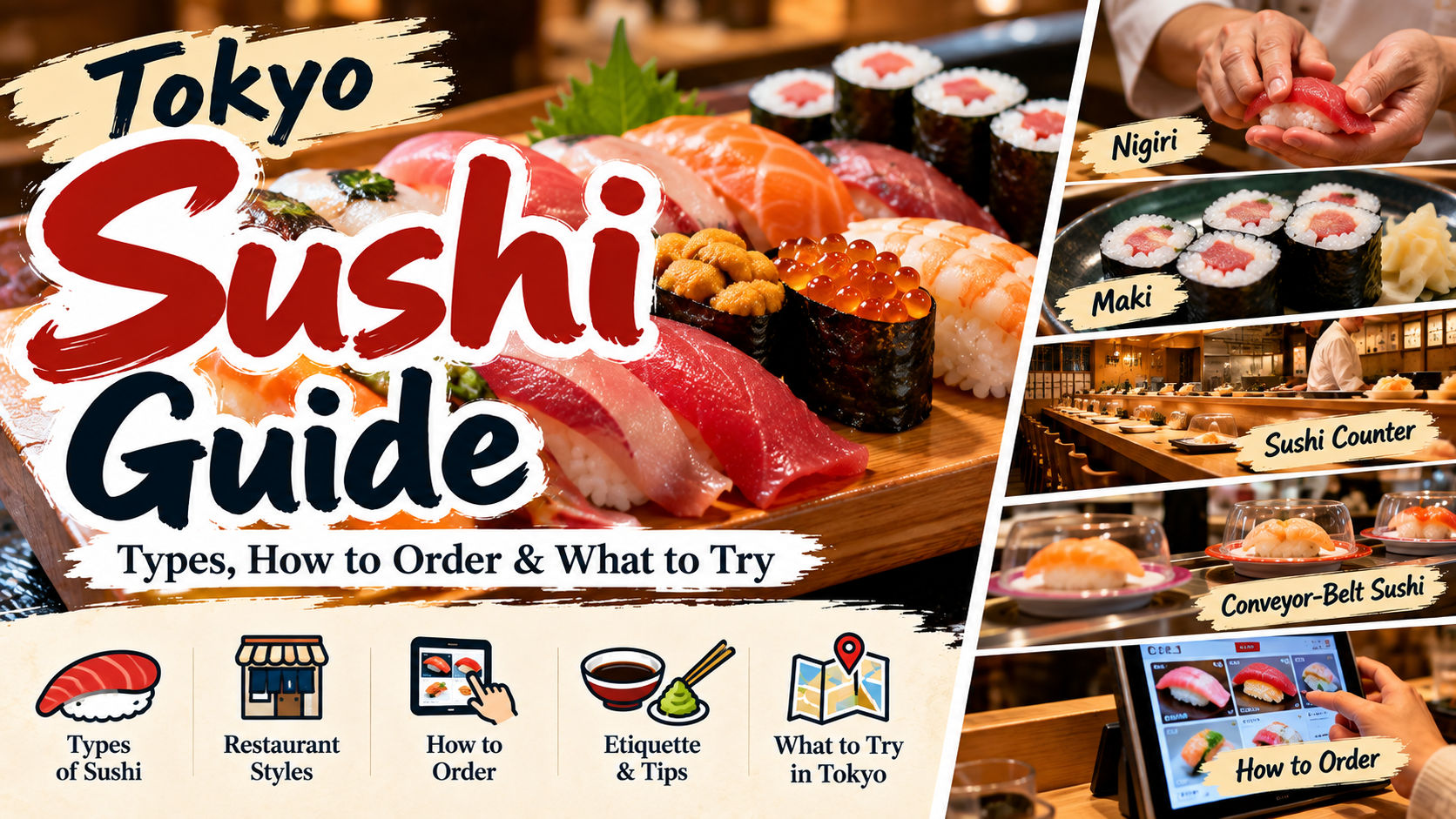
Sushi is one of the foods many travelers look forward to most when visiting Tokyo.
But ordering sushi in Japan can feel more complicated than expected. Should you visit a conveyor-belt sushi restaurant or sit at a traditional counter? What is the difference between nigiri and maki? How much should you order? And what are you supposed to do with the soy sauce and wasabi?
The good news is that you do not need to be a sushi expert to enjoy an excellent meal in Tokyo.
This guide explains the main types of sushi, different restaurant styles, how to order, basic etiquette, and how first-time visitors can choose the right sushi experience.
For a broader introduction to eating in the city, see our Tokyo Food Guide for First-Time Visitors.
Is Sushi Worth Trying in Tokyo?
For most food-loving travelers, yes.
Tokyo offers an enormous range of sushi experiences, from casual conveyor-belt restaurants to small counter-style establishments where sushi is prepared directly in front of you.
That variety makes sushi suitable for many different types of travelers.
You can choose sushi when you want:
- a quick and casual meal
- an interactive Japanese dining experience
- fresh seafood
- a special dinner
- an easy way to sample several different ingredients
However, the best sushi experience depends heavily on what you actually want from the meal.
Miruvia’s Take
Do not begin by asking, “What is the best sushi restaurant in Tokyo?”
First decide what kind of sushi experience you want.
A first-time visitor who wants an easy lunch has very different needs from someone looking for a quiet counter experience or a special dinner.
Choosing the restaurant style first usually makes the decision much easier.
Understanding the Main Types of Sushi
The word “sushi” covers several different styles.
You do not need to memorize Japanese terminology, but understanding a few basic types will make menus much easier to navigate.
Nigiri
Nigiri is one of the most recognizable forms of sushi.
It usually consists of a small portion of vinegared rice topped with seafood or another ingredient.
Common toppings include:
- tuna
- salmon
- shrimp
- squid
- eel
- white fish
- shellfish
Some restaurants may apply sauce, seasoning, or wasabi before serving the sushi.
Who Should Try Nigiri?
Nigiri is an excellent choice if you want to focus on the flavor and texture of individual seafood ingredients.
It is also one of the easiest ways to compare different types of fish during the same meal.
Miruvia’s Take
If this is your first sushi meal in Japan, trying several different pieces of nigiri is one of the simplest ways to discover what you actually like.
Do not feel that you need to recognize every fish before ordering.
Maki
Maki refers to rolled sushi.
Rice and fillings are usually wrapped with nori seaweed and sliced into smaller pieces.
Fillings vary widely and may include seafood, vegetables, pickles, or combinations of ingredients.
Maki can be particularly approachable for travelers who are still getting used to raw seafood.
Gunkan
Gunkan sushi uses a small mound of rice wrapped around the sides with nori.
The shape creates a small space on top for ingredients that would be difficult to place directly on rice.
Common examples may include fish roe or finely chopped seafood.
You may see gunkan frequently at conveyor-belt sushi restaurants.
Temaki
Temaki is hand-rolled sushi.
It is usually shaped like a cone, with nori wrapped around rice and fillings.
Unlike small pieces of nigiri, temaki is normally held in the hand and eaten directly.
Sashimi vs Sushi
Sashimi and sushi are not the same thing.
Sashimi generally refers to slices of raw seafood served without sushi rice.
Sushi normally includes vinegared rice.
If your main goal is to taste seafood itself, sashimi can be an excellent option.
If you want the combination of seafood and seasoned rice, choose sushi.
Conveyor-Belt Sushi vs Counter Sushi
One of the most useful decisions you can make before choosing a restaurant is whether you want a casual conveyor-belt experience or a more traditional counter-style meal.
| Experience | Conveyor-Belt Sushi | Counter Sushi |
|---|---|---|
| Atmosphere | Casual | Often quieter and more focused |
| Ordering | Usually simple | May involve direct interaction |
| Time needed | Often shorter | Often longer |
| Beginner-friendly | Very high | Depends on the restaurant |
| Flexibility | High | May follow a set course |
| Best for | Easy meals and sampling | Focused sushi experience |
Neither style is automatically better.
They simply serve different purposes.
Conveyor-Belt Sushi
Conveyor-belt sushi is often one of the easiest introductions to sushi in Tokyo.
Depending on the restaurant, dishes may travel around the dining area on a conveyor belt, or customers may order using a touchscreen and receive dishes directly at their seats.
This format allows you to order gradually instead of deciding on your entire meal at once.
Why First-Time Visitors May Like It
Conveyor-belt sushi can be useful because you can:
- see individual dishes before eating
- order small amounts
- try unfamiliar ingredients
- control how much you spend
- add more food whenever you want
Some modern restaurants also provide multilingual touchscreen menus.
Miruvia’s Take
If you feel nervous about ordering sushi in Japan, start with conveyor-belt sushi.
It removes much of the pressure and lets you learn what you enjoy before trying a more traditional sushi counter.
Counter Sushi
Counter-style sushi offers a different experience.
Guests sit near the sushi chef, and pieces may be prepared individually and served directly in front of them.
Some restaurants allow individual ordering, while others focus on set menus or chef-selected courses.
The experience can range from relatively casual to highly formal.
What Is Omakase?
Omakase essentially means leaving the selection to the chef.
Instead of choosing every piece yourself, you receive a sequence selected by the chef based on the restaurant’s style and available ingredients.
Omakase can be memorable, but it is not automatically the best choice for every traveler.
Omakase May Be Good for You If:
- you enjoy trying unfamiliar seafood
- you want a structured dining experience
- you are comfortable letting the chef choose
- sushi is an important part of your Tokyo trip
You May Prefer Something Else If:
- you are a very selective eater
- you want complete control over what you order
- you have significant dietary restrictions
- you want a quick meal
- you mainly want familiar sushi
Miruvia’s Take
Do not book omakase simply because it sounds like the most “authentic” option.
A casual sushi restaurant can be a better first experience if you want flexibility.
Save omakase for when the dining experience itself is one of the main activities of your day.
What Sushi Should First-Time Visitors Try?
There is no single correct list.
However, sampling several different textures and flavors is more useful than ordering many pieces of the same ingredient.
A simple first meal might include a combination such as:
- tuna
- salmon
- shrimp
- white fish
- squid
- eel
- a maki roll
Availability and preparation vary by restaurant.
Miruvia’s Take
Start with ingredients you recognize, then add one or two unfamiliar pieces.
This gives you a comfortable starting point without turning the meal into something completely predictable.
Understanding Tuna Sushi
Tuna appears frequently on sushi menus and may be offered in several forms.
Different cuts can have noticeably different textures and levels of richness.
You may encounter leaner tuna as well as fattier cuts.
If you enjoy tuna, comparing different cuts during the same meal can be an easy way to understand how much variation exists within one type of fish.
Raw vs Cooked Sushi
Not all sushi involves raw seafood.
Depending on the restaurant, you may find ingredients such as:
- cooked shrimp
- eel
- egg
- seared seafood
- vegetables
- other cooked toppings
This means travelers who are uncomfortable with completely raw seafood can still enjoy sushi.
How to Order Sushi in Tokyo
Ordering depends on the restaurant.
Common systems include:
- touchscreen ordering
- paper menus
- ordering directly from staff
- ordering directly from the sushi chef
- set menus
- chef-selected courses
Before sitting down, take a moment to understand the restaurant’s system.
Ordering at Conveyor-Belt Sushi Restaurants
Modern conveyor-belt restaurants often use touchscreen ordering.
A typical process may look like this:
- Take your seat.
- Change the screen language if available.
- Browse the menu.
- Select individual sushi dishes.
- Confirm your order.
- Wait for the sushi to arrive.
- Continue ordering until you are satisfied.
- Follow the restaurant’s checkout procedure.
The exact process differs between restaurants, so follow the instructions displayed at your seat.
Ordering at a Sushi Counter
At a counter, ordering may be more direct.
If individual ordering is available, you can request pieces as you go.
You do not need to order everything immediately.
If the restaurant offers a set course, however, the sequence may already be determined.
Useful Strategy for Beginners
If you are unsure, begin with a small number of pieces.
You can usually order more afterward when individual ordering is available.
How Much Sushi Should You Order?
There is no universal number because sushi pieces and appetites vary.
Instead of worrying about a specific quantity, order gradually when the restaurant format allows it.
This is especially useful at casual sushi restaurants.
Miruvia’s Take
For your first sushi meal, variety is usually more valuable than volume.
Try several types first.
If you discover a favorite, order another piece later.
How to Use Soy Sauce
Soy sauce is commonly available with sushi, but you do not need to heavily soak every piece.
Some sushi may already be seasoned by the chef.
At casual restaurants, you can use a small amount of soy sauce according to your preference.
The goal is to complement the sushi rather than overwhelm its flavor.
What About Wasabi?
Wasabi may already be placed between the topping and rice at some restaurants.
Other restaurants may serve sushi without wasabi or allow customers to adjust it themselves.
If you do not like wasabi, look for options to order without it or ask staff when possible.
There is no reason to force yourself to eat more wasabi than you enjoy.
Can You Eat Sushi with Your Hands?
Depending on the setting and type of sushi, eating certain sushi with your hands can be acceptable.
Chopsticks are also commonly used.
For most travelers, there is no need to become overly anxious about choosing between the two.
Use the method that allows you to eat comfortably and neatly.
Sushi Etiquette for Travelers
Sushi restaurants vary from casual chains to small traditional counters.
The appropriate atmosphere therefore depends on where you are eating.
A few simple habits work well almost everywhere.
Avoid Strong Perfume
At small sushi counters, strong fragrances can interfere with the dining experience because sushi often has delicate aromas.
Using little or no strong perfume is considerate.
Do Not Overuse Soy Sauce
Using excessive soy sauce can overpower the sushi and create unnecessary mess.
Start with less.
Follow the Pace of the Restaurant
At a casual restaurant, you can usually eat at your own speed.
At a structured counter meal, pieces may be served in sequence.
Pay attention to how the restaurant operates.
Ask Before Extensive Photography
Taking a quick photo may be acceptable in many places, but rules vary.
This is especially important at small counters.
If you are unsure, ask before photographing chefs, other customers, or the restaurant extensively.
Do Not Worry About Being Perfect
Most travelers do not need to memorize a complicated list of sushi rules.
Be polite, observe the restaurant, and follow staff instructions.
That matters more than trying to perform every traditional custom perfectly.
How Much Does Sushi Cost in Tokyo?
Sushi can fit very different travel budgets.
A casual sushi meal and a chef-led counter experience are fundamentally different products, so comparing them only by price is not very useful.
Your total cost can depend on:
- restaurant style
- seafood selection
- number of pieces
- set menu versus individual ordering
- lunch versus dinner
- whether you choose a premium course
Miruvia’s Take
Choose your sushi budget before choosing the restaurant.
If you simply want to experience sushi in Tokyo, you do not need the most expensive option.
If sushi is one of the highlights of your trip, allocating more time and budget to a dedicated counter experience may make sense.
Do You Need to Visit a Famous Sushi Restaurant?
No.
Famous restaurants can be attractive, but popularity also brings disadvantages.
You may encounter:
- difficult reservations
- long waits
- less flexibility
- higher expectations
- a meal that takes more planning
Tokyo has many places to eat sushi.
A restaurant that fits your schedule, budget, and preferred dining style may give you a better experience than chasing a famous name simply because it appears on social media.
Miruvia’s Take
Choose the experience first and the restaurant second.
This is one of the most useful principles for eating sushi in Tokyo.
Should You Reserve a Sushi Restaurant?
It depends on the restaurant.
Casual sushi restaurants may not require advance reservations, while small counters and more specialized restaurants can have limited seating.
If you have a specific restaurant that is essential to your trip, check its reservation policy before your travel date.
If you mainly want a casual sushi meal, keeping your plans flexible can be easier.
Best Time to Eat Sushi in Tokyo
The best time depends on the experience you want.
Lunch
Lunch can work well if you want sushi without making it the main event of your evening.
It can also fit naturally into a sightseeing day.
Dinner
Dinner is better when sushi itself is one of the major experiences of the day.
A longer counter meal can work particularly well here.
Off-Peak Hours
If the restaurant remains open between traditional meal periods, visiting outside peak times may provide a more relaxed experience.
However, opening hours vary considerably.
Always check the restaurant you plan to visit.
Is Sushi Good for Solo Travelers?
Yes.
Sushi can be particularly convenient for solo travelers.
Counter seating naturally accommodates individual diners, while casual sushi restaurants allow you to control the amount and pace of your meal.
You also do not need a large group to sample several different types of sushi.
Is Sushi Good for Families?
It can be, but restaurant selection matters.
Casual sushi restaurants are generally easier for families than small, formal counters.
Families may benefit from restaurants with:
- table seating
- touchscreen ordering
- cooked options
- flexible ordering
- a relaxed atmosphere
If traveling with young children, check restaurant policies and seating arrangements beforehand.
What About Vegetarian or Vegan Sushi?
Vegetarian sushi options exist, but traditional sushi restaurants are usually centered around seafood.
Possible plant-based ingredients can include vegetables, pickles, tofu-related items, or other non-seafood toppings.
However, sauces, seasonings, and preparation methods may contain ingredients that are not obvious.
Travelers following a strict vegetarian or vegan diet should confirm ingredients rather than assuming that vegetable-looking sushi is automatically suitable.
For more plant-based dining advice, see our Tokyo Vegetarian & Vegan Guide.
What About Halal Sushi?
Seafood itself may fit many Muslim travelers’ dietary requirements, but sushi restaurants can still use ingredients that require attention.
Seasonings, sauces, cooking ingredients, or other menu items may contain alcohol-derived or non-halal components.
Requirements also differ between individuals.
If strict halal compliance is important to you, confirm the restaurant’s ingredients and preparation policies directly.
Muslim travelers can find more detailed dining guidance in our Tokyo Halal Food Guide.
Sushi vs Ramen: Which Should You Prioritize?
Many first-time visitors want to try both.
They provide very different experiences.
| If You Want… | Consider |
|---|---|
| Seafood and subtle flavors | Sushi |
| Hot, filling comfort food | Ramen |
| A meal with many small tastes | Sushi |
| A single hearty bowl | Ramen |
| A possible chef-led experience | Sushi |
| A quick solo meal | Ramen or casual sushi |
| Easy ingredient comparison | Sushi |
| Strong broth and noodle flavors | Ramen |
Choose Sushi If:
- seafood is a major reason you want to eat in Japan
- you enjoy sampling multiple ingredients
- you want a meal that can range from casual to highly specialized
- you are interested in the dining experience itself
Choose Ramen If:
- you want something hot and filling
- you prefer noodles to raw seafood
- you want a relatively straightforward solo meal
- you enjoy strong broth-based flavors
Miruvia’s Take
Do not choose between them if your itinerary has room for both.
They represent completely different sides of Tokyo’s food culture.
Use ramen for one meal and sushi for another rather than treating them as substitutes.
If ramen is also on your list, see our Tokyo Ramen Guide for ramen types, ordering tips and what to try.
A Simple First-Time Sushi Strategy
If you are still unsure where to begin, use this approach.
Step 1: Choose Your Restaurant Style
Decide between:
- casual conveyor-belt sushi
- standard sushi restaurant
- dedicated counter experience
Step 2: Decide Your Budget
Know whether you want a convenient everyday meal or a major dining experience.
Step 3: Start with Familiar Ingredients
Choose two or three pieces you already recognize.
Step 4: Add Something New
Try one or two unfamiliar fish or sushi styles.
Step 5: Order Gradually
If the restaurant allows individual ordering, do not order everything immediately.
Step 6: Remember What You Liked
Knowing whether you prefer lean fish, fatty tuna, shellfish, eel, or rolls makes your next sushi meal much easier.
Practical Tips for Eating Sushi in Tokyo
Before your meal:
- check whether reservations are needed
- confirm the restaurant’s ordering style
- check dietary restrictions if necessary
- avoid strong fragrances for small counter restaurants
- do not assume every restaurant has extensive English support
During your meal:
- observe how the restaurant works
- start with a small order if possible
- use soy sauce moderately
- ask before extensive photography
- keep an open mind about unfamiliar seafood
After your meal:
- follow the restaurant’s payment process
- do not stay unnecessarily long at a small counter after finishing
- remember which sushi you enjoyed for your next meal
Frequently Asked Questions
Do I need to know Japanese to eat sushi in Tokyo?
Not necessarily.
Many casual restaurants use visual menus or touchscreen ordering systems, and some provide multiple languages.
Smaller restaurants may have less English support, but basic communication and polite observation can go a long way.
Is all sushi raw?
No.
Sushi can include raw seafood, cooked seafood, egg, vegetables, eel, seared ingredients, and other toppings.
Is conveyor-belt sushi worth trying?
Yes, particularly for first-time visitors who want a casual and flexible introduction to sushi.
It allows you to try different dishes without committing to a formal meal.
Do I need to eat expensive sushi in Tokyo?
No.
Tokyo offers sushi at many different levels.
The right choice depends on whether you want a convenient meal or a dedicated dining experience.
Should I book omakase?
Book omakase if you specifically want a chef-led meal and are comfortable giving up some control over the selection.
It is not a requirement for enjoying sushi in Tokyo.
Can I eat sushi if I do not like raw fish?
Yes.
Look for cooked seafood, eel, egg, vegetable sushi, seared items, or other cooked options.
The selection depends on the restaurant.
Can I eat sushi alone?
Yes.
Sushi is one of the easier Japanese dining experiences for solo travelers, particularly at counters and casual restaurants.
Final Thoughts
Eating sushi in Tokyo does not need to be intimidating.
You do not need to understand every fish, memorize complicated etiquette, or reserve an expensive restaurant to have a memorable experience.
Start by deciding what kind of meal you want.
Choose casual conveyor-belt sushi if you value flexibility and easy ordering. Choose a counter restaurant when you want a more focused experience. Consider omakase when the meal itself is one of the highlights of your trip.
Most importantly, try more than one thing.
Sushi is not a single flavor or experience. Different seafood, preparation styles, restaurant formats, and price levels can make two sushi meals feel completely different.
Your first sushi meal in Tokyo does not need to be perfect.
It only needs to make you curious about the next piece.
