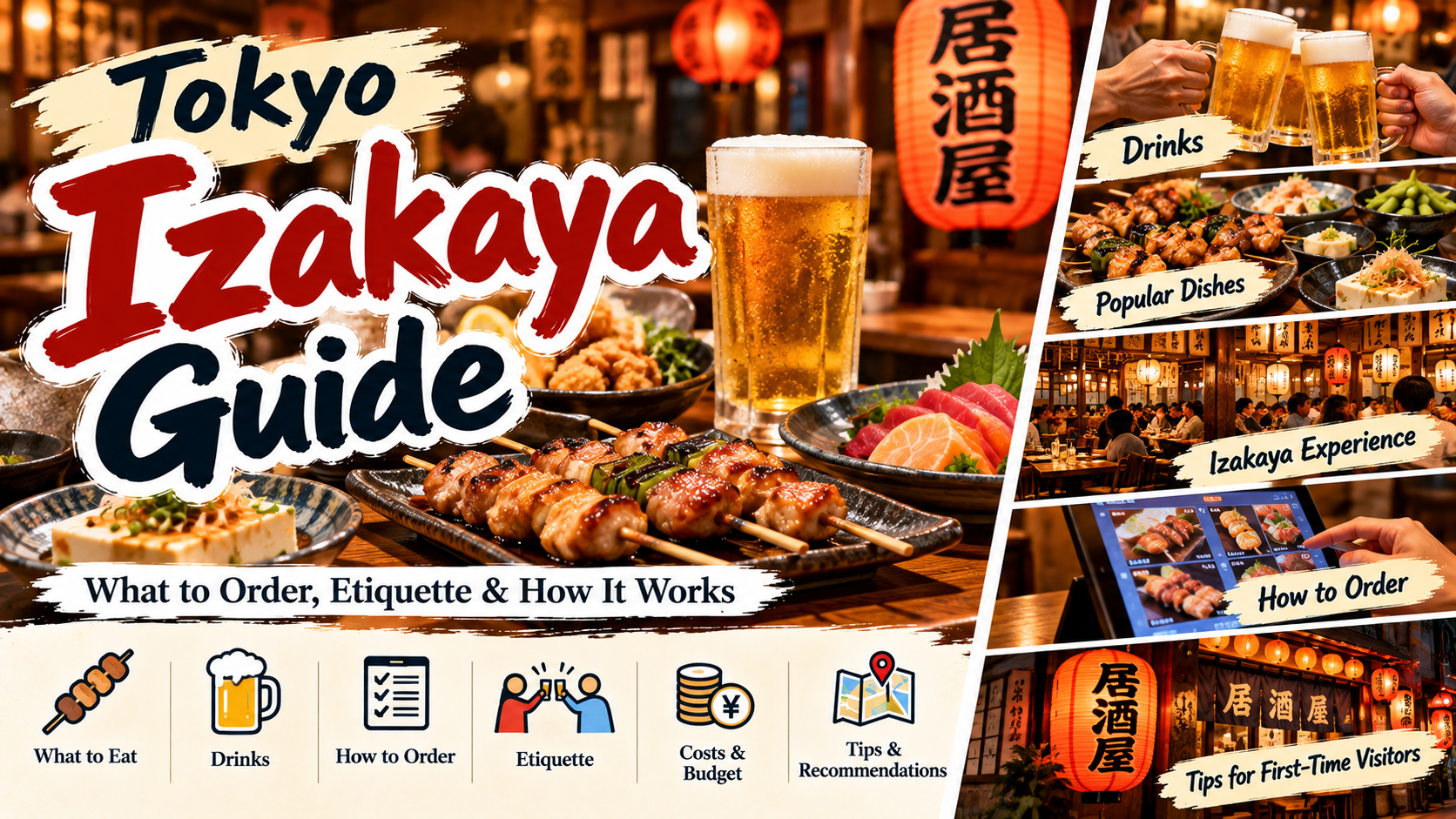
An izakaya is one of the most enjoyable ways to experience everyday Japanese food culture in Tokyo.
But for first-time visitors, walking into an izakaya can also feel confusing.
What exactly is an izakaya? Do you need to order alcohol? What is the small dish that sometimes appears before you order? Are you supposed to share the food? And how do you know when you have ordered enough?
The experience becomes much easier once you understand a few basic rules.
This guide explains how izakaya work in Tokyo, what to order, common drinks and dishes, etiquette, costs, and practical tips for enjoying your first izakaya experience.
For a broader introduction to eating in the city, see our Tokyo Food Guide for First-Time Visitors.
What Is an Izakaya?
An izakaya is a Japanese-style drinking and dining establishment where people typically enjoy drinks together with a variety of small dishes.
It is sometimes compared with a pub or tapas bar, but neither comparison is exact.
The important difference for travelers is that an izakaya is usually not just about drinking.
Food is a major part of the experience.
Depending on the restaurant, you may find:
- sashimi
- grilled meat
- grilled fish
- yakitori
- fried dishes
- tofu
- vegetables
- dumplings
- rice dishes
- noodles
- desserts
This makes an izakaya particularly useful when you want to try several Japanese dishes during one meal.
Miruvia’s Take
Think of an izakaya as an experience rather than a specific type of cuisine.
Instead of ordering one main dish for yourself, the fun often comes from ordering several different dishes and trying them gradually.
Is an Izakaya Worth Visiting in Tokyo?
For many travelers, yes.
An izakaya can show you a more social and casual side of Japanese dining than restaurants focused on a single specialty such as ramen or sushi.
It can be particularly enjoyable if you want:
- several dishes instead of one main meal
- a relaxed evening meal
- Japanese drinks
- food to share with friends
- an introduction to different Japanese flavors
- a lively local atmosphere
However, izakaya vary enormously.
Some are large chains with touchscreen menus, while others are tiny neighborhood establishments with only a few seats.
Choosing the right style can make a major difference for first-time visitors.
What Happens When You Enter an Izakaya?
The exact process varies, but a typical experience may look like this:
- Enter the restaurant.
- Tell the staff how many people are in your group.
- Wait to be shown to your seat.
- Receive menus or use a touchscreen or QR ordering system.
- Order drinks.
- Order several food dishes.
- Add more food or drinks during the meal.
- Ask for the bill or follow the restaurant’s checkout system.
- Pay according to the restaurant’s instructions.
You do not usually need to order your entire meal immediately.
One of the advantages of izakaya dining is that you can add dishes as the evening continues.
What Is Otoshi?
One of the biggest surprises for first-time visitors can be otoshi.
At many izakaya, a small appetizer may be served automatically after you sit down.
You may not have ordered it.
The dish is often connected with a small seating or table charge.
The exact system varies by restaurant.
For travelers unfamiliar with this custom, it can look like an unwanted dish has been added to the bill.
Miruvia’s Take
Do not automatically assume that an unexpected small appetizer is a mistake.
If a small dish arrives shortly after you sit down, it may be the restaurant’s otoshi system.
Understanding this before your first izakaya visit prevents unnecessary confusion when you receive the bill.
Do You Have to Drink Alcohol at an Izakaya?
Not necessarily.
Although drinking is traditionally an important part of izakaya culture, many establishments offer non-alcoholic drinks.
Depending on the restaurant, these may include:
- tea
- soft drinks
- juice
- non-alcoholic beer
- other alcohol-free beverages
You can still enjoy izakaya food without making alcohol the focus of your meal.
However, policies and expectations vary between establishments, especially at very small or specialized drinking-focused venues.
Common Drinks at an Izakaya
If you do drink alcohol, izakaya menus often offer several categories.
Beer
Beer is one of the most straightforward choices.
It is commonly ordered at the beginning of a meal and pairs easily with fried foods, grilled dishes, and salty snacks.
Highball
A highball generally combines whisky with soda water.
It is a popular izakaya-style drink because it is refreshing and works with many types of food.
Sour and Chuhai-Style Drinks
You may see drinks flavored with lemon, grapefruit, or other fruits.
Names and recipes vary between establishments.
If you prefer something lighter or fruitier than straight spirits, these can be approachable choices.
Sake
Sake may be served in different styles and temperatures depending on the restaurant and product.
If you are unfamiliar with sake, asking staff for a recommendation can be easier than trying to understand an extensive list.
Shochu
Shochu is a Japanese distilled spirit.
It can be served in several ways, including with water, soda, or on the rocks.
Its flavor depends partly on the ingredients used to produce it.
What Food Should You Order at an Izakaya?
There is no single correct izakaya meal.
The best approach is usually to combine dishes with different flavors, textures, and cooking styles.
Instead of ordering five similar dishes, create variety.
A simple first meal might include:
- one raw or fresh dish
- one grilled dish
- one fried dish
- one vegetable dish
- one filling dish toward the end
This gives you a broader experience without requiring detailed knowledge of Japanese cuisine.
Sashimi
Some izakaya serve sashimi or other seafood dishes.
This can be a useful option if you want seafood but do not necessarily want a dedicated sushi meal.
Selections depend heavily on the restaurant.
Yakitori
Yakitori generally refers to grilled chicken served on skewers.
Different parts of the chicken may be available, and seasoning often varies between salt-based and sauce-based preparations.
Yakitori is particularly easy to share and works well as part of a larger izakaya meal.
Miruvia’s Take
If you are overwhelmed by a large izakaya menu, yakitori is often an approachable place to begin.
Order a few different skewers rather than immediately trying to decode every item on the menu.
Karaage
Karaage is Japanese-style fried chicken and is a common casual dish.
It is generally easy to share and can be a comfortable choice for travelers who want something familiar alongside more adventurous dishes.
Edamame
Edamame are young soybeans commonly served as a simple snack or side dish.
They are especially useful while waiting for other dishes to arrive.
Grilled Fish
Depending on the izakaya, grilled fish can be an important part of the menu.
The type of fish may vary by season and availability.
This is a good choice if you want to experience a more traditional Japanese meal alongside drinks.
Gyoza
Some izakaya offer gyoza, or Japanese dumplings.
They are typically easy to share and work well as part of a mixed order.
Tofu and Vegetable Dishes
Not everything at an izakaya needs to be meat or seafood.
Menus may include tofu, salads, pickled vegetables, grilled vegetables, and other lighter dishes.
The exact selection depends on the restaurant.
Rice and Noodle Dishes
Many people finish an izakaya meal with something more filling.
Depending on the restaurant, this might include:
- rice dishes
- fried rice
- ochazuke
- noodles
- yakisoba
- other carbohydrate-based dishes
You do not necessarily need to order these at the beginning.
They can be added later if you are still hungry.
How Should You Order Food at an Izakaya?
The most useful rule is simple:
Do not order everything at once unless you have a reason to.
Start with drinks and a few dishes.
Then add more as you eat.
This helps you:
- avoid ordering too much
- adjust based on portion sizes
- discover which dishes you enjoy
- keep hot food from arriving all at once
- make the meal feel more relaxed
Miruvia’s Take
For two people, begin with a small selection covering different categories rather than a huge first order.
You can almost always add more food later.
Are Izakaya Dishes Meant to Be Shared?
Many izakaya dishes work well for sharing.
This is one reason izakaya are particularly enjoyable for couples and groups.
Instead of everyone ordering an individual main course, the table can order several dishes and try them together.
However, portion sizes vary.
Some dishes may be quite small, while others can be substantial.
Order gradually until you understand the restaurant’s serving sizes.
How to Order at an Izakaya
Ordering systems vary widely.
You may encounter:
- direct ordering with staff
- touchscreen tablets
- QR-code menus
- paper menus
- handwritten menus
- menus displayed on walls
Large chains can be particularly easy for international visitors because digital ordering systems may include photos and multiple languages.
Small neighborhood izakaya can require more direct communication.
What If There Is No English Menu?
Do not panic.
A few strategies can help.
You can:
- look for photos
- use a translation tool
- point to menu items
- ask for recommendations
- choose dishes you recognize
- observe what type of food the restaurant specializes in
You do not need to understand every item to have a good meal.
Miruvia’s Take
At a small izakaya, not understanding the entire menu can actually be part of the experience.
Choose a few items confidently rather than spending too much time trying to translate every line.
How Much Does an Izakaya Cost in Tokyo?
There is no single izakaya price level.
The total depends on:
- restaurant type
- number of dishes
- number of drinks
- portion sizes
- premium ingredients
- table or appetizer charges
- how long you stay
A casual chain and a seafood-focused neighborhood izakaya can produce very different bills.
Miruvia’s Take
Think about izakaya spending as a combination of food, drinks, and possible table-related charges rather than expecting the price of a single main course.
Ordering gradually also gives you more control over the total.
What Is Nomihodai?
You may encounter the term nomihodai.
It generally refers to an all-you-can-drink system available for a set period under specific conditions.
The available drinks, time limits, minimum group requirements, food requirements, and other rules vary by restaurant.
Do not assume every drink on the menu is included.
Check the conditions before ordering.
What Is Tabehodai?
Tabehodai generally refers to an all-you-can-eat system.
Some restaurants may combine food and drink plans.
Again, rules vary.
Time limits, eligible dishes, ordering limits, and additional charges can differ between establishments.
Read the conditions carefully before choosing this option.
Should First-Time Visitors Choose a Chain or Local Izakaya?
Both can be good choices.
They simply offer different advantages.
| If You Value… | Consider |
|---|---|
| Easy ordering | Large chain |
| Multilingual menus | Large chain |
| Predictable process | Large chain |
| Local atmosphere | Neighborhood izakaya |
| Smaller-scale experience | Neighborhood izakaya |
| More adventurous ordering | Neighborhood izakaya |
Choose a Chain If:
- this is your first izakaya
- you are nervous about ordering
- you want photos or digital menus
- your group has different food preferences
- convenience matters more than atmosphere
Choose a Local Izakaya If:
- you enjoy small independent restaurants
- you are comfortable with limited English
- atmosphere is important to you
- you want a less standardized experience
Miruvia’s Take
Your first izakaya does not need to be the smallest hidden restaurant you can find.
Starting somewhere easy can help you understand how izakaya dining works.
Once you are comfortable with the format, trying a smaller neighborhood establishment becomes much easier.
Izakaya Etiquette for Travelers
You do not need to memorize dozens of rules.
A few basic habits are enough.
Wait to Be Seated
Do not automatically choose any empty table.
Wait for staff to direct you.
Respect the Restaurant’s Ordering System
If the restaurant uses a tablet or QR code, use that system unless staff tell you otherwise.
Share Food Considerately
When eating with others, remember that many dishes are intended for the table.
Avoid taking most of a shared dish before everyone has had a chance to try it.
Keep Your Voice Appropriate
Some izakaya are lively and noisy, while others are small and quiet.
Match the atmosphere around you.
Do Not Stay Indefinitely After Finishing
Small restaurants may have limited seating.
Once your group has finished eating and drinking, it is considerate not to occupy the table unnecessarily.
How Do You Ask for the Bill?
The process varies.
At some restaurants, you ask staff for the bill.
At others, a bill or table number may already be provided and you take it to the cashier.
Some digital systems include a checkout function.
If you are unsure, observe other customers or ask staff.
A simple gesture indicating payment is often enough to communicate what you need.
Tipping at Izakaya
Japan generally does not use the same tipping culture found in some other countries.
You normally pay the amount requested by the restaurant rather than calculating an additional percentage-based tip.
Remember, however, that charges such as otoshi or seating-related fees may already be part of the restaurant’s system.
Is an Izakaya Good for Solo Travelers?
Yes, depending on the restaurant.
Counter seating can make some izakaya very convenient for solo diners.
Solo travelers may particularly enjoy:
- yakitori-focused establishments
- counter-style izakaya
- casual chains
- small restaurants serving individual portions
However, some dishes are designed for sharing, so a large group-oriented menu may be less practical alone.
Miruvia’s Take
Solo travelers should look for counter seating and menus where dishes can be ordered individually.
You do not need a group to experience izakaya culture.
Is an Izakaya Good for Families?
It depends heavily on the establishment.
Some large casual izakaya can accommodate families comfortably.
Other venues may be:
- very small
- smoky or historically smoking-oriented
- focused heavily on alcohol
- crowded late at night
- unsuitable for young children
If traveling with children, research the specific restaurant rather than assuming every izakaya works the same way.
Earlier evening hours may also be easier for families.
What About Vegetarian or Vegan Travelers?
Izakaya menus can contain vegetable and tofu dishes, but identifying fully vegetarian or vegan options may still be difficult.
Ingredients that appear plant-based can sometimes use:
- fish-based stock
- sauces containing animal-derived ingredients
- shared cooking equipment
- hidden seasonings
Travelers following strict diets should confirm ingredients carefully.
A specialized vegetarian or vegan restaurant may be easier when dietary compliance is a priority.
For more plant-based dining advice, see our Tokyo Vegetarian & Vegan Guide.
What About Halal Food at Izakaya?
Traditional izakaya can present challenges for Muslim travelers.
Even dishes without pork may involve:
- cooking alcohol
- sauces containing alcohol-derived ingredients
- shared cooking surfaces
- non-halal meat
- unclear seasonings
Requirements differ between travelers, so confirm ingredients and preparation methods based on your own needs.
Muslim travelers can find more detailed dining guidance in our Tokyo Halal Food Guide.
Izakaya vs Ramen: Which Should You Choose?
These experiences serve different purposes.
| If You Want… | Consider |
|---|---|
| A quick meal | Ramen |
| Several different dishes | Izakaya |
| A social evening | Izakaya |
| A simple solo meal | Ramen |
| Drinks with food | Izakaya |
| One filling specialty dish | Ramen |
Choose ramen when you want efficiency and a focused meal.
Choose an izakaya when you want the meal itself to become part of your evening.
For more help choosing your first bowl, see our Tokyo Ramen Guide.
Izakaya vs Sushi: Which Should You Choose?
Sushi is usually more focused around seafood and the sushi itself.
An izakaya offers a much wider variety of cooking styles.
Choose sushi if:
- seafood is your priority
- you want nigiri or sashimi
- you are interested in sushi preparation
- you want a dedicated sushi experience
Choose an izakaya if:
- you want several different Japanese dishes
- your group has different preferences
- drinks are part of the evening
- you want a more varied meal
Miruvia’s Take
Ramen, sushi, and izakaya should not be treated as interchangeable restaurant choices.
Ramen is a focused bowl.
Sushi is a specialized food experience.
Izakaya is a social format built around variety.
If your Tokyo itinerary allows it, each deserves a separate meal.
If sushi is also part of your food plans, see our Tokyo Sushi Guide.
Best Time to Visit an Izakaya
Izakaya are primarily associated with the evening.
An earlier visit can be useful if you:
- want a quieter atmosphere
- are traveling with family
- prefer easier seating
- do not want to stay out late
Later in the evening, some areas can become considerably livelier.
Opening hours vary by restaurant, so always check the establishment you plan to visit.
How Long Should You Spend at an Izakaya?
Unlike ramen, an izakaya is rarely about eating as quickly as possible.
The experience works best when you have time to order gradually.
For many travelers, it makes sense to treat an izakaya as an evening activity rather than squeezing it between tightly scheduled attractions.
Miruvia’s Take
Do not plan your first izakaya immediately before another reservation.
Give yourself enough time to understand the menu, order several rounds of food, and enjoy the atmosphere without constantly checking the clock.
Where Should You Try an Izakaya in Tokyo?
You can find izakaya throughout Tokyo.
Instead of traveling across the city solely because one restaurant appeared online, consider looking near the area where you already plan to spend the evening.
Busy districts, major station areas, entertainment neighborhoods, and local shopping streets can all contain izakaya.
The best area depends on the atmosphere you want.
For first-time visitors, convenience matters.
Choosing an izakaya near your hotel or final sightseeing area can make the evening much easier.
A Simple First-Time Izakaya Strategy
If you have never visited an izakaya before, use this approach.
Step 1: Choose the Right Style
For the easiest first experience, consider a casual restaurant with a clear menu or digital ordering.
Step 2: Check the Charging System
Be aware that otoshi or other table-related charges may apply.
Step 3: Order Drinks and a Few Dishes
Do not order the entire meal immediately.
Step 4: Create Variety
Try one or two familiar foods alongside something new.
Step 5: Add More Gradually
Once you understand the portion sizes, order additional dishes.
Step 6: Finish with Something Filling
If you are still hungry, add rice or noodles toward the end.
Step 7: Check the Bill Carefully but Calmly
Remember that an unfamiliar charge may relate to the restaurant’s standard seating or appetizer system.
Practical Tips for Your First Tokyo Izakaya
Before entering:
- check whether reservations are needed
- look at the menu if it is displayed outside
- check payment options if important to you
- consider whether the restaurant suits your group
- be aware of possible table or appetizer charges
After sitting down:
- understand how to order
- begin with a few dishes
- ask for help when necessary
- order gradually
- pay attention to portion sizes
During the meal:
- share dishes considerately
- match the atmosphere of the restaurant
- try a variety of foods
- do not worry about understanding every menu item
- enjoy the experience rather than rushing
Frequently Asked Questions
What is an izakaya?
An izakaya is a Japanese-style establishment where people typically enjoy drinks together with a variety of small food dishes.
Do I have to drink alcohol?
Not necessarily.
Many izakaya offer non-alcoholic beverages, although the exact selection and restaurant style vary.
What is otoshi?
Otoshi is a small appetizer commonly served automatically at some izakaya and is often associated with a small table or seating charge.
Are izakaya expensive?
They can range from casual and accessible to more specialized and expensive.
Your bill depends heavily on how much food and how many drinks you order.
Can I go to an izakaya alone?
Yes.
Counter-style and casual izakaya can work particularly well for solo travelers.
Do izakaya have English menus?
Some do, particularly larger chains and restaurants in areas popular with visitors.
Small independent establishments may have limited English support.
Are izakaya suitable for children?
Some are, while others are not.
Check the specific restaurant because atmosphere, seating, smoking policies, menu options, and alcohol focus can vary.
Do I need a reservation?
Not always.
Large casual establishments may accept walk-ins, while popular or small restaurants can fill quickly.
Check in advance if a particular restaurant is important to your plans.
Final Thoughts
A Tokyo izakaya is more than a place to order dinner.
It is a dining format built around variety, conversation, drinks, and the freedom to keep adding small dishes throughout the evening.
For first-time visitors, the unfamiliar parts — otoshi, shared dishes, ordering systems, and the large menus — can initially make the experience seem complicated.
But the basic strategy is simple.
Choose an izakaya that matches your comfort level, order a few dishes first, try different flavors, and add more food as the evening continues.
You do not need to find Tokyo’s most hidden izakaya or understand every item on the menu.
Your first izakaya experience should help you discover something much more useful:
how enjoyable a Japanese meal can be when you do not have to choose just one dish.
