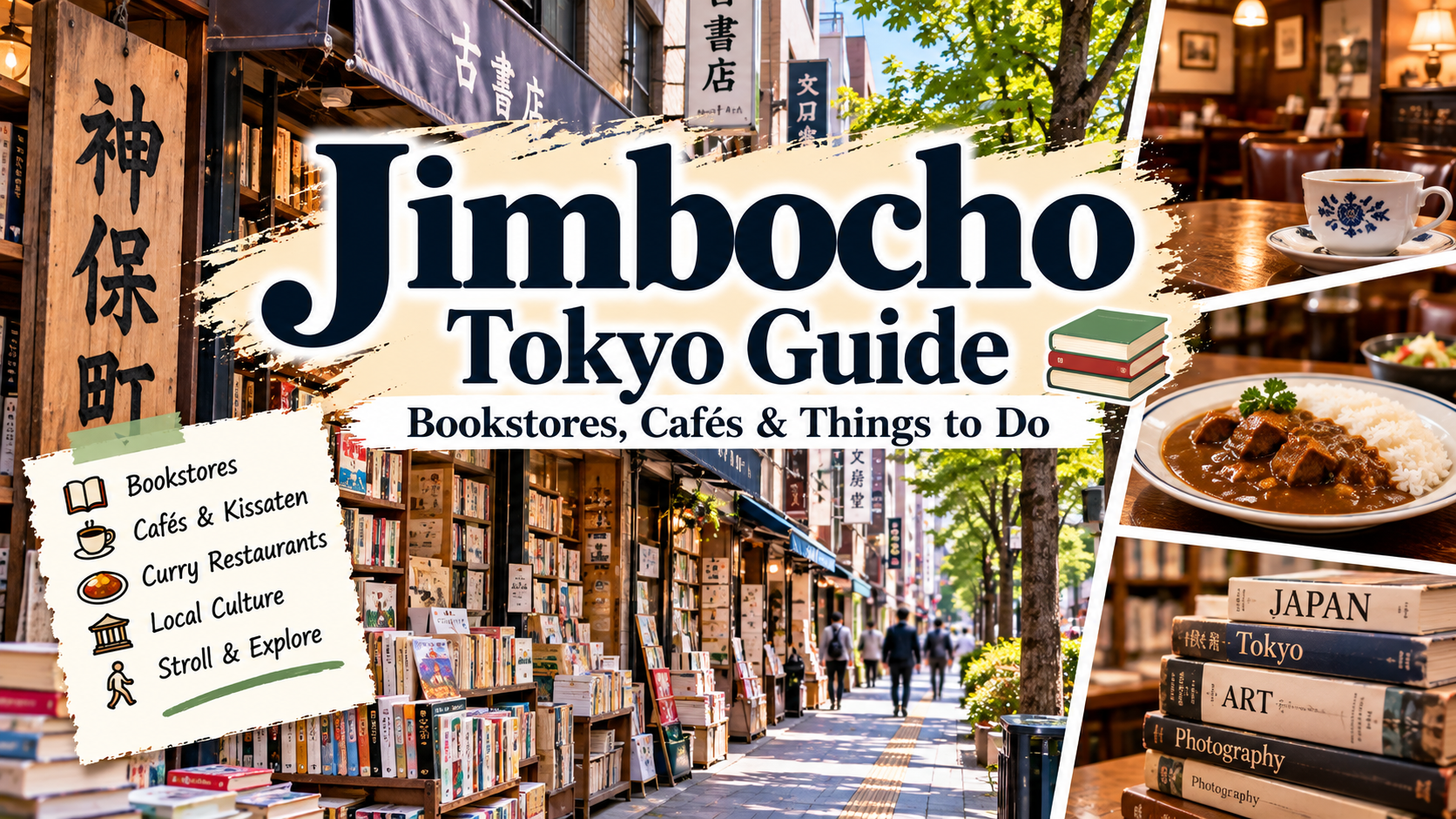
Jimbocho is one of Tokyo’s most distinctive neighborhoods for travelers who love books, cafés, culture, and exploring places with a strong local identity.
Often described as Tokyo’s “Book Town,” Jimbocho is famous for its concentration of bookstores, particularly secondhand and specialty bookshops.
But books are only part of the experience.
The neighborhood is also known for traditional kissaten cafés, curry restaurants, academic culture, and streets where browsing is more important than rushing between major attractions.
Jimbocho does not offer the giant landmarks or neon spectacle associated with some of Tokyo’s better-known districts.
Instead, it rewards curiosity.
You can spend an afternoon searching through old books, discovering vintage prints, stopping for coffee, eating curry, and simply exploring a part of Tokyo that has developed around reading and intellectual culture.
This guide covers the best things to do in Jimbocho, how to explore Tokyo’s famous book district, what to eat, and whether the neighborhood deserves a place in your Tokyo itinerary.
Where Is Jimbocho in Tokyo?
Jimbocho is a neighborhood in Chiyoda City, central Tokyo, best known for its secondhand bookstores, specialist bookshops, traditional cafés, and curry restaurants. It is also commonly called Tokyo’s Book Town.
The easiest way to reach the neighborhood is via Jimbocho Station, which is served by three subway lines:
- Tokyo Metro Hanzomon Line (Z07)
- Toei Shinjuku Line (S06)
- Toei Mita Line (I10)
The main bookstore streets are within walking distance of the station. Tokyo Metro identifies exits A1 and A7 as convenient for the bookstore area, although the best exit depends on which shops you plan to visit.
Jimbocho is an excellent destination for travelers who want to experience a quieter, more literary side of Tokyo without traveling far from the city center.
Travel tip: If you are visiting several bookstores, allow at least two to three hours so you can browse at a relaxed pace and enjoy a coffee or curry break.
Is Jimbocho Worth Visiting?
Yes, particularly if books, cafés, or local neighborhood exploration interest you.
Jimbocho is a good choice if you:
- Love bookstores and secondhand books
- Enjoy browsing without a strict shopping list
- Are interested in Japanese publishing and literary culture
- Like traditional cafés and kissaten
- Want to try one of Tokyo’s best-known curry areas
- Prefer neighborhoods with a strong identity
- Have already visited Tokyo’s major sightseeing districts
However, Jimbocho may be less suitable if you have only a few days in Tokyo and are primarily interested in major landmarks.
Miruvia’s Take
Jimbocho is a specialist neighborhood.
That is exactly what makes it interesting.
Someone with little interest in books may spend an hour here and feel satisfied.
A book lover could easily spend half a day exploring the same few streets.
Unlike districts designed around major tourist attractions, Jimbocho becomes more rewarding when your personal interests match what the neighborhood does best.
Why Is Jimbocho Known as Tokyo’s Book Town?
Jimbocho has long been associated with books, publishers, universities, and academic culture.
The neighborhood developed a particularly strong concentration of bookstores, including shops specializing in used books, academic subjects, art, literature, maps, magazines, and other niche categories.
Today, walking through Jimbocho still feels noticeably different from shopping in most Tokyo neighborhoods.
Books appear everywhere.
Some stores have shelves extending toward the street, while others specialize so narrowly that browsing them can feel almost like entering a private collection.
Japanese-language books naturally dominate many stores, but travelers who cannot read Japanese can still enjoy the experience.
Photography books, art books, maps, illustrations, vintage magazines, prints, and visually interesting publications can all make browsing worthwhile regardless of language ability.
Best Things to Do in Jimbocho
Explore Jimbocho’s Secondhand Bookstores
The essential Jimbocho experience is bookstore hopping.
Rather than choosing one famous shop and immediately leaving, walk through the main bookstore area and enter whichever stores catch your attention.
Some bookstores are large and easy to browse.
Others are small, crowded with shelves, and highly specialized.
You may find:
- Japanese literature
- Foreign-language books
- Academic publications
- Art and design books
- Photography collections
- Manga
- Vintage magazines
- Old maps
- Posters and prints
- Historical documents
The unpredictability is part of the appeal.
You do not always know what you will find until you start looking.
Browse the Outdoor Book Displays
One of the most recognizable parts of Jimbocho’s bookstore culture is the presence of books displayed close to the street.
These displays make browsing feel integrated into the neighborhood itself.
Even if you do not intend to buy anything, walking slowly past the shelves gives you a sense of why Jimbocho is different from an ordinary commercial district.
If something catches your attention, step inside and explore further.
Visit Sanseido Bookstore
Sanseido is one of the major names associated with Jimbocho’s book culture.
For travelers who find highly specialized secondhand shops difficult to navigate, a large bookstore can provide a more accessible introduction to the area’s reading culture.
Because stores can relocate, renovate, or change their operating arrangements, check current location and opening information before your visit.
Three More Places to Visit in Jimbocho
If you are visiting Jimbocho for the first time, these three places are worth considering alongside the neighborhood’s secondhand bookstores.
1. Kanda Suzuran-dori Street
Suzuran-dori is one of Jimbocho’s characteristic shopping streets, lined with bookstores, cafés, art supply shops, and restaurants. It is a good place to experience the neighborhood’s atmosphere while browsing different shops.
The street is approximately a three-minute walk from Jimbocho Station Exit A5.
2. Jimbocho Book Center
Jimbocho Book Center combines a bookstore, café, and spaces for reading and working. It is a useful stop if you want to browse books and enjoy a coffee break in the same place.
Address: 2-3-1 Kanda-Jimbocho, Chiyoda City, Tokyo.
3. Book House Cafe
Book House Cafe specializes in children’s books and includes a café. It is especially worth considering for families or travelers interested in Japanese picture books and illustrations.
The shop is approximately a one-minute walk from Jimbocho Station Exit A1.
Travel tip: You do not need to visit every location. Choose one or two based on your interests, then leave time to explore the smaller bookstores you discover along the way. Check current opening hours before visiting.
Look for Art Books, Prints and Vintage Materials
Jimbocho is not only for people looking for novels.
Travelers interested in design, photography, illustration, architecture, or Japanese visual culture may find the neighborhood especially rewarding.
Old magazines, prints, photography books, and other visual materials can also make unusual souvenirs.
Unlike mass-produced tourist products, these items may reflect a specific part of Japanese culture or publishing history.
Explore Jimbocho’s Traditional Kissaten
Books and coffee fit naturally together, and Jimbocho has a long café culture.
Traditional Japanese coffee shops known as kissaten offer a different experience from modern specialty cafés.
Expect an atmosphere that may feel quieter, darker, and more nostalgic than contemporary coffee shops.
The appeal is not necessarily elaborate coffee presentation.
It is the environment.
After browsing bookstores for an hour or two, sitting down in a traditional café can feel like part of the Jimbocho experience rather than simply a break from it.
Walk Without a Strict Route
Jimbocho is compact enough that you do not need a complicated itinerary.
Start around the main bookstore streets and explore gradually.
Enter shops that look interesting.
Turn into smaller streets.
Stop for coffee when you need a break.
Choose a curry restaurant when you become hungry.
A rigid attraction-by-attraction schedule can actually make Jimbocho less enjoyable.
Jimbocho’s Curry Culture
Books may be Jimbocho’s most famous identity, but curry is another important part of the neighborhood.
The area has developed a strong reputation for curry restaurants, with numerous styles available within a relatively compact district.
Why Curry Fits Jimbocho
Jimbocho’s universities, offices, bookstores, and long-established businesses have helped create demand for convenient and satisfying meals.
Curry became one of the foods strongly associated with the neighborhood.
Today, visitors can find restaurants serving different interpretations of Japanese curry as well as other curry styles.
For travelers, this creates an easy combination:
Browse bookstores, stop for curry, drink coffee, and continue exploring.
What Kind of Curry Can You Find?
Depending on the restaurant, you may encounter:
- Classic Japanese curry rice
- Rich European-style Japanese curry
- Spicier curry
- Soup-like curry
- Curry served with different meats or vegetables
- Restaurants with long-established local followings
You do not need to identify a single “best” restaurant for the neighborhood to be worthwhile.
Part of the fun is choosing according to your preferred style, budget, and waiting time.
Miruvia’s Take
If you are visiting Jimbocho around lunchtime, make curry part of the itinerary.
It gives the neighborhood experience a natural structure:
Books → curry → coffee → more books.
Few Tokyo neighborhoods have such a clear combination of activities.
Jimbocho for Book Lovers Who Cannot Read Japanese
You do not need Japanese reading ability to enjoy Jimbocho.
However, your experience will be different.
If you cannot read Japanese, focus on categories where visual content matters.
Good options include:
- Photography books
- Art books
- Architecture books
- Design publications
- Vintage magazines
- Manga and illustration
- Maps
- Posters
- Prints
You may also encounter bookstores carrying foreign-language material.
Using a translation app can help with signs, categories, and basic communication, but you do not need to understand every title to enjoy browsing.
Miruvia’s Take
Do not dismiss Jimbocho because you cannot read Japanese.
Think of it partly as a cultural browsing experience rather than only a place to buy something you will read cover to cover.
For visually oriented travelers, the neighborhood can still be fascinating.
How Much Time Do You Need in Jimbocho?
The answer depends heavily on how much you like books.
1–2 Hours
Enough for:
- Walking through the main bookstore area
- Entering several bookshops
- Briefly exploring the neighborhood
- Having coffee or a quick meal
This works for curious visitors who want an introduction to Jimbocho.
3–4 Hours
A better choice if books genuinely interest you.
You can:
- Visit multiple bookstores
- Browse without rushing
- Have curry for lunch
- Stop at a kissaten
- Explore smaller streets
- Search for books, prints, or unusual souvenirs
Half Day or Longer
Serious book lovers could spend half a day or more in Jimbocho.
Specialized shops can consume much more time than expected, particularly if you are searching for specific subjects.
Miruvia’s Take
For most travelers, around three hours is a good starting point.
For book lovers, do not set a strict departure time unless the rest of your itinerary requires it.
Jimbocho is exactly the kind of neighborhood where “one more bookstore” can turn into another hour.
A Simple Jimbocho Walking Plan
Short Visit
- Arrive at Jimbocho Station
- Walk through the main bookstore streets
- Browse several secondhand bookshops
- Explore a larger bookstore
- Stop for coffee or curry
- Return to the station
Allow approximately 1–2 hours.
Half-Day Visit
- Arrive at Jimbocho Station
- Begin with the main secondhand bookstore area
- Explore specialist bookshops
- Have curry for lunch
- Continue browsing bookstores
- Look for art books, prints, maps, or vintage magazines
- Take a break at a traditional kissaten
- Explore smaller surrounding streets before leaving
Allow approximately 3–5 hours.
The exact route matters less than giving yourself enough browsing time.
Jimbocho vs Akihabara: Which Should You Visit?
Both neighborhoods can appeal to travelers interested in Japanese media and collecting, but their strengths are very different.
| Jimbocho | Akihabara | |
|---|---|---|
| Main appeal | Books and literary culture | Anime, manga, games and electronics |
| Shopping | Used books and specialist stores | Character goods, electronics and hobby shops |
| Atmosphere | Academic and nostalgic | Bright, commercial and energetic |
| Café culture | Traditional kissaten | Theme cafés and modern cafés |
| Food identity | Curry | Broad casual dining |
| Pace | Slow browsing | Active shopping |
| Best for | Book lovers and cultural exploration | Anime, gaming and pop-culture fans |
Choose Jimbocho If:
- Books are a major interest
- You enjoy secondhand shopping
- You like traditional cafés
- You prefer slower neighborhood exploration
- Vintage publications and prints interest you
Choose Akihabara If:
- Anime and manga merchandise are priorities
- You enjoy gaming
- Electronics interest you
- You want a more energetic shopping environment
- Character goods are on your shopping list
Visit Both If:
You are interested in different sides of Japanese media culture.
Jimbocho provides a more literary and historical experience.
Akihabara provides a more commercial and pop-culture-focused experience.
They complement each other rather than offering the same thing.
Jimbocho for First-Time vs Repeat Visitors
First-Time Visitors
Jimbocho can fit into a first Tokyo trip, particularly if you love books.
If books are one of your main interests, there is no reason to wait until a second visit.
However, travelers with only two or three days may want to prioritize Tokyo’s major sightseeing districts unless Jimbocho directly matches their interests.
With five or more days, it becomes much easier to include.
If this is your first trip to the city, see our Tokyo Travel Guide for First-Time Visitors to decide which neighborhoods and major attractions to prioritize.
Repeat Visitors
Jimbocho is particularly suitable for repeat visitors.
After Tokyo’s famous landmarks have been covered, highly specialized neighborhoods become more valuable.
Jimbocho allows you to build an afternoon around a personal interest rather than a famous attraction.
That is one of the advantages of returning to Tokyo.
You can stop asking what everyone is supposed to see and start exploring what actually interests you.
Jimbocho vs Yanaka: Which Is Better for a Slower Tokyo Experience?
Both work well when you want to escape Tokyo’s busiest commercial districts, but they feel very different.
Yanaka is better suited to travelers interested in traditional streets, temples, local shopping, and an old-Tokyo atmosphere.
Jimbocho is better suited to travelers interested in books, cafés, curry, and cultural browsing.
Choose based on what you want to do rather than which neighborhood is more famous.
For a visual walk through older Tokyo, choose Yanaka.
For an afternoon built around books and coffee, choose Jimbocho.
How to Combine Jimbocho with Nearby Areas
Jimbocho is easy to use as part of a larger sightseeing day.
Jimbocho and Kanda
Kanda can extend the local exploration experience and works well for travelers interested in food, traditional businesses, and central Tokyo neighborhoods.
Jimbocho and Akihabara
This is a useful combination for travelers interested in books, manga, anime, games, or collecting.
Begin with slower bookstore browsing in Jimbocho, then move toward the more energetic shopping environment of Akihabara.
Jimbocho and the Imperial Palace Area
Travelers interested in central Tokyo can combine Jimbocho with sightseeing around the Imperial Palace area.
This creates a day with more variety than spending the entire time shopping.
Miruvia’s Take
Jimbocho works best as a half-day component rather than something you force into a packed schedule.
Pair it with one nearby area and leave enough time to browse.
Best Time to Visit Jimbocho
Late Morning
A good time to arrive as shops begin operating and before lunch.
This works particularly well if you want curry around midday.
Afternoon
The best overall period for most visitors.
Bookstores and cafés are active, and you can browse without needing to rush.
Evening
Jimbocho can still be enjoyable, particularly for food, but bookstore opening hours become more important.
If books are your main priority, do not leave your entire visit until late evening.
Miruvia’s Take
Arrive in the late morning or early afternoon.
Browse for a while, have curry, continue exploring, then finish with coffee.
That sequence matches the neighborhood naturally.
How to Get to Jimbocho
Jimbocho Station is the most convenient access point for the neighborhood.
The station is served by multiple Tokyo subway lines, making Jimbocho relatively easy to reach from other parts of the city.
Once you arrive, walking is the best way to explore.
The bookstore district is concentrated enough that trains or buses are unnecessary for moving between the main points of interest.
Comfortable shoes are still useful because browsing often involves more walking and standing than expected.
Practical Tips for Visiting Jimbocho
Do Not Rush the Bookstores
The value of Jimbocho comes from browsing.
If you enter every shop with only a few minutes available, much of the experience disappears.
Carry Some Cash
Tokyo has become increasingly card-friendly, but smaller or older businesses may have different payment options.
Having some cash available can still be useful.
Use Translation Tools When Needed
A translation app can help with store categories, signs, menus, and basic communication.
This is particularly useful in specialized secondhand bookstores.
Handle Old Books Carefully
Some materials may be old, rare, or delicate.
Follow store rules and handle items respectfully.
Ask Before Taking Photos Inside Shops
Do not assume photography is permitted inside every bookstore or café.
Check signs or ask staff if you are unsure.
Check Opening Hours
Independent bookstores, cafés, and restaurants may have different closing days and operating hours.
If a specific business is essential to your visit, check current information before going.
Leave Space in Your Bag
If you enjoy books, this is more important than it sounds.
Books become heavy quickly.
Consider how much you realistically want to carry for the rest of your trip.
Is Jimbocho Good for Solo Travelers?
Yes.
Jimbocho is particularly well suited to solo exploration.
Bookstore browsing is naturally independent, cafés provide easy breaks, and there is no need to coordinate a complicated itinerary.
Solo travelers who enjoy books can spend several hours here without needing any formal activity.
Is Jimbocho Good for Families?
It depends on the children’s interests.
Families with older children who enjoy books, manga, art, or browsing shops may find Jimbocho interesting.
For younger children, the neighborhood may offer fewer obvious attractions than areas with parks, museums, or entertainment facilities.
A shorter visit may work better in that case.
Frequently Asked Questions
Is Jimbocho worth visiting?
Yes, especially if you enjoy books, secondhand shopping, traditional cafés, curry, or exploring specialized Tokyo neighborhoods.
What is Jimbocho famous for?
Jimbocho is best known as Tokyo’s Book Town because of its concentration of bookstores, particularly secondhand and specialist bookshops. It is also well known for curry and traditional cafés.
Can I enjoy Jimbocho if I cannot read Japanese?
Yes. Art books, photography, design publications, vintage magazines, maps, manga, prints, and other visual materials can still make the bookstores interesting.
How long should I spend in Jimbocho?
Around three hours is a good starting point. Serious book lovers may want half a day or longer.
Is Jimbocho good for buying souvenirs?
It can be, particularly if you want something less conventional. Vintage prints, maps, magazines, art books, and other publications can make distinctive souvenirs.
Is Jimbocho better than Akihabara?
They serve different interests. Jimbocho is better suited to books, literary culture, traditional cafés, and slow browsing. Akihabara focuses more heavily on anime, gaming, electronics, and pop-culture merchandise.
What should I eat in Jimbocho?
Curry is one of the neighborhood’s best-known food experiences and fits naturally into a bookstore-focused visit.
Final Thoughts
Jimbocho is proof that some of Tokyo’s most interesting neighborhoods do not need famous landmarks.
Its identity comes from specialization.
Books fill storefronts.
Old publications sit beside modern releases.
Traditional cafés offer places to rest between shops.
Curry restaurants provide an easy lunch before another round of browsing.
For travelers with no interest in books, Jimbocho may simply be a pleasant local neighborhood.
For travelers who love books, it can become one of the most memorable places in Tokyo.
That difference is important.
The deeper you explore Tokyo, the less useful it becomes to ask which neighborhood is universally “best.”
A better question is which neighborhood matches what you care about.
If the answer includes books, coffee, old publications, and slow browsing, make time for Jimbocho.
