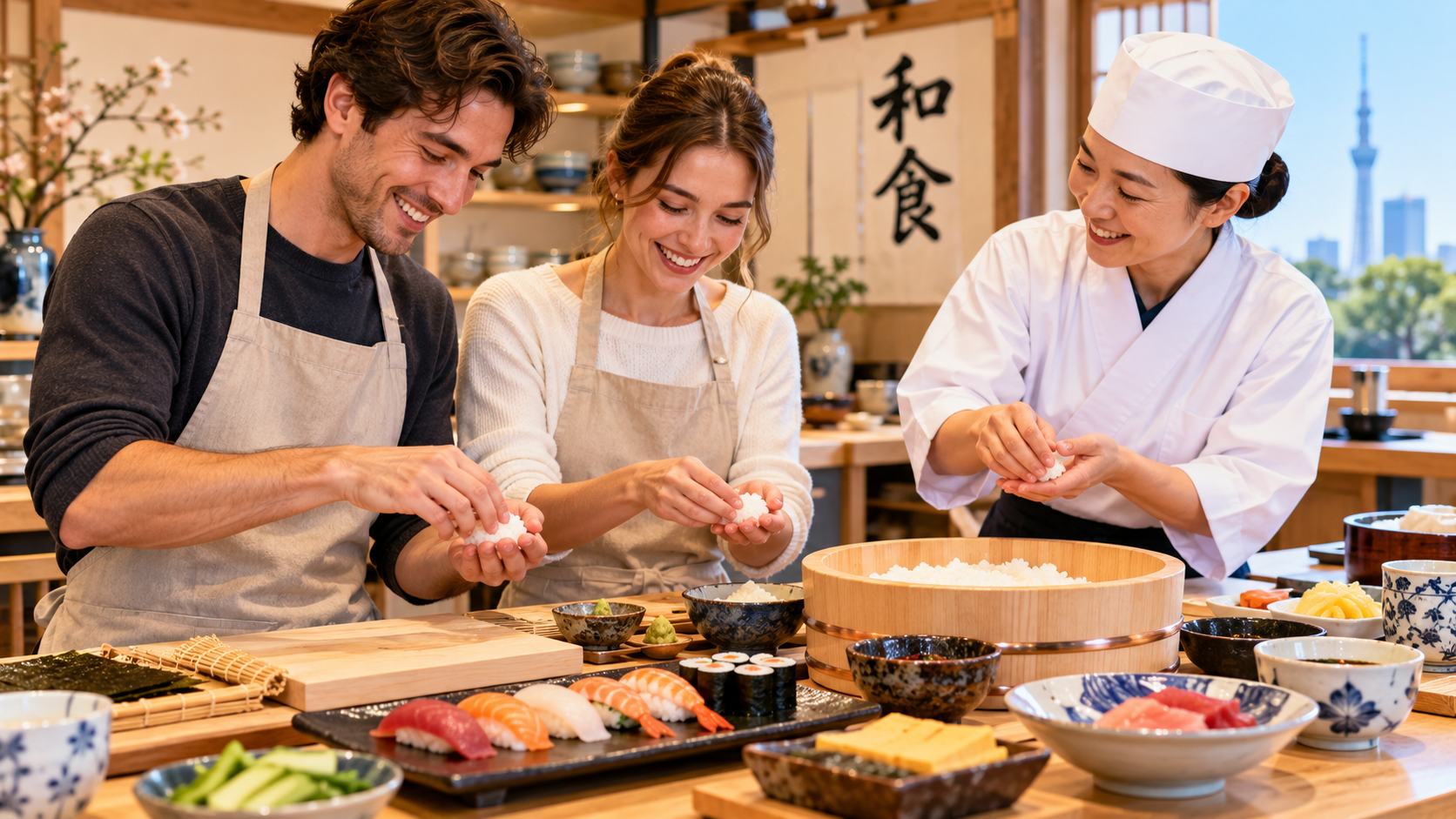
Why Take a Cooking Class in Tokyo?
Tokyo is one of the world’s most exciting cities for food lovers.
From sushi and ramen to Japanese home cooking, the city offers an enormous variety of dishes to discover. But eating Japanese food is only one way to experience its culinary culture.
Taking a cooking class allows you to understand how Japanese dishes are prepared, learn about local ingredients, and practice techniques that you can use after returning home.
For international travelers, a cooking class can also be a welcome change from sightseeing. Instead of moving between crowded attractions, you spend time creating something yourself.
Tokyo offers classes covering sushi, ramen, wagashi, traditional home cooking, and other Japanese specialties.
The challenge is choosing an experience that matches your interests, schedule, cooking ability, and dietary requirements.
This guide explains what to expect from cooking classes in Tokyo, how to compare different experiences, and what to check before booking.
Miruvia’s Take: Choose the Experience, Not Just the Dish
A common mistake is choosing a cooking class based only on the food shown in promotional photographs.
Two classes advertised as sushi-making experiences can be completely different.
One may involve preparing sushi rice, learning basic knife techniques, and assembling several pieces of sushi.
Another may focus primarily on arranging ingredients that have already been prepared.
Neither approach is necessarily wrong.
However, the amount of actual cooking can affect how satisfying the experience feels.
Before booking, we recommend checking three things:
- What you will prepare yourself
- How much instruction you will receive
- Whether the experience matches your cooking ability
If you want to learn practical skills, prioritize hands-on preparation.
If you mainly want a relaxed cultural activity and a meal, a shorter introductory class may be enough.
The best cooking class is not necessarily the most elaborate or expensive one. It is the one that delivers the experience you expect.
What Types of Cooking Classes Are Available in Tokyo?
Tokyo cooking classes cover a wide range of Japanese dishes and culinary traditions.
Common options include:
- Sushi-making classes
- Ramen-making classes
- Japanese home cooking
- Bento-making classes
- Wagashi-making classes
- Vegetarian and vegan cooking
- Seasonal Japanese cuisine
- Family-friendly cooking experiences
Each offers a different combination of cooking skills, cultural learning, and dining.
Sushi-Making Classes
Sushi-making is one of the most recognizable Japanese cooking experiences.
Depending on the class, you may learn how to:
- Prepare and season sushi rice
- Shape nigiri sushi
- Roll maki sushi
- Arrange toppings
- Use basic sushi-making tools
- Present finished sushi
Some classes also explain the cultural background of sushi and the differences between common styles.
Is a Sushi Class Good for Beginners?
Yes. Many tourist-oriented sushi classes are designed for participants with little or no cooking experience.
However, check whether ingredients are prepared in advance.
A beginner class may focus on shaping and assembling sushi rather than teaching professional fish preparation.
This can still be enjoyable, but it is important to understand what is included.
What About Raw Fish?
Sushi classes may use raw seafood, cooked ingredients, vegetables, or combinations of these.
If you do not eat raw fish, check whether suitable alternatives are available.
Do not assume every class can accommodate dietary requests without advance notice.
Ramen-Making Classes
Ramen classes are another popular choice. If you want to understand ramen styles and what to try in Tokyo, see our Tokyo Ramen Guide.
They can introduce travelers to the different components that make up a bowl of Japanese ramen.
Depending on the experience, activities may include:
- Preparing or handling noodles
- Learning about broth
- Mixing seasonings
- Preparing toppings
- Assembling a bowl of ramen
Do You Make Ramen From Scratch?
Not always.
Traditional ramen broth can require many hours of preparation.
As a result, some short tourist classes use broth or other components prepared before the session.
Other classes may provide a more extensive cooking experience.
Before booking, check whether you will actually make noodles, prepare broth, or primarily assemble the finished dish.
Is Ramen Suitable for Vegetarians?
Some classes offer vegetarian or vegan alternatives, but many traditional ramen recipes contain meat, fish, or animal-derived stock.
Even a vegetable-based bowl may use broth or seasonings containing animal products.
If dietary restrictions are important, confirm the ingredients directly with the operator.
Japanese Home Cooking Classes
Japanese home cooking classes focus on dishes commonly prepared in households rather than restaurant specialties.
Possible dishes include:
- Miso soup
- Tamagoyaki
- Onigiri
- Teriyaki-style dishes
- Japanese curry
- Seasonal vegetable dishes
- Rice-based meals
- Simple side dishes
The menu depends on the instructor and class.
Why Choose Home Cooking?
Home cooking can be particularly rewarding because the techniques are often easier to repeat after returning home.
You may learn about:
- Everyday Japanese ingredients
- Meal preparation
- Seasoning combinations
- Rice preparation
- Food presentation
- Balanced meal composition
If your goal is to bring Japanese cooking into your daily routine, a home cooking class may be more useful than a highly specialized restaurant-style experience.
Bento-Making Classes
Bento-making classes focus on preparing and arranging food in a Japanese lunch box.
They may include rice, vegetables, egg dishes, and other small portions.
Some experiences emphasize traditional presentation, while others feature decorative or character-inspired arrangements.
Who Should Choose a Bento Class?
Bento classes can appeal to:
- Families
- Travelers interested in food presentation
- People who prepare packed lunches
- Visitors who enjoy creative activities
Check the menu and difficulty level before booking, especially when traveling with children.
Wagashi-Making Classes
Wagashi are traditional Japanese sweets often associated with tea culture and seasonal aesthetics. Explore the different varieties in our Tokyo Wagashi Guide.
A wagashi-making class may involve shaping, coloring, and decorating sweets using ingredients such as sweet bean paste and rice-based dough.
The specific process depends on the type of wagashi being made.
Why Try Wagashi-Making?
Wagashi-making combines food preparation with artistic expression.
You may learn how seasonal motifs are represented through shapes, colors, and textures.
It can be a good choice if you prefer a calm, creative activity rather than preparing a full meal.
Some classes include matcha or an introduction to Japanese tea culture.
Vegetarian and Vegan Cooking Classes
Tokyo has cooking experiences that cater to vegetarian and vegan travelers. For more information about plant-based food options in the city, see our Tokyo Vegetarian & Vegan Guide.
However, dietary labels should be checked carefully.
Traditional Japanese recipes sometimes contain ingredients that are not immediately obvious, such as:
- Fish-based dashi
- Bonito flakes
- Fish sauce
- Meat-derived stock
- Gelatin
- Other animal-derived seasonings
If you follow a strict vegetarian or vegan diet, confirm all relevant ingredients before booking.
It is safer to choose a class that explicitly offers an appropriate menu than to assume a standard class can be modified.
Which Tokyo Cooking Class Should You Choose?
The best choice depends on what you want from the experience.
Choose Sushi-Making If You Want:
- An iconic Japanese food experience
- A recognizable dish
- A relatively approachable activity
- A meal you prepare and eat yourself
Choose Ramen-Making If You Want:
- To understand ramen components
- A hearty meal
- An introduction to noodles and broth
- A hands-on experience connected to popular Japanese food culture
Choose Home Cooking If You Want:
- Practical everyday recipes
- Skills you can use at home
- A broader understanding of Japanese ingredients
- Several dishes rather than one specialty
Choose Wagashi-Making If You Want:
- A creative activity
- Traditional Japanese sweets
- Seasonal designs
- A cultural experience that combines food and craftsmanship
Choose Bento-Making If You Want:
- Food presentation skills
- A family-friendly activity
- A creative lunch-making experience
- Ideas for preparing packed meals at home
What Happens During a Tokyo Cooking Class?
The exact structure varies, but many beginner-friendly cooking classes follow a similar format.
1. Arrival and Introduction
You arrive at the cooking studio or meeting point.
The instructor explains the menu, introduces the equipment, and provides basic safety information.
Some experiences begin with an introduction to Japanese ingredients.
2. Ingredient Preparation
Depending on the class, you may wash, cut, measure, or arrange ingredients.
Some ingredients may already be prepared to keep the session within its scheduled duration.
3. Cooking and Instruction
The instructor demonstrates techniques and guides participants through the preparation process.
You may work individually, in pairs, or as part of a small group.
4. Presentation
Once the food is ready, you may arrange the finished dishes.
Presentation is an important part of many Japanese culinary traditions.
5. Eating Your Food
Many cooking classes include time to eat what you have prepared.
However, not every workshop includes a full meal.
Confirm whether tasting, dining, or takeaway is included.
6. Photos and Recipes
Some operators allow photographs or provide recipes to take home.
Others may offer digital recipe materials.
Check what is included if you want to recreate the dishes later.
Do You Need Cooking Experience?
Usually not.
Many cooking classes designed for international visitors welcome complete beginners.
You do not necessarily need to know how to use Japanese cooking tools or prepare traditional ingredients.
However, class difficulty varies.
An introductory sushi workshop is different from an advanced culinary lesson.
Look for descriptions such as:
- Beginner-friendly
- No experience required
- Small-group instruction
- Hands-on guidance
If the class involves specialized knives or complicated techniques, check whether beginners are welcome.
Do You Need to Speak Japanese?
Not necessarily.
Tokyo has cooking classes specifically designed for international travelers, including experiences conducted in English.
Some operators provide bilingual instruction or translation support.
However, language support varies by class and instructor.
Before booking, confirm:
- Whether instruction is available in English
- Whether recipe materials are translated
- Whether questions can be answered in English
- Whether the class uses demonstrations that are easy to follow
For technical cooking lessons, clear communication can make a significant difference.
How Long Does a Cooking Class Take?
Many tourist-oriented cooking experiences last approximately 1.5 to 3 hours.
Short introductory activities may take less time.
More detailed classes, especially those involving multiple dishes or market visits, may take longer.
Allow additional time for:
- Traveling to the venue
- Finding the entrance
- Checking in
- Eating the finished meal
- Returning to your next destination
Avoid scheduling another reservation immediately after the class.
How Much Do Cooking Classes Cost in Tokyo?
Prices depend on the menu, duration, group size, location, and level of instruction.
As a general planning estimate:
- Short introductory experiences: approximately ¥4,000–¥8,000 per person
- Standard small-group classes: approximately ¥8,000–¥15,000 per person
- Private or specialized experiences: approximately ¥15,000–¥30,000 or more per person
These are indicative ranges, not fixed prices or verified quotations from individual operators.
Prices can change, and premium experiences may cost considerably more.
Always confirm the total price and inclusions before booking.
What Is Usually Included?
Depending on the operator, the price may include:
- Ingredients
- Cooking equipment
- Instructor guidance
- Apron rental
- Recipe materials
- The finished meal
- Tea or other drinks
Some classes may charge separately for additional ingredients, optional drinks, or special arrangements.
Do not assume every item is included.
Group Classes vs Private Cooking Classes
Both formats have advantages.
Group Cooking Classes
Group classes are often more affordable and can be a good way to meet other travelers.
They may offer:
- A social atmosphere
- Shared instruction
- A structured schedule
- Lower prices than private sessions
However, the instructor’s attention is divided among participants.
Private Cooking Classes
Private classes may offer:
- More personalized instruction
- Flexible pacing
- Greater opportunity to ask questions
- Potential menu customization
They can be especially useful for families, serious home cooks, or travelers with specific requirements.
The main disadvantage is typically the higher cost.
How Many People Are in a Class?
Class sizes vary significantly.
Some workshops accommodate only a few participants, while others operate with larger groups.
A smaller class may provide more opportunities for individual guidance.
Before booking, check the maximum group size if personalized instruction is important to you.
Also confirm whether the class requires a minimum number of participants.
Where Should You Take a Cooking Class in Tokyo?
Cooking experiences are available in different parts of the city.
The best location is often the one that fits your existing sightseeing plans.
Asakusa
Asakusa is a convenient choice for travelers interested in combining traditional sightseeing with a cultural activity.
You can explore Senso-ji and the surrounding streets before or after your class.
Shinjuku
Shinjuku can be convenient for travelers staying in western or central Tokyo.
Its extensive transportation connections make it relatively easy to combine a cooking experience with other activities.
Shibuya
Shibuya is suitable for visitors who want to combine a cooking class with contemporary Tokyo shopping, cafés, and sightseeing.
Other Tokyo Neighborhoods
Cooking classes may also be offered in residential neighborhoods or smaller studios outside major tourist districts.
These can provide a different atmosphere, but transportation and accessibility deserve closer attention.
Should You Choose a Class Near Your Hotel?
For a short trip, convenience matters.
A cooking class lasting two hours can occupy much more of your day if reaching the studio requires a long journey.
When comparing otherwise similar experiences, consider:
- Distance from your hotel
- Nearest station
- Walking time
- Class start time
- Nearby sightseeing opportunities
Choosing a convenient location can make the day significantly more relaxed.
Can You Combine a Cooking Class with Sightseeing?
Yes.
A cooking class can fit naturally into a Tokyo itinerary.
For example, you could:
- Explore Asakusa in the morning and attend a class afterward
- Take a morning class before shopping in Shibuya
- Join a cooking experience before an evening in Shinjuku
- Combine a culinary activity with a nearby Japanese garden or traditional neighborhood
Avoid placing a large meal immediately before a class that includes eating.
Cooking Class vs Food Tour
A cooking class and a food tour offer different experiences.
A food tour generally focuses on visiting food establishments, tasting dishes, and learning about local food culture.
A cooking class focuses on preparing food yourself.
Choose a cooking class if you want:
- Hands-on learning
- Practical techniques
- A slower-paced activity
- Skills to recreate dishes at home
Choose a food tour if you want:
- To explore multiple establishments
- To taste a variety of foods
- To discover dining areas
- Less hands-on preparation
Both can be valuable, depending on your interests.
Cooking Class vs Sushi Dining
Eating sushi at a restaurant is a different experience from making it yourself. For more about sushi varieties, ordering, and dining etiquette, see our Tokyo Sushi Guide.
A sushi restaurant emphasizes the finished food and the chef’s preparation.
A sushi-making class emphasizes learning, participation, and understanding basic techniques.
If your priority is tasting expertly prepared sushi, a restaurant may be the better choice.
If you want to understand how sushi is assembled, a class may be more memorable.
Cooking Class vs Traditional Craft Workshop
Both activities allow travelers to learn by doing.
A cooking class usually produces food that you can eat during the session.
A traditional craft workshop may produce an object that you can take home, collect later, or arrange to have shipped.
Choose cooking if you enjoy food and practical culinary skills.
Choose a craft workshop if you prefer creating a physical souvenir or exploring Japanese artistic traditions.
Cooking Class vs Tea Ceremony
A tea ceremony and a cooking class are both connected to Japanese food culture, but their purposes differ.
A tea ceremony focuses on hospitality, matcha preparation, etiquette, and traditional aesthetics.
A cooking class focuses on preparing dishes through practical instruction.
A tea ceremony may be more suitable for travelers seeking a structured cultural experience.
A cooking class may be better for travelers who want to participate actively in food preparation.
Can Children Join Cooking Classes?
Some cooking classes welcome families with children.
Others have minimum age requirements, especially when sharp knives, hot equipment, or complicated techniques are involved.
Before booking, confirm:
- Minimum age
- Whether children need adult supervision
- Whether the menu is suitable for children
- Whether child-sized equipment is available
- Whether all participants must pay
A family-friendly class should clearly explain its age and safety policies.
Are Cooking Classes Good for Solo Travelers?
Yes.
Cooking classes can be particularly enjoyable for solo travelers because they provide a structured activity and opportunities to interact with others.
Group classes may offer a social atmosphere without requiring you to organize a group yourself.
However, some experiences have minimum booking requirements or private-session pricing.
Check whether single-person reservations are accepted.
Are Cooking Classes Good for Couples?
Cooking classes can make an enjoyable activity for couples.
You can prepare food together, learn new techniques, and share the finished meal.
If you want a more intimate experience, consider a private class.
For couples who enjoy meeting other travelers, a small-group class may be equally appealing.
Are Cooking Classes Good for Rainy Days?
Yes.
Most cooking classes take place indoors, making them a practical option when Tokyo’s weather is poor.
However, some experiences include outdoor market visits or walking components.
If you are booking specifically because of rain, check whether the entire activity takes place indoors.
Food Allergies and Dietary Restrictions
Dietary requirements are one of the most important things to check before booking.
Japanese cooking can involve ingredients such as:
- Soy
- Wheat
- Fish
- Shellfish
- Eggs
- Sesame
- Milk
- Peanuts or tree nuts
Ingredient combinations vary by recipe.
Cross-contact may also occur when equipment and preparation surfaces are shared.
What Should You Do Before Booking?
Contact the operator and explain your requirements clearly.
Ask:
- Can the menu accommodate my restrictions?
- Which ingredients are used?
- Are substitutions possible?
- Is shared equipment used?
- Can cross-contact be prevented?
For severe allergies, do not rely solely on a general statement that a class is allergy-friendly.
Obtain clear confirmation of the specific precautions available. If the operator cannot meet your safety needs, choose another experience.
Can You Request a Halal-Friendly Cooking Class?
Some cooking experiences may be able to accommodate halal dietary requirements.
However, a menu without pork is not automatically halal.
Ingredients, seasonings, meat sourcing, and preparation procedures may all matter.
Contact the operator in advance and confirm whether the experience meets your individual requirements.
Do not assume halal accommodation is available unless explicitly confirmed.
What Should You Wear?
Comfortable clothing is usually best.
Consider wearing:
- Clothes that allow easy movement
- Comfortable shoes
- Clothing you do not mind getting slightly messy
Some studios provide aprons.
Avoid loose sleeves or accessories that could interfere with cooking.
If you have long hair, tie it back when appropriate.
Do You Need to Bring Anything?
Many tourist-oriented classes provide the necessary ingredients and equipment.
However, you may need:
- Booking confirmation
- Comfortable clothing
- A hair tie
- Any required personal items
- Details of dietary restrictions
Check the operator’s instructions before arriving.
Can You Take Photos?
Many cooking classes allow participants to take photographs.
However, photography rules vary.
Some instructors may ask you not to take photos during certain demonstrations.
Always ask before photographing other participants or staff.
If taking photos is important to you, confirm the policy in advance.
Can You Take Leftover Food Home?
Not necessarily.
Food safety policies vary by operator.
Some classes require participants to eat prepared food on-site and do not allow takeaway.
Others may permit certain items to be taken away under specific conditions.
Check the policy before booking rather than assuming leftovers can be packed.
Do Cooking Classes Provide Recipes?
Some classes provide printed or digital recipes.
Others focus on the experience without offering detailed materials.
If you want to recreate the dishes at home, ask whether the recipes include:
- Ingredient quantities
- Step-by-step instructions
- English translations
- Substitution suggestions
- Equipment recommendations
A class that provides clear recipes may offer more long-term value for travelers interested in cooking regularly.
How to Choose a Cooking Class in Tokyo
When comparing classes, focus on the experience itself rather than only the photographs.
1. Check the Menu
Confirm exactly which dishes you will prepare.
Do not assume that every sushi or ramen class includes the same techniques.
2. Check the Hands-On Activities
Find out which steps you will complete yourself.
This is especially important for travelers who want practical cooking skills.
3. Confirm Language Support
Make sure the instruction language matches your needs.
4. Check Group Size
Smaller groups may allow more individual guidance.
5. Review Dietary Policies
Contact the operator in advance if you have allergies or restrictions.
6. Confirm the Total Price
Check whether ingredients, equipment, drinks, and meals are included.
7. Check the Location
Choose a studio that fits your sightseeing plans.
8. Read the Cancellation Policy
Understand the refund and rescheduling conditions before paying.
9. Check Recent Reviews
Look for comments about instruction quality, actual participation, cleanliness, communication, and value.
10. Confirm What You Will Take Away
Determine whether you will receive recipes, photographs, a meal, or any additional materials.
How Far in Advance Should You Book?
Popular classes can fill up, particularly during busy travel periods.
If a specific cooking experience is a priority, booking in advance is sensible.
Private classes, weekend sessions, and experiences with limited capacity may require more planning.
If your itinerary is flexible, you may have more options closer to your travel date.
However, last-minute availability should not be assumed.
What If You Need to Cancel?
Cancellation policies vary by operator.
Some experiences offer refunds within a specified period, while others have stricter conditions.
Before booking, check:
- Cancellation deadlines
- Refund eligibility
- Rescheduling options
- Late arrival policies
- Minimum participant requirements
Keep your booking confirmation accessible during your trip.
What If You Arrive Late?
Cooking classes often follow a fixed schedule.
Arriving late can disrupt instruction and may prevent you from participating in certain activities.
Plan to arrive slightly before the scheduled start time.
Check the exact meeting point and allow extra time for navigating unfamiliar stations.
First-Time Visitor Recommendation
For a first visit to Tokyo, choose a beginner-friendly class with clear English instruction and a convenient location.
A sushi-making or Japanese home cooking class can be an approachable starting point.
Prioritize:
- A manageable duration
- Clear hands-on activities
- A menu you enjoy
- Convenient transportation
- Transparent pricing
A class that fits smoothly into your itinerary is often more enjoyable than a complicated experience requiring extensive travel.
Repeat Visitor Recommendation
If you have visited Tokyo before, consider a more specialized cooking experience.
You might explore:
- Regional Japanese cuisine
- Advanced sushi techniques
- Handmade noodles
- Seasonal home cooking
- Traditional sweets
- Private lessons
Repeat visitors may appreciate smaller classes that offer more detailed instruction or introduce unfamiliar ingredients.
Common Mistakes to Avoid
Booking Based Only on Photos
Attractive food photographs do not explain how much cooking you will actually do.
Read the activity description carefully.
Assuming Everything Is Made From Scratch
Some ingredients may be prepared in advance.
This is common in shorter experiences and is not necessarily a problem, but expectations should be clear.
Ignoring Dietary Requirements
Do not assume substitutions are available.
Confirm restrictions before booking.
Choosing an Inconvenient Location
A class far from your other activities can consume more time than expected.
Booking Too Close to Another Meal
Many cooking classes include eating the finished food.
Leave enough space in your schedule.
Overlooking Cancellation Rules
Check refund and rescheduling policies before paying.
Expecting Professional-Level Training
Most short tourist cooking classes are introductions rather than professional culinary courses.
Choose a specialized lesson if advanced instruction is your priority.
Who Should Take a Cooking Class in Tokyo?
Cooking classes are particularly suitable for:
- Food lovers
- Home cooks
- Couples
- Families
- Solo travelers
- Repeat visitors
- Travelers seeking hands-on experiences
- People interested in Japanese ingredients and culinary traditions
They can also be a good option for travelers who prefer meaningful activities over additional shopping or sightseeing.
Who Might Skip a Cooking Class?
A cooking class may not be the best use of your time if:
- You have little interest in cooking
- You prefer eating at restaurants
- Your schedule is extremely limited
- You cannot find a class that meets your dietary needs
- You want advanced instruction that short tourist classes do not provide
Tokyo offers many food experiences, so choose the format that matches your interests.
Frequently Asked Questions
Are cooking classes in Tokyo suitable for beginners?
Yes. Many cooking classes designed for international travelers welcome beginners. Check the class description to confirm the expected skill level.
How much does a cooking class in Tokyo cost?
As a general estimate, short experiences may cost around ¥4,000–¥8,000 per person, standard small-group classes around ¥8,000–¥15,000, and private or specialized lessons more. Actual prices vary.
Can I take a cooking class in English?
Yes. Some Tokyo cooking classes offer English-language instruction. Confirm the language before booking.
What is the best cooking class for first-time visitors?
Sushi-making and Japanese home cooking classes are approachable options. The best choice depends on your interests, preferred level of participation, and dietary requirements.
Do you eat the food you make?
Many cooking classes include time to eat the finished dishes, but this is not universal. Check what is included in the experience.
Can vegetarians join Japanese cooking classes?
Some classes offer vegetarian menus or substitutions. Confirm ingredients and dietary accommodation before booking, particularly because Japanese stocks and seasonings may contain fish.
Are Tokyo cooking classes family-friendly?
Some are. Check minimum ages, supervision requirements, equipment safety, and menu suitability.
Can solo travelers book cooking classes?
Many group classes accept individual participants, but booking policies vary. Check whether a single-person reservation is allowed.
How long does a Tokyo cooking class take?
Many introductory experiences last approximately 1.5 to 3 hours. More detailed or combined experiences may take longer.
Should I book a cooking class in advance?
Booking ahead is recommended if you have a specific class, date, or time in mind, especially during busy travel periods.
Can I take photos during the class?
Photography is often allowed, but policies vary. Follow the instructor’s guidance and respect other participants’ privacy.
Is a cooking class worth it in Tokyo?
For travelers interested in Japanese food and hands-on learning, a cooking class can be a rewarding experience. Its value depends on the quality of instruction, the amount of participation, and how well the class matches your expectations.
Final Thoughts
Taking a cooking class in Tokyo offers a different perspective on Japanese food.
Instead of simply tasting a finished dish, you can learn about ingredients, preparation methods, and the decisions involved in creating it.
For first-time visitors, sushi-making and home cooking classes are approachable options.
For repeat visitors, specialized lessons can provide a deeper understanding of Japanese culinary traditions.
Before booking, pay particular attention to what you will actually prepare, language support, dietary requirements, and the total cost.
The most rewarding cooking class is one that fits your interests and gives you something valuable to remember—or recreate—after your trip.
Whether you choose sushi, ramen, wagashi, or home cooking, the experience can add a meaningful hands-on element to your Tokyo itinerary.
