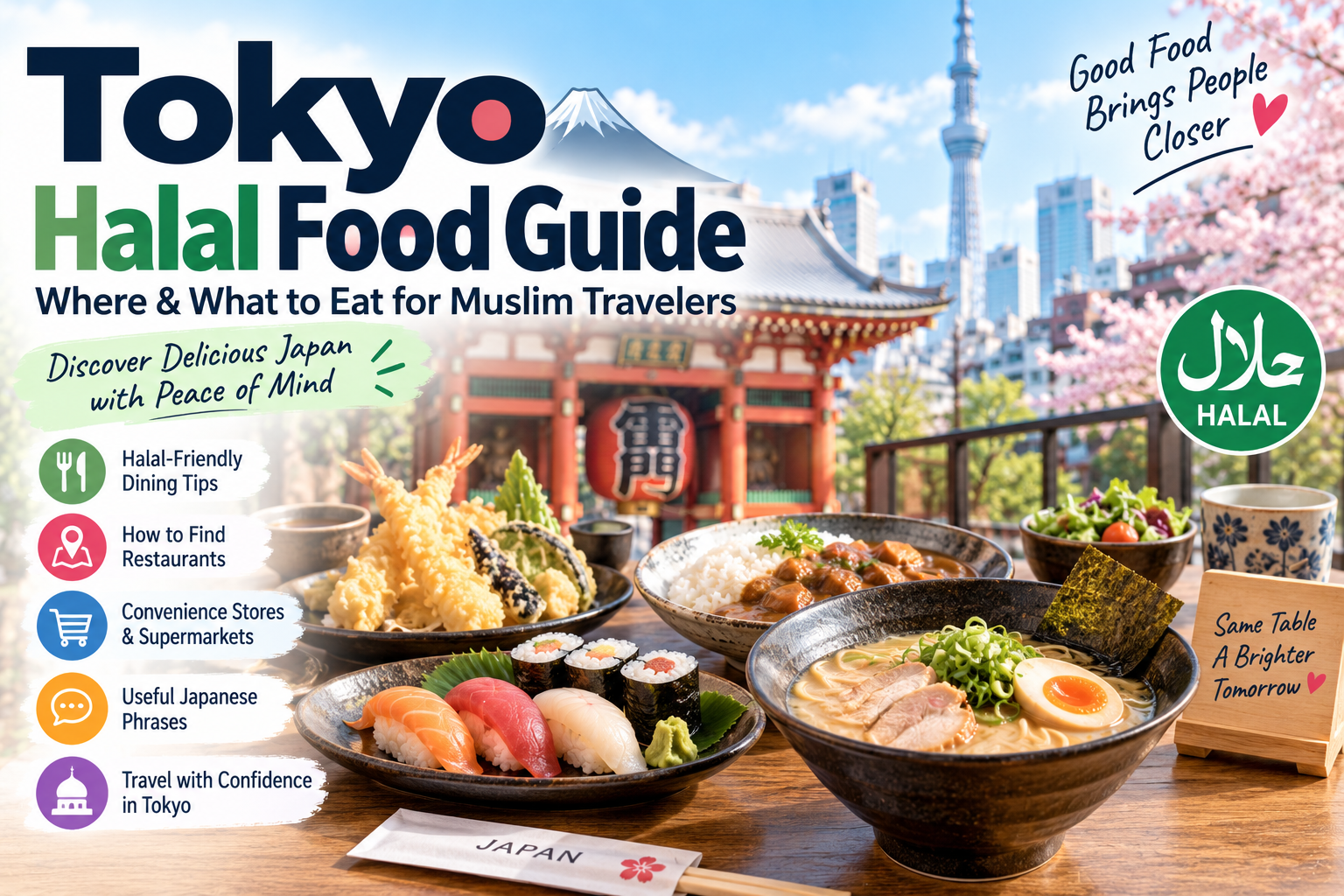
Tokyo is one of the world’s great food cities, but finding suitable meals can require extra planning for Muslim travelers.
Japanese cuisine includes many dishes that may appear simple but contain ingredients such as pork, alcohol, mirin, cooking sake, or non-halal meat. At the same time, Tokyo’s international food scene has expanded significantly, and travelers can now find halal-certified restaurants, Muslim-friendly dining options, vegetarian meals, seafood dishes, and other alternatives across the city.
The key is understanding what “halal” and “Muslim-friendly” mean in Japan and knowing what questions to ask before ordering.
This Tokyo halal food guide explains what Muslim travelers should know about Japanese ingredients, how to find suitable restaurants, which foods require extra attention, and how to make dining in Tokyo easier.
Halal Food in Tokyo at a Glance
For Muslim travelers visiting Tokyo:
- Research suitable restaurants before each sightseeing day.
- Do not assume a dish is halal because it contains no visible pork.
- Check whether meat is halal-certified.
- Ask about alcohol, mirin, and cooking sake.
- Understand the difference between halal-certified and Muslim-friendly.
- Use restaurant information and translation tools when necessary.
- Keep backup meal options for busy sightseeing days.
- Reconfirm current restaurant policies before visiting.
Tokyo requires more preparation than destinations where halal food is available everywhere, but planning ahead can make dining much easier.
Is Halal Food Easy to Find in Tokyo?
Halal food is available in Tokyo, particularly in major tourist and commercial areas.
However, travelers should not expect every neighborhood to have multiple halal restaurants within walking distance.
Availability varies significantly depending on location.
Central areas and major sightseeing districts generally provide more options than quiet residential neighborhoods.
For this reason, it is useful to consider meals when planning your sightseeing route rather than waiting until you become hungry.
If you already know where you want to eat, you can build nearby attractions around that location.
Halal-Certified vs Muslim-Friendly
One of the most important things to understand is that restaurants may use different descriptions.
Halal-Certified
A halal-certified restaurant or product has received certification from a halal certification organization.
However, certification standards and organizations can differ.
Travelers who follow specific standards should check the restaurant’s current certification and determine whether it meets their requirements.
Muslim-Friendly
“Muslim-friendly” does not necessarily mean the restaurant is fully halal-certified.
A restaurant may offer dishes made without pork or alcohol while still preparing other non-halal dishes in the same kitchen.
Cooking equipment, utensils, fryers, and storage areas may also be shared.
Different travelers have different levels of observance, so determine what is acceptable for you before ordering.
Never Assume “No Pork” Means Halal
A dish without pork is not automatically halal.
Other ingredients may include:
- non-halal meat
- cooking sake
- mirin
- alcohol-based sauces
- animal-derived seasonings
- non-halal broth
Shared cooking equipment can also matter depending on your dietary requirements.
When information is unclear, ask the restaurant rather than relying only on the appearance of the food.
Alcohol in Japanese Cooking
Alcohol is an important consideration when eating Japanese food.
Two common ingredients are:
Mirin
Mirin is a sweet seasoning commonly used in Japanese cooking.
It can appear in sauces, simmered dishes, marinades, and other foods.
Cooking Sake
Sake may also be used during cooking.
It can be found in sauces, broths, marinades, meat dishes, and seafood preparations.
Even foods that do not taste alcoholic may have been prepared with these ingredients.
Travelers avoiding alcohol should ask specifically about mirin and cooking sake.
Pork Can Appear in Unexpected Places
Pork is common in Japanese cuisine.
It may be obvious in dishes such as pork ramen or tonkatsu, but it can also appear in less obvious forms.
For example:
- soup broth
- dumpling fillings
- curry
- sauces
- meat toppings
- mixed ground meat
- fried foods
Always check the complete dish rather than simply removing visible pieces of pork.
Ramen
Ramen is one of the foods many travelers want to try in Japan.
Traditional ramen frequently uses pork, chicken, or other animal-based broth.
Even ramen without visible pork toppings may contain pork-based soup.
Fortunately, Tokyo has restaurants offering halal ramen and other alternatives.
When choosing ramen, check:
- broth ingredients
- meat source
- seasoning
- alcohol use
- certification or Muslim-friendly policy
Do not assume vegetarian-looking ramen is automatically suitable.
Sushi
Sushi can appear straightforward because many pieces contain seafood and rice.
However, Muslim travelers may still need to check certain ingredients.
Potential concerns include:
- mirin or alcohol in sauces
- processed toppings
- meat-based ingredients
- seasoning used in prepared seafood
- shared preparation environments
Simple seafood sushi may be easier to evaluate than heavily processed or sauce-covered dishes.
If you have strict dietary requirements, communicate them clearly.
Tempura
Vegetable and seafood tempura can look like a convenient option.
However, shared frying oil may be used for different ingredients.
Sauces served with tempura may also contain ingredients you wish to avoid.
Ask about:
- frying oil
- shared fryers
- dipping sauce ingredients
- alcohol-based seasonings
Requirements will differ between travelers, so choose according to your own standards.
Japanese Curry
Japanese curry often contains meat or animal-derived ingredients.
Even vegetable curry may use a curry roux or stock containing ingredients that are not immediately visible.
Some restaurants offer halal curry, but ordinary curry should not automatically be considered suitable.
Check the ingredients before ordering.
Yakiniku
Yakiniku, or Japanese grilled meat, can be a memorable experience.
For Muslim travelers, the most important issue is whether the meat itself is halal.
Some Tokyo restaurants specialize in halal wagyu or other halal meat.
At other restaurants, even beef or chicken may not meet halal requirements.
Sauces and shared grills should also be considered.
Wagyu Beef
Many visitors want to try Japanese wagyu.
The word “wagyu” describes Japanese beef; it does not mean the meat is halal.
If eating halal wagyu is important to you, specifically look for restaurants that clearly state that they serve halal-certified meat or otherwise provide information that meets your requirements.
Never assume expensive or premium beef is halal.
Yakitori
Yakitori is grilled chicken served on skewers.
Although chicken is the main ingredient, standard yakitori is not necessarily halal.
Consider:
- source of the chicken
- sauce ingredients
- mirin or sake
- shared grills
Specialized halal restaurants are generally easier for travelers who want greater certainty.
Udon and Soba
Udon and soba may look like simple noodle dishes, but the broth often contains dashi and seasonings.
Depending on the restaurant, the soup may include mirin or other ingredients requiring attention.
Cold noodles may also come with dipping sauces containing similar seasonings.
Ask about the broth and sauce rather than checking only the noodles.
Onigiri
Onigiri, or Japanese rice balls, are widely available at convenience stores and supermarkets.
Some fillings are simple, while others contain sauces, mayonnaise, meat, or seasonings.
Packaging is usually written primarily in Japanese, so checking ingredients can be difficult for first-time visitors.
Translation apps can help, but they should not be treated as perfect ingredient verification tools.
When uncertain, choose products whose ingredients you can confidently understand.
Seafood Can Be Useful
Japan’s extensive seafood cuisine can provide useful options for some Muslim travelers.
However, seafood dishes can still include alcohol-based seasonings, sauces, or other ingredients.
The seafood itself may be acceptable while the preparation method is not.
Ask about sauces and cooking methods when necessary.
Vegetarian and Vegan Food as an Alternative
Vegetarian and vegan restaurants can sometimes provide useful alternatives because they avoid meat.
However, vegetarian or vegan does not automatically mean halal.
Alcohol may still be used in cooking or sauces.
For travelers whose main concern is avoiding non-halal meat, plant-based restaurants can broaden the available choices, but individual ingredients should still be checked according to your requirements.
For travelers looking for plant-based dining options, see our Tokyo Vegetarian & Vegan Guide for more information about Japanese dishes, ingredients, and restaurant planning.
Convenience Stores
Convenience stores are extremely useful during a Tokyo trip, but identifying suitable packaged foods can be challenging.
Common products include:
- rice balls
- bread
- salads
- fruit
- desserts
- drinks
- snacks
- prepared meals
Ingredient labels are usually available, but they may be difficult to interpret without Japanese knowledge.
Products and recipes can also change.
Avoid relying on old online lists claiming that a particular convenience store product is always suitable.
Check the current packaging whenever possible.
For more information about convenience store food, shopping, and useful services, see our Tokyo Convenience Store Guide.
Supermarkets
Supermarkets can provide additional choices, particularly for:
- fresh fruit
- vegetables
- plain rice
- simple seafood
- packaged foods
- drinks
- snacks
Larger supermarkets often provide a wider selection than small convenience stores.
For longer stays, supermarkets can also help travelers prepare simple meals rather than relying entirely on restaurants.
For practical advice on grocery shopping, prepared foods, discounts, and checkout procedures, see our Tokyo Supermarket Guide.
How to Find Halal Restaurants in Tokyo
Research before leaving your hotel.
Useful approaches include:
- searching map applications
- checking official restaurant websites
- checking current halal certification information
- reading recent traveler reviews
- asking hotel staff
- contacting restaurants directly
Search terms such as “halal restaurant Tokyo,” “halal ramen Tokyo,” or “halal wagyu Tokyo” can help identify possibilities.
Always verify important information through current restaurant information when possible.
Check Information Again Before Visiting
Restaurant information changes.
A restaurant may:
- close
- relocate
- change its menu
- change ingredients
- change operating hours
- change reservation rules
- change certification status
Before traveling across Tokyo specifically for one restaurant, check its latest information.
This is particularly important for restaurants found through older blog posts or social media recommendations.
Reservations Can Be Helpful
Popular halal restaurants may become busy, especially during weekends and major travel periods.
If a restaurant accepts reservations, booking ahead can reduce uncertainty.
Reservations are particularly useful when:
- traveling with a family
- visiting with a group
- planning a special wagyu meal
- traveling during peak seasons
- following a strict sightseeing schedule
For flexible casual meals, reservations may not always be necessary.
Useful Japanese Words
Knowing a few words can help when checking menus.
Halal
ハラール
Pork
豚肉 (butaniku)
Alcohol
アルコール (arukōru)
Sake
酒 / 日本酒 (sake / nihonshu)
Mirin
みりん (mirin)
Chicken
鶏肉 (toriniku)
Beef
牛肉 (gyūniku)
Vegetarian
ベジタリアン (bejitarian)
Vegan
ヴィーガン (vīgan)
These words can help with basic communication, but they do not replace a full explanation of dietary requirements.
Useful Japanese Phrases
You may find these phrases useful.
Does this contain pork?
これは豚肉が入っていますか?
(Kore wa butaniku ga haitte imasu ka?)
Does this contain alcohol?
これはアルコールが入っていますか?
(Kore wa arukōru ga haitte imasu ka?)
Does this contain mirin?
これはみりんが入っていますか?
(Kore wa mirin ga haitte imasu ka?)
Is this halal?
これはハラールですか?
(Kore wa harāru desu ka?)
A translation app can help when you need to explain more detailed requirements.
Consider Using a Dietary Requirement Card
Travelers with strict requirements may benefit from carrying a written explanation in Japanese.
The card can explain that you avoid specific ingredients such as:
- pork
- pork-derived ingredients
- non-halal meat
- alcohol
- mirin
- cooking sake
A written explanation reduces the risk of misunderstandings when verbal communication is difficult.
However, restaurant staff may still be unable to guarantee that a dish meets specific religious standards.
Staff May Not Fully Understand Halal Requirements
The concept of halal is increasingly recognized in Japan, but not every restaurant employee will understand all requirements.
Someone may interpret halal simply as “no pork.”
That may not address alcohol, meat certification, shared cooking equipment, or other concerns.
Ask specific questions instead of relying only on the word “halal” when the restaurant does not specialize in halal food.
Shared Kitchens and Cooking Equipment
Some Muslim-friendly restaurants prepare suitable dishes in kitchens that also handle pork, alcohol, or non-halal meat.
The same may apply to:
- knives
- cutting boards
- grills
- frying oil
- pans
- utensils
If avoiding cross-contact is important to you, ask about preparation procedures.
A restaurant that is transparent about its practices allows you to make your own informed decision.
Plan Meals Around Your Sightseeing Route
One of the easiest ways to reduce food-related stress is to include restaurants in your daily itinerary.
For example:
Morning sightseeing → halal lunch → afternoon attraction → dinner near hotel
This is easier than finishing an attraction while hungry and then trying to find a suitable restaurant nearby.
Save several restaurant options around the areas you plan to visit.
Keep Backup Options
Restaurants can unexpectedly be closed, fully booked, or difficult to find.
Always have a backup.
Before each sightseeing day, save:
- primary lunch option
- backup lunch option
- primary dinner option
- nearby supermarket or convenience store
This small amount of preparation can prevent significant inconvenience.
Carry Emergency Snacks
Keeping a few suitable snacks in your bag is useful during long sightseeing days.
This is especially helpful when:
- attractions take longer than expected
- trains are delayed
- restaurants are crowded
- you travel outside central Tokyo
- suitable food is difficult to identify
A snack does not replace a meal, but it gives you time to find an appropriate restaurant without rushing.
Choose Your Hotel Location Carefully
Accommodation location can affect access to suitable food.
Before booking a hotel, search the surrounding neighborhood for restaurants and supermarkets that meet your needs.
Staying near a major station usually provides more dining choices.
However, a slightly less central hotel near several suitable restaurants may be more convenient for some travelers than staying in a famous tourist district with limited options.
Breakfast Requires Planning Too
Travelers often research lunch and dinner but forget breakfast.
Hotel breakfast buffets may contain a mixture of foods, and ingredient information may be limited.
Before booking, check whether the hotel can accommodate your requirements.
Alternative strategies include:
- buying suitable food the previous evening
- using a supermarket
- finding a suitable café
- choosing accommodation with basic kitchen facilities
Planning breakfast can make mornings much easier.
Traveling During Ramadan
Muslim travelers visiting Tokyo during Ramadan should plan meals carefully.
Restaurant opening hours may not align with fasting schedules.
Depending on the season, sunset and sunrise times in Tokyo can also differ significantly from what travelers experience at home.
Before traveling:
- check local prayer and fasting times
- research late-opening restaurants
- confirm restaurant closing times
- keep suitable food in your hotel room
- plan transportation around meals when necessary
Do not assume halal restaurants will automatically offer Ramadan-specific hours or services.
Prayer Planning
Food may be the primary focus of this guide, but prayer planning can also affect restaurant choices and daily routes.
Tokyo has mosques and some prayer spaces in major commercial, tourism, and transportation facilities.
Availability varies by area.
If prayer facilities are important for your itinerary, identify them in advance and combine them with nearby sightseeing and dining options.
This can significantly reduce unnecessary travel.
Eating Outside Central Tokyo
Halal dining choices may become more limited when traveling outside Tokyo’s major commercial districts.
This matters for day trips and less tourist-oriented neighborhoods.
Before leaving central Tokyo:
- research restaurants
- check opening hours
- carry snacks
- identify supermarkets
- save translations explaining your dietary requirements
Preparation becomes increasingly valuable when restaurant choices are limited.
Common Mistakes Muslim Travelers Make
Assuming Seafood Is Automatically Suitable
Preparation methods and sauces still matter.
Assuming Vegetarian Means Halal
Vegetarian food may contain alcohol-based seasonings.
Checking Only for Pork
Other meat, alcohol, and cooking methods may also require consideration.
Relying on Old Online Lists
Restaurants and menus change.
Waiting Until You Are Hungry
Research suitable restaurants before sightseeing.
Assuming “Muslim-Friendly” Means Fully Halal
Always check what the restaurant specifically means by the term.
Forgetting Breakfast
Morning meals deserve the same preparation as lunch and dinner.
A Simple Halal Dining Strategy for Tokyo
Before your trip:
- Identify suitable restaurants near major sightseeing areas.
- Save them on your map.
- Research restaurants near your hotel.
- Prepare a Japanese dietary requirement card.
- Install a translation app.
Each morning:
- Confirm your main restaurant options are open.
- Save one backup option.
- Carry a suitable snack.
- Check how the meal fits into your sightseeing route.
At the restaurant:
- Check current menu information.
- Confirm anything that is unclear.
- Ask specific questions about ingredients.
- Decide whether the restaurant’s preparation practices meet your personal requirements.
This approach provides much more confidence than trying to solve every meal spontaneously.
Can Muslim Travelers Enjoy Japanese Food in Tokyo?
Absolutely.
Dietary restrictions do not mean you need to miss the experience of eating Japanese food.
Tokyo’s enormous restaurant scene means travelers can find opportunities to experience dishes such as ramen, sushi, wagyu, curry, grilled foods, and other Japanese specialties through restaurants that accommodate Muslim diners.
The key is preparation.
Instead of assuming every Japanese dish is suitable—or assuming that nothing is suitable—research individual restaurants and ingredients.
That approach opens up far more possibilities.
Final Thoughts
Tokyo can be a rewarding food destination for Muslim travelers, but successful dining usually requires some advance planning.
Understand the difference between halal-certified and Muslim-friendly restaurants.
Pay attention to pork, non-halal meat, alcohol, mirin, cooking sake, sauces, broths, and preparation methods.
Research restaurants before each sightseeing day, keep backup options, and confirm current information rather than relying entirely on old recommendations.
Most importantly, decide what standards you personally need restaurants and food to meet.
Once those requirements are clear, Tokyo becomes much easier to navigate.
With thoughtful preparation, Muslim travelers can explore the city while enjoying Japanese food with greater confidence and far less uncertainty.
For a broader introduction to Japanese dishes and dining in the city, continue with our Tokyo Food Guide for First-Time Visitors.
