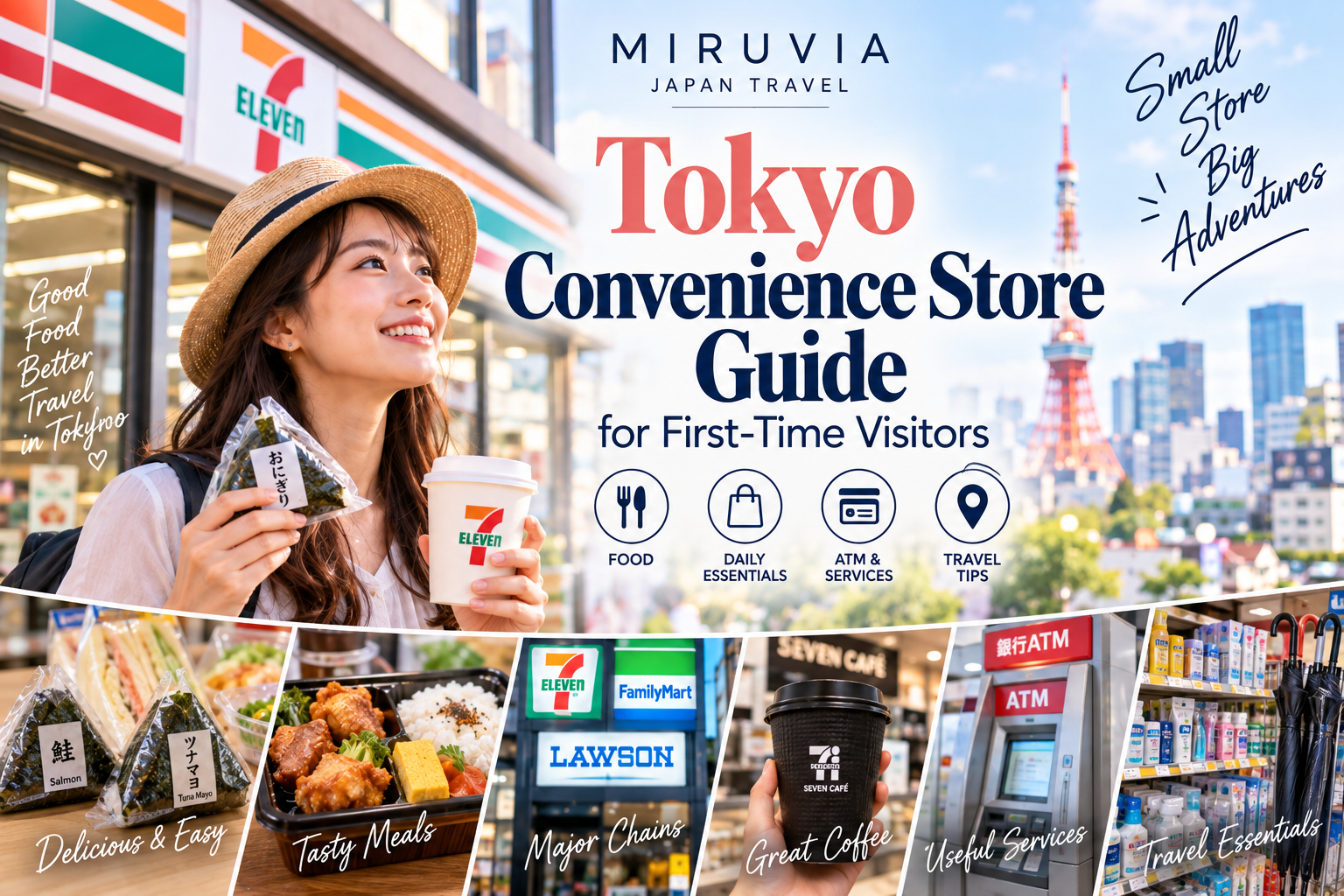
Convenience stores are everywhere in Tokyo, but for first-time visitors, they can be surprisingly useful.
Known as konbini in Japanese, convenience stores are much more than places to buy drinks and snacks. During a trip to Tokyo, you can use them for quick breakfasts, affordable meals, coffee, toiletries, ATMs, printing, and many other everyday needs.
Major chains such as 7-Eleven, FamilyMart, and Lawson can be found throughout the city, often close to train stations, hotels, and tourist areas.
If you know how to use them, convenience stores can make traveling in Tokyo considerably easier.
This guide explains what to buy at Japanese convenience stores, useful services for travelers, payment methods, etiquette, and practical tips for your first trip to Tokyo.
Tokyo Convenience Stores at a Glance
| Category | What You Can Find |
|---|---|
| Major chains | 7-Eleven, FamilyMart, Lawson |
| Quick meals | Onigiri, bento, sandwiches, noodles |
| Snacks | Chips, chocolate, Japanese sweets |
| Drinks | Water, tea, coffee, soft drinks |
| Breakfast | Bread, yogurt, fruit, eggs, coffee |
| Travel essentials | Toiletries, umbrellas, chargers |
| Useful services | ATMs, printing, copying |
| Payment | Cash, cards and various cashless options |
| Locations | Stations, neighborhoods, hotel areas |
| Best for travelers | Quick meals and everyday essentials |
What Is a Japanese Convenience Store?
Japanese convenience stores are small retail stores designed around everyday convenience.
Unlike convenience stores in some countries that primarily sell snacks and drinks, Japanese konbini usually offer a much broader range of products and services.
You can find prepared meals, hot snacks, desserts, coffee, toiletries, stationery, basic clothing items, umbrellas, and travel necessities in a relatively small space.
For travelers, their biggest advantage is accessibility.
You rarely need to plan a special trip to find one. In central Tokyo, convenience stores are common around stations, hotels, business districts, and residential neighborhoods.
Many locations operate for long hours, although opening hours can vary by store.
The Three Major Convenience Store Chains
Visitors to Tokyo will quickly notice three major names appearing throughout the city.
7-Eleven
7-Eleven is one of the most recognizable convenience store chains in Japan.
Stores typically offer a large selection of onigiri, sandwiches, bento, noodles, desserts, drinks, and everyday essentials.
For international travelers, 7-Eleven is also well known for its ATMs, which can be useful when you need Japanese yen during your trip.
FamilyMart
FamilyMart is another major chain found throughout Tokyo.
It offers the usual convenience store selection of meals, snacks, drinks, desserts, and daily necessities.
Many visitors also recognize FamilyMart for its selection of hot foods available near the checkout counter.
Lawson
Lawson is also widely available in Tokyo.
Like the other major chains, it sells meals, snacks, desserts, drinks, and practical everyday items.
Different convenience store chains have their own products and limited-time items, so it can be fun to visit more than one during your trip.
Best Convenience Store Foods to Try in Tokyo
One of the main reasons travelers visit Japanese convenience stores is the food.
Konbini meals should not replace every restaurant experience in Tokyo, but they are extremely useful when you need something fast, affordable, or easy.
For a broader introduction to Japanese food, restaurants, and local dishes, see our Tokyo Food Guide for First-Time Visitors.
1. Onigiri
Onigiri are Japanese rice balls and one of the easiest convenience store foods to try.
They are usually filled with ingredients such as salmon, tuna, pickled plum, or other Japanese flavors.
Many are wrapped in seaweed and packaged so that the seaweed remains separate from the rice until you open it.
The packaging can look confusing the first time, but numbered instructions often show the correct order for opening it.
Best for:
- Quick breakfast
- Light lunch
- Train journeys
- Small snacks
Trying several fillings during your trip is an easy way to discover which flavors you prefer.
2. Bento
Bento are prepared boxed meals containing combinations such as rice, meat, fish, vegetables, and side dishes.
They are useful when you want a more substantial meal without visiting a restaurant.
Some bento are intended to be eaten warm.
If appropriate for the product and store, staff may ask whether you want the meal heated.
3. Sandwiches
Japanese convenience stores sell a wide variety of sandwiches.
Common options include egg, ham, tuna, and mixed sandwiches.
They are simple, portable, and especially useful for travelers who want a familiar breakfast or light meal before sightseeing.
4. Noodles
Depending on the store, you may find ramen, soba, udon, pasta, and other noodle dishes in the refrigerated section.
Some are designed to be heated before eating.
These can be useful when you return to your hotel after a long sightseeing day and do not want to search for a restaurant.
5. Hot Snacks
Near the checkout counter, many convenience stores sell hot foods.
Depending on the chain and location, options may include fried chicken, croquettes, and other snacks.
Ordering can feel intimidating if you do not speak Japanese, but pointing to the item you want is often enough.
6. Japanese Desserts
The dessert section is worth exploring even if you are not looking for a full meal.
Convenience stores frequently sell puddings, cakes, cream-based desserts, mochi-style sweets, ice cream, and seasonal products.
The selection changes regularly, which means you may discover something different each time you visit.
7. Drinks and Coffee
Convenience stores have large refrigerated drink sections.
You can usually find:
- Bottled water
- Green tea
- Coffee
- Soft drinks
- Sports drinks
- Juice
- Milk drinks
Many stores also sell freshly prepared convenience-store coffee using machines near the checkout area.
This can be an easy and inexpensive option before beginning your sightseeing day.
Convenience Store Breakfast Ideas
Konbini are especially useful for breakfast.
Restaurants and cafés may not always match your sightseeing schedule, so buying breakfast from a convenience store can help you start early.
A simple breakfast might include:
Option 1
- Onigiri
- Yogurt
- Green tea
Option 2
- Egg sandwich
- Fruit
- Coffee
Option 3
- Bread or pastry
- Yogurt
- Bottled drink
You can also buy breakfast the night before and keep suitable refrigerated items in your hotel refrigerator.
Always check storage instructions and expiration information on the packaging.
Using Convenience Stores for Lunch
Convenience stores can also help when your sightseeing schedule is busy.
For example, you might not want to spend an hour searching for a restaurant between attractions.
Buying an onigiri, sandwich, or bento can provide a quick alternative.
However, be considerate about where you eat.
Do not assume that eating while walking or eating inside a store is appropriate everywhere. Some locations may have designated eating spaces, while others do not.
When in doubt, follow local signage and the behavior expected at that location.
Useful Convenience Store Services for Travelers
Food is only one reason convenience stores are useful.
Several services can solve common travel problems.
ATMs
Running out of Japanese yen can be stressful during a trip.
Convenience store ATMs are widely available, and some support international cards.
However, compatibility, fees, withdrawal limits, and operating conditions can depend on your card and the ATM network.
Before traveling, check your bank’s overseas withdrawal rules.
It is also useful to have more than one payment method available.
Printing and Copying
Many convenience stores have multifunction machines that can provide printing and copying services.
This can be useful if you need a paper copy of a reservation, ticket, travel document, or other information.
The exact functions and instructions vary by chain and machine.
Toiletries
Forgot something at home?
Convenience stores often sell basic travel necessities such as:
- Toothbrushes
- Toothpaste
- Razors
- Tissues
- Basic skincare products
- Hygiene products
The selection is smaller than a drugstore, but it can be extremely useful late at night or when you need something quickly.
Umbrellas
Sudden rain is not unusual during certain times of the year.
Convenience stores commonly sell umbrellas, making them a useful emergency stop when the weather changes unexpectedly.
Chargers and Small Electronics
Some stores sell charging cables, batteries, earphones, adapters, and other small electronic accessories.
Selection varies significantly by location, so electronics stores are still better for specialized items.
But for an emergency charging cable or battery, checking a nearby convenience store can be worthwhile.
How to Pay at a Japanese Convenience Store
Payment procedures are generally straightforward, although the exact checkout system varies by chain and store.
Cash remains useful, while many locations also accept major credit cards and various electronic payment methods.
Some registers require customers to select a payment method on a screen.
Others involve more direct interaction with the cashier.
If you are uncertain, wait for the screen or cashier instructions rather than rushing.
Do You Need Cash?
It is possible to use cashless payment frequently in Tokyo, but carrying some Japanese yen is still sensible.
Smaller businesses, older ticket machines, temples, local restaurants, and other situations may still require cash.
Convenience store ATMs can therefore become particularly useful during your trip.
Understanding the Checkout Process
Your first Japanese convenience store checkout may feel slightly unfamiliar.
The cashier may ask questions about your purchase, such as whether certain food should be heated or whether you need additional items.
If you do not understand, stay calm.
Simple gestures and context often make the meaning clear.
Self-checkout or semi-self-service payment systems are also increasingly common in some locations.
Bags, Chopsticks and Spoons
Depending on what you purchase, you may need a bag, chopsticks, spoon, fork, or other utensil.
Do not automatically assume everything will be included.
Check your purchase before leaving, particularly if you plan to eat somewhere else.
Bringing a reusable shopping bag can also be convenient during your trip.
Convenience Store Etiquette
Konbini are casual places, but basic etiquette still matters.
Queue Properly
Look for floor markings or signs showing where the checkout line begins.
Avoid standing directly in front of a register if a separate queue has formed.
Prepare Your Payment
Have your cash, card, or payment method ready when possible.
This keeps the checkout process moving smoothly.
Do Not Open Products Before Paying
Pay for food and drinks before opening or consuming them.
Follow Rules About Eating
Some stores or buildings may have specific areas where eating is permitted.
If you are unsure, check signage rather than assuming you can eat anywhere.
Dispose of Trash Properly
Public trash bins can sometimes be difficult to find in Tokyo.
Do not leave packaging behind.
Use appropriate waste bins when available, or keep your trash with you until you find a suitable place to dispose of it.
Convenience Stores Near Your Hotel
One useful thing to check after arriving in Tokyo is the location of the nearest convenience store.
Save it on your map along with your hotel and nearest train station.
A nearby konbini can become useful for:
- Breakfast
- Bottled water
- Late-night food
- Snacks
- Toiletries
- Umbrellas
- Cash withdrawals
- Emergency travel items
This is particularly convenient after a long sightseeing day when you do not want to travel farther for basic necessities.
Using Convenience Stores Late at Night
Convenience stores can be especially helpful after restaurants and shops begin closing.
Operating hours vary, but many locations stay open late and some operate around the clock.
This makes them useful if you return to your hotel late and need food, drinks, or basic supplies.
However, do not assume every store is open 24 hours.
Check the specific location if late-night access is important.
Convenience Stores vs Supermarkets
Convenience stores prioritize accessibility and speed.
Supermarkets often offer a larger selection and may provide better value for certain groceries and larger purchases.
Use convenience stores when you need something quickly.
Consider supermarkets when you want:
- Larger grocery selections
- Fresh produce
- Multiple meals
- Larger quantities
- More options for longer stays
Both can be useful during a Tokyo trip.
Convenience Stores vs Restaurants
Tokyo has an extraordinary food scene, so you should not spend your entire trip eating convenience store meals.
Use konbini strategically.
They are particularly useful for:
- Early breakfasts
- Quick lunches
- Late-night meals
- Snacks
- Travel days
- Busy sightseeing schedules
For memorable food experiences, make time for restaurants as well.
A good Tokyo trip can include both.
If you are planning your daily expenses, our Tokyo Travel Budget Guide explains typical travel costs and practical ways to manage your budget.
What Should First-Time Visitors Buy?
If this is your first trip to Japan, consider trying a mixture of practical and fun items.
A simple first konbini shopping list could include:
- One onigiri
- Japanese egg sandwich
- Green tea
- Convenience-store coffee
- A Japanese dessert
- A seasonal snack
- Bottled water
After that, explore the shelves and try products that look interesting.
Part of the fun is discovering items you may not find at home.
Common Convenience Store Mistakes to Avoid
Convenience stores are easy to use, but first-time visitors sometimes make avoidable mistakes.
Try not to:
- Assume every store accepts every payment method
- Depend on a single foreign bank card
- Throw trash into the wrong bin
- Eat in places where it is not permitted
- Forget utensils for takeaway food
- Buy every meal from a convenience store and miss Tokyo’s restaurants
- Assume every location has identical products or services
- Assume every store operates 24 hours
A little awareness makes the experience much easier.
Practical Konbini Tips for First-Time Visitors
Keep these tips in mind:
- Save the convenience store closest to your hotel.
- Carry both cash and another payment method.
- Check food expiration and storage information.
- Try different chains because product selections vary.
- Buy breakfast the night before when you have an early start.
- Use convenience stores for travel emergencies.
- Check whether your meal needs heating.
- Make sure you have the utensils you need.
- Keep your trash until you find an appropriate bin.
- Do not rely on konbini for every meal.
For more practical advice before your first visit, read our essential Tokyo Travel Tips for First-Time Visitors.
Are Tokyo Convenience Stores Worth Visiting?
Absolutely.
For Japanese residents, convenience stores are part of everyday life.
For travelers, they are both practical and an interesting introduction to modern daily life in Japan.
You might enter your first konbini because you need water and leave with an onigiri, dessert, coffee, umbrella, and a completely unexpected snack.
That combination of convenience and discovery is part of what makes Japanese convenience stores memorable for many visitors.
Final Thoughts
Tokyo convenience stores can make a first trip to Japan significantly easier.
They provide quick meals, snacks, drinks, ATMs, travel essentials, and useful everyday services throughout the city.
You do not need to understand every product or service during your first visit.
Start with something simple, explore the shelves, and learn how the stores work as you travel.
Use convenience stores for what they do best: making everyday travel easier.
Then spend the time you save exploring more of Tokyo.
Continue planning your trip with our complete Tokyo Travel Guide for First-Time Visitors.
