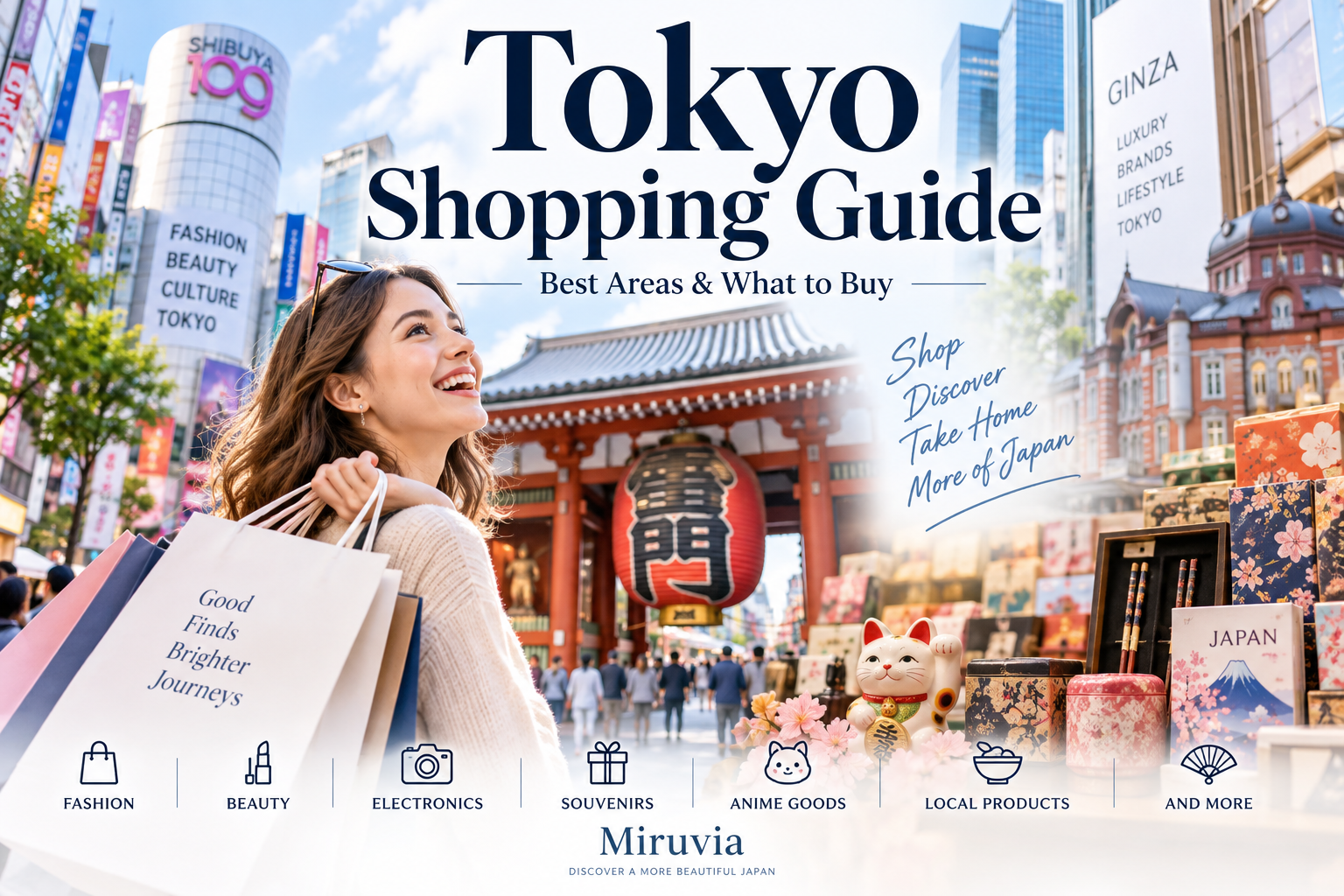
Tokyo is one of the world’s most exciting cities for shopping, offering everything from fashion and electronics to anime goods, Japanese cosmetics, traditional crafts, stationery, snacks, and souvenirs.
For first-time visitors, however, the enormous number of shopping areas and stores can make it difficult to know where to begin. Shibuya and Harajuku are known for fashion and youth culture, Ginza offers department stores and luxury shopping, Akihabara is famous for electronics and pop culture, while Asakusa is a useful area for traditional Japanese souvenirs.
Shopping in Tokyo does not need to be expensive. Alongside major department stores and specialty shops, you can find drugstores, convenience stores, 100-yen shops, and other affordable places to buy useful items and gifts.
It is also worth understanding a few practical details before you shop. Payment methods, tax-free shopping procedures, store opening hours, luggage space, and product restrictions when returning home can all affect what and where you buy.
This Tokyo shopping guide explains the best shopping areas, what to buy, where to find souvenirs, department stores, drugstores, affordable shopping, tax-free purchases, payment methods, and practical tips for first-time visitors.
Whether you are searching for Japanese souvenirs, anime merchandise, cosmetics, fashion, electronics, or simply want to browse Tokyo’s shops, a little planning can help you spend more time enjoying the experience and less time traveling between stores.
Is Tokyo Good for Shopping?
Yes. Tokyo is an excellent city for shopping because of the enormous variety of products, neighborhoods, and stores available.
You can spend one part of the day browsing major fashion stores in Shibuya, explore electronics and anime merchandise in Akihabara, shop at department stores in Ginza, and look for traditional souvenirs around Asakusa.
Tokyo is particularly appealing because shopping is available across many different budgets. Luxury boutiques and specialist stores exist alongside affordable chains, drugstores, convenience stores, secondhand shops, and 100-yen stores.
Shopping can also be easily combined with sightseeing. Many of Tokyo’s major shopping districts are destinations in their own right, with restaurants, cafés, entertainment, and attractions nearby.
For first-time visitors, the main challenge is usually deciding where to spend your time. Tokyo is too large to visit every major shopping district efficiently in a single day, so it is better to choose areas based on what you actually want to buy.
For example, travelers interested in fashion may prioritize Shibuya, Harajuku, and Ginza, while visitors looking for anime, manga, games, or electronics may spend more time in Akihabara.
Before making expensive purchases, compare prices and check product specifications, warranty conditions, tax-free eligibility, and whether the item will work or can legally be brought into your home country.
Tip: Make a short list of the things you most want to buy before deciding which shopping areas to visit. This can prevent you from spending valuable sightseeing time traveling between similar stores across Tokyo.
Best Shopping Areas in Tokyo
Tokyo’s shopping districts have very different personalities. Instead of trying to visit all of them, choose the areas that best match the products and experiences you are interested in.
These seven areas are particularly useful for first-time visitors.
Shibuya
Shibuya is one of Tokyo’s major destinations for fashion, shopping, entertainment, and youth culture.
The area contains department stores, fashion complexes, specialty shops, lifestyle stores, and numerous places to eat and drink. It is particularly convenient if you want to combine shopping with attractions such as Shibuya Crossing.
Best for: fashion, accessories, lifestyle goods, entertainment, and a lively atmosphere.
Keep in mind: Shibuya is busy and spread across several shopping complexes, so decide which stores interest you before arriving if your time is limited.
Shinjuku
Shinjuku offers an enormous variety of shopping around one of Tokyo’s busiest transportation hubs.
You can find department stores, electronics retailers, fashion shops, drugstores, bookstores, and many other types of stores within the wider station area.
Best for: travelers who want many types of shopping in one area.
Keep in mind: Shinjuku Station and its surroundings are extremely large. Check which exit or side of the station your destination is near before you start walking.
Ginza
Ginza is known for department stores, luxury brands, flagship shops, restaurants, and polished shopping streets.
Even if luxury shopping is not part of your budget, the area can still be enjoyable for browsing department stores, Japanese brands, food halls, stationery, and specialty products.
Best for: department stores, luxury goods, Japanese brands, gifts, and a more refined shopping experience.
Keep in mind: some stores focus on premium products, but you do not need a luxury budget to explore Ginza.
Harajuku and Omotesando
Harajuku and Omotesando offer contrasting but complementary shopping experiences within walking distance of each other.
Harajuku is associated with youth fashion, character goods, trends, and colorful shopping streets, while Omotesando has designer boutiques, larger brands, and stylish architecture.
Best for: fashion, trends, accessories, youth culture, and design-focused shopping.
Keep in mind: popular streets can become very crowded, particularly during busy periods.
Akihabara
Akihabara is one of Tokyo’s best-known areas for electronics and Japanese pop culture.
Visitors can find electronics retailers alongside stores specializing in anime, manga, games, figures, trading cards, collectibles, and other character merchandise.
Best for: electronics, anime, manga, games, figures, and collectibles.
Keep in mind: compare prices and product specifications carefully when buying electronics. Check language settings, voltage compatibility, warranties, and whether a product is intended for use outside Japan.
Asakusa
Asakusa is a useful shopping area for visitors looking for souvenirs and products connected with traditional Japanese culture.
The streets around Senso-ji contain numerous shops selling snacks, small gifts, crafts, accessories, and other souvenir items.
Shopping here can easily be combined with sightseeing around Senso-ji and the surrounding historic streets.
Best for: traditional-style souvenirs, Japanese sweets, small gifts, and sightseeing combined with shopping.
Keep in mind: the area is heavily visited by tourists, so compare options rather than assuming the first souvenir shop will be the best choice.
Tokyo Station
Tokyo Station is particularly convenient for travelers who want to shop without adding another major neighborhood to their itinerary.
The station and surrounding complexes offer souvenirs, sweets, character merchandise, food, fashion, and other products.
It can be especially useful near the beginning or end of a journey, or when transferring between Tokyo and another Japanese city.
Best for: souvenirs, Japanese sweets, character goods, gifts, and convenient last-minute shopping.
Keep in mind: Tokyo Station is extremely large. Allow enough time to find specific stores, particularly if you also need to catch a train.
Want to combine shopping with sightseeing? See our Best Areas to Visit in Tokyo for First-Time Visitors for a broader comparison of Tokyo’s major neighborhoods.
What to Buy in Tokyo
Tokyo offers an enormous range of products that can make useful purchases, memorable souvenirs, or gifts to take home.
What you should buy depends on your interests, budget, luggage space, and the customs regulations of the country you will return to.
These are some of the most popular categories for first-time visitors.
Japanese Snacks and Sweets
Japanese snacks and sweets are easy-to-find souvenirs because they come in a huge variety of flavors, sizes, and packaging.
Look for regional or seasonal products, traditional wagashi, cookies, chocolates, rice crackers, matcha-flavored sweets, and other packaged snacks.
Department store food halls, Tokyo Station, supermarkets, convenience stores, and souvenir shops are all useful places to browse.
Tip: Check expiration dates and your destination country’s food import rules before buying large quantities.
Cosmetics and Skincare
Japanese cosmetics and skincare products are widely available in Tokyo, from affordable everyday items to premium beauty brands.
Drugstores, department stores, specialty beauty shops, and brand stores can all be useful depending on what you are looking for.
Product packaging and instructions may primarily be in Japanese, so check the ingredients, intended use, quantity, and any restrictions that matter to you before purchasing.
Tip: If you are buying a product for sensitive skin or because of a specific ingredient, confirm the current formulation rather than relying only on online recommendations.
Anime, Manga and Character Goods
Tokyo is an excellent place to shop for anime, manga, games, figures, trading cards, and character merchandise.
Akihabara is the most obvious destination for many first-time visitors, but character stores and specialist shops can also be found in areas such as Ikebukuro, Shibuya, and Tokyo Station.
Products range from inexpensive small souvenirs to limited-edition collectibles.
Tip: For expensive collectibles, check the condition, whether the item is new or secondhand, and exactly what is included before purchasing.
Fashion and Accessories
Tokyo offers fashion across almost every style and budget.
Shibuya and Harajuku are useful for trends and youth fashion, Ginza and Omotesando offer premium and designer shopping, and department stores provide many brands in one location.
Secondhand fashion is also popular in Tokyo and can be worth exploring if you enjoy searching for unusual or discontinued items.
Tip: Japanese clothing and shoe sizing may differ from sizing in your home country. Try items on when possible and check measurements carefully.
Traditional Japanese Souvenirs
Traditional-style souvenirs can be a good choice if you want something that reflects Japanese design, craftsmanship, or everyday culture.
Options may include:
- Chopsticks
- Tenugui cloths
- Folding fans
- Ceramics
- Small decorative items
- Tea-related goods
- Traditional-pattern accessories
- Japanese sweets
Asakusa is particularly convenient for browsing this type of souvenir, although traditional goods can be found throughout Tokyo.
Tip: Fragile ceramics and other breakable items require careful packing, so consider how you will transport them before buying.
Stationery
Japan is well known for its wide selection of stationery, making it an excellent souvenir category for travelers who want something practical and easy to pack.
You can find notebooks, pens, pencils, stickers, masking tape, letter sets, planners, and design-focused paper products at specialist stores, department stores, lifestyle shops, and large general retailers.
Stationery can also work well as a small gift because many items are inexpensive and take up very little luggage space.
Electronics
Tokyo offers everything from cameras and headphones to household electronics, gaming accessories, and small gadgets.
Large electronics retailers in areas such as Akihabara and Shinjuku make it easy to compare many products in one place.
Before buying electronics, check:
- Voltage and plug compatibility
- Available languages
- Regional restrictions
- Warranty coverage outside Japan
- Whether the product can be serviced in your country
- Airline restrictions for batteries
A lower price does not necessarily make an electronic product a good purchase if it cannot be conveniently used or serviced after you return home.
Tip: Leave some luggage space before arriving in Tokyo if shopping is an important part of your trip. Small purchases can add up surprisingly quickly.
Where to Buy Souvenirs in Tokyo
Souvenirs are available throughout Tokyo, so you do not need to dedicate an entire day to souvenir shopping.
The best place to shop depends on what you want to buy and when you want to carry it during your trip.
Useful places to look for souvenirs include:
- Asakusa — traditional-style gifts, Japanese sweets, crafts, and small souvenirs
- Tokyo Station — packaged sweets, character goods, gifts, and convenient last-minute shopping
- Department stores — high-quality sweets, food gifts, cosmetics, household goods, and Japanese brands
- Shopping centers — fashion, lifestyle products, character merchandise, and general gifts
- Specialty stores — useful when you want something specific such as stationery, crafts, anime goods, or Japanese design products
- Drugstores — cosmetics, skincare, personal-care products, and everyday Japanese goods
- 100-yen shops — inexpensive small gifts, stationery, household items, and travel accessories
- Supermarkets and convenience stores — snacks, drinks, sweets, and inexpensive food souvenirs
If you are buying gifts for several people, consider purchasing lightweight and individually packaged items. They are generally easier to organize and pack than bulky souvenirs.
You also do not need to buy everything when you first see it. However, limited, seasonal, or location-specific products may not be available elsewhere, so decide whether an item would be difficult to replace before leaving it behind.
Travelers continuing to other parts of Japan should consider luggage space before buying large quantities in Tokyo. In many cases, it is easier to leave some souvenir shopping until later in the trip.
For food, cosmetics, medicines, plants, animal products, and other regulated items, check the customs and import rules of your destination country before purchasing.
Tip: Keep a simple souvenir list on your phone with the people you are buying for. It can help prevent both forgotten gifts and unnecessary purchases.
Department Stores in Tokyo
Department stores are useful shopping destinations in Tokyo because they bring many different types of products together in one building.
Depending on the store, you may find fashion, cosmetics, accessories, household goods, traditional Japanese products, stationery, restaurants, and extensive food departments.
They can be particularly convenient for first-time visitors who want to browse high-quality products without traveling between many individual specialty stores.
Major shopping areas such as Shinjuku, Ginza, Shibuya, Ikebukuro, and the Tokyo Station area have large department stores and commercial complexes.
One of the highlights of Japanese department stores is the basement food floor, commonly called a depachika. These floors often contain:
- Japanese and Western sweets
- Bento boxes
- Sushi and prepared foods
- Bread and pastries
- Seasonal specialties
- Gift boxes
- Premium food products
Depachika can be especially useful for buying food souvenirs or exploring Japanese food products in one location.
Department stores may also provide services useful to international visitors, such as tax-free shopping procedures, information counters, or multilingual assistance. Available services vary by store, so check the current information at the specific location you visit.
Restaurant floors are also common in department stores, making it easy to combine shopping with lunch or dinner without leaving the building.
If you plan to purchase an expensive item, compare prices, return conditions, warranty coverage, and tax-free eligibility before completing the purchase.
Interested in Tokyo’s food halls as well as shopping? See our Tokyo Food Guide: What and Where to Eat for First-Time Visitors for more information about depachika and other dining options.
Convenience Stores and Drugstores
Convenience stores and drugstores are useful places for everyday shopping in Tokyo and can also be surprisingly good sources of inexpensive souvenirs.
They are widely available across the city, so you usually do not need to travel to a specific neighborhood just to visit one.
Convenience Stores
Convenience stores sell much more than food and drinks. Depending on the location, you may also find toiletries, travel essentials, stationery, batteries, umbrellas, basic clothing items, and other useful products.
They are particularly convenient when you forget something at your hotel, need an item late in the day, or want inexpensive snacks and sweets to take home.
Product selection varies between stores, and seasonal or limited-edition items may appear throughout the year.
Drugstores
Japanese drugstores are popular with international visitors because many locations sell cosmetics, skincare, personal-care products, toiletries, and other everyday goods in addition to medicines.
Large stores in major shopping districts may carry an extensive range of Japanese beauty and personal-care products.
When buying cosmetics or skincare, check the product type, ingredients, quantity, and instructions rather than relying only on packaging or online recommendations.
Extra care is necessary when purchasing medicines. A product sold without a prescription in Japan may contain different active ingredients or be subject to different rules in your home country.
Check your destination country’s import regulations before purchasing medicines to take abroad, particularly if you plan to buy multiple packages.
Convenience stores and drugstores can be useful for filling small gaps in your shopping list, but there is usually no need to build an entire sightseeing day around them. Visit stores near the neighborhoods you are already exploring.
Tip: Take a photograph of the exact product name or packaging if you are searching for a specific Japanese item. Similar-looking products may have different formulations or purposes.
100-Yen Shops and Affordable Shopping
Shopping in Tokyo does not have to be expensive. The city has many stores where travelers can find practical items, small gifts, stationery, household goods, and souvenirs at relatively low prices.
100-yen shops are particularly popular with visitors because they offer a huge variety of inexpensive products in one place.
Depending on the store, you may find:
- Stationery
- Kitchen accessories
- Travel items
- Storage products
- Small household goods
- Japanese-style decorations
- Gift-wrapping supplies
- Snacks and sweets
- Beauty accessories
- Small souvenirs
Despite the name, not every product necessarily costs exactly 100 yen before tax. Some stores also sell higher-priced items, so check the displayed price before purchasing.
Affordable shopping is not limited to 100-yen shops. Variety stores, supermarkets, drugstores, secondhand shops, and large general retailers can also be useful when you want inexpensive products or gifts.
These stores are particularly helpful if you need small souvenirs for several people. Lightweight stationery, practical household items, and packaged goods are generally easier to pack than large decorative souvenirs.
However, low prices can make it easy to buy more than you intended. Consider whether you actually have enough luggage space before filling your basket with small items.
Tip: Set a rough souvenir budget before visiting large discount or 100-yen stores. Small purchases can quickly become a surprisingly large collection.
Tax-Free Shopping in Japan
Eligible international visitors may be able to use Japan’s tax-free shopping system when purchasing qualifying goods from participating tax-free stores.
However, tax-free shopping is not automatically available at every store or for every purchase. Eligibility, required identification, qualifying purchases, and procedures are determined by Japan’s current tax-free shopping rules.
Japan’s tax-free shopping system is changing from November 1, 2026. Under the new refund system, eligible travelers will generally purchase qualifying goods at the tax-inclusive price and receive the amount equivalent to consumption tax after the required departure procedures confirm that the goods are being taken out of Japan.
Because procedures can change, travelers should check the latest official information before relying on tax-free shopping as part of their budget.
When shopping tax-free:
- Look for stores that participate in Japan’s tax-free shopping system
- Carry the identification and travel documents required under the current rules
- Follow the store’s tax-free procedures
- Keep relevant purchase information until departure
- Make sure qualifying goods are taken out of Japan as required
- Allow additional time for any necessary departure procedures
Individual stores may handle the process differently, particularly as the new system is introduced. Ask the store how its tax-free procedure works before completing a large purchase.
Tax-free shopping should be treated as a possible saving rather than the main reason to buy something. Compare the final price, product specifications, warranty, and whether you genuinely want the item before making a purchase.
Tip: Tax-free shopping rules can change. Check the latest official Japanese government information shortly before your trip, especially if you are traveling on or after November 1, 2026.
How to Pay When Shopping in Tokyo
Payment options in Tokyo have become increasingly diverse, but the methods accepted can still vary from one store to another.
Major department stores, shopping centers, electronics retailers, and many chain stores commonly accept major credit cards and other cashless payment methods. Smaller shops, traditional businesses, markets, and some independent stores may have more limited options.
For this reason, it is useful to have more than one way to pay while shopping in Tokyo.
Consider carrying:
- A major credit or debit card — useful for many larger purchases and stores
- Some Japanese yen in cash — useful when a store does not accept your preferred cashless method
- Another payment option — helpful if your primary card is declined or temporarily unavailable
Contactless payments and mobile payment systems are available at many businesses, but you should not assume that every store accepts the same services.
Before making a large purchase, check which payment methods the store accepts. If you are using a foreign-issued card, your bank or card provider may also apply foreign transaction fees or currency conversion charges.
When a payment terminal offers a choice between paying in Japanese yen or your home currency, check the exchange rate and fees carefully before selecting an option.
Keep receipts for expensive purchases, tax-free transactions, warranties, or items you may need to return or exchange.
Return and exchange policies can also differ from those in your home country. Do not assume that an unwanted item can automatically be returned after purchase, particularly if it has been opened or used.
Tip: Carry a card and some Japanese yen rather than relying on a single payment method throughout your trip.
Shopping with Luggage
Shopping can quickly add weight and volume to your luggage, especially if you buy souvenirs, clothing, cosmetics, food, or larger items during your stay.
If shopping is an important part of your Tokyo trip, plan for luggage space before you leave home rather than trying to solve the problem after your suitcase is already full.
Practical options include:
- Leave extra space in your suitcase — one of the simplest solutions if you already expect to shop
- Pack a foldable extra bag — useful for lightweight purchases on the return journey
- Use coin lockers when sightseeing — helpful when you do not want to carry shopping bags around all day
- Use hotel luggage storage — ask whether your accommodation can hold luggage before check-in or after check-out
- Consider luggage forwarding — useful when moving between hotels or cities in Japan
- Buy bulky items later in your trip — this reduces the amount of time you need to carry them
When using station lockers, remember that availability and locker sizes vary. Large lockers can be harder to find during busy periods, so they should not be your only plan for oversized luggage.
If you are continuing from Tokyo to another Japanese city, consider whether it makes sense to buy large souvenirs before carrying them through the rest of your trip.
Also check your airline’s baggage allowance before making large or heavy purchases. Excess baggage fees can easily reduce the value of a bargain.
Certain products may also be restricted in checked or carry-on baggage. Batteries, liquids, aerosols, and other regulated items can be subject to airline and aviation-security rules, so check the current requirements before packing them.
Planning how much to bring to Japan? See our Tokyo Packing List: What to Bring for Your First Trip to Japan for a practical packing checklist.
When Are Shops Open in Tokyo?
Shopping hours in Tokyo vary considerably depending on the type of store, neighborhood, and individual business.
Many department stores, shopping centers, fashion stores, and specialty shops open later in the morning than visitors may expect and remain open into the evening. However, there is no single opening schedule that applies across Tokyo.
Convenience stores are useful when other businesses are closed, and many operate for extended hours. Drugstores and large retailers may also stay open later than traditional shops, depending on the location.
When planning a shopping day, keep these points in mind:
- Check specific stores before visiting — opening hours can differ even between locations of the same chain
- Do not plan important shopping too early in the morning — many retail stores may not yet be open
- Check closing times before evening visits — especially if you need a particular store
- Look for temporary closures — maintenance, holidays, or other circumstances can affect normal schedules
- Check department store floors separately when necessary — restaurants and other facilities may operate on different schedules from retail floors
- Allow enough time before closing — tax-free procedures or larger purchases may take additional time
Japanese public holidays, New Year, building maintenance days, and special events can also affect business hours.
If a particular shop is an important part of your itinerary, check its official website or official social media information shortly before your visit rather than relying only on an older travel article or map listing.
For casual browsing, you can usually remain flexible and simply visit stores while exploring the surrounding neighborhood.
Tip: Plan sightseeing for the morning and shopping for later in the day when appropriate. This can work well because many attractions become active earlier than some retail stores.
Common Shopping Mistakes to Avoid
Shopping in Tokyo can be one of the most enjoyable parts of a trip, but a few common mistakes can waste time, increase costs, or create problems when you return home.
Try to avoid these mistakes:
- Trying to visit every major shopping district — Tokyo is enormous, so choose areas based on what you actually want to buy.
- Buying everything at the first store you visit — prices and selections can vary, particularly for electronics, collectibles, and secondhand goods.
- Ignoring luggage space — small purchases can quickly become difficult to pack when accumulated over several days.
- Assuming every purchase is tax-free — eligibility and procedures depend on Japan’s current tax-free shopping rules and the participating store.
- Forgetting customs regulations at home — food, medicines, cosmetics, plants, animal products, and other items may be restricted when entering another country.
- Buying electronics without checking compatibility — confirm voltage, plugs, language settings, regional restrictions, and warranty coverage.
- Assuming clothing sizes are the same as at home — check measurements or try items on when possible.
- Relying on only one payment method — keep another payment option available in case your preferred method is not accepted.
- Ignoring return and exchange policies — rules vary by store and may be more restrictive than you expect.
- Leaving important shopping until the final minutes of your trip — finding a specific product or completing tax-free procedures can take longer than expected.
- Buying too much simply because something is inexpensive — consider whether you actually want the item and have space to take it home.
Another mistake is allowing shopping to dominate an itinerary when it was not originally a priority. Tokyo’s major shopping areas can consume several hours very easily, so decide how much of your trip you actually want to dedicate to shopping.
Tip: Before buying something large, expensive, fragile, or regulated, ask yourself four questions: Can I use it at home? Can I pack it? Can I legally bring it home? Is the final price actually worth it?
Tokyo Shopping Tips for First-Time Visitors
Shopping in Tokyo becomes much easier when you decide what matters to you before visiting stores.
You do not need a detailed shopping schedule, but a little preparation can save time and help you avoid unnecessary purchases.
Keep these practical tips in mind:
- Decide what you want to buy first. Choose shopping areas based on your interests rather than trying to visit every famous district.
- Combine shopping with sightseeing. Shop in neighborhoods you already plan to explore whenever possible.
- Save specific stores on your map. This is particularly useful for specialty products, limited items, or stores you definitely want to visit.
- Check current opening hours. Do this shortly before visiting any store that is important to your plans.
- Compare expensive purchases. Price, warranty, specifications, condition, and tax-free eligibility can all matter.
- Keep some Japanese yen available. Payment methods vary between businesses.
- Understand tax-free rules before relying on them. Procedures and eligibility can change.
- Check sizes and specifications carefully. Clothing, shoes, cosmetics, and electronics may differ from products sold in your home country.
- Think about luggage before buying. Consider the size, weight, fragility, and airline restrictions of your purchases.
- Keep important receipts. They may be needed for tax-free procedures, warranties, returns, or your own records.
- Check customs rules before buying regulated products. Your destination country determines what you can legally bring home.
- Leave some flexibility. Unexpected shops and products can be part of the fun of exploring Tokyo.
Most importantly, remember that you do not need to buy something simply because it is popular in Japan. The best souvenirs are products that you genuinely want to use, eat, display, or give to someone after your trip.
Tip: Create a simple shopping list with three categories — must buy, would like to buy, and only if I find something special. This makes it much easier to control both your time and budget.
Final Thoughts
Shopping in Tokyo can be as simple or as extensive as you want it to be.
From fashion in Shibuya and Harajuku to department stores in Ginza, electronics and pop culture in Akihabara, traditional souvenirs in Asakusa, and convenient gift shopping around Tokyo Station, each area offers a different experience.
You do not need to visit every famous shopping district. Choose the neighborhoods that match what you actually want to buy and combine shopping with the sightseeing already in your itinerary.
Tokyo also offers options for almost every budget. Department stores and specialty shops can be mixed with drugstores, convenience stores, secondhand shops, supermarkets, and 100-yen stores depending on what you are looking for.
Before making expensive or unusual purchases, check product specifications, warranty conditions, luggage requirements, and any customs restrictions that apply when you return home.
Tax-free shopping may also be available to eligible international visitors, but procedures and requirements can change. Check the latest official information before your trip rather than relying on outdated rules.
Finally, leave some room for unexpected discoveries. Tokyo is filled with stores that you may never encounter while researching from home, and browsing them can become part of the travel experience itself.
Plan the purchases that matter most, keep your schedule flexible, and enjoy discovering what Tokyo has to offer.
Ready to plan the rest of your trip? See our Tokyo Travel Guide for First-Time Visitors for an overview of sightseeing, transportation, food, accommodation, seasons, and other essential information.
