Planning your first trip to Tokyo can be exciting—but deciding how to spend your time can be surprisingly difficult.
Tokyo is enormous. Shibuya, Shinjuku, Asakusa, Ginza, Ueno, and many other neighborhoods each offer a completely different experience, and trying to see everything in one trip can quickly become overwhelming.
The good news is that you do not need to see all of Tokyo to have an unforgettable first visit.
With a well-planned itinerary, you can explore modern neighborhoods, historic temples, famous food areas, shopping districts, and some of the city’s most memorable sights without spending your entire trip rushing from place to place.
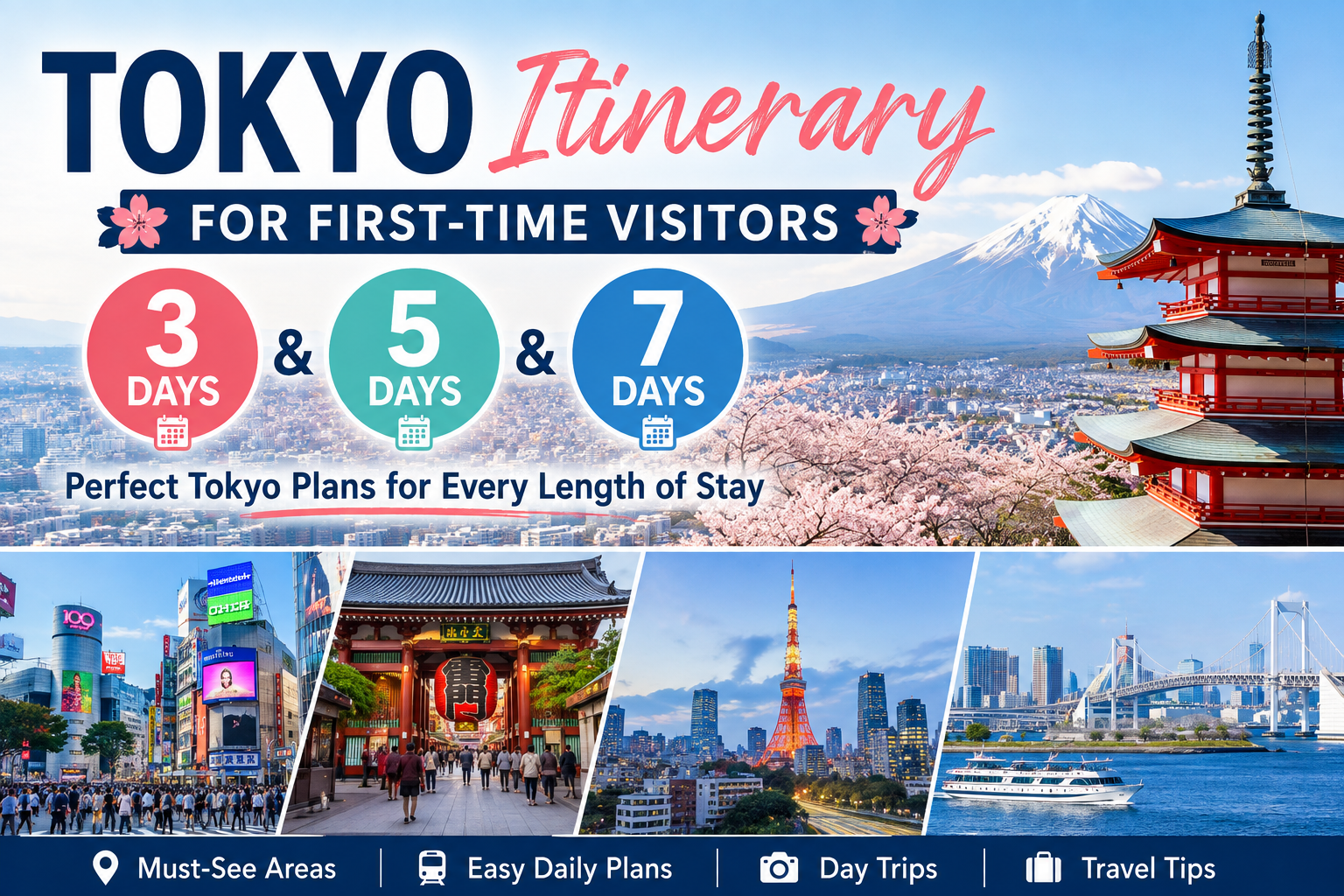
In this guide, we will show you how to spend 3, 5, or 7 days in Tokyo, with practical itineraries designed especially for first-time visitors.
You can follow these itineraries as they are or adjust them depending on your interests, travel pace, and the length of your stay.
If you are still deciding where to base yourself, read our guide to Where to Stay in Tokyo for First-Time Visitors before planning your daily itinerary.
Quick Answer: How Many Days Do You Need in Tokyo?
For most first-time visitors, 5 days is an excellent amount of time to spend in Tokyo.
Three days is enough to experience several of the city’s most famous neighborhoods, while five days gives you a more comfortable pace and time to explore beyond the major highlights. With seven days, you can slow down, discover more of Tokyo, and add a day trip outside the city.
Use the table below to choose the itinerary that best matches your trip.
| Length | Best For | What You Can Experience | Pace |
|---|---|---|---|
| 3 Days | Short first trip | Major Tokyo highlights | Busy |
| 5 Days | Most first-time visitors | Highlights + deeper exploration | Balanced |
| 7 Days | Longer first trip | Tokyo + day trip + flexible time | Relaxed |
If you have the flexibility, we recommend spending 5 days in Tokyo on your first visit. It gives you enough time to experience both modern and traditional Tokyo without making every day feel rushed.
However, a shorter trip can still be extremely rewarding. The key is grouping nearby neighborhoods together and avoiding unnecessary travel across the city.
Before You Plan Your Tokyo Itinerary
Before deciding exactly what to do each day, it helps to understand one important thing about Tokyo: the city is much larger than it may look on a map.
Tokyo’s public transportation system makes it possible to travel almost anywhere in the city, but moving between distant neighborhoods can still take time. A good itinerary therefore groups nearby areas together instead of constantly crossing the city.
For example, Shibuya and Harajuku are easy to combine, while Asakusa and Ueno work well together on another day. This simple approach can reduce unnecessary travel and give you more time to actually enjoy each neighborhood.
Keep these four principles in mind when planning your trip:
Group nearby neighborhoods together — Plan each day around one part of Tokyo rather than jumping between distant areas.
Do not schedule every hour — Leave room for meals, shopping, unexpected discoveries, and simply exploring.
Allow extra time for transportation — Large stations and transfers can take longer than expected, especially on your first visit.
Choose your priorities — You do not need to see everything. Focus on the places and experiences that matter most to you.
The itineraries below follow these principles. Think of them as a practical starting point rather than a strict schedule—you can easily adjust them to match your own travel style.
Still deciding which experiences to prioritize? Explore our Best Things to Do in Tokyo for First-Time Visitors for ideas covering iconic attractions, traditional culture, food, shopping, pop culture, and city views.
Not sure which neighborhoods to include? See our Best Areas to Visit in Tokyo for First-Time Visitors to compare Tokyo’s major areas and choose the ones that best match your interests.
Tokyo 3-Day Itinerary
Three days in Tokyo is enough to experience many of the city’s most famous highlights, but you will need to choose your areas carefully.
This itinerary groups nearby neighborhoods together to reduce unnecessary travel while giving you a mix of modern Tokyo, traditional culture, shopping, food, and nightlife.
You do not need to follow every stop exactly. Use this itinerary as a framework and spend more time in the places that interest you most.
Day 1 — Shibuya, Harajuku & Shinjuku
Start your first day in western Tokyo, where some of the city’s most famous modern neighborhoods are located. Shibuya, Harajuku, and Shinjuku are relatively close to one another, making them a practical combination for your first day.
Morning — Shibuya
Begin your morning in Shibuya, one of the best places to experience the energy of modern Tokyo.
See the famous Shibuya Scramble Crossing, explore the streets around the station, and take some time to browse the area’s shops and cafés. If you want a panoramic view of the city, you can also consider visiting one of Shibuya’s observation spots.
Do not rush through the neighborhood just to check off the crossing. Exploring the smaller streets around Shibuya is part of the experience.
Afternoon — Harajuku & Meiji Shrine
From Shibuya, continue toward Harajuku.
Explore the area around Harajuku and Omotesando before visiting Meiji Shrine, where the forested approach offers a striking contrast to the busy streets nearby.
This combination is a good example of what makes Tokyo so interesting: modern fashion, shopping, and pop culture can exist only a short walk from a peaceful shrine surrounded by trees.
Evening — Shinjuku
Finish your first day in Shinjuku.
Explore the skyscraper district, department stores, restaurants, and the livelier streets on the east side of the station. Shinjuku is particularly enjoyable after dark, when the signs and city lights create a very different atmosphere from the daytime.
Have dinner in the area and take your time exploring before returning to your hotel.
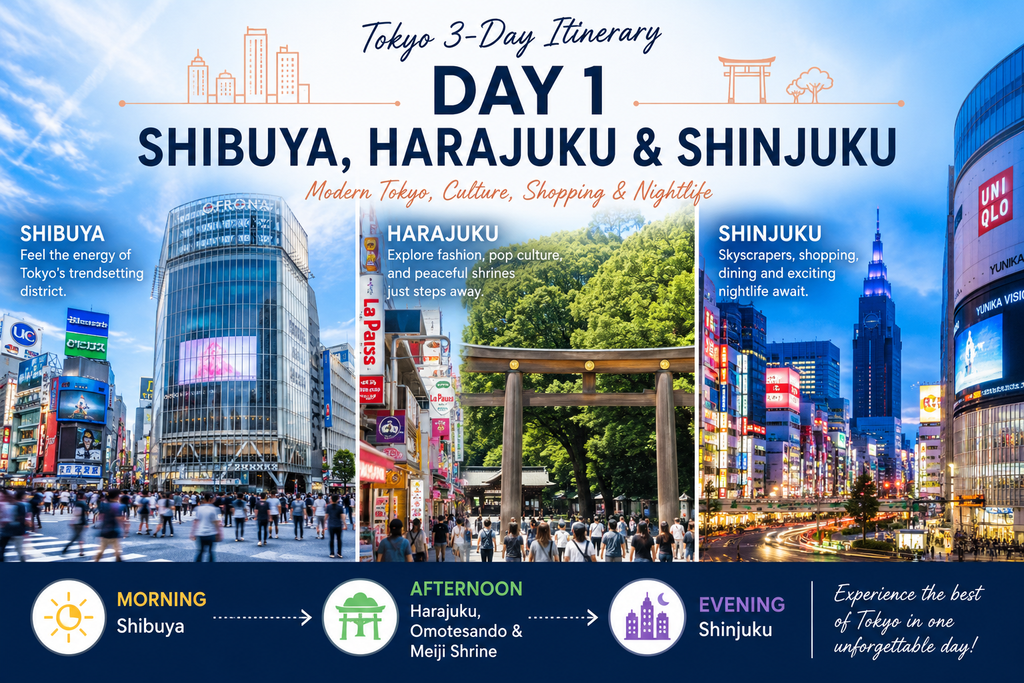
Day 1 at a Glance
Morning: Shibuya
Afternoon: Harajuku, Omotesando & Meiji Shrine
Evening: Shinjuku
Best for: Modern Tokyo, shopping, city atmosphere and nightlife
Day 2 — Asakusa, Ueno & Akihabara
On your second day, explore the eastern side of Tokyo, where historic neighborhoods, museums, traditional streets, and modern pop culture are relatively close together.
Starting in Asakusa and gradually moving toward Ueno and Akihabara creates a natural route and gives you a very different experience from your first day in western Tokyo.
Morning — Asakusa
Begin your day in Asakusa, one of the best areas for experiencing traditional Tokyo.
Walk through Kaminarimon Gate and Nakamise shopping street toward Senso-ji Temple, taking time to explore the smaller streets around the temple area as well.
Asakusa is especially pleasant earlier in the day, before the busiest sightseeing hours. Rather than rushing from one landmark to another, allow some time to enjoy the atmosphere, browse traditional shops, and try a local snack along the way.
Afternoon — Ueno
Continue to Ueno, where you can choose how deeply you want to explore depending on your interests.
Walk through Ueno Park, visit one of the area’s museums, or explore the streets around the station and nearby Ameyoko shopping area.
You do not need to visit every attraction in Ueno. If museums are important to you, give yourself more time here. Otherwise, Ueno can work as a relaxed cultural stop between Asakusa and Akihabara.
Evening — Akihabara
Finish the day in Akihabara, Tokyo’s best-known district for electronics, anime, manga, games, and otaku culture.
Explore the large electronics stores and smaller specialty shops around the station. Even if anime or gaming is not a major part of your trip, walking through Akihabara after dark offers another memorable view of modern Tokyo.
If you are particularly interested in anime, manga, or games, consider shortening your time in Ueno and spending a longer afternoon and evening here.
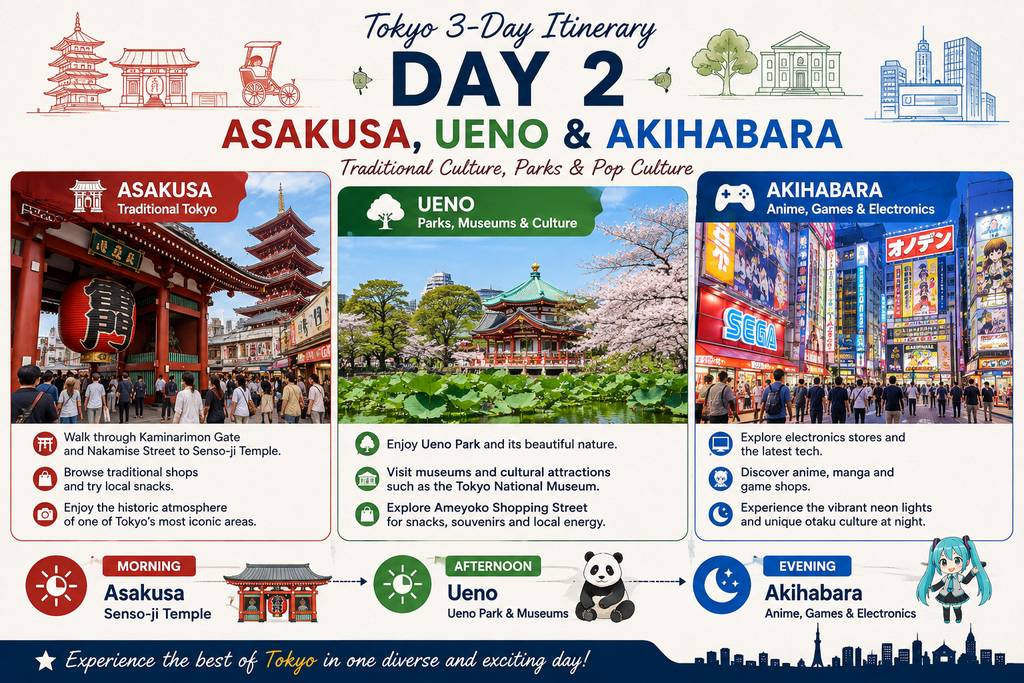
Day 2 at a Glance
Morning: Asakusa & Senso-ji Temple
Afternoon: Ueno Park, museums & Ameyoko
Evening: Akihabara
Best for: Traditional Tokyo, culture, museums, anime, manga and games
Day 3 — Tokyo Station, Ginza & Tokyo Bay
On your third day, explore central Tokyo before finishing your three-day itinerary around Tokyo Bay.
This route combines the architecture and transportation hub around Tokyo Station, the polished streets of Ginza, and the more open waterfront atmosphere of Tokyo Bay. It is a good way to experience another side of the city before the end of your trip.
Morning — Tokyo Station
Start your morning around Tokyo Station, one of the city’s most important transportation hubs and a useful starting point for exploring central Tokyo.
Take some time to see the historic Marunouchi side of the station and walk through the surrounding business district. If you are interested in the Imperial Palace area, you can also explore the public spaces around the palace grounds nearby.
Tokyo Station itself is worth exploring as well. Its underground passages and shopping areas contain restaurants, shops, and places to pick up souvenirs before continuing your day.
Afternoon — Ginza
From Tokyo Station, continue to Ginza, one of Tokyo’s best-known shopping districts.
Walk along the main streets, explore department stores and specialty shops, and stop for lunch or coffee along the way. Even if luxury shopping is not a priority, Ginza is worth experiencing for its architecture, polished atmosphere, and central location.
Because Tokyo Station and Ginza are relatively close, you can explore both without spending much of the day in transit.
Evening — Tokyo Bay
Spend your final evening around Tokyo Bay, where the city opens up into a very different landscape of waterfront views, modern architecture, and entertainment areas.
Depending on your interests, you can explore areas such as Odaiba or simply enjoy the waterfront atmosphere before dinner.
Keep this part of the day flexible. After three busy days of sightseeing, you may prefer a relaxed evening rather than trying to fit in several more attractions.
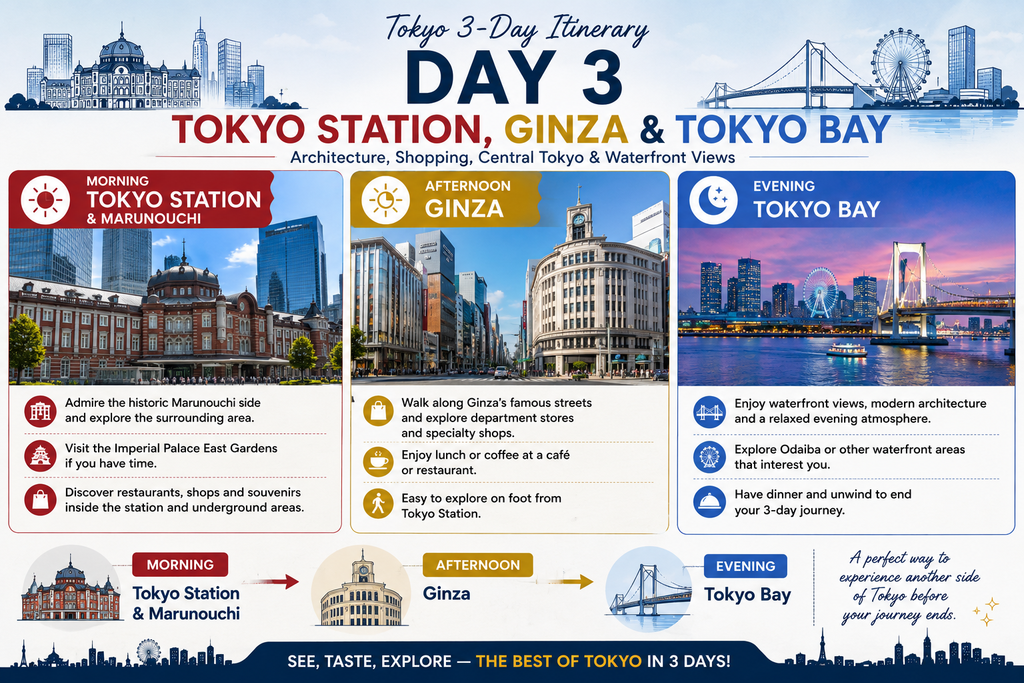
Day 3 at a Glance
Morning: Tokyo Station & Marunouchi
Afternoon: Ginza
Evening: Tokyo Bay
Best for: Architecture, shopping, central Tokyo and waterfront views
Tokyo 5-Day Itinerary
If you have five days in Tokyo, you can experience the city’s major highlights at a more comfortable pace while adding neighborhoods and experiences that are difficult to fit into a shorter trip.
For most first-time visitors, five days offers the best balance between sightseeing and flexibility. You can follow the three-day itinerary above for your first three days, then use Days 4 and 5 to explore Tokyo more deeply.
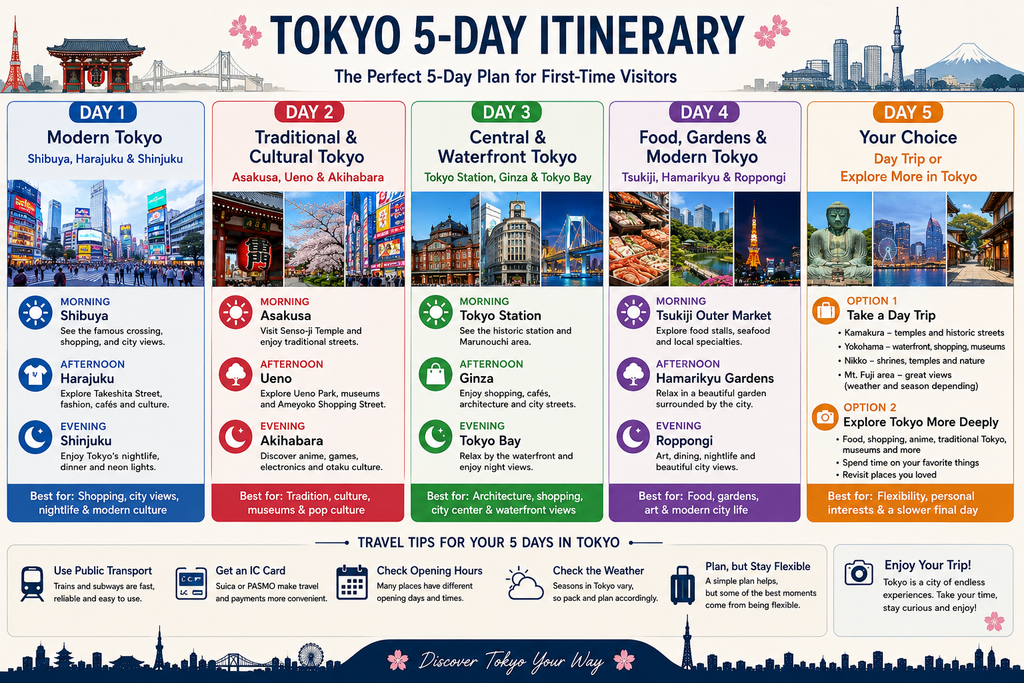
A simple five-day plan looks like this:
Day 1: Shibuya, Harajuku & Shinjuku
Day 2: Asakusa, Ueno & Akihabara
Day 3: Tokyo Station, Ginza & Tokyo Bay
Day 4: Tsukiji, Hamarikyu & Roppongi
Day 5: Choose a Day Trip or Explore Tokyo More Deeply
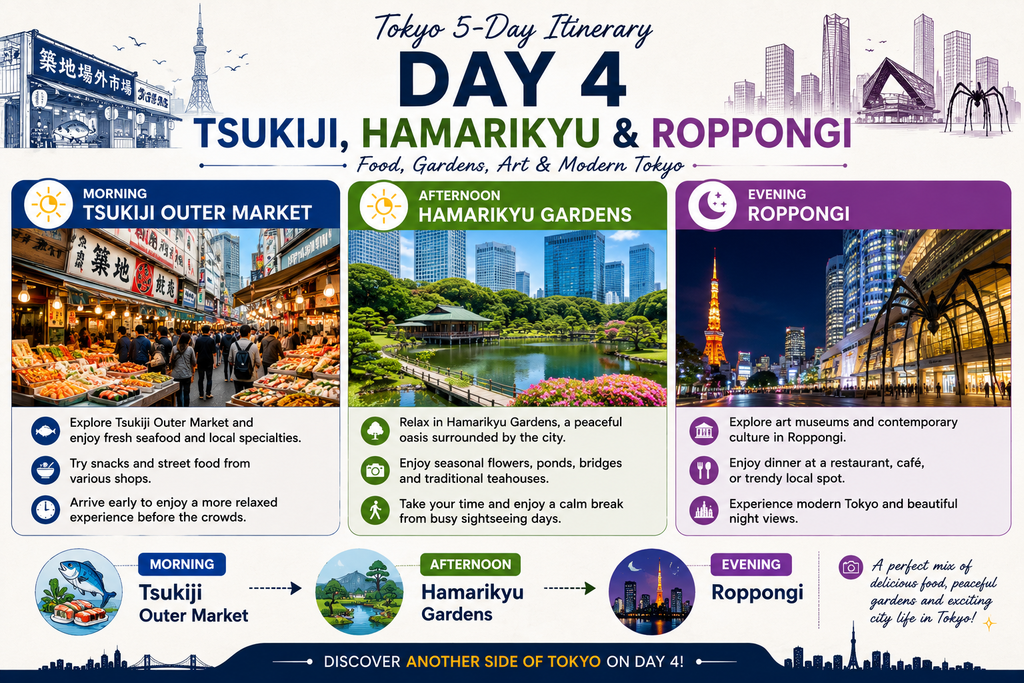
Day 4 — Tsukiji, Hamarikyu & Roppongi
After three days of major sightseeing, Day 4 slows the pace slightly and combines food, gardens, and another side of modern Tokyo.
The day begins around Tsukiji before moving through the nearby waterfront area and finishing in Roppongi, giving you a mixture of local food, green space, art, and city views.
Morning — Tsukiji
Start the morning around Tsukiji Outer Market, where you can explore shops and food stalls selling seafood, Japanese ingredients, snacks, and other specialties.
Arriving earlier in the day generally gives you more time to explore before moving on. Rather than trying to eat at every popular shop, choose a few things that interest you and treat the area as both a food stop and a chance to see another side of Tokyo’s culinary culture.
Afternoon — Hamarikyu Gardens
From Tsukiji, continue toward Hamarikyu Gardens, a landscaped garden surrounded by the modern city.
After several busy days in Tokyo, spending some time walking through a quieter green space can provide a welcome change of pace.
Take your time here rather than treating the garden as another attraction to complete quickly.
Evening — Roppongi
Finish the day in Roppongi, an area known for contemporary art, restaurants, nightlife, and modern city views.
Depending on your interests, you can visit an art museum, explore the surrounding developments, have dinner in the area, or simply enjoy Tokyo after dark.
Keeping the evening flexible also gives you room to return to somewhere you enjoyed earlier in the trip.
Day 4 at a Glance
Morning: Tsukiji Outer Market
Afternoon: Hamarikyu Gardens
Evening: Roppongi
Best for: Food, gardens, art and modern Tokyo
Day 5 — Choose a Day Trip or Explore Tokyo More Deeply
By Day 5, you will already have experienced many of Tokyo’s major neighborhoods. Instead of adding another packed sightseeing route, use your final day to choose what matters most to you.
You have two good options: take a day trip outside central Tokyo or stay in the city and explore one of your interests more deeply.
Option 1 — Take a Day Trip
If you want to see a different side of Japan, Day 5 is a good opportunity to take a day trip from Tokyo.
Popular options include:
Kamakura — Temples, shrines, historic streets, and a more relaxed atmosphere south of Tokyo.
Yokohama — A waterfront city with shopping, food, museums, and a different urban atmosphere from central Tokyo.
Nikko — An option for travelers interested in historic shrines, temples, and nature, although it requires a longer journey.
Mt. Fuji area — A good choice when seeing Mount Fuji is a major priority, but visibility and the best destination can depend heavily on weather and season.
A day trip adds variety to your itinerary, but do not feel that you have to leave Tokyo. Five days is still nowhere near enough to see everything the city offers.
Option 2 — Explore Tokyo More Deeply
If you would rather stay in Tokyo, use Day 5 to explore according to your interests.
For food: Return to an area you enjoyed and spend more time exploring restaurants, markets, cafés, and local specialties.
For shopping: Spend more time in Shibuya, Shinjuku, Ginza, Harajuku, or another shopping district that matches your style.
For anime and manga: Give yourself more time in Akihabara or explore other areas connected to Japanese pop culture.
For traditional Tokyo: Return to the eastern side of the city or explore quieter neighborhoods, temples, shrines, and traditional streets.
For museums and art: Build the day around one or two museums rather than trying to fit them between other attractions.
Day 5 at a Glance
Option 1: Take a day trip from Tokyo
Option 2: Explore Tokyo based on your interests
Best for: Flexibility, personal interests and a slower final day
Whichever option you choose, avoid turning your final day into a checklist. By this point in your trip, you may have discovered a neighborhood, food, museum, or experience that you want to revisit—and making time for that can be more rewarding than adding another famous attraction.
Tokyo 7-Day Itinerary
Seven days gives you much more flexibility on your first trip to Tokyo. Instead of rushing through the city, you can spend more time in the neighborhoods you enjoy, add a day trip, and leave room for experiences that are difficult to fit into a shorter itinerary.
Start with the five-day itinerary above, then use Days 6 and 7 to expand your trip based on your interests.
A simple seven-day plan looks like this:
Day 1: Shibuya, Harajuku & Shinjuku
Day 2: Asakusa, Ueno & Akihabara
Day 3: Tokyo Station, Ginza & Tokyo Bay
Day 4: Tsukiji, Hamarikyu & Roppongi
Day 5: Explore Tokyo More Deeply
Day 6: Take a Day Trip from Tokyo
Day 7: Slow Down, Revisit Favorites & Enjoy Your Final Day
Day 6 — Take a Day Trip from Tokyo
After five days exploring Tokyo, Day 6 is a good opportunity to experience somewhere outside the city.
Tokyo’s extensive rail connections make several destinations possible as day trips, allowing you to see a different side of Japan without changing hotels.
Choose one destination rather than trying to combine several places in the same day.
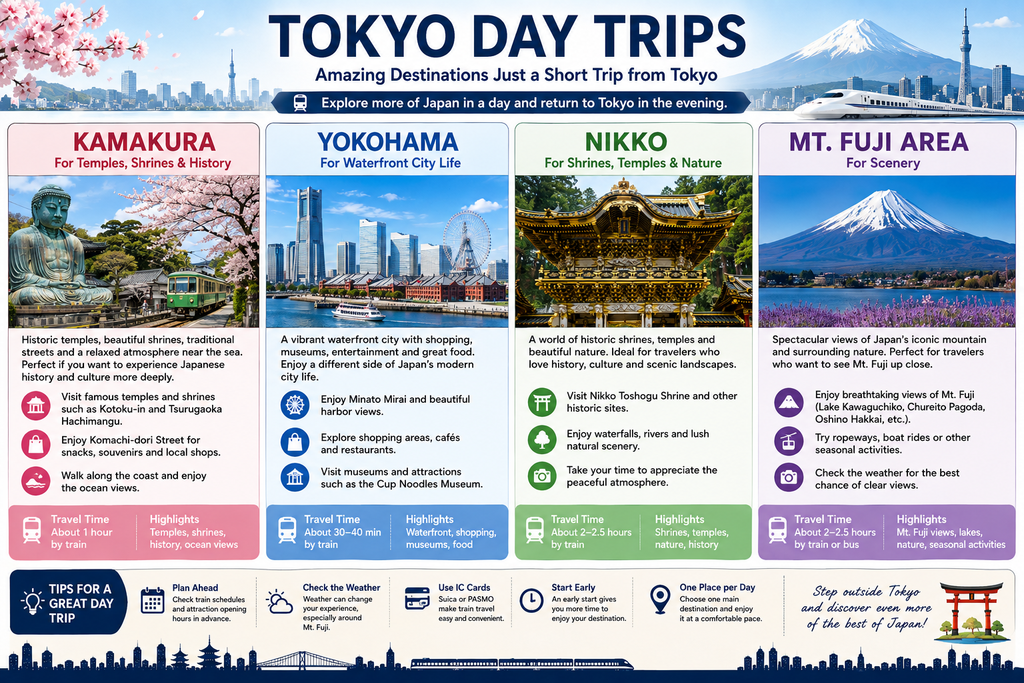
Kamakura — For Temples, Shrines & History
Kamakura is a strong choice if you want to experience historic temples, shrines, traditional streets, and a more relaxed atmosphere than central Tokyo.
It works particularly well for travelers who enjoyed Asakusa but want to explore Japanese history and religious sites more deeply.
Yokohama — For Waterfront City Life
Yokohama offers a different urban experience with waterfront areas, shopping, museums, and food.
It is a good option if you want an easy change of scenery while still enjoying the convenience of a major city.
Nikko — For Shrines, Temples & Nature
Nikko is worth considering if historic architecture and nature are major priorities for your trip.
Because the journey is longer than some other day-trip options, plan for an early start and avoid adding too many activities to the same day.
Mt. Fuji Area — For Scenery
If seeing Mount Fuji is one of your biggest reasons for visiting Japan, you can dedicate Day 6 to the Fuji area.
Keep in mind that views of Mount Fuji depend on weather conditions, and the best experience can vary by season. Check the forecast before committing a large part of your itinerary to mountain views.
Want to compare more options before choosing your day trip? See our Best Day Trips from Tokyo for First-Time Visitors for Hakone, Kamakura, Nikko, Yokohama, Kawagoe, Mt. Takao, Lake Kawaguchi, and practical planning tips.
Day 6 at a Glance
Choose one: Kamakura, Yokohama, Nikko or the Mt. Fuji area
Best for: Experiencing somewhere beyond Tokyo
Tip: Check transportation, opening hours and weather shortly before your trip
Day 7 — Slow Down, Revisit Favorites & Enjoy Your Final Day
After six days of sightseeing, your final day in Tokyo does not need another packed itinerary.
By now, you will probably have discovered neighborhoods, foods, shops, or experiences that you enjoyed more than expected. Use Day 7 to return to your favorites, explore somewhere you missed, or simply experience Tokyo at a slower pace.
Leaving part of your final day open also gives you flexibility for shopping, souvenirs, packing, or adjusting plans because of weather earlier in the trip.
Option 1 — Revisit Your Favorite Neighborhood
Return to the area you enjoyed most during your trip.
You might want another evening in Shinjuku, more shopping in Shibuya, a slower walk through Asakusa, additional time in Akihabara, or another meal in Ginza.
Revisiting a neighborhood often feels very different from seeing it for the first time because you can explore without worrying about checking off major sights.
Option 2 — Explore Somewhere You Missed
If there is still an area on your list, use your final day to explore it without trying to combine too many neighborhoods.
Choose one part of Tokyo and give yourself time to wander, stop for food, visit shops, or discover places that were not originally part of your itinerary.
Option 3 — Shopping, Food & Souvenirs
Your final day is also a practical time for shopping and souvenirs.
Return to a department store, shopping street, specialty shop, or food area you discovered earlier in the trip. Keeping your final purchases until later can also help you avoid carrying extra items throughout your sightseeing days.
Day 7 at a Glance
Morning: Keep your schedule flexible
Afternoon: Revisit a favorite or explore somewhere new
Evening: Enjoy a final meal or neighborhood in Tokyo
Best for: Flexibility, shopping, revisiting favorites and a relaxed end to your trip
A seven-day trip gives you something that shorter Tokyo itineraries cannot: time to change your plans.
If you discover somewhere you love, stay longer. If the weather changes, move an outdoor activity to another day. And if you are tired, take a slower morning without feeling that you are missing your only opportunity to see Tokyo.
The goal is not to complete every item on an itinerary. It is to use your time in a way that makes your first trip to Tokyo memorable.
How to Adjust This Tokyo Itinerary
No Tokyo itinerary works perfectly for every traveler.
The routes above are designed as practical starting points for first-time visitors, but you should adjust them based on your interests, energy level, weather, and who you are traveling with.
Here are some simple ways to customize the itinerary without rebuilding your entire trip.
If You Love Traditional Japan
Spend more time in Asakusa and consider adding quieter temples, shrines, gardens, or historic neighborhoods to your itinerary.
Kamakura or Nikko can also be strong day-trip choices if temples, shrines, and Japanese history are among your main interests.
You can reduce time in shopping-focused areas such as Shibuya or Ginza to create more room for these experiences.
If You Love Shopping
Give yourself additional time in Shibuya, Shinjuku, Harajuku, and Ginza instead of trying to fit shopping between sightseeing stops.
Tokyo’s major shopping districts can easily take several hours to explore, so consider making shopping one of the main activities of the day rather than treating it as something to do only when you have spare time.
If You Love Anime, Manga & Games
Spend more time in Akihabara and consider building part of another day around Japanese pop culture.
Rather than rushing through Akihabara in a single evening, travelers with a strong interest in anime, manga, games, figures, or electronics may want several hours to explore stores at their own pace.
If You Are Traveling with Children
Reduce the number of neighborhoods you visit each day and leave more time for meals, rest, and transportation.
Large Tokyo stations and busy sightseeing areas can be tiring, especially when traveling with young children. One or two main areas in a day may be more enjoyable than trying to follow every stop in this itinerary.
It is also useful to keep at least part of each day flexible in case your plans take longer than expected.
If It Rains
Tokyo still offers plenty to do on rainy days.
Move shopping, museums, department stores, indoor observation areas, and other indoor activities to rainy periods, and save gardens, long neighborhood walks, and outdoor viewpoints for clearer weather.
With a five- or seven-day itinerary, you have more flexibility to move activities between days rather than canceling them completely.
Think of the itinerary as a framework rather than a set of rules. A good Tokyo itinerary should adapt to your trip—not force your trip to adapt to the itinerary.
Where to Stay for This Tokyo Itinerary
Choosing the right place to stay can make this Tokyo itinerary much easier to follow.
For first-time visitors, staying near a well-connected train or subway station can reduce unnecessary travel and make it easier to reach different parts of the city each day.
Shinjuku is one of our top choices for first-time visitors because of its extensive transportation connections and easy access to many areas of Tokyo. However, it is not the best choice for everyone.
Shibuya may suit travelers who prioritize shopping and nightlife, while Asakusa offers a more traditional atmosphere. Ginza and the Tokyo Station area can be convenient for travelers who prefer a central location, and Ueno can be useful for access toward Narita Airport.
For a complete comparison of these neighborhoods, read our Where to Stay in Tokyo for First-Time Visitors guide before booking your hotel.
If you have not planned the rest of your Tokyo trip yet, our Tokyo Travel Guide for First-Time Visitors covers transportation, food, sightseeing, the best time to visit, and other essentials for planning your first stay.
Tokyo Itinerary Tips for First-Time Visitors
Even a well-planned Tokyo itinerary works better when you leave room for the realities of traveling through such a large city.
Keep these practical tips in mind as you explore Tokyo for the first time.
Use an IC Card for Transportation
An IC card can make getting around Tokyo much easier by allowing you to tap in and out of trains, subways, and many buses without buying a separate ticket for every journey.
Depending on your device and availability during your trip, you may be able to use a physical or mobile IC card. Check the latest options before you travel, as availability and services can change.
For a complete explanation of trains, subways, IC cards, airport access, and navigation, see our Tokyo Transportation Guide for First-Time Visitors.
Avoid the Busiest Rush Hours When Possible
Tokyo’s trains can become extremely crowded during weekday commuting periods.
As a visitor, you usually have more flexibility than local commuters, so avoiding the busiest morning and evening periods can make transportation more comfortable—especially if you are carrying luggage.
Allow Extra Time at Large Stations
Stations such as Shinjuku, Tokyo, Shibuya, and Ueno can be much larger than first-time visitors expect.
Finding the correct platform or exit can take additional time, so do not plan connections too tightly. The exit you choose can also make a significant difference in how far you need to walk once you reach your destination.
Expect to Walk a Lot
Even with Tokyo’s excellent public transportation, sightseeing often involves a considerable amount of walking.
Wear comfortable shoes, take breaks when you need them, and avoid assuming that every attraction near the same station is only a few minutes apart.
Check Opening Hours Before Each Day
Opening days and hours can vary between temples, museums, observation decks, shops, gardens, and other attractions.
Check the official information for places that are important to your itinerary shortly before visiting, particularly if admission requires advance reservations.
Do Not Overplan Your Meals
Tokyo has an enormous number of places to eat, and some of your most enjoyable meals may be places you discover while exploring.
Make reservations for restaurants that are especially important to you, but leave some meals flexible so you can try something you find along the way.
Most importantly, build extra time into your itinerary. Tokyo is a city where an interesting shop, side street, café, shrine, or neighborhood can easily change your plans—and that is often part of what makes exploring the city so enjoyable.
Plan a Realistic Daily Budget
Your daily spending can vary significantly depending on your accommodation, meals, attractions, and shopping. Setting a rough daily budget before your trip can help you enjoy your itinerary without constantly worrying about expenses.
For practical estimates covering accommodation, food, transportation, sightseeing, and different trip lengths, see our Tokyo Travel Budget: How Much Does a Trip to Tokyo Cost?
Planning your first Tokyo trip involves more than choosing where to go. See our Tokyo Travel Tips for First-Time Visitors for practical advice on transportation, money, etiquette, luggage, restaurants, airports, and other essentials.
Final Thoughts
Tokyo can feel overwhelming when you first start planning your trip, but you do not need to experience everything in one visit.
The key is choosing the right amount of time for your trip, grouping nearby neighborhoods together, and leaving enough flexibility to enjoy the places you discover along the way.
If you only have 3 days, focus on Tokyo’s major highlights and avoid trying to cover too much of the city.
With 5 days, you can explore at a more comfortable pace and experience more of Tokyo beyond the most famous neighborhoods. For most first-time visitors, this is the itinerary we recommend.
With 7 days, you have enough flexibility to slow down, take a day trip, revisit your favorite areas, and adjust your plans depending on your interests and the weather.
Whichever itinerary you choose, treat it as a starting point rather than a checklist. Some of the best moments in Tokyo happen when you leave enough time to explore beyond your original plans.
If you are still planning the rest of your trip, read our Tokyo Travel Guide for First-Time Visitors for more practical information about transportation, food, sightseeing, seasons, and other essentials for your first visit to Tokyo.
Plan the essentials, leave room for discovery, and enjoy your first trip to Tokyo.
