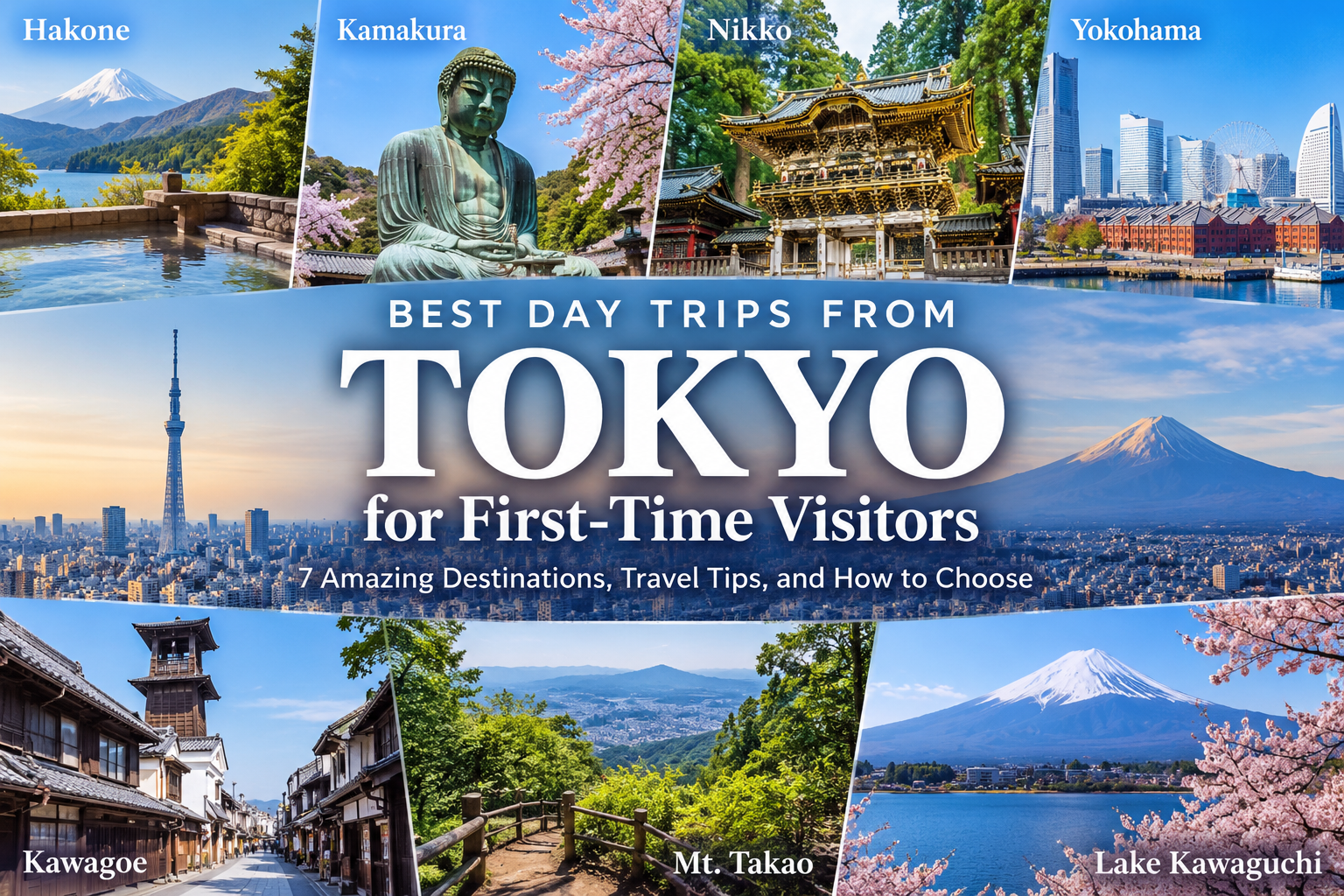
Tokyo has enough attractions to fill an entire trip, but spending one day outside the city can show you a completely different side of Japan.
Within a few hours of central Tokyo, you can visit historic temples, mountain landscapes, hot spring towns, coastal cities, traditional streets, and some of the best places to see Mt. Fuji.
The challenge for first-time visitors is deciding which day trip is worth adding to a limited Tokyo itinerary. Hakone, Kamakura, Nikko, Yokohama, Kawagoe, Mt. Takao, and Lake Kawaguchi all offer different experiences, and the best choice depends on what you want to see and how much travel time you are comfortable with.
This guide compares the best day trips from Tokyo for first-time visitors, including what each destination is best known for, how much time to allow, and practical considerations when planning your journey.
You do not need to take several day trips to enjoy Japan. For many first-time visitors, choosing one destination that matches your interests is enough to add variety to a Tokyo-focused itinerary.
Best Day Trips from Tokyo at a Glance
Tokyo offers many excellent day trip options, but each destination provides a very different experience.
Some places are best for history and traditional culture, while others are better for nature, hiking, hot springs, coastal scenery, or views of Mt. Fuji.
The table below provides a quick comparison to help you choose the destination that best matches your interests.
| Destination | Best For | Approx. Travel Time from Central Tokyo | Ideal For |
|---|---|---|---|
| Hakone | Hot springs, nature, Mt. Fuji views | Around 1.5–2 hours | Nature & relaxation |
| Kamakura | Temples, Great Buddha, coast | Around 1 hour | History & culture |
| Nikko | Shrines, temples, mountain scenery | Around 2 hours | History & nature |
| Yokohama | Waterfront, city views, food | Around 30–45 minutes | Easy day trip |
| Kawagoe | Traditional streets & old-town atmosphere | Around 30–60 minutes | Culture & photography |
| Mt. Takao | Hiking & nature | Around 1 hour | Outdoor activities |
| Lake Kawaguchi | Mt. Fuji views & lakeside scenery | Around 2 hours | Mt. Fuji scenery |
If this is your first trip to Japan, you do not need to visit all of these destinations. Choose one based on the experience you value most and consider the amount of travel time involved.
Kamakura and Yokohama are relatively easy to add to a Tokyo itinerary, while destinations such as Hakone, Nikko, and Lake Kawaguchi require more travel time and benefit from an earlier start.
1. Hakone — Hot Springs, Mt. Fuji Views and Nature
Hakone is one of the most popular day trips from Tokyo, especially for travelers who want to experience nature, hot springs, and possible views of Mt. Fuji.
Located in Kanagawa Prefecture, Hakone offers a very different atmosphere from central Tokyo. The area is known for mountain scenery, Lake Ashi, hot spring resorts, museums, and the volcanic landscape around Owakudani.
One of the most popular ways to explore Hakone is to combine several forms of transportation, including trains, buses, cable cars, ropeways, and sightseeing boats. This allows you to experience different parts of the area in a single day, although the journey requires more planning than easier day trips such as Yokohama or Kamakura.
Mt. Fuji can sometimes be seen from parts of Hakone when the weather is clear, but visibility is never guaranteed. Clouds can hide the mountain even when the rest of the weather seems relatively good, so avoid planning your entire day around seeing Fuji.
Hakone is also famous for onsen, or Japanese hot springs. Some facilities allow day visitors, while others are primarily connected to hotels and ryokan. If visiting an onsen is important to you, check the facility’s rules, opening hours, and tattoo policies in advance.
What to See in Hakone
Popular places and experiences include:
- Lake Ashi
- Owakudani
- Hakone Ropeway
- Hakone Shrine
- Hot springs
- Museums and art attractions
- Views of Mt. Fuji when weather conditions allow
Who Should Choose Hakone?
Hakone is a good choice if you want a break from Tokyo’s urban environment and are interested in mountains, hot springs, scenic transportation, and Japanese resort culture.
Because reaching and exploring Hakone takes time, start your day early and avoid trying to fit too many attractions into your schedule.
If hot springs are a major priority, staying overnight in Hakone can provide a more relaxed experience than visiting as a day trip.
2. Kamakura — Temples, the Great Buddha and Coastal Scenery
Kamakura is one of the easiest and most rewarding day trips from Tokyo for first-time visitors. Located south of Tokyo in Kanagawa Prefecture, the city combines historic temples, shrines, traditional streets, and coastal scenery.
Kamakura was once an important political center of Japan, and today it is particularly famous for its Buddhist temples and the Great Buddha of Kamakura. Compared with central Tokyo, the city feels smaller and more relaxed, making it a good destination when you want to experience history and traditional culture without traveling too far.
One of Kamakura’s advantages is its accessibility. Depending on your departure point and route, you can reach the area from central Tokyo in around an hour, making it possible to enjoy a full day without an extremely early start.
The main attractions are spread across different parts of the city, so some planning is still useful. Trains, local buses, and walking can be combined to explore the area efficiently.
What to See in Kamakura
Popular places and experiences include:
- The Great Buddha of Kamakura at Kotoku-in
- Hasedera Temple
- Tsurugaoka Hachimangu
- Komachi Street
- Historic temples and gardens
- Enoden railway
- Coastal scenery around Yuigahama and nearby areas
Who Should Choose Kamakura?
Kamakura is an excellent choice for travelers interested in Japanese history, temples, traditional culture, photography, and relaxed walking.
It is also one of the better options if you want a day trip that feels different from Tokyo without spending several hours traveling in each direction.
If you have limited time and want your first day trip from Tokyo to be relatively simple, Kamakura is one of the strongest choices on this list.
3. Nikko — Shrines, Temples and Mountain Nature
Nikko is one of the best day trips from Tokyo for travelers who want to combine Japanese history, impressive religious architecture, and mountain scenery.
Located in Tochigi Prefecture, Nikko is particularly famous for the UNESCO World Heritage shrines and temples in the area, including the richly decorated Nikko Toshogu Shrine.
The journey from central Tokyo generally takes around two hours depending on your departure point and train service. This makes Nikko possible as a day trip, but it requires more travel time than destinations such as Kamakura or Yokohama.
Nikko is surrounded by mountains and forests, giving the area a very different atmosphere from Tokyo. The combination of historic buildings and natural scenery makes it especially appealing to travelers who want to experience both culture and nature in a single trip.
The wider Nikko area also includes waterfalls, lakes, and other natural attractions. However, trying to combine the main shrine area with distant natural attractions in one day can make your itinerary rushed.
What to See in Nikko
Popular places and experiences include:
- Nikko Toshogu Shrine
- Rinnoji Temple
- Futarasan Shrine
- Shinkyo Bridge
- Historic shrine and temple areas
- Forest and mountain scenery
- Lake Chuzenji and Kegon Falls if your schedule allows
Who Should Choose Nikko?
Nikko is an excellent choice for travelers interested in Japanese history, temples, shrines, architecture, and nature.
Start early if you are visiting from Tokyo, especially if you want to explore beyond the main shrine and temple area.
For a comfortable day trip, first-time visitors may find it better to focus on the historic center rather than trying to see every major attraction in the wider Nikko region.
If you want to explore both the cultural sites and the mountain areas at a slower pace, an overnight stay may be a better option.
4. Yokohama — Waterfront Views and an Easy Escape from Tokyo
Yokohama is an excellent day trip for travelers who want to leave central Tokyo without spending much of the day on transportation.
Located just south of Tokyo, Yokohama is Japan’s second-largest city and offers a very different atmosphere from the capital. Its spacious waterfront, modern skyline, historic port areas, and diverse food scene make it easy to explore at a relaxed pace.
Depending on your departure point, Yokohama can be reached from central Tokyo in around 30 to 45 minutes. This makes it one of the easiest destinations on this list and a good option if you do not want to commit to a long journey.
Many of Yokohama’s major attractions are concentrated around the waterfront, including Minato Mirai, Yamashita Park, and the Red Brick Warehouse area. Chinatown is also one of the city’s most popular places to explore and eat.
Because transportation is relatively simple, you can visit Yokohama for a full day or combine it with a slower morning or evening in Tokyo.
What to See in Yokohama
Popular places and experiences include:
- Minato Mirai
- Yokohama Red Brick Warehouse
- Yamashita Park
- Yokohama Chinatown
- Waterfront views
- Cup Noodles Museum
- Harbor and city views after sunset
Who Should Choose Yokohama?
Yokohama is a strong choice for travelers who enjoy waterfront scenery, modern cities, food, shopping, and relaxed sightseeing.
It is particularly suitable if you want an easy day trip without spending several hours traveling between Tokyo and your destination.
Compared with Hakone or Nikko, Yokohama provides less of an escape into traditional Japan or mountain nature. However, its convenience makes it one of the easiest additions to a first-time Tokyo itinerary.
5. Kawagoe — Traditional Streets Near Tokyo
Kawagoe is a convenient day trip for travelers who want to experience traditional streets and historic architecture without traveling far from Tokyo.
Located in Saitama Prefecture, Kawagoe is often nicknamed “Little Edo” because parts of the city preserve the atmosphere of Japan’s Edo period. Its warehouse-style buildings, traditional shops, temples, and narrow streets create a strong contrast with modern Tokyo.
Depending on your departure point and train service, Kawagoe can generally be reached from central Tokyo in around 30 to 60 minutes. This makes it one of the easier destinations to include in a Tokyo itinerary.
The main sightseeing area is relatively compact, making Kawagoe suitable for travelers who prefer walking and exploring at a relaxed pace. You can browse traditional shops, try local snacks, visit temples, and photograph historic streets without needing to move between widely separated attractions.
Kawagoe is particularly known for sweet potato-based foods and sweets, which can be fun to try while exploring the old town.
What to See in Kawagoe
Popular places and experiences include:
- Kurazukuri warehouse district
- Toki no Kane (Bell Tower)
- Kashiya Yokocho (Candy Alley)
- Kitain Temple
- Kawagoe Hikawa Shrine
- Traditional shops and cafés
- Local sweet potato foods and sweets
Who Should Choose Kawagoe?
Kawagoe is a good choice for travelers interested in traditional streets, historic architecture, photography, local food, and relaxed sightseeing.
It is especially suitable if you want to experience a more traditional atmosphere without spending several hours traveling from Tokyo.
Kawagoe does not offer the dramatic mountain scenery of Hakone or Nikko, but its accessibility and compact sightseeing area make it an easy and comfortable day trip for first-time visitors.
6. Mt. Takao — Hiking and Nature Close to the City
Mt. Takao is one of the easiest places to experience hiking and nature without traveling far from central Tokyo.
Located in western Tokyo, the mountain offers several hiking trails, forest scenery, temples, observation areas, and seasonal landscapes. Despite being relatively close to the city, the atmosphere feels very different from Tokyo’s busy central neighborhoods.
From central Tokyo, the journey generally takes around an hour depending on your departure point and route. This makes Mt. Takao a practical option for travelers who want to spend part or most of a day outdoors.
Several routes lead toward the summit, ranging from relatively accessible paths to more natural hiking trails. A cable car and chair lift also operate on part of the mountain, although reaching the summit still requires some walking.
On clear days, views from the mountain can extend across the surrounding landscape, and Mt. Fuji may sometimes be visible. However, as with other viewpoints around Tokyo, Fuji visibility depends heavily on weather conditions.
What to See and Do at Mt. Takao
Popular experiences include:
- Hiking the mountain trails
- Riding the cable car or chair lift
- Visiting Yakuoin Temple
- Enjoying viewpoints along the mountain
- Experiencing seasonal nature
- Trying local food around the mountain and station area
- Looking for Mt. Fuji on clear days
Who Should Choose Mt. Takao?
Mt. Takao is a good choice for travelers who enjoy hiking, forests, outdoor activities, and a break from urban sightseeing.
It is particularly convenient if you want to experience Japanese nature without spending several hours traveling to a distant destination.
Wear comfortable footwear and check the weather before leaving Tokyo. Trail conditions and the difficulty of your experience can vary depending on the route you choose.
During popular periods, especially weekends and peak autumn foliage season, the mountain can become busy. Starting earlier in the day can provide a more comfortable experience.
7. Lake Kawaguchi — One of the Best Places to See Mt. Fuji
Lake Kawaguchi, also known as Kawaguchiko, is one of the most popular destinations for travelers who want to see Mt. Fuji from outside Tokyo.
Located in Yamanashi Prefecture in the Fuji Five Lakes area, the lake offers famous views of Mt. Fuji combined with lakeside scenery. When conditions are clear, the mountain can dominate the landscape and create some of the most memorable views of a Japan trip.
From Tokyo, reaching Lake Kawaguchi generally takes around two hours depending on your departure point and whether you travel by train or highway bus. Because of the travel time, starting early is recommended if you plan to visit as a day trip.
The most important thing to understand is that seeing Mt. Fuji is never guaranteed. Clouds can completely hide the mountain, even when the weather around the lake does not appear particularly bad. Visibility can also change throughout the day.
For this reason, check the weather forecast before traveling and keep some flexibility in your itinerary when possible. Even without a clear view of Mt. Fuji, the lake and surrounding area can still be enjoyable, but travelers visiting primarily for the mountain should pay particular attention to conditions.
What to See and Do at Lake Kawaguchi
Popular places and experiences include:
- Views of Mt. Fuji from around Lake Kawaguchi
- Walking along the lakeside
- Mt. Fuji Panoramic Ropeway
- Oishi Park
- Seasonal flowers and scenery
- Museums and attractions around the lake
- Photography of Mt. Fuji and the surrounding landscape
Who Should Choose Lake Kawaguchi?
Lake Kawaguchi is one of the strongest choices on this list if seeing and photographing Mt. Fuji is a major priority for your trip.
It is particularly suitable for travelers who enjoy scenic landscapes, photography, lakeside walks, and slower sightseeing.
However, compared with destinations such as Kamakura or Yokohama, the journey requires more time and weather conditions have a much greater influence on the experience.
If Mt. Fuji is one of the highlights of your Japan trip, consider keeping your schedule flexible enough to choose a day with favorable visibility rather than committing to a poor-weather day far in advance.
Which Tokyo Day Trip Is Best for You?
The best day trip from Tokyo depends on what you want to experience. There is no single destination that is best for every traveler.
If this is your first trip to Japan, think about what your Tokyo itinerary is missing. If you are already spending several days exploring temples, shopping districts, and city neighborhoods, a nature-focused destination may provide more variety. If your Tokyo itinerary is mainly modern sightseeing, a historic destination can offer a useful contrast.
Use the following guide as a simple starting point:
- Choose Hakone if you want hot springs, mountain scenery, and a relaxing escape from the city.
- Choose Kamakura if you want temples, history, traditional culture, and an easy journey from Tokyo.
- Choose Nikko if you want impressive shrines, historic architecture, and mountain nature.
- Choose Yokohama if you want an easy, flexible day trip with waterfront scenery, food, and modern city attractions.
- Choose Kawagoe if you want traditional streets, historic architecture, and a shorter journey from Tokyo.
- Choose Mt. Takao if hiking and outdoor activities are your priority.
- Choose Lake Kawaguchi if seeing and photographing Mt. Fuji is one of your main goals.
Best Choice for Most First-Time Visitors
For travelers who want a simple first day trip from Tokyo, Kamakura is one of the easiest destinations to recommend. It provides a strong contrast with central Tokyo while remaining relatively easy to reach.
However, your interests should ultimately determine your choice. Travelers who consider Mt. Fuji a major priority may prefer Lake Kawaguchi, while those interested in hot springs and mountain scenery may find Hakone more rewarding.
Do not choose a destination simply because it appears on a list of “must-see” places. The best day trip is the one that adds an experience you are not already getting from the rest of your itinerary.
Not sure how a day trip fits into your schedule? See our Tokyo Itinerary for First-Time Visitors: 3, 5 & 7 Days for practical ways to organize your time in and around Tokyo.
How Many Day Trips Should You Take from Tokyo?
The ideal number of day trips depends mainly on how many days you have in Tokyo.
Tokyo itself has enough neighborhoods, attractions, restaurants, and experiences to fill several days. First-time visitors should be careful not to spend so much time outside the city that they miss the places they originally came to Tokyo to see.
As a general guideline:
- 3 days in Tokyo: Focus mainly on Tokyo and usually skip a day trip.
- 5 days in Tokyo: Consider one day trip if there is a destination you particularly want to visit.
- 7 days in Tokyo: One or two day trips can work well while still leaving plenty of time to explore the city.
- More than 7 days: You have greater flexibility to include multiple destinations or spend a night outside Tokyo.
These are not strict rules. If seeing Mt. Fuji or visiting Nikko is one of the main reasons for your trip, including a day trip during a shorter stay may still make sense.
The important thing is to consider the opportunity cost. Every full day outside Tokyo is one less day for neighborhoods such as Shinjuku, Shibuya, Asakusa, Ueno, Ginza, and other parts of the city.
For many first-time visitors spending around five days in Tokyo, one carefully chosen day trip provides a good balance between exploring the capital and experiencing somewhere different.
Should You Use a Guided Tour or Travel Independently?
Most of the day trip destinations in this guide can be visited independently using public transportation. Japan’s rail network makes destinations such as Kamakura, Yokohama, Kawagoe, and Mt. Takao relatively straightforward to reach from Tokyo.
Traveling independently gives you more flexibility. You can choose when to leave, how long to spend at each attraction, where to eat, and when to return to Tokyo.
However, a guided tour can be useful when transportation is more complicated, several attractions are spread across a wide area, or you simply prefer not to spend time planning routes and schedules.
Tours may be particularly convenient for destinations where you want to visit multiple locations in a single day, such as parts of the Mt. Fuji area or Hakone. They can also be helpful for travelers who are uncomfortable navigating transportation independently.
Choose Independent Travel If…
Independent travel is usually a good choice if:
- You are comfortable using trains and buses
- You want maximum flexibility
- You prefer exploring at your own pace
- Your destination has straightforward transportation
- You want more control over your travel budget
Consider a Guided Tour If…
A guided tour may be worth considering if:
- You want to visit several attractions efficiently
- Transportation between attractions is complicated
- You prefer having the itinerary organized for you
- You want explanations from a guide
- You are traveling with family members who would benefit from simpler logistics
Neither option is automatically better. Choose based on the destination, your travel style, and how much planning you want to do yourself.
Tokyo Day Trip Transportation Tips
Transportation is one of the most important parts of planning a successful day trip from Tokyo.
Before leaving, check your route, departure station, approximate travel time, and whether your train requires a separate ticket or seat reservation. Some destinations can be reached using regular commuter trains, while others may be more convenient with limited express trains, highway buses, or reserved-seat services.
Starting early is particularly useful for destinations such as Hakone, Nikko, and Lake Kawaguchi. An earlier departure gives you more time at your destination and reduces the pressure of rushing back to Tokyo.
Keep these transportation tips in mind:
- Check your route again on the morning of your trip
- Confirm whether your train requires a reservation or additional ticket
- Check the time of the last practical service back to Tokyo
- Allow extra time when transferring at unfamiliar stations
- Avoid weekday rush hour when possible
- Keep your IC card charged for compatible local transportation
- Check for service disruptions or timetable changes
- Consider weather conditions, especially for mountain destinations
Do not assume that every journey can be completed using only an IC card. Some limited express trains, reserved-seat services, and highway buses may require separate tickets or reservations.
For longer day trips, knowing how you will return to Tokyo is just as important as knowing how you will get there.
If you are still getting familiar with transportation in the city, see our Tokyo Transportation Guide for First-Time Visitors for trains, subways, IC cards, buses, taxis, and practical navigation advice.
What to Bring on a Day Trip from Tokyo
You usually do not need much equipment for a day trip from Tokyo, but carrying a few essentials can make the journey more comfortable.
What you need will depend on your destination. A day in Yokohama or Kamakura requires less preparation than hiking Mt. Takao or spending a full day around Hakone or Lake Kawaguchi.
Consider bringing:
- A comfortable day bag
- Comfortable walking shoes
- A charged smartphone
- A portable charger
- Some Japanese yen
- An IC card for compatible transportation
- Water
- A compact umbrella or rain protection
- Clothing appropriate for the weather
- Any tickets or reservation details you need
- Your passport
For mountain destinations, temperatures and weather conditions can differ from central Tokyo. Check the forecast for the actual destination rather than assuming Tokyo’s weather will be the same.
Comfortable footwear is particularly important. Even destinations that do not involve hiking can require considerable walking between stations, temples, viewpoints, shopping streets, and other attractions.
Finally, avoid carrying unnecessary luggage. A light day bag will make trains, buses, walking, and sightseeing much easier.
Final Thoughts
Taking a day trip from Tokyo is a great way to experience another side of Japan without changing hotels or completely reorganizing your itinerary.
The best destination depends on what you want from your trip. Kamakura offers history and traditional culture with relatively easy access, Hakone combines nature and hot springs, Nikko provides impressive shrines and mountain scenery, and Lake Kawaguchi is a strong choice when seeing Mt. Fuji is a priority.
Yokohama and Kawagoe are excellent options for travelers who want an easier journey, while Mt. Takao provides a convenient escape into nature without traveling far from Tokyo.
For most first-time visitors, there is no need to take several day trips. Choose one destination that adds something different to your Tokyo experience, start early when necessary, and leave enough time to enjoy the journey without rushing.
Before traveling, check the latest transportation schedules, weather conditions, opening hours, and reservation requirements for your chosen destination.
Still planning the rest of your stay? Our Tokyo Travel Guide for First-Time Visitors covers accommodation, transportation, sightseeing, food, seasons, and other essentials for planning your first trip to Tokyo.
