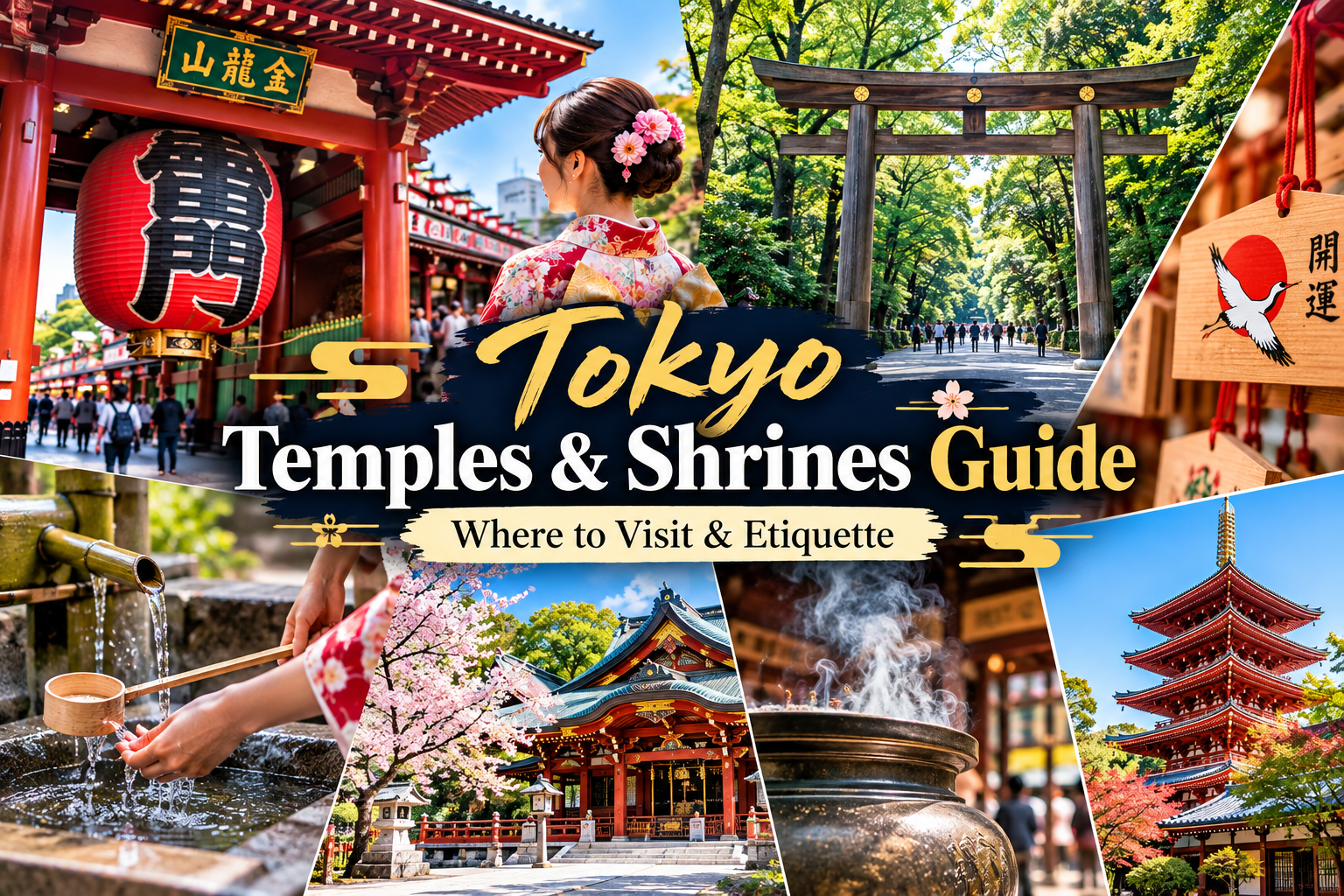
Tokyo may be famous for skyscrapers, neon lights, and busy train stations, but temples and shrines remain an important part of everyday life throughout the city.
You can find a quiet shrine hidden between office buildings, a centuries-old temple surrounded by traditional shopping streets, or a large forested sanctuary only minutes from one of Tokyo’s busiest neighborhoods.
For travelers, visiting these places is not only about sightseeing. It is also an opportunity to experience Japanese history, architecture, customs, and spiritual traditions.
However, first-time visitors often have questions.
What is the difference between a temple and a shrine? How should you behave when entering? Should you bow? Can you take photographs? What are omikuji and goshuin?
This guide explains the basics and introduces some of the most interesting temples and shrines to visit in Tokyo.
Temples vs Shrines: What Is the Difference?
One of the first things international visitors notice in Japan is that temples and shrines can sometimes look similar.
However, they belong to different religious traditions.
Buddhist places of worship are generally called temples, while Shinto places of worship are called shrines.
You do not need to understand Japanese religion in detail before visiting, but recognizing a few visual differences can make the experience more meaningful.
How to Recognize a Shinto Shrine
The easiest clue is often a torii gate.
Torii are large gates that mark the entrance to sacred Shinto space. They may be made from wood, stone, or other materials and are often associated with the entrance to a shrine.
Shrines may also have shimenawa, sacred ropes often decorated with folded paper strips called shide.
Many shrine names include words such as:
- Jingu
- Jinja
- Taisha
Meiji Jingu is one of Tokyo’s most famous examples.
How to Recognize a Buddhist Temple
Buddhist temples often contain structures such as large entrance gates, pagodas, incense burners, Buddhist statues, and temple halls.
Many temple names end in:
- ji
- dera
- in
Senso-ji in Asakusa is probably the most famous Buddhist temple in Tokyo.
The distinction becomes easier to recognize after visiting several religious sites during your trip.
Do Travelers Need to Be Religious to Visit?
No.
Tokyo’s temples and shrines welcome enormous numbers of visitors, including travelers who do not practice Buddhism or Shinto.
You can visit to appreciate the architecture, gardens, history, atmosphere, and cultural traditions.
The important thing is to remember that these are not simply tourist attractions.
Many people visit them to pray, participate in ceremonies, or mark important moments in their lives.
Behaving respectfully is therefore more important than knowing every rule perfectly.
Best Temples and Shrines to Visit in Tokyo
Tokyo contains countless religious sites, from internationally famous landmarks to tiny neighborhood shrines.
You do not need to visit all of them.
A better approach is to choose a few that offer different experiences.
Senso-ji
Senso-ji in Asakusa is one of Tokyo’s most famous temples and an excellent introduction to Buddhist temple culture.
Visitors typically approach through the enormous Kaminarimon gate before walking along Nakamise, a historic shopping street leading toward the temple complex.
The area combines religious tradition with the lively atmosphere of one of Tokyo’s most popular sightseeing districts.
What to See at Senso-ji
Look for:
- Kaminarimon
- Nakamise shopping street
- Hozomon Gate
- the five-story pagoda
- the main temple hall
- the incense burner
- omikuji fortune stalls
The temple becomes extremely busy during the day.
If you want to appreciate the architecture with fewer people around, visiting early in the morning can create a very different experience.
How Much Time Do You Need?
Allow approximately 60 to 90 minutes if you want to explore the temple grounds and Nakamise at a comfortable pace.
You can easily spend longer in Asakusa if you combine the temple with food, shopping, and nearby traditional streets.
Meiji Jingu
Meiji Jingu offers a completely different atmosphere.
The shrine sits beside Harajuku and is surrounded by a large forested area.
After entering through a massive torii gate, visitors follow a long path through the trees before reaching the main shrine complex.
The transition from busy city streets to a quiet forest is one of the reasons the shrine is so memorable.
What to See at Meiji Jingu
During your visit, pay attention to:
- the enormous torii gates
- the forest approach
- the main shrine buildings
- sake barrels displayed along the approach
- traditional ceremonies if one happens to be taking place
Weddings and other ceremonies occasionally occur at the shrine.
If you encounter one, observe respectfully and avoid interfering with participants.
How Much Time Do You Need?
Plan approximately one to two hours.
The walk between the entrance and main shrine is part of the experience, so do not treat Meiji Jingu as a quick photo stop.
Nezu Shrine
Nezu Shrine is a useful choice for travelers who want a beautiful shrine without the same level of crowds found at Tokyo’s most famous attractions.
It is known for traditional shrine architecture and rows of smaller torii gates.
The grounds feel more intimate than Meiji Jingu and can work particularly well when exploring the Yanaka and Nezu area.
Spring is especially popular because of the shrine’s azaleas.
However, the historic atmosphere makes it worth considering at other times of year as well.
Hie Shrine
Hie Shrine sits in central Tokyo near Akasaka.
Its location makes it interesting because the traditional shrine grounds contrast with the surrounding office buildings and modern cityscape.
One of its most recognizable features is a staircase lined with red torii gates.
For travelers with limited time, Hie Shrine can be easier to combine with other central Tokyo destinations than more distant religious sites.
Gotokuji Temple
Gotokuji is widely associated with maneki-neko, the familiar Japanese beckoning cat.
Visitors can see large numbers of white cat figures gathered within the temple grounds.
The visual appeal has made the temple increasingly popular with international travelers.
However, remember that Gotokuji is still an active religious site rather than simply a location for photographing cat figures.
Its location away from Tokyo’s central tourist districts also means you should allow extra travel time.
Zojoji Temple
Zojoji offers one of Tokyo’s most distinctive combinations of old and new.
The Buddhist temple sits near Tokyo Tower, creating a striking view of traditional temple architecture against a modern city landmark.
This contrast makes Zojoji particularly interesting for travelers who want to see how historical and contemporary Tokyo coexist.
The temple grounds are also easier to include in an itinerary if you are already visiting the Tokyo Tower area.
Kanda Myojin
Kanda Myojin is an interesting shrine for travelers exploring areas around Akihabara and Ochanomizu.
The shrine has a long history but is also known for its connection with the surrounding modern technology and pop-culture districts.
That unusual relationship between traditional religion and contemporary Tokyo makes it different from many other shrine visits.
It can be combined naturally with a day exploring central Tokyo.
Which Temple or Shrine Should First-Time Visitors Choose?
If this is your first trip to Tokyo, you do not need to visit every famous religious site.
For most first-time visitors, two experiences provide a useful contrast.
Visit Senso-ji to experience a lively historic temple district.
Then visit Meiji Jingu to experience a peaceful Shinto shrine surrounded by forest.
Together, they demonstrate two very different sides of Tokyo’s religious and cultural landscape.
Travelers who want to explore further can then add smaller sites such as Nezu Shrine, Hie Shrine, or a neighborhood temple.
Shrine Etiquette
Visitors are not expected to perform every custom perfectly.
A respectful attitude matters more than memorizing complicated rules.
Still, understanding the basic sequence can make visiting a shrine more comfortable.
Entering Through a Torii Gate
A torii gate marks the entrance to sacred shrine space.
It is common to bow lightly before passing through the gate.
Traditionally, visitors avoid walking directly through the center of the path because the center is sometimes considered the route reserved for the deity.
You do not need to become anxious about this rule, especially at crowded shrines.
Simply behave respectfully and follow the general flow of visitors.
Purification at the Temizuya
Many shrines have a purification fountain near the entrance.
This is called a temizuya or chozuya.
Traditionally, visitors use water to purify their hands before approaching the main shrine.
The exact procedure can vary, and some facilities now use simplified systems.
If ladles are provided, a common sequence is:
- Take the ladle with your right hand and rinse your left hand.
- Switch hands and rinse your right hand.
- Pour a little water into your hand to symbolically rinse your mouth.
- Do not place the ladle directly against your mouth.
- Allow the remaining water to rinse the handle if appropriate.
If instructions are displayed at the shrine, follow them.
How to Pray at a Shinto Shrine
A commonly used shrine prayer sequence is:
- Offer a coin.
- Bow twice.
- Clap twice.
- Make your prayer or wish.
- Bow once.
You may hear this described as “two bows, two claps, one bow.”
However, customs can differ at certain shrines.
If the shrine provides specific instructions, follow those instead.
You are also not required to pray simply because you are visiting.
Observing quietly is perfectly acceptable.
Temple Etiquette
Buddhist temple customs differ from Shinto shrine customs.
One important difference is that clapping is generally not part of Buddhist temple prayer.
At a temple, visitors may quietly bow, offer a coin, and place their hands together.
Some temples also have large incense burners.
Visitors may purchase incense or gently direct some of the smoke toward themselves according to local custom.
Again, follow any instructions displayed at the site.
Photography Etiquette
Photography is usually possible in outdoor areas, but permission varies.
Some temple halls, shrine interiors, statues, ceremonies, gardens, or special exhibitions may prohibit photography.
Look for signs before taking pictures.
Be particularly careful when:
- a religious ceremony is taking place
- people are praying
- a wedding is being held
- you are inside a building
- signs indicate photography restrictions
Avoid blocking entrances, prayer areas, or paths simply to take a photograph.
Drones should never be assumed to be permitted.
What Is an Omikuji?
Omikuji are paper fortunes available at many temples and shrines.
You typically make a small offering and receive a fortune describing your luck in areas such as health, travel, relationships, or work.
The exact system varies by location.
Some fortunes are available in English, while others are only in Japanese.
If you receive an unfavorable fortune, you may see people tying the paper to a designated rack or area.
Practices vary, so follow instructions at the site rather than tying paper to random trees or structures.
Omikuji can be an enjoyable cultural experience even if you do not take the prediction literally.
What Is a Goshuin?
Goshuin are special stamps and handwritten calligraphy traditionally received at temples and shrines.
They often include the name of the religious site, the date of the visit, and distinctive seals.
Travelers interested in Japanese culture sometimes collect them in a dedicated book called a goshuincho.
Goshuin Are Not Ordinary Souvenir Stamps
It is better to think of goshuin as records connected with visiting religious sites rather than ordinary tourist stamps.
Present your goshuincho politely at the designated office and follow the local process.
A small fee is normally required.
At some locations, you may receive a prepared sheet instead of having calligraphy written directly into your book.
Opening hours for goshuin reception may also be shorter than the opening hours of the grounds.
Ema: Wooden Prayer Plaques
Another common sight at shrines is the ema.
These are small wooden plaques on which visitors write wishes or prayers.
They are then left at the shrine on designated racks.
You may see wishes written in many languages at shrines popular with international visitors.
If you choose to write one, treat it as a cultural and religious practice rather than simply a decorative souvenir.
Omamori: Japanese Amulets
Temples and shrines often offer small amulets called omamori.
Different types may be associated with:
- safe travel
- health
- academic success
- relationships
- business
- traffic safety
Designs and meanings vary between religious sites.
For travelers, a safe-travel omamori can be a particularly meaningful item from a trip to Japan.
What Should You Wear?
Tokyo’s temples and shrines generally do not impose the same strict clothing requirements found at some religious sites in other countries.
Normal travel clothing is usually acceptable.
However, basic respect is appropriate.
Avoid clothing that would be obviously inappropriate in a place of worship, and remember that you may need to remove your shoes when entering certain buildings.
Comfortable footwear is useful because major sites often involve significant walking.
Can You Eat at Temples and Shrines?
Do not assume that eating is appropriate everywhere within religious grounds.
Some major sites have designated food areas, festival stalls, cafés, or nearby shopping streets.
Others are quiet sacred spaces where eating while walking would feel inappropriate.
Follow posted rules and observe how the space is being used.
Senso-ji, for example, is surrounded by a busy commercial district, while other shrine environments can feel much quieter.
Best Time to Visit
Early morning is often the best choice for famous temples and shrines.
There are several advantages:
- fewer tour groups
- quieter atmosphere
- easier photography
- cooler temperatures during warm months
- more time to appreciate the architecture
However, not every facility or shop opens early.
If your priority is receiving a goshuin, buying an omamori, or visiting nearby shops, check operating hours.
Late afternoon can also be pleasant, but avoid arriving so late that important facilities have already closed.
Temples and Shrines by Season
The atmosphere of Tokyo’s religious sites changes throughout the year.
Spring
Cherry blossoms and other flowers can transform temple and shrine grounds.
Popular locations can become extremely crowded during peak bloom.
Nezu Shrine is particularly known for its azalea season.
Summer
Summer festivals provide opportunities to experience shrine culture in a much livelier environment.
Expect heat and humidity, so bring water and plan breaks.
Autumn
Autumn foliage can make temple grounds and gardens particularly beautiful.
Cooler temperatures also make walking more comfortable.
Winter
Winter often provides clearer skies and quieter sightseeing conditions outside major holiday periods.
However, New Year is one of the busiest periods of the year at many temples and shrines.
Visiting During New Year
The first shrine or temple visit of the year is known as hatsumode.
It is an important Japanese New Year tradition.
Major sites such as Meiji Jingu can attract enormous crowds.
For international travelers, this can be culturally fascinating, but it is very different from an ordinary quiet shrine visit.
Expect:
- long lines
- crowded transportation
- food stalls at some locations
- special New Year decorations
- large numbers of visitors praying
If you prefer a calm atmosphere, visit on another date.
Temple and Shrine Festivals
Festivals, or matsuri, are often connected with shrines and temples.
They may include:
- portable shrines
- traditional music
- performances
- food stalls
- processions
- seasonal ceremonies
Encountering a festival can become one of the most memorable experiences of a Tokyo trip.
However, festivals can also dramatically increase crowds.
If you see preparations during your visit, check whether an event is taking place before changing your schedule.
Famous Sites vs Neighborhood Shrines
Tokyo’s famous temples and shrines are worth visiting, but they represent only part of the experience.
Small neighborhood shrines can be equally interesting.
You may find one beside a residential street, behind an office building, or between modern shops.
These smaller sites usually do not require a special trip.
Instead, notice them while exploring Tokyo on foot.
This is one of the best ways to see how traditional culture continues to exist within the modern city.
Miruvia’s Take: Do Not Turn Every Shrine Into a Checklist
It is easy to create a Tokyo itinerary containing five or six temples and shrines because each one looks interesting online.
For most travelers, that is unnecessary.
After several similar visits, the experiences can begin to blend together.
Choose sites for different reasons instead.
For example:
- Senso-ji for a major historic temple district
- Meiji Jingu for a forested shrine experience
- Nezu Shrine for a quieter traditional atmosphere
- Zojoji for the contrast with Tokyo Tower
- Kanda Myojin for the connection between tradition and modern pop culture
This creates variety without turning religious sites into a checklist.
How to Combine Temples and Shrines with Your Tokyo Itinerary
Temples and shrines work best when they are integrated into a neighborhood rather than treated as isolated destinations.
Asakusa
Combine Senso-ji with:
- Nakamise
- traditional streets
- local food
- views of Tokyo Skytree
Harajuku and Shibuya
Combine Meiji Jingu with:
- Harajuku
- Omotesando
- Shibuya
The contrast between the shrine forest and nearby fashion districts is part of what makes the area interesting.
Yanaka and Nezu
Combine Nezu Shrine with:
- Yanaka
- traditional residential streets
- small cafés
- local shops
This works particularly well for travelers looking for a slower side of Tokyo.
Tokyo Tower Area
Combine Zojoji with:
- Tokyo Tower
- nearby parks
- central Tokyo sightseeing
Akihabara and Ochanomizu
Combine Kanda Myojin with:
- Akihabara
- electronics
- anime and game shopping
- Ochanomizu
This route demonstrates Tokyo’s mixture of traditional and contemporary culture particularly well.
How Much Time Should You Spend?
For a major temple or shrine, allow approximately one to two hours.
Smaller neighborhood sites may require only 15 to 30 minutes.
Do not schedule religious sites too tightly.
Part of the value comes from slowing down, observing details, walking through the grounds, and noticing how local visitors use the space.
For most first-time Tokyo itineraries, two or three major temple or shrine visits across the entire trip are enough.
Do You Need Reservations?
Generally, no.
Most temple and shrine grounds can be visited without reservations.
However, special experiences may require advance booking, including:
- guided cultural tours
- special temple access
- meditation sessions
- ceremonies
- seasonal events
Opening hours can also vary between the grounds, buildings, gardens, and offices offering goshuin or omamori.
Check official information when a specific experience is important to your trip.
How Much Does It Cost?
Many shrine and temple grounds in Tokyo are free to enter.
You may pay separately for:
- gardens
- museums
- special halls
- exhibitions
- goshuin
- omamori
- omikuji
- special events
This makes temples and shrines useful for travelers who want meaningful cultural experiences without spending heavily on attractions.
Carry some Japanese yen because small offerings and religious items may be easier to pay for with cash.
Common Mistakes to Avoid
A few simple mistakes can reduce the quality of the experience.
Visiting Only for Photos
Photography can be part of your visit, but these are active religious sites.
Take time to observe the place rather than immediately moving from one photo location to another.
Clapping at a Buddhist Temple
Clapping is associated with common Shinto shrine prayer practice.
At Buddhist temples, visitors generally pray quietly with their hands together.
Blocking Worshippers
Do not stand directly in front of prayer areas for extended photo sessions.
Allow people who are there to worship to use the space.
Ignoring Photography Signs
Some buildings and sacred areas prohibit photography.
Always check before taking pictures indoors.
Overplanning
You probably do not need six temples and shrines in a three-day Tokyo itinerary.
Choose a smaller number of meaningful visits.
First-Time Visitor Route
If you want a simple introduction to Tokyo’s temple and shrine culture, use this structure.
Morning: Senso-ji
Visit early and explore the temple before the area becomes busiest.
Walk through Asakusa afterward.
Afternoon: Explore Modern Tokyo
Move to another neighborhood for food, shopping, museums, or sightseeing.
This prevents the day from becoming overloaded with similar cultural attractions.
Late Afternoon: Meiji Jingu
Explore the forest approach and shrine grounds before continuing into Harajuku, Omotesando, or Shibuya.
This route gives you both a major Buddhist temple and a major Shinto shrine while still leaving room for modern Tokyo.
For Repeat Visitors
Repeat visitors can move beyond Tokyo’s most famous religious sites.
Consider:
- neighborhood shrines
- seasonal festivals
- goshuin collecting
- smaller temples
- traditional neighborhoods
- religious sites connected with specific local histories
Instead of asking “What are the most famous temples in Tokyo?”, ask “Which neighborhood do I want to understand better?”
That shift often leads to more interesting discoveries.
FAQ
What is the most famous temple in Tokyo?
Senso-ji in Asakusa is generally the best-known Buddhist temple among international visitors and is one of Tokyo’s major sightseeing landmarks.
What is the most famous shrine in Tokyo?
Meiji Jingu is one of Tokyo’s best-known Shinto shrines and is particularly popular with visitors because of its forested setting near Harajuku.
Are temples and shrines free in Tokyo?
Many are free to enter, although certain gardens, museums, special halls, or exhibitions may charge admission.
Can foreigners pray at Japanese shrines?
Yes. International visitors may respectfully participate in common shrine customs. You are not required to pray if you prefer simply to observe.
Can I take photos at Japanese temples and shrines?
Often yes in outdoor areas, but restrictions vary. Always check signs, especially inside buildings and during ceremonies.
Should I bow at a torii gate?
A light bow when entering and leaving is a common respectful practice, although visitors should not become overly worried about performing every custom perfectly.
What is the difference between a temple and a shrine?
Temples are generally Buddhist, while shrines belong to the Shinto tradition. Torii gates are one of the easiest visual clues that you are entering a Shinto shrine.
Should I clap at a Buddhist temple?
Generally, no. The common clapping ritual is associated with Shinto shrine prayer. Buddhist temple prayer is usually quieter.
Can I collect goshuin as a tourist?
Yes. Visitors can receive goshuin at participating temples and shrines, but they should be treated respectfully as part of a religious tradition rather than as ordinary tourist stamps.
How many temples and shrines should I visit in Tokyo?
For most first-time visitors, two or three major sites across the trip are enough. Choose places that offer different environments rather than visiting many similar sites.
Final Thoughts
Tokyo’s temples and shrines reveal a side of the city that can easily be overlooked among skyscrapers, shopping districts, and entertainment areas.
Senso-ji shows the energy of a historic temple district. Meiji Jingu offers a peaceful forested shrine experience. Smaller places such as Nezu Shrine, Hie Shrine, and neighborhood religious sites show how traditional customs continue within everyday Tokyo.
You do not need to memorize every rule before visiting.
Learn the basic difference between temples and shrines, follow posted instructions, respect people who are worshipping, and give yourself enough time to observe the surroundings.
The goal is not to collect as many religious sites as possible.
A few thoughtful visits can give you a much deeper understanding of Tokyo and the traditions that continue to shape the city today.
