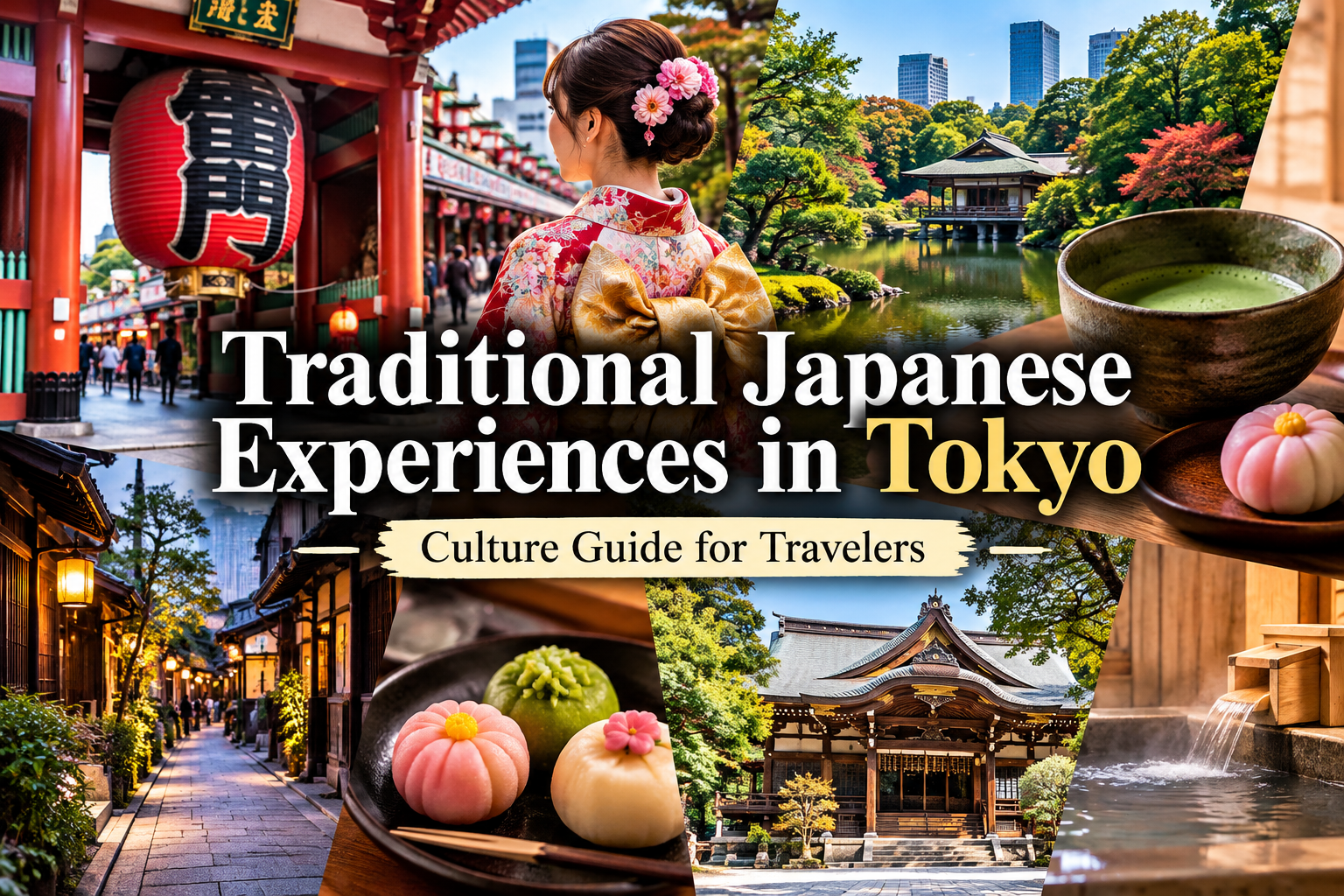
Tokyo is famous for neon streets, skyscrapers, anime, technology, and fast-paced city life.
But the city is also one of the easiest places in Japan for international travelers to experience traditional Japanese culture.
You can participate in a tea ceremony, wear a kimono, visit temples and shrines, walk through historic neighborhoods, explore Japanese gardens, try traditional sweets, visit a sento, watch traditional performing arts, and learn about crafts — often without leaving central Tokyo.
The challenge is deciding which experiences are genuinely worth adding to a limited itinerary.
This guide introduces some of the best traditional Japanese experiences in Tokyo, explains who they are best for, how much time to allow, and how to combine them with other sightseeing.
Why Experience Traditional Japanese Culture in Tokyo?
Many travelers imagine they need to visit Kyoto or rural Japan to experience traditional culture.
Those destinations are certainly important, but Tokyo offers a different advantage: accessibility.
Traditional experiences can often be combined with major sightseeing areas.
For example, you can:
- Visit a shrine in the morning
- Join a tea ceremony
- Eat traditional Japanese sweets
- Walk through an older neighborhood
- Explore a Japanese garden
- Visit a sento in the evening
This makes Tokyo particularly convenient for first-time visitors who want to experience several sides of Japan during one trip.
Miruvia’s Take: Do Not Try to Experience Everything
Traditional culture is a broad category.
Trying to fit tea ceremony, kimono, temples, gardens, crafts, traditional food, performing arts, and historic neighborhoods into one day can turn meaningful experiences into a checklist.
Instead, choose two or three experiences that match your interests.
For example:
Culture and history: Temple or shrine + historic neighborhood + garden
Food and tradition: Tea ceremony + wagashi + traditional shopping
Relaxation: Garden + sento + local neighborhood
Photography: Kimono + historic streets + shrine or garden
A smaller number of well-chosen experiences usually creates a better day.
Tea Ceremony
A Japanese tea ceremony is one of the most accessible traditional cultural experiences for international visitors.
A typical experience may introduce:
- Matcha preparation
- Tea utensils
- Tatami-room etiquette
- Seasonal elements
- Japanese sweets
- Basic tea ceremony philosophy
Some experiences are designed specifically for beginners and international travelers.
You do not need prior knowledge.
Is a Tea Ceremony Worth It?
For first-time visitors interested in Japanese culture, usually yes.
A tea ceremony offers more than simply drinking matcha.
The value comes from observing the movements, utensils, atmosphere, and attention to detail.
However, travelers who dislike structured activities may prefer visiting a traditional tea house independently.
How Much Time Do You Need for a Tea Ceremony?
Short introductory experiences may take around 30–60 minutes.
More detailed programs can take longer.
Allow additional time for finding the location and arriving early.
Do not schedule another reservation immediately afterward.
Try Wagashi with Matcha
Traditional Japanese sweets, known as wagashi, are closely connected with tea culture.
They often emphasize:
- Seasonality
- Color
- Texture
- Natural motifs
- Subtle sweetness
Popular examples include:
- Daifuku
- Dango
- Dorayaki
- Yokan
- Manju
- Monaka
- Nerikiri
Trying wagashi alongside matcha helps you understand why Japanese sweets are often designed differently from Western desserts.
Wear a Kimono
Kimono rental is one of the most popular cultural activities for international visitors.
Rental services typically provide:
- Kimono
- Obi
- Dressing assistance
- Traditional accessories
- Bag
- Footwear
Some packages also offer hairstyling or photography.
Where Does Kimono Work Best in Tokyo?
A kimono experience becomes more meaningful when combined with an area that suits the atmosphere.
Good choices include historic neighborhoods, temples, shrines, gardens, and traditional streets.
Asakusa is particularly popular because traditional architecture and major cultural attractions are concentrated nearby.
Is Kimono Comfortable for a Full Day?
Not necessarily.
Kimono can restrict movement compared with normal clothing, and traditional footwear may become uncomfortable after extended walking.
For many visitors, a few hours is enough.
Plan a relatively compact route rather than crossing Tokyo repeatedly.
Visit Senso-ji
Senso-ji in Asakusa is one of Tokyo’s most famous Buddhist temples.
The surrounding area makes it particularly accessible for first-time visitors.
A visit can include:
- Kaminarimon Gate
- Nakamise shopping street
- Temple buildings
- Incense
- Omikuji fortune slips
- Traditional snacks
- Souvenir shopping
Because the area is extremely popular, expect crowds.
Best Time to Visit Senso-ji
Early morning is one of the best times if you want a quieter atmosphere.
Shops along Nakamise may not all be open very early, but the temple environment can feel significantly calmer.
Later in the day is better if shopping and food are priorities.
Choose according to what matters more to you.
Visit a Shinto Shrine
Temples and shrines are different religious institutions.
Buddhist temples and Shinto shrines have different traditions, architecture, and customs.
Tokyo has many shrines, ranging from major landmarks to small neighborhood sites.
Visiting both a temple and a shrine can help first-time travelers recognize some of these differences.
Meiji Jingu
Meiji Jingu is one of Tokyo’s most famous Shinto shrines.
Its forested approach creates a striking contrast with nearby Harajuku.
This makes it easy to experience traditional and modern Tokyo within the same part of the city.
A visit can work particularly well in the morning before exploring Harajuku, Omotesando, or Shibuya.
Shrine Etiquette
Visitors do not need to understand every detail of Shinto practice.
Basic respectful behavior is enough.
Common principles include:
- Walk calmly through sacred areas
- Follow posted instructions
- Avoid blocking worshippers
- Speak quietly near prayer areas
- Follow photography restrictions
- Do not enter restricted spaces
Observe what others are doing rather than worrying about performing every ritual perfectly.
Temple Etiquette
Temple customs differ from shrine customs.
Again, international visitors are not expected to be experts.
The most important rule is respectful behavior.
Avoid treating active religious sites purely as photo sets.
People may be praying, attending ceremonies, or visiting for personal reasons.
Explore Yanaka
Yanaka offers a different side of Tokyo from Shinjuku or Shibuya.
The neighborhood is known for its older streets, temples, small shops, cafés, and slower atmosphere.
It is especially suitable for travelers who want to experience everyday Tokyo with traces of the city’s past.
Rather than rushing between attractions, Yanaka is best explored on foot.
Walk Through Kagurazaka
Kagurazaka combines traditional atmosphere with restaurants, narrow lanes, slopes, and a distinctive neighborhood character.
Historically associated with geisha culture, the area still contains streets that feel very different from Tokyo’s major commercial districts.
It works well for travelers interested in:
- Traditional streets
- Food
- Architecture
- Evening walks
- Local atmosphere
Kagurazaka is less about one major attraction and more about experiencing the neighborhood itself.
Visit a Japanese Garden
Japanese gardens are an excellent choice for travelers who want a traditional experience without joining a formal activity.
Tokyo has several gardens where you can observe:
- Ponds
- Bridges
- Stone arrangements
- Carefully shaped trees
- Seasonal flowers
- Autumn leaves
- Traditional landscaping
Gardens can provide a useful break from crowded sightseeing districts.
Why Japanese Gardens Are Worth Your Time
The appeal is not simply that they are beautiful.
Traditional Japanese gardens are designed around composition, perspective, seasonality, and the relationship between natural and constructed elements.
Walking slowly makes a significant difference.
Do not treat a garden as somewhere to rush through between attractions.
Best Seasons for Japanese Gardens
Japanese gardens change significantly throughout the year.
Spring
Fresh greenery and seasonal flowers create a bright atmosphere.
Summer
Gardens become intensely green, though Tokyo can be hot and humid.
Autumn
Fall colors can make gardens particularly popular.
Winter
Some gardens become quieter and more minimal, offering a different kind of beauty.
There is no single season when gardens are worth visiting.
Visit a Sento
A sento is a Japanese public bath.
Unlike an onsen, which is defined by naturally sourced hot-spring water, a sento is traditionally a neighborhood bathing facility.
For international travelers, visiting a sento can provide insight into a part of everyday Japanese culture that is very different from conventional sightseeing.
What Happens at a Sento?
The basic process usually involves:
- Remove your shoes where required.
- Pay the admission fee.
- Enter the appropriate changing area.
- Remove your clothes.
- Wash thoroughly before entering the bath.
- Relax in the bathing area.
- Dry yourself before returning fully into the changing space.
Rules and facilities vary.
Always check the specific bath’s instructions.
Sento Etiquette
Important points generally include:
- Wash before entering the bath
- Do not wear a swimsuit unless specifically permitted
- Keep towels out of the bathwater
- Avoid swimming
- Keep noise reasonable
- Follow tattoo policies
- Follow photography restrictions
Never take photographs inside bathing or changing areas.
Sento vs Onsen
Travelers often confuse the two.
A simple distinction is:
Sento: Public bath traditionally serving local communities.
Onsen: Bath using water that meets Japan’s legal definition of hot-spring water.
Tokyo offers opportunities to experience both styles.
If bathing culture interests you, either can be worthwhile.
Try Traditional Japanese Crafts
Hands-on craft experiences can be an excellent option for travelers who prefer creating something rather than simply observing.
Depending on availability, Tokyo experiences may include:
- Calligraphy
- Pottery
- Japanese paper crafts
- Indigo dyeing
- Woodblock printing
- Traditional decorative crafts
- Incense-related activities
These experiences often provide a physical souvenir that has personal meaning.
Japanese Calligraphy
Calligraphy, or shodo, combines language, brush technique, composition, and concentration.
Beginner workshops may teach:
- How to hold the brush
- Basic strokes
- Ink preparation
- Simple kanji
- Writing your own piece
You do not need to speak or read Japanese fluently to enjoy an introductory class.
Woodblock Printing
Japanese woodblock printing has a long artistic history.
Some workshops allow visitors to learn basic printing techniques and create a small print.
This can be particularly interesting for travelers who enjoy art, design, or ukiyo-e.
Visit a Traditional Craft Shop
You do not necessarily need to join a workshop.
Traditional craft shops can introduce you to:
- Ceramics
- Lacquerware
- Textiles
- Fans
- Chopsticks
- Japanese paper
- Wooden objects
- Kitchenware
These items can also make more meaningful souvenirs than generic tourist merchandise.
Watch Kabuki
Kabuki is one of Japan’s best-known traditional performing arts.
Its visual style includes elaborate costumes, distinctive makeup, dramatic acting, music, and highly stylized movement.
You do not need to understand every line of dialogue to appreciate the visual performance.
However, learning the basic story beforehand can make the experience easier to follow.
Is Kabuki Good for First-Time Visitors?
Yes, particularly for travelers interested in performing arts or Japanese history.
A full performance may feel long for some visitors.
If shorter viewing options are available, they can provide a more accessible introduction.
Check current schedules and ticket formats before planning your visit.
Sumo Culture
Sumo is another traditional Japanese experience strongly associated with Tokyo.
Major tournaments are held only at specific times of year, so not every visitor can attend one.
Depending on timing, travelers may instead explore sumo-related neighborhoods, food, museums, or other cultural experiences.
If attending a tournament is important to you, plan around the official schedule rather than assuming tickets will be available during any Tokyo trip.
Eat Traditional Japanese Food
Food is one of the easiest ways to experience culture.
Traditional options extend far beyond sushi.
Consider trying:
- Soba
- Tempura
- Unagi
- Sukiyaki
- Kaiseki-style cuisine
- Wagashi
- Matcha
- Traditional breakfast dishes
- Seasonal Japanese foods
You do not need an expensive restaurant for food to feel culturally meaningful.
Small local restaurants can be equally memorable.
Visit a Depachika
Department store basement food halls, known as depachika, offer a modern way to explore Japanese food culture.
You can see:
- Bento
- Prepared dishes
- Sushi
- Wagashi
- Seasonal foods
- Premium fruit
- Regional specialties
- Gift foods
Depachika are not traditional attractions in the historical sense, but they show how Japanese food presentation, gifting, seasonality, and craftsmanship remain part of contemporary urban life.
Explore Traditional Shopping Streets
Tokyo still has shopping streets that feel more connected to neighborhood life than giant commercial centers.
Depending on the area, you may find:
- Small food shops
- Traditional sweets
- Family-run businesses
- Tea
- Local restaurants
- Everyday household products
These streets can provide cultural context that major tourist attractions sometimes lack.
Look for Seasonal Traditions
Japan’s traditional culture is strongly connected to the seasons.
Depending on when you visit, you may encounter:
- Cherry blossom traditions
- Summer festivals
- Fireworks
- Autumn foliage
- New Year customs
- Seasonal foods
- Seasonal wagashi
- Temple or shrine events
This means the best traditional experience may depend on your travel dates.
Traditional Culture for First-Time Visitors
If this is your first trip to Tokyo, prioritize experiences that are easy to combine with major sightseeing.
A strong combination could be:
Morning: Senso-ji and Asakusa
Late morning: Kimono or tea ceremony
Lunch: Japanese food
Afternoon: Japanese garden
Evening: Sento or traditional neighborhood dinner
You do not need to complete every activity.
Use this as a menu rather than a checklist.
Traditional Culture for Repeat Visitors
Repeat visitors can go deeper.
Instead of returning only to major temples, consider:
- Neighborhood shrines
- Craft workshops
- Smaller gardens
- Local sento
- Traditional shopping streets
- Specialist museums
- Seasonal festivals
- Less famous historic neighborhoods
Repeat trips are ideal for moving from sightseeing toward participation.
Traditional Tokyo vs Kyoto
Tokyo and Kyoto should not be treated as interchangeable.
Kyoto has an extraordinary concentration of temples, shrines, historic architecture, gardens, and traditional cultural heritage.
Tokyo offers something different.
Traditional culture exists inside one of the world’s largest modern cities.
You can move from a quiet shrine to a major fashion district, or from an old neighborhood to a skyscraper area within the same day.
That contrast is part of Tokyo’s appeal.
How Much Time Should You Spend on Traditional Experiences?
There is no universal answer.
For a short Tokyo trip, one half-day focused on traditional culture can work well.
For a longer trip, spread cultural experiences across several days.
For example:
Day 1: Shrine
Day 2: Historic neighborhood
Day 3: Garden
Day 4: Tea ceremony or craft workshop
This often feels more natural than concentrating everything into one day.
Do You Need Reservations?
Some experiences require or strongly benefit from reservations.
These may include:
- Tea ceremonies
- Kimono rental
- Craft workshops
- Performances
- Guided cultural experiences
Temples, shrines, gardens, neighborhoods, and many sento generally work differently.
Check current requirements for specific places before visiting.
How Much Do Traditional Experiences Cost?
Costs vary significantly.
Some of Tokyo’s most meaningful cultural experiences are free or inexpensive.
For example:
- Walking through historic neighborhoods
- Visiting many temples and shrines
- Exploring traditional shopping streets
Other activities can cost more:
- Kimono rental
- Tea ceremonies
- Workshops
- Performances
- Guided experiences
You do not need a large budget to experience traditional Tokyo.
What Should You Wear?
Normal comfortable travel clothing is appropriate for most temples, shrines, gardens, and neighborhoods.
Choose comfortable shoes because many cultural sightseeing days involve substantial walking.
If participating in a formal activity, follow any instructions provided by the organizer.
For sento and bathing experiences, check facility-specific rules beforehand.
Photography Etiquette
Traditional locations can be extremely photogenic, but not every space should be photographed.
Always look for signs.
Avoid photography when:
- It is explicitly prohibited
- A religious ceremony is taking place
- People are praying
- You are inside bathing or changing facilities
- A workshop instructor asks you not to photograph
- Photography would disturb other visitors
Experiencing the place is more important than documenting every moment.
Avoid Treating Culture as a Photo Prop
Kimono, shrines, temples, tea ceremony, and traditional neighborhoods make beautiful photographs.
But these are not simply decorative tourist experiences.
Many are connected to active religious practices, living communities, professional crafts, and traditions that continue today.
Approaching them with curiosity and respect creates a better experience for both visitors and local communities.
Common Mistakes
Trying to Do Too Much
Choose a few experiences rather than building a cultural checklist.
Only Visiting Famous Places
Major landmarks are worthwhile, but smaller neighborhoods can provide a different perspective.
Ignoring Etiquette
You do not need perfect knowledge, but basic respect matters.
Scheduling Activities Too Closely
Tea ceremonies, kimono rentals, and workshops may take longer than expected.
Wearing Uncomfortable Shoes
Traditional neighborhoods and gardens often involve significant walking.
Focusing Only on Photos
Leave time to actually experience the activity.
Assuming Traditional Culture Exists Only in Kyoto
Tokyo has its own cultural history and many accessible traditional experiences.
A Simple Traditional Tokyo Day
For first-time visitors, this is a practical example.
Morning: Asakusa
Visit Senso-ji before the busiest period.
Explore the temple and surrounding streets.
Late Morning: Tea Ceremony or Kimono
Choose one major hands-on experience.
Lunch: Japanese Cuisine
Try soba, tempura, sushi, or another Japanese meal.
Afternoon: Japanese Garden
Slow down after the busy morning.
Late Afternoon: Wagashi and Matcha
Take a break with traditional sweets.
Evening: Sento or Historic Neighborhood
Finish with a public bath or dinner in an atmospheric neighborhood.
This provides variety without requiring you to cross Tokyo repeatedly.
Who Will Enjoy Traditional Tokyo Most?
These experiences are particularly suitable for travelers interested in:
- Japanese history
- Food
- Architecture
- Religion
- Art
- Crafts
- Photography
- Gardens
- Local neighborhoods
- Everyday Japanese culture
You do not need deep prior knowledge.
Curiosity is enough.
Frequently Asked Questions
What is the best traditional Japanese experience in Tokyo?
There is no single best choice. Tea ceremony is an accessible introduction, while temples, shrines, gardens, kimono, sento, crafts, and traditional neighborhoods suit different interests.
Can I experience traditional Japan without visiting Kyoto?
Yes. Kyoto offers an exceptional concentration of traditional heritage, but Tokyo also provides many temples, shrines, gardens, historic neighborhoods, workshops, traditional foods, and cultural activities.
Is a tea ceremony worth doing in Tokyo?
For many first-time visitors, yes. It provides an accessible introduction to matcha, wagashi, etiquette, utensils, and Japanese aesthetics.
Where should I wear a kimono in Tokyo?
Asakusa is one of the most popular choices because temples and traditional streets are concentrated nearby.
Are temples and shrines free in Tokyo?
Many can be visited without a general admission fee, although specific gardens, museums, halls, or special areas may charge admission.
Can tourists visit a sento?
Yes, many sento welcome international visitors. Check the facility’s rules, especially regarding tattoos and bathing etiquette.
Do I need to speak Japanese?
No. Many major cultural experiences are accessible without Japanese, particularly those designed for international visitors. Translation tools can help in smaller local establishments.
How many traditional experiences should I plan in one day?
Two or three substantial experiences are usually enough. Avoid turning the day into a rushed checklist.
Is traditional Tokyo good for repeat visitors?
Yes. Repeat visitors can move beyond major landmarks and explore neighborhood shrines, local sento, craft workshops, smaller gardens, and seasonal traditions.
What is the best area for traditional atmosphere in Tokyo?
Asakusa is one of the easiest choices for first-time visitors. Yanaka and Kagurazaka offer different, more neighborhood-focused experiences.
Final Thoughts
Tokyo’s traditional culture does not exist separately from the modern city.
That is precisely what makes experiencing it here so interesting.
You can begin the morning at a centuries-old temple, drink matcha in a quiet room, walk through a Japanese garden, explore an old neighborhood, and end the evening surrounded by modern Tokyo.
For first-time visitors, start with accessible experiences such as a temple or shrine, tea ceremony, traditional food, and a historic neighborhood.
For repeat visitors, go deeper through crafts, sento, smaller neighborhoods, seasonal traditions, and local cultural experiences.
Do not try to experience everything.
Choose the traditions that genuinely interest you, give them enough time, and experience them with curiosity and respect.
The contrast between old and new is not a contradiction in Tokyo.
It is one of the city’s defining experiences.
