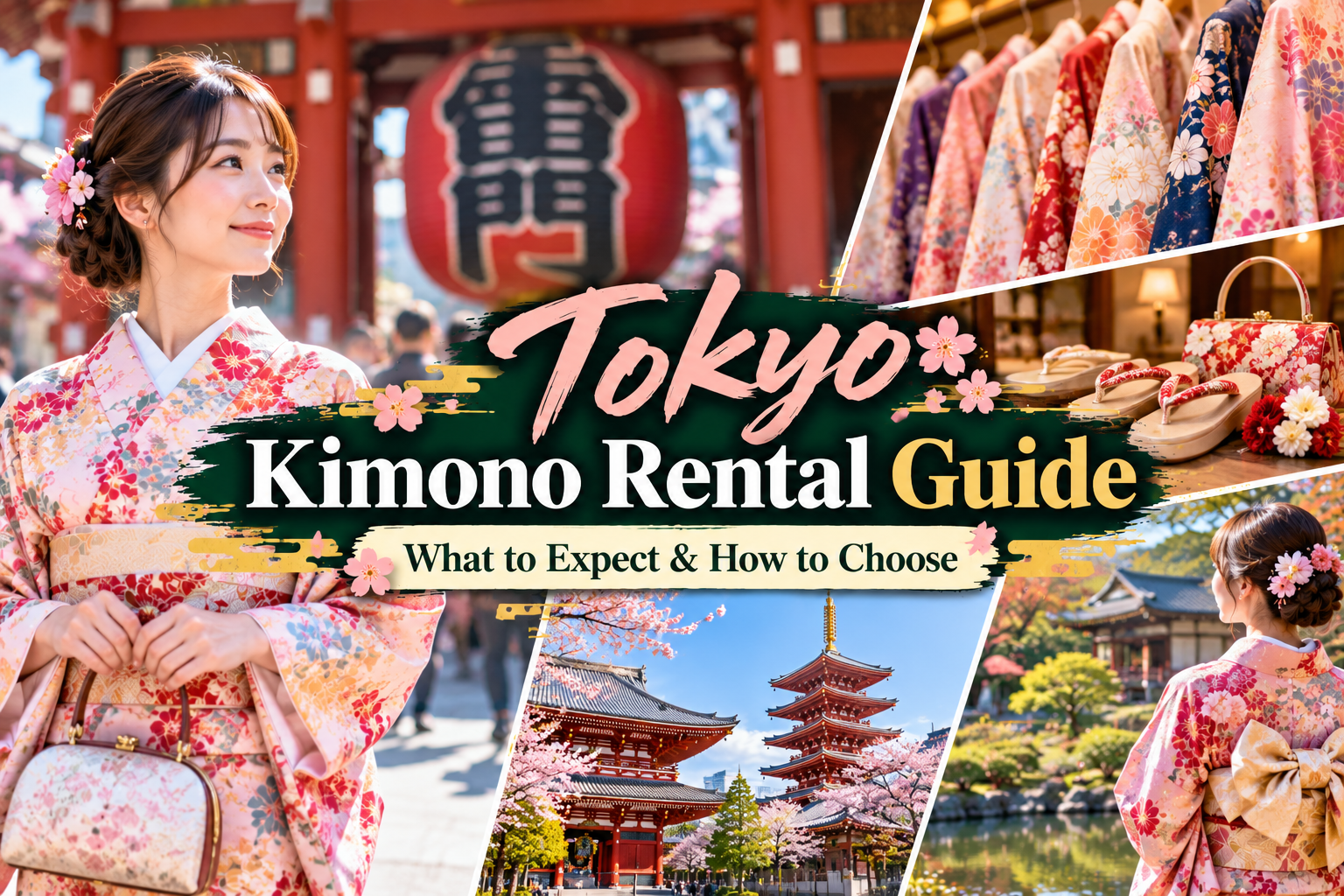
Why Rent a Kimono in Tokyo?
Renting a kimono is one of the easiest ways for travelers to experience traditional Japanese culture while exploring Tokyo.
Unlike experiences that take place entirely indoors, kimono rental becomes part of your sightseeing day. You can walk through historic streets, visit temples and shrines, take photos, stop at cafés, and experience familiar Tokyo neighborhoods from a different perspective.
Asakusa is the most popular area for kimono rental, but it is not the only option. The right experience depends on your schedule, budget, clothing preferences, photography plans, and the season of your visit.
This guide explains what to expect from kimono rental in Tokyo, how much it usually costs, what is included, and how to choose the right plan.
Miruvia’s Take: Choose Convenience Over the Cheapest Price
The cheapest kimono rental is not always the best value.
For most international travelers, location and convenience matter more than saving a small amount of money.
A well-located rental shop with clear English information, straightforward pricing, professional dressing, convenient luggage storage, and a realistic return time can make the entire experience much easier.
Before booking, check exactly what is included in the advertised price.
A low base price may not include:
- Hairstyling
- Hair accessories
- Upgraded kimono designs
- Larger bags
- Photography
- Extended rental time
- Special seasonal options
Compare the complete experience rather than only the starting price.
What Happens When You Rent a Kimono in Tokyo?
The process is usually straightforward, even if you have never worn a kimono before.
A typical rental experience follows several steps.
Arrival and Check-In
Arrive at the rental shop at your reserved time.
Staff may confirm your reservation, explain the available plans, and tell you when the kimono must be returned.
Arriving late can reduce your sightseeing time, especially when the shop has a fixed closing time.
Choosing Your Kimono
You will usually choose from a selection of colors, patterns, and styles.
Some shops include all designs in one price, while others separate their collection into standard and premium categories.
Popular colors and designs may become less available later in the day, so morning appointments can offer a wider selection.
Dressing
Professional staff will help you put on the kimono correctly.
You do not need to know how to wear one yourself.
The dressing process usually includes the kimono, obi, and necessary undergarments or accessories provided by the shop.
Hairstyling
Some rental plans include a simple hairstyle, while others charge separately.
Hair accessories may also be included or available as an upgrade.
If hairstyling is important to you, confirm the details before booking rather than assuming it is included.
Choosing Accessories
Depending on the plan, you may receive accessories such as:
- A small traditional-style bag
- Sandals
- Hair ornaments
- Seasonal accessories
Options vary significantly between rental shops.
Sightseeing
Once you are dressed, you can usually leave the shop and explore the surrounding area.
This is the main reason location matters.
A rental shop close to the places you want to visit gives you more time to enjoy the experience and less time traveling in unfamiliar clothing.
Returning the Kimono
Most same-day rentals require you to return the kimono by a specific time.
Do not treat the return time as a suggestion.
Returning late may result in additional charges or create problems near closing time.
How Long Does Kimono Rental Take?
The complete experience can range from a few hours to most of the day.
The preparation itself may take roughly 30 to 60 minutes depending on:
- How busy the shop is
- How quickly you choose your kimono
- The complexity of dressing
- Whether hairstyling is included
- The size of your group
After dressing, many travelers spend two to five hours sightseeing and taking photos.
If kimono rental is one of your main activities for the day, reserving approximately half a day is a comfortable approach.
How Much Does Kimono Rental Cost in Tokyo?
Prices vary depending on the shop and package.
Basic rental plans can begin at relatively affordable prices, while premium kimono, elaborate hairstyles, couples plans, professional photography, or special garments can increase the total significantly.
Instead of choosing by price alone, check whether the package includes:
- Kimono
- Obi
- Dressing
- Footwear
- Bag
- Hairstyling
- Hair accessories
- Luggage storage
- Tax
Also check whether the attractive kimono shown in promotional photographs are included in the basic plan or require an upgrade.
Best Area for Kimono Rental in Tokyo
Asakusa
For most first-time visitors, Asakusa is the easiest recommendation.
The neighborhood combines kimono rental shops with some of Tokyo’s most recognizable traditional scenery.
After getting dressed, you can explore areas around Senso-ji, Kaminarimon, Nakamise, and the surrounding streets.
The compact sightseeing area also means you can enjoy the experience without spending much of your rental period on trains.
Ginza
Ginza offers a different atmosphere.
Instead of the dense historic streets associated with Asakusa, the area combines traditional Japanese elements with elegant modern Tokyo.
It can work well for travelers who want a more refined urban setting or plan to combine kimono rental with dining, shopping, or a nearby cultural experience.
Other Areas
Kimono rental services can also be found in other parts of Tokyo.
However, choosing a shop far from your planned sightseeing route can make the day unnecessarily complicated.
For most travelers, the best location is not simply the area with the most rental shops.
It is the area where you actually want to spend the next several hours.
Kimono Rental in Asakusa: Why It Works So Well
Asakusa is particularly suitable because many traditional-looking attractions are within walking distance.
You can rent a kimono, explore the neighborhood, take photographs, eat local snacks, and return the clothing without complicated transportation.
This creates a natural half-day cultural experience.
A simple route could include:
- Morning kimono rental
- Kaminarimon
- Nakamise
- Senso-ji
- Nearby side streets
- Lunch or a café
- Return the kimono
Starting earlier can also help you experience the area before the largest crowds arrive.
Should You Wear a Kimono to a Temple or Shrine?
Yes, wearing a rented kimono while visiting temples and shrines is generally fine.
However, remember that these are religious sites rather than photography sets.
Follow normal visitor etiquette, avoid blocking entrances or worship areas for photographs, and respect any restrictions.
The clothing does not change the basic rules of visiting a religious site.
Kimono vs Yukata: What Is the Difference?
Travelers may encounter both kimono and yukata rentals.
A kimono is generally more structured and layered.
Yukata are lighter cotton garments traditionally associated with summer, festivals, and bathing culture.
During Tokyo’s hot and humid summer, some rental businesses offer yukata because they can be more comfortable than heavier kimono.
If you visit during summer, check which garment is appropriate for the weather and available from the rental shop.
What Should You Wear Under a Kimono?
Wear comfortable, relatively simple clothing that is easy to change out of.
Rental shops usually provide or explain the necessary layers used with the kimono.
Avoid planning around bulky clothing unless the weather requires it.
In winter, ask the rental shop about cold-weather options and what you can comfortably wear underneath.
What Shoes Do You Wear?
Traditional-style footwear is commonly provided as part of kimono rental.
However, unfamiliar sandals can become uncomfortable during long periods of walking.
Tokyo sightseeing often involves more walking than travelers expect.
If you plan an extended route, consider:
- Keeping the walking distance reasonable
- Taking regular breaks
- Avoiding unnecessarily long transfers
- Confirming the shop’s footwear options
Comfort matters more than maximizing the number of attractions.
What Happens to Your Clothes and Bags?
Many rental shops can keep your regular clothing while you are wearing the kimono.
Luggage policies vary.
A normal handbag or backpack may be manageable, while large suitcases may require additional storage or may not be accepted.
If you are traveling with large luggage, do not assume the rental shop can store it.
Check before arriving.
Should You Add Hairstyling?
For many travelers, yes.
A simple professional hairstyle can make the overall appearance feel more complete and may be especially worthwhile if you plan to take many photographs.
However, hairstyling is not essential to enjoying kimono rental.
If your priority is sightseeing rather than photography, a basic plan may be enough.
Travelers with short hair should also check available styling options before paying for an additional package.
Kimono Rental with Professional Photography
Some travelers combine kimono rental with a professional photo session.
This can be worthwhile if photography is one of the main reasons for renting the kimono.
Professional photographers may know quieter streets, useful angles, and locations that work well with traditional clothing.
However, photography packages can significantly increase the price.
Consider whether you want:
- Casual smartphone photos
- Photos taken by your travel companion
- A short professional session
- A dedicated private photography experience
There is no need to add professional photography unless the photos themselves are an important part of the experience.
Can You Take Photos Yourself?
Yes.
For most travelers, smartphone photography is sufficient.
Asakusa in particular provides many visually interesting backgrounds within a relatively small area.
Be considerate when taking photographs.
Avoid:
- Blocking narrow streets
- Standing in busy entrances
- Interrupting worship
- Photographing restricted areas
- Using private property as a photo location without permission
Tokyo is busy, and popular photography spots are shared spaces.
Kimono Rental for Couples
Couples plans are common at many rental businesses.
These can make the experience easier when two people want coordinated rentals and photographs.
Check whether the advertised couples price includes the complete rental for both people or whether additional options are charged separately.
You do not need perfectly matching designs.
Choosing complementary colors can look more natural than wearing identical patterns.
Kimono Rental for Families
Families can also enjoy kimono rental, but planning becomes more important.
Before booking, confirm:
- Children’s sizes
- Minimum age or height requirements
- Dressing time
- Footwear
- Return time
- Whether strollers can be stored
- Whether children can comfortably wear the clothing for several hours
Young children may enjoy a shorter experience more than a full sightseeing day.
Kimono Rental for Solo Travelers
Solo travelers should not hesitate to rent a kimono.
You do not need a companion to participate.
If photographs are important, consider choosing a shop offering photography services or ask whether staff can take a quick photograph before you leave.
A compact neighborhood such as Asakusa also makes solo exploration relatively straightforward.
Kimono Sizes for International Travelers
Sizing is an important consideration.
Many rental shops accommodate a range of body types, but availability is not unlimited.
If you are particularly tall, short, or require larger sizes, check the shop’s size information before booking.
Do not rely only on generic statements such as “many sizes available.”
Contacting the business in advance can prevent disappointment on the day.
Tattoos and Kimono Rental
Policies regarding visible tattoos can vary.
Kimono itself may cover many tattoos depending on their location, but you should not assume that every tattoo will be hidden.
If you are concerned about a shop’s policy or plan to combine the experience with another activity such as a public bath, check the relevant rules separately.
Kimono Rental in Spring
Spring is one of the most popular seasons for kimono rental.
Mild temperatures can make walking more comfortable, and cherry blossoms create highly sought-after photography opportunities.
The disadvantage is demand.
During peak cherry blossom periods, popular rental times and photography locations can become crowded.
Book early if kimono rental is a priority.
Kimono Rental in Summer
Tokyo summers can be extremely hot and humid.
Heavy clothing combined with outdoor sightseeing may become uncomfortable.
This is when yukata can be a better option.
Plan shorter walking routes, take indoor breaks, stay hydrated, and avoid building an overly ambitious schedule.
Kimono Rental in Autumn
Autumn is another excellent season.
Comfortable temperatures and autumn foliage can work particularly well for traditional clothing and outdoor photography.
Popular foliage periods can still create crowds, especially at famous gardens and temples.
Kimono Rental in Winter
Winter can offer clearer weather and fewer problems with heat.
However, staying warm becomes important.
Ask the rental shop about winter layers, shawls, or other seasonal accessories.
Do not sacrifice comfort simply for photographs.
What Happens If It Rains?
Light rain does not necessarily mean you must cancel.
However, rain can make traditional footwear, long clothing, and outdoor photography more difficult.
Before booking, check the shop’s cancellation and weather policies.
On rainy days, consider shortening your outdoor route and including more indoor activities.
Should You Combine Kimono Rental with a Tea Ceremony?
Combining kimono rental with a tea ceremony can be an excellent option.
Both experiences fit naturally into a traditional culture-focused day, and wearing kimono can make the occasion feel more memorable.
However, check the timing carefully.
A tea ceremony has a fixed starting time, while kimono dressing may take longer than expected.
Leave enough buffer between your rental appointment and the ceremony.
Should You Combine Kimono Rental with a Japanese Garden?
Visiting a Japanese garden can also work well, particularly if the garden is reasonably close to the rental location.
Traditional gardens can provide a calm environment that complements the clothing and offers attractive seasonal scenery.
However, long train journeys in unfamiliar footwear can reduce the enjoyment.
Prioritize convenient combinations rather than trying to reach the most famous garden.
How to Fit Kimono Rental Into Your Tokyo Itinerary
Treat kimono rental as a major activity rather than squeezing it between several attractions.
This makes it easier to build a realistic Tokyo itinerary without rushing the experience.
The easiest approach is to build half a day around one neighborhood.
Asakusa Half-Day
A practical plan is:
- Morning rental appointment
- Explore Senso-ji and nearby streets
- Take photographs
- Have lunch or visit a café
- Return the kimono
You can then continue to another area in normal clothing.
Kimono and Tea Ceremony
Another option is:
- Kimono rental
- Short neighborhood walk
- Tea ceremony
- Photography
- Return the kimono
Confirm that the tea ceremony allows sufficient time for arrival and that your rental return deadline is realistic.
Kimono and Japanese Garden
If logistics are convenient:
- Morning rental
- Garden visit
- Tea or wagashi
- Photography
- Return the kimono
Avoid spending too much of the rental period traveling between distant neighborhoods.
Morning vs Afternoon Rental
Morning is usually the better choice.
Advantages include:
- More kimono designs may be available
- More sightseeing time
- Less pressure from the return deadline
- Potentially quieter streets
- Better flexibility if dressing takes longer than expected
Afternoon rental can still work if you only want a short experience or photography session.
Do You Need to Book in Advance?
Booking in advance is recommended.
Walk-in rentals may be possible, but availability can vary.
Advance reservations are particularly useful during:
- Cherry blossom season
- Autumn foliage season
- Weekends
- Japanese holidays
- Popular travel periods
Booking also gives you time to understand the package details before arriving.
How Far in Advance Should You Book?
There is no universal rule.
For ordinary weekdays outside peak seasons, you may have considerable flexibility.
For popular dates, booking several days or weeks ahead can provide better time-slot choices.
If you want a specific photography package, premium kimono, or early morning appointment, book earlier.
What to Check Before Booking
Before paying, confirm the following:
- Exact rental price
- What clothing is included
- Dressing fee
- Hairstyling
- Hair accessories
- Footwear
- Bag
- Luggage storage
- Rental duration
- Final return time
- Late-return fees
- Cancellation policy
- Rain policy
- Size availability
- English support
- Photography options
Taking a few minutes to check these details can prevent most common problems.
Common Kimono Rental Mistakes
Choosing Only by Price
The cheapest plan may exclude options you expected to receive.
Compare the complete package.
Booking Too Late in the Day
A late appointment can leave little time before the return deadline.
Planning Too Much Walking
Traditional footwear can become uncomfortable.
Keep your route compact.
Traveling Across Tokyo in Kimono
Long train journeys use valuable rental time and can be inconvenient.
Choose a rental location near your sightseeing area.
Ignoring the Weather
Tokyo’s summer heat, winter cold, and rainy days can significantly affect comfort.
Forgetting the Return Time
Set a reminder on your phone and begin heading back before the deadline.
Carrying Too Much
Large bags can make the experience awkward and may not fit the overall rental setup.
Travel light if possible.
Is Kimono Rental Culturally Appropriate for Foreign Visitors?
International visitors can generally enjoy kimono rental respectfully.
The important point is how you behave while wearing it.
Treat the clothing and cultural settings with respect, follow staff instructions, and behave appropriately at temples, shrines, and other public spaces.
You do not need extensive knowledge of Japanese culture before participating.
A good rental business will explain what you need to know.
Who Should Rent a Kimono in Tokyo?
Kimono rental is particularly suitable for travelers who:
- Enjoy cultural experiences
- Like photography
- Want to explore historic neighborhoods
- Are interested in traditional clothing
- Prefer experiential sightseeing
- Have enough time for a relaxed half-day
Who Might Skip It?
You may prefer another cultural activity if:
- You dislike changing clothes
- You have limited sightseeing time
- The weather is extremely hot
- You want to walk long distances
- Traditional footwear would be difficult for you
- You are not particularly interested in photography or clothing
A tea ceremony, Japanese garden, craft workshop, or temple visit may suit you better.
First-Time Visitor Recommendation
For a first trip to Tokyo, Asakusa is the simplest choice.
Book a morning rental, keep your route within the neighborhood, explore Senso-ji and surrounding streets, take photographs, and return the kimono before continuing your day.
This provides the experience without making your itinerary unnecessarily complicated.
Repeat Visitor Recommendation
Repeat visitors can be more selective.
Instead of automatically choosing Asakusa, consider what you want from the experience.
You might prioritize:
- A quieter neighborhood
- Premium kimono
- Professional photography
- A tea ceremony combination
- Seasonal scenery
- A Japanese garden
- A more specialized cultural experience
The goal is not simply to repeat a classic tourist activity, but to create an experience that fits your interests.
A Simple Traditional Tokyo Day
One easy cultural itinerary is:
Morning: Rent a kimono in Asakusa.
Late morning: Explore Senso-ji and nearby traditional streets.
Lunch: Eat in the Asakusa area.
Early afternoon: Join a tea ceremony or enjoy matcha and wagashi.
Mid-afternoon: Return the kimono.
Evening: Continue sightseeing elsewhere in comfortable clothing.
This schedule keeps the traditional experiences geographically concentrated and avoids unnecessary travel while wearing kimono.
Frequently Asked Questions
Can foreigners rent kimono in Tokyo?
Yes. Many kimono rental businesses in Tokyo regularly serve international visitors.
Do I need to know how to wear a kimono?
No. Staff normally dress you as part of the rental service.
Is hairstyling included?
It depends on the plan. Some packages include simple hairstyling, while others charge an additional fee.
Can men rent kimono?
Yes. Many rental businesses offer options for men as well as women.
Can children rent kimono?
Many shops offer children’s sizes, but age, height, and size availability vary. Check before booking.
Can I wear my own shoes?
Rental plans generally provide suitable footwear, but policies vary. Ask the shop if you have mobility or comfort concerns.
Can I rent a kimono when it rains?
Often yes, but policies differ. Rain can also make walking and photography less comfortable.
Can I wear kimono all day?
Some plans allow most of the day, but you must follow the shop’s return deadline.
Is kimono rental worth it if I do not want professional photos?
Yes. Many travelers enjoy the experience simply while walking around and sightseeing.
Should I choose kimono or yukata?
Kimono works across much of the year, while lighter yukata can be more comfortable during hot summer weather.
Final Thoughts
Kimono rental can turn an ordinary sightseeing day into one of the most memorable cultural experiences of a Tokyo trip.
The best experience does not require the most expensive kimono or the longest rental period.
Choose a convenient location, understand exactly what your package includes, keep your sightseeing route manageable, and leave enough time to enjoy wearing the kimono without rushing.
For first-time visitors, Asakusa offers the easiest combination of rental shops, traditional scenery, sightseeing, and photography.
More experienced visitors can build the experience around tea ceremony, gardens, seasonal scenery, or professional photography.
Whichever option you choose, treat kimono rental as an experience in itself rather than simply another item to fit into a crowded Tokyo itinerary.
