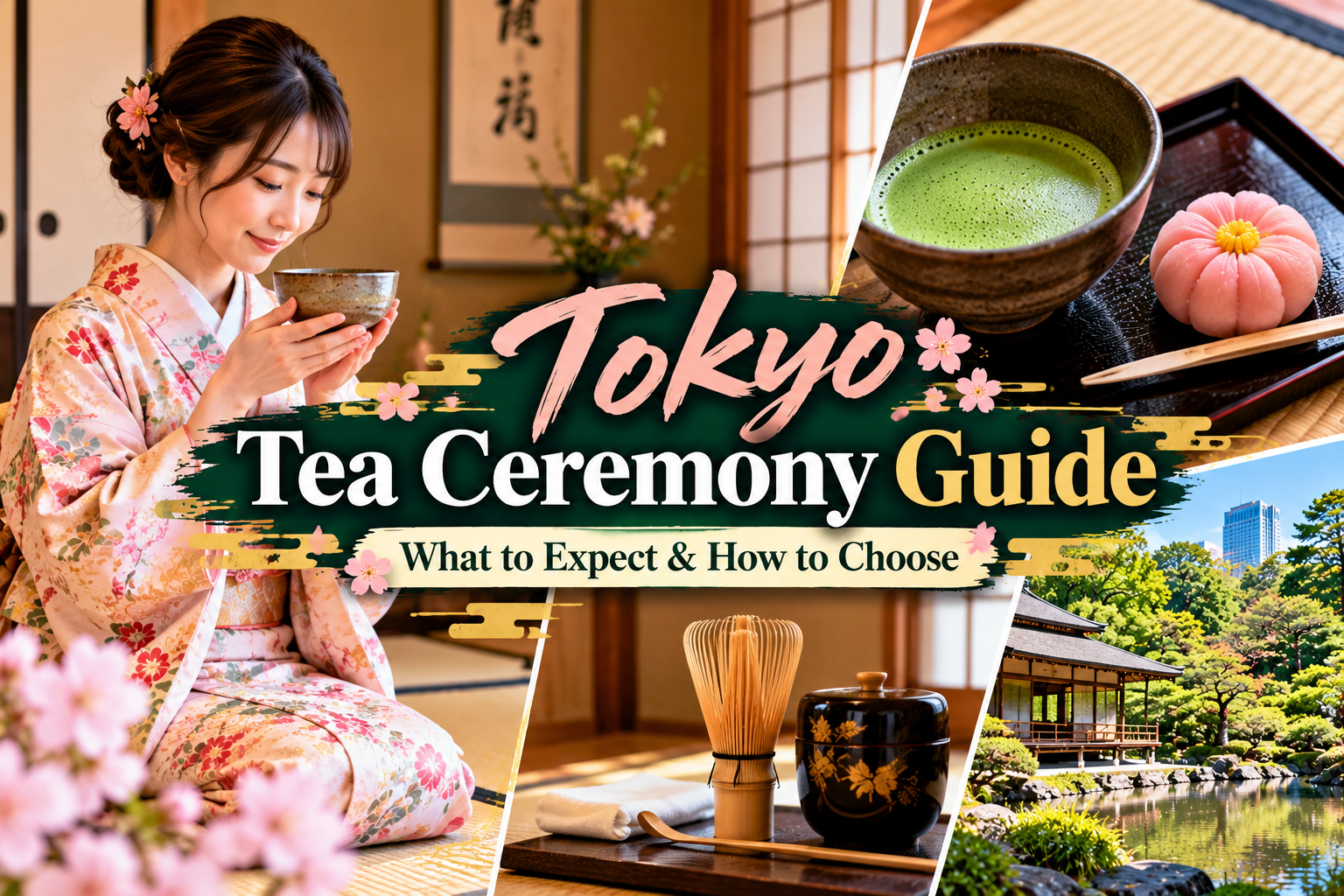
Why Experience a Tea Ceremony in Tokyo?
A Japanese tea ceremony can be one of the most memorable cultural experiences of a trip to Tokyo.
At first glance, it may seem simple: you sit down, receive a bowl of matcha, eat a Japanese sweet, and watch the host prepare tea.
But the experience is about much more than drinking matcha.
The movements of the host, the utensils, the arrangement of the room, the seasonal decorations, and even the way the tea bowl is handled reflect traditions that have developed over centuries.
For international travelers, a tea ceremony provides an accessible way to experience Japanese hospitality, aesthetics, and attention to detail.
The challenge is choosing the right experience.
Tokyo offers everything from short beginner-friendly sessions to more formal tea ceremonies in traditional rooms.
This guide explains what happens during a Japanese tea ceremony, how much time and money to expect, what to wear, basic etiquette, and how to choose an experience that fits your trip.
Miruvia’s Take: Choose the Experience, Not Just the Location
When searching for a tea ceremony in Tokyo, it is easy to focus only on location.
Asakusa sounds traditional, so travelers often assume that any tea ceremony there will provide the experience they want.
Location matters, but the format matters more.
Some experiences are designed specifically for first-time international visitors and explain each step in English.
Others emphasize kimono, photography, or entertainment.
More traditional sessions may focus heavily on the tea itself and provide less explanation for beginners.
Before booking, decide what you actually want.
If this is your first tea ceremony, an English-friendly introductory experience lasting around 45 to 60 minutes is usually the easiest place to start.
What Is a Japanese Tea Ceremony?
The Japanese tea ceremony is often called chanoyu, sado, or chado.
Although these terms have slightly different cultural nuances, travelers will generally encounter them in connection with the preparation and serving of matcha.
A tea ceremony involves a host preparing powdered green tea using a sequence of carefully practiced movements.
The experience may include:
- entering a traditional tea room
- observing the preparation of tea
- learning about tea utensils
- eating wagashi
- drinking matcha
- learning basic guest etiquette
- sometimes preparing your own bowl of tea
The exact format depends on the provider.
A short tourist-oriented session is very different from a formal traditional gathering that can last several hours.
For most visitors to Tokyo, the shorter introductory format is more practical.
Is a Tea Ceremony Worth It?
For travelers interested in Japanese culture, usually yes.
A tea ceremony offers something that simply visiting a temple or traditional neighborhood cannot provide.
You participate.
Instead of only looking at traditional architecture or objects, you interact with a host and experience a sequence of customs firsthand.
It can be especially worthwhile if you are interested in:
- Japanese culture
- matcha
- wagashi
- traditional architecture
- Japanese aesthetics
- mindfulness
- hospitality
- seasonal traditions
However, it may not be essential for every traveler.
If your Tokyo itinerary is extremely short and your main interests are food, shopping, anime, nightlife, or modern attractions, you should not feel obligated to book one simply because it appears on lists of “must-do” Japanese experiences.
What Happens During a Tea Ceremony?
Every experience is different, but beginner-friendly sessions often follow a similar structure.
Arrival and Introduction
You arrive at the venue and may be asked to remove your shoes before entering a tatami room.
The host usually introduces the basics of tea ceremony culture and explains what will happen.
English-friendly experiences may explain the history of tea, the meaning of the utensils, and the etiquette expected from guests.
This introduction is useful because many of the movements would otherwise be difficult for first-time visitors to understand.
Entering the Tea Room
Traditional tea rooms are usually simple and intentionally uncluttered.
You may notice:
- tatami flooring
- a hanging scroll
- seasonal flowers
- a tea kettle
- bamboo utensils
- ceramic tea bowls
The simplicity is deliberate.
Rather than filling the room with decoration, attention is directed toward a small number of carefully chosen elements.
Wagashi Is Served
Before drinking matcha, guests are commonly served a Japanese sweet.
These sweets are known as wagashi.
The sweetness helps balance the bitterness of matcha.
Wagashi can also reflect the season through their colors, shapes, and ingredients.
A spring sweet might reference cherry blossoms, while an autumn design might represent maple leaves or seasonal plants.
For many travelers, this combination of visual design and seasonal meaning is one of the most interesting parts of the experience.
The Host Prepares Matcha
The host prepares matcha using traditional utensils.
Common tools include:
- chawan — tea bowl
- chasen — bamboo whisk
- chashaku — bamboo tea scoop
- natsume — container for matcha
The host cleans and handles the utensils through a sequence of precise movements.
You do not need to memorize them.
Simply observing how much attention is given to seemingly small actions is part of the experience.
Drinking the Matcha
Once the tea is served, the host may explain how to receive and drink it.
In many beginner-friendly experiences, you may be shown how to:
- Bow when receiving the bowl.
- Hold the bowl carefully.
- Rotate it slightly before drinking.
- Drink the matcha.
- Appreciate the tea bowl before returning it.
Exact etiquette depends on the tea tradition and the type of session.
Do not worry about performing every movement perfectly.
A good host expects first-time international guests to be unfamiliar with the customs.
You May Prepare Your Own Matcha
Some tourist-oriented tea ceremonies allow guests to whisk their own matcha after watching the host.
This can make the experience more interactive.
Using the bamboo whisk looks simple, but creating the right texture takes practice.
For first-time visitors, trying it yourself can make the ceremony easier to remember than simply watching.
How Long Does a Tea Ceremony Take?
For most travelers, expect approximately 30 to 90 minutes.
A useful breakdown is:
- Short introductory experience: around 30–45 minutes
- Standard beginner experience: around 45–60 minutes
- More detailed cultural experience: around 60–90 minutes
- Formal traditional gathering: potentially several hours
For a first visit, around 45 to 60 minutes is usually ideal.
It is long enough to understand the basics without consuming a large portion of your sightseeing day.
Short vs Longer Tea Ceremony Experiences
Choosing the correct length matters.
Short Experience
A short session works well if:
- you have limited time
- you mainly want an introduction
- you are traveling with children
- you want to combine tea with sightseeing
The tradeoff is that explanations may be brief.
Standard Experience
A 45- to 60-minute session is the best balance for many first-time visitors.
There is usually enough time to understand the basic philosophy, observe tea preparation, enjoy wagashi and matcha, and sometimes prepare tea yourself.
Longer Experience
Longer sessions can be valuable if Japanese culture is one of your main interests.
They may include more detailed explanations, multiple types of tea, additional sweets, or deeper instruction.
Choose this format because you genuinely want the cultural depth, not because a longer experience automatically means a better one.
Where to Experience a Tea Ceremony in Tokyo
Tea ceremonies are available throughout Tokyo, but several areas are particularly convenient for travelers.
Asakusa
Asakusa is one of the most popular areas for tea ceremony experiences.
The neighborhood already has a strong traditional atmosphere because of Senso-ji, Nakamise, kimono rental shops, and historic streets.
This makes it easy to build a cultural half-day around the tea ceremony.
A possible itinerary is:
- visit Senso-ji early
- explore Asakusa
- attend a tea ceremony
- have lunch
- continue toward another Tokyo neighborhood
Asakusa is particularly convenient for first-time visitors.
Ginza
Ginza offers a different environment.
Instead of traditional streets, you experience tea culture within one of Tokyo’s most sophisticated shopping districts.
This can work well if you are already planning to visit department stores, galleries, restaurants, or nearby Hamarikyu Gardens.
Tea experiences in central Tokyo can also be easier to fit into a tightly scheduled itinerary.
Shinjuku and Central Tokyo
Tea ceremony experiences can also be found around Shinjuku and other central areas.
The atmosphere may not feel as traditionally scenic as Asakusa, but convenience can be more important.
If your itinerary is already busy, choosing a location near your hotel or planned sightseeing can save significant travel time.
Tea Ceremony in a Japanese Garden
Some gardens and cultural facilities offer opportunities to enjoy matcha and wagashi in traditional surroundings.
This may not always be a full formal tea ceremony.
However, it can be an excellent alternative for travelers who want a lighter introduction to tea culture.
A garden teahouse can be particularly attractive if you prefer flexibility over a scheduled activity.
Should You Combine Tea Ceremony and Kimono?
Many experiences offer kimono rental or dressing as part of a package.
This can be enjoyable, but it changes the focus of the activity.
Choose a tea ceremony with kimono if:
- you specifically want the kimono experience
- photography is important to you
- you have enough time
- you enjoy immersive cultural activities
Choose tea ceremony without kimono if:
- you mainly want to learn about tea
- your itinerary is tight
- you prefer a simpler experience
- you do not want to spend time changing clothes
Neither option is more authentic simply because kimono is included.
What Should You Wear?
For most beginner-friendly tea ceremonies, normal clean travel clothing is acceptable.
You generally do not need formal clothes.
However, a few practical choices can make the experience easier.
Wear Comfortable Clothing
You may sit on tatami.
Loose or comfortable clothing can make this easier than restrictive outfits.
Wear Clean Socks
Traditional rooms may require you to remove your shoes.
Clean socks are therefore a good idea.
Some venues may have specific requirements, so check the booking information.
Avoid Excessive Accessories
Large jewelry or accessories can potentially damage delicate tea utensils.
Some traditional experiences may ask you to remove watches, rings, or bracelets before handling tea bowls.
Follow the host’s instructions.
Do You Have to Sit in Seiza?
Seiza is the traditional kneeling position used on tatami.
Many international travelers worry about this before booking a tea ceremony.
Fortunately, beginner-friendly experiences generally understand that visitors may not be comfortable sitting in seiza.
Depending on the venue, alternatives may include:
- sitting cross-legged
- changing position when necessary
- using a small stool
- sitting on a chair
If you have knee, hip, or mobility concerns, check with the provider before booking.
Do not force yourself to remain in a painful position simply to appear respectful.
Tea Ceremony Etiquette for Beginners
You do not need to memorize an extensive set of rules.
A few principles are enough.
Follow the Host
The easiest rule is simply to watch and listen.
If the host asks you to bow, rotate the bowl, or eat the sweet at a particular time, follow their guidance.
Handle Utensils Carefully
Tea bowls and other utensils may be handmade, old, or valuable.
Use both hands when instructed and avoid unnecessary handling.
Keep Your Phone Quiet
Put your phone on silent.
A tea room is designed to create a calm atmosphere.
Ask Before Taking Photos
Photography policies vary.
Some experiences actively encourage photos, while others restrict photography during particular parts of the ceremony.
Ask first.
Do Not Worry About Mistakes
A beginner-friendly tea ceremony is designed for beginners.
You are not expected to understand years of tea tradition after a short explanation.
Respect and attention matter more than perfect technique.
Can You Take Photos During a Tea Ceremony?
Often yes, but not always.
Tourist-focused experiences may include dedicated photography time.
More traditional sessions may limit photos because phones and cameras can disrupt the atmosphere.
The best approach is simple:
Ask before taking photographs.
If photography is allowed, avoid constantly looking through your phone.
Watching the host directly will usually make the experience more meaningful.
How Much Does a Tea Ceremony Cost in Tokyo?
Prices vary widely depending on the experience.
Factors include:
- session length
- group size
- private vs shared experience
- location
- English guidance
- kimono rental
- number of tea servings
- quality of sweets
- additional cultural activities
Short group experiences are generally more affordable.
Private sessions, kimono packages, and more elaborate cultural programs cost more.
Instead of choosing only by price, compare what is actually included.
A more expensive experience may provide significantly more instruction or private interaction, while another may mainly charge for additional services such as kimono dressing and photography.
Group vs Private Tea Ceremony
Both formats can work well.
Group Experience
Advantages:
- usually cheaper
- easy for first-time visitors
- social atmosphere
- widely available
Possible disadvantages:
- less personal attention
- other guests may affect the pace
- larger groups can feel less intimate
Private Experience
Advantages:
- more direct interaction with the host
- easier to ask questions
- quieter atmosphere
- potentially more personalized explanations
Possible disadvantages:
- higher price
- may require earlier booking
For most first-time visitors, a well-reviewed small-group session is sufficient.
English-Friendly Tea Ceremonies
If you do not speak Japanese, look specifically for experiences that provide English guidance.
This matters more than it may seem.
Watching tea preparation can be beautiful, but understanding why the host performs certain movements makes the ceremony much more interesting.
Good English guidance may explain:
- the history of tea ceremony
- the role of matcha
- seasonal decorations
- utensils
- guest etiquette
- the philosophy behind the ceremony
If cultural understanding is your priority, language support should be one of your main booking criteria.
Do You Need to Book in Advance?
For organized tea ceremony experiences, advance reservations are usually the safest approach.
Popular sessions can fill up, particularly during:
- cherry blossom season
- autumn foliage season
- weekends
- Japanese holidays
- peak international travel periods
If tea ceremony is one of your priority experiences, do not leave the booking until the final day.
However, travelers who only want to drink matcha at a garden teahouse or traditional café may have more flexibility.
How Far in Advance Should You Book?
For ordinary travel periods, booking several days in advance may be sufficient for many experiences.
During peak seasons, booking earlier provides more choice.
You should book especially early if you require:
- a specific time
- private experience
- kimono package
- English-speaking host
- larger group
- family-friendly session
The more specific your requirements, the less useful it is to rely on same-day availability.
Tea Ceremony with Children
Children can participate in many tea ceremony experiences, but the ideal format depends on age and personality.
Shorter interactive sessions are generally easier for children than long formal ceremonies.
Look for experiences that:
- explicitly welcome families
- allow guests to whisk matcha
- provide clear explanations
- do not require long periods of seiza
- last around 30 to 60 minutes
Parents should also explain beforehand that the tea room is a calm environment and that utensils need to be handled carefully.
Is Matcha Very Bitter?
Matcha has a distinctive flavor that can include bitterness, sweetness, vegetal notes, and umami.
Ceremonial matcha prepared during a tea experience may taste different from sweet matcha lattes many travelers know.
This is one reason wagashi is served before the tea.
The sweetness remains on your palate and balances the stronger flavor of the matcha.
Even if you do not normally enjoy bitter drinks, trying the combination is part of the cultural experience.
What Is Wagashi?
Wagashi are traditional Japanese sweets.
They are closely connected with tea culture.
Ingredients can include:
- sweet bean paste
- rice flour
- mochi
- agar
- sugar
- chestnuts
- seasonal ingredients
The appearance is often just as important as the flavor.
Colors and shapes may represent flowers, leaves, snow, water, or other seasonal themes.
Tea ceremony gives travelers an opportunity to understand wagashi in its intended context rather than treating it simply as a dessert.
Tea Ceremony vs Matcha Café
These are different experiences.
A matcha café is primarily about enjoying food and drinks.
A tea ceremony is primarily a cultural experience in which the preparation and serving of tea are central.
Choose a café if you mainly want:
- matcha drinks
- desserts
- casual atmosphere
- flexible timing
Choose a tea ceremony if you want:
- cultural explanation
- traditional etiquette
- interaction with a host
- tea utensils
- a structured experience
You can easily do both during the same Tokyo trip.
Tea Ceremony vs Garden Teahouse
A garden teahouse offers a useful middle ground.
You may enjoy matcha and wagashi in a traditional setting without participating in a complete ceremony.
This works well for travelers who:
- do not want to reserve a time
- prefer a shorter experience
- are already visiting a Japanese garden
- mainly want to enjoy tea and scenery
A dedicated tea ceremony is better if you want to understand the customs in more depth.
Tea Ceremony vs Traditional Café
Traditional cafés and kissaten can offer nostalgic Japanese atmosphere, but they are not substitutes for tea ceremony.
The purpose is different.
A café is a dining environment.
A tea ceremony is a structured cultural practice.
Both can help you experience different aspects of Japanese hospitality.
Best Time for a Tea Ceremony
Tea ceremony can be enjoyed throughout the year.
Unlike cherry blossoms or autumn foliage, it is not dependent on a short seasonal window.
However, seasonality still matters.
The host may change:
- wagashi
- flowers
- hanging scrolls
- tea utensils
- decorative themes
This means the experience can reflect the season even when it takes place indoors.
Tea Ceremony in Spring
Spring experiences may use colors and motifs associated with cherry blossoms and new growth.
If you are already visiting traditional neighborhoods or gardens for spring scenery, tea ceremony can complement the day well.
Tea Ceremony in Summer
An indoor cultural activity can provide a welcome break from Tokyo’s heat and humidity.
Tea ceremony traditions may also incorporate seasonal utensils and arrangements intended to create a sense of coolness.
Tea Ceremony in Autumn
Autumn colors and seasonal wagashi can make this an especially attractive time for tea culture.
Combining a tea ceremony with a Japanese garden can create a strong seasonal itinerary.
Tea Ceremony in Winter
Winter is an excellent time to appreciate warm matcha and the quiet atmosphere of a tea room.
Because many outdoor attractions are less colorful, indoor cultural experiences can become more valuable in a winter itinerary.
How to Fit a Tea Ceremony Into Your Tokyo Itinerary
The easiest method is to combine it with sightseeing in the same area.
Do not cross the entire city solely because one tea ceremony is slightly cheaper than another.
Travel time matters.
This makes it easier to fit the experience into your Tokyo itinerary.
Asakusa Cultural Half-Day
A simple route could be:
- Senso-ji
- Nakamise
- tea ceremony
- lunch
- traditional streets
This is one of the easiest options for first-time visitors.
Ginza and Hamarikyu
Another option is:
- Hamarikyu Gardens
- matcha or garden scenery
- Ginza
- tea ceremony or cultural activity
- dinner
This combines traditional culture with modern central Tokyo.
Tea Ceremony Before an Evening Activity
Because many experiences last less than an hour, tea ceremony can also fit between afternoon sightseeing and dinner.
Leave enough time between reservations so train delays or sightseeing do not make you arrive late.
Should You Arrive Early?
Yes.
Aim to arrive approximately 10 to 15 minutes before the scheduled start unless the provider gives different instructions.
Tea ceremonies often operate on fixed schedules.
Arriving late may interrupt the experience for the host and other guests.
Tokyo stations can also be larger and more confusing than expected.
Do not plan to arrive at the nearest station exactly when the ceremony begins.
Common Mistakes to Avoid
Booking Based Only on Photos
Beautiful tatami rooms and kimono photos do not tell you how much cultural explanation the experience provides.
Read the description carefully.
Choosing the Cheapest Experience Automatically
Price matters, but compare duration, group size, language support, and what is included.
Assuming Kimono Is Required
You do not need to wear kimono to participate respectfully in a tea ceremony.
Worrying Too Much About Etiquette
Beginners are expected to make mistakes.
Listen to the host and enjoy the experience.
Taking Photos Constantly
If photography is allowed, take a few photographs and then put the phone away.
Arriving Late
Scheduled cultural activities are less flexible than visiting an ordinary sightseeing attraction.
Plan your transportation carefully.
Booking Too Many Traditional Activities in One Day
Tea ceremony, kimono, temples, gardens, and craft workshops can all be interesting.
Doing all of them consecutively may make the day feel like a checklist.
Give each experience room to breathe.
What to Check Before Booking
Before paying, confirm:
- duration
- location
- language
- group size
- private or shared format
- kimono inclusion
- wagashi inclusion
- whether you prepare matcha yourself
- photography policy
- accessibility
- age restrictions
- cancellation policy
These details matter more than simply choosing the highest-rated option.
Who Should Choose a Tea Ceremony?
A tea ceremony is particularly suitable for travelers who enjoy:
- culture
- food traditions
- history
- design
- architecture
- mindfulness
- seasonal customs
- learning from local hosts
It is also useful for repeat visitors who want to move beyond standard sightseeing.
Who Might Skip It?
You may prefer to spend your limited time elsewhere if:
- you strongly dislike matcha
- you have no interest in traditional culture
- your Tokyo stay is extremely short
- structured activities make you uncomfortable
- your main travel priorities are elsewhere
There is no requirement to experience every famous Japanese tradition during one trip.
First-Time Visitor Recommendation
For most first-time visitors, choose:
- 45–60 minutes
- small-group format
- English guidance
- wagashi included
- opportunity to observe tea preparation
- opportunity to whisk your own matcha
- convenient location
Kimono is optional.
Private sessions are optional.
You do not need the most elaborate package to have a meaningful experience.
Repeat Visitor Recommendation
Repeat visitors can look for more specialized experiences.
Consider:
- smaller traditional tea rooms
- private sessions
- deeper explanations
- seasonal tea gatherings
- tea experiences connected with gardens
- experiences focusing on specific tea schools or traditions
Once you understand the basics, the smaller details become more interesting.
A Simple Traditional Tokyo Day
If tea ceremony is one of your priorities, a balanced cultural day might look like this.
Morning
Visit Senso-ji before the largest crowds arrive.
Explore the temple grounds and nearby streets.
Late Morning
Attend a tea ceremony in Asakusa.
Enjoy wagashi and matcha while learning the basics of tea culture.
Lunch
Eat in Asakusa or another nearby neighborhood.
Afternoon
Visit a Japanese garden or explore a traditional neighborhood.
Evening
Switch to modern Tokyo for dinner, shopping, or city views.
The contrast keeps the day from becoming overly focused on one type of sightseeing.
FAQ
Is a tea ceremony in Tokyo worth it?
Yes, particularly for travelers interested in Japanese culture, matcha, wagashi, hospitality, and traditional aesthetics. A beginner-friendly session can provide cultural context that ordinary sightseeing does not.
How long does a Tokyo tea ceremony take?
Many beginner-friendly experiences last approximately 30 to 90 minutes. Around 45 to 60 minutes is a good choice for most first-time visitors.
Do I need to wear a kimono?
No. Normal clean travel clothing is usually acceptable unless the provider specifies otherwise.
Do I have to sit in seiza?
Not necessarily. Many experiences designed for international visitors offer alternatives for guests who cannot comfortably sit in the traditional kneeling position.
Can I take photos during a tea ceremony?
Policies vary. Some experiences encourage photography, while others restrict it during certain parts of the ceremony. Always ask the host.
Do tea ceremonies in Tokyo have English-speaking hosts?
Many experiences aimed at international travelers provide English guidance. Confirm the language before booking.
Should I book a tea ceremony in advance?
Advance booking is recommended, especially during peak travel seasons or if you want a specific time, private session, or kimono package.
Is matcha served with sweets?
Tea ceremony commonly includes wagashi before the matcha. The sweetness helps balance the stronger flavor of the tea.
Can children join a tea ceremony?
Many experiences welcome children, but age policies vary. Short, interactive sessions are usually easier for families.
Where is the best area for a tea ceremony in Tokyo?
Asakusa is particularly convenient for first-time visitors because a tea ceremony can easily be combined with Senso-ji and other traditional sightseeing. Central areas such as Ginza can also work well depending on your itinerary.
Final Thoughts
A tea ceremony offers something different from simply seeing traditional Tokyo.
It allows you to participate.
You watch the host prepare matcha, learn how the utensils are used, taste wagashi, and experience the quiet attention to detail that defines Japanese tea culture.
For most first-time visitors, there is no need to choose the longest or most expensive ceremony.
A 45- to 60-minute English-friendly experience with a small group, wagashi, and the opportunity to prepare matcha yourself provides an excellent introduction.
Choose a location that fits naturally into your Tokyo itinerary, arrive early, follow the host’s guidance, and do not worry about performing every movement perfectly.
The purpose is not to master tea ceremony in an hour.
It is to slow down long enough to understand why something as simple as preparing a bowl of tea can carry so much meaning.
