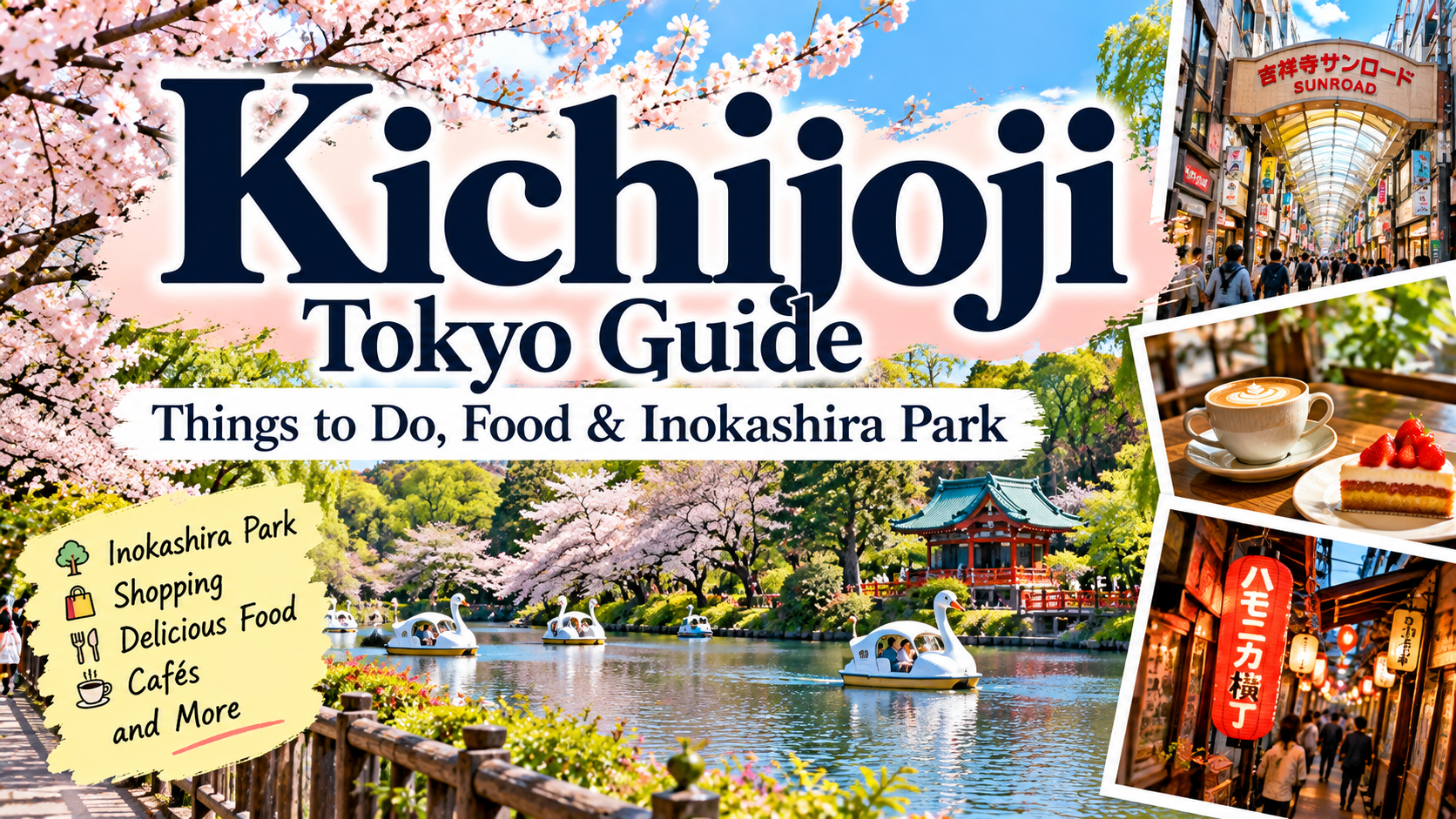
Kichijoji offers something many Tokyo neighborhoods struggle to combine: nature, shopping, food, cafés, and everyday city life within an easy walking distance.
Located west of central Tokyo, Kichijoji is best known among visitors for Inokashira Park. But treating the neighborhood only as a place to visit the park misses much of its appeal.
Around Kichijoji Station, busy shopping streets, department stores, small restaurants, cafés, narrow alleys, and independent shops create a lively urban atmosphere. Walk a little farther, and the scenery changes quickly as you reach the trees and water of Inokashira Park.
This combination makes Kichijoji particularly appealing to travelers who want to spend half a day experiencing Tokyo without moving between multiple neighborhoods.
This guide explains the best things to do in Kichijoji, what to eat, how much time to spend, how to combine the town with Inokashira Park, and whether Kichijoji deserves a place in your Tokyo itinerary.
Is Kichijoji Worth Visiting?
Yes — particularly if you want to combine a Tokyo neighborhood with a large green space.
Kichijoji does not have the same concentration of internationally famous landmarks as Shibuya, Shinjuku, or Asakusa.
Its appeal is different.
Instead of traveling there for one must-see attraction, you can spend several hours moving naturally between the park, shopping streets, cafés, restaurants, and smaller local businesses.
Kichijoji May Be a Good Choice If You:
- Want to visit Inokashira Park
- Enjoy exploring neighborhoods on foot
- Like combining nature with shopping and food
- Want a break from Tokyo’s busiest tourist districts
- Enjoy cafés and smaller restaurants
- Are interested in seeing a more everyday side of Tokyo
- Have already visited Tokyo’s major attractions
- Want an easy half-day destination
Kichijoji May Be Less Suitable If You:
- Have only two or three days in Tokyo
- Want to focus entirely on famous landmarks
- Prefer high-rise city views and major entertainment districts
- Want luxury shopping
- Have no interest in parks or neighborhood exploration
Miruvia’s take: Kichijoji is not essential for every first-time Tokyo itinerary. But if you have enough time, enjoy parks, or want to experience a neighborhood where sightseeing and everyday Tokyo overlap, it can be one of the most enjoyable half-day trips within the city.
What Makes Kichijoji Different?
Kichijoji works because several different experiences are concentrated around one station.
Near the station, the atmosphere is energetic.
You will find shopping arcades, department stores, restaurants, cafés, narrow alleys, and busy pedestrian streets.
Walk south from the station and the environment changes.
Inokashira Park provides trees, walking paths, a pond, and a much calmer setting than the commercial streets nearby.
This creates an easy rhythm for visitors:
Explore the city → eat or shop → walk through the park → return for cafés or dinner.
You do not need to spend much time on trains between each activity.
That convenience is one of Kichijoji’s biggest strengths.
Best Things to Do in Kichijoji
Walk Through Inokashira Park
Inokashira Park is the best-known attraction in Kichijoji and a natural starting point for many visits.
The park centers around Inokashira Pond and contains walking paths, trees, bridges, and places to sit and relax.
Rather than rushing through, give yourself time to walk around part of the pond.
The experience changes with the season, and spring is especially popular when cherry blossoms appear around the park.
However, Kichijoji is not only a spring destination.
The greenery of warmer months and autumn foliage can also make the park an attractive break from Tokyo’s dense urban districts.
Spend Time Around Inokashira Pond
The pond gives the park much of its character.
Walking beside the water is enough for many visitors, but rental boats may also be available depending on operating conditions.
If you are traveling as a couple or family and have extra time, the boats can turn a simple park walk into a more leisurely experience.
If your schedule is limited, however, do not feel that a boat ride is necessary. Walking through the park provides the main experience without requiring additional time.
Visit Inokashira Benzaiten
While walking around the park, you may encounter Inokashira Benzaiten, a small temple located near the pond.
It provides a cultural stop within the park and adds variety to a visit that might otherwise focus entirely on nature.
You do not need to allocate a large amount of time here. Include it naturally as part of your walk.
Explore Sunroad Shopping Arcade
After the park, return toward the station and experience the commercial side of Kichijoji.
Sunroad is a covered shopping arcade extending from the north side of Kichijoji Station.
The area contains a mixture of shops, restaurants, pharmacies, cafés, and everyday businesses.
For international visitors, places like Sunroad are useful because they show how a Tokyo neighborhood functions beyond its tourist attractions.
It is also convenient in poor weather because much of the arcade is covered.
Walk Through Harmonica Yokocho
Close to Kichijoji Station, Harmonica Yokocho provides a completely different atmosphere.
The compact network of narrow alleys contains small restaurants, bars, and shops packed closely together.
During the day, you can walk through quickly and observe the unusual layout.
In the evening, the area becomes more closely associated with food and drinks.
Travelers interested in Tokyo’s smaller alleyway dining culture may find it particularly appealing.
Browse Independent Shops
Kichijoji is a good neighborhood for browsing without a specific shopping list.
Alongside larger commercial facilities, you can find smaller fashion stores, lifestyle shops, specialty businesses, bookstores, and other independent retailers.
This makes shopping here feel different from spending several hours inside a single department store or mall.
Allow yourself to enter shops that look interesting rather than planning every stop in advance.
Stop at a Café
Kichijoji has plenty of opportunities for a café break.
This fits naturally with the neighborhood’s slower pace.
A practical way to structure your visit is to explore Inokashira Park first and stop at a café afterward before continuing into the shopping streets.
Alternatively, use a café as an afternoon break before staying for dinner.
What to Eat in Kichijoji
Kichijoji is not defined by one single food in the way some destinations are.
That is actually useful for travelers.
The area has enough variety that you can choose food based on your schedule rather than designing your entire visit around one famous restaurant.
Explore Harmonica Yokocho
If you want a distinctive Kichijoji dining atmosphere, Harmonica Yokocho is one of the most interesting areas to explore.
Small establishments are packed into narrow lanes near the station.
Some businesses are better suited to evening visits, so the experience can be very different depending on what time you arrive.
Look Beyond Famous Restaurants
Popular restaurants can attract long lines.
Unless one specific place is a major priority, consider nearby alternatives rather than spending a large portion of your Kichijoji visit waiting.
This is particularly important if you only have half a day.
The neighborhood contains enough restaurants that flexibility can often produce a better overall experience than chasing one famous meal.
Combine Food with Your Walking Route
A simple strategy is:
Park in the morning → lunch near the station → shopping and cafés in the afternoon
or:
Shopping in the afternoon → park walk → dinner around Kichijoji Station
Both approaches reduce unnecessary backtracking.
How Much Time Do You Need in Kichijoji?
For most travelers, three to five hours is a practical amount of time.
Around 2 Hours
Suitable if you mainly want to:
- See Inokashira Park
- Walk around the pond
- Explore briefly around Kichijoji Station
This gives you a basic introduction but leaves little time for shopping or cafés.
Around 3–5 Hours
Better if you want to:
- Explore Inokashira Park
- Have lunch
- Walk through Sunroad
- See Harmonica Yokocho
- Browse shops
- Stop at a café
For most international visitors, this is the best balance.
Half a Day or Longer
Consider a longer visit if you:
- Enjoy slow neighborhood exploration
- Plan to shop
- Want a long lunch or café stop
- Intend to stay for dinner
- Are combining Kichijoji with another nearby attraction
Miruvia’s take: Do not schedule Kichijoji as a rushed one-hour stop simply to see Inokashira Park. The neighborhood becomes much more worthwhile when you combine the park with the streets around the station.
A Simple Kichijoji Half-Day Plan
A first visit does not require a complicated itinerary.
One practical route is:
Kichijoji Station → Inokashira Park → Inokashira Pond → Return toward the station → Lunch → Shopping streets → Harmonica Yokocho → Café
Morning Version
If you prefer quieter sightseeing:
Morning: Inokashira Park
Late morning: Walk around the station
Lunch: Kichijoji
Early afternoon: Shopping and café
This leaves the rest of the day available for another Tokyo neighborhood.
Afternoon and Evening Version
If you want more food and atmosphere:
Afternoon: Shopping and cafés
Late afternoon: Inokashira Park
Evening: Dinner or drinks near the station
This version works particularly well if Harmonica Yokocho is one of your priorities.
Kichijoji vs Shimokitazawa: Which Should You Visit?
Both neighborhoods work well for travelers who want to experience Tokyo beyond its major tourist districts, but they offer different reasons to visit.
| Kichijoji | Shimokitazawa | |
|---|---|---|
| Main appeal | Park, food and neighborhood life | Vintage, cafés and creative culture |
| Nature | Excellent | Limited |
| Shopping | Broad mix | Strong for vintage |
| Food | Wide variety | Curry, cafés and small restaurants |
| Atmosphere | Relaxed and balanced | Creative and youthful |
| Major attraction | Inokashira Park | Neighborhood itself |
| Best for | Nature + city combination | Fashion, music and vintage |
| Typical visit | 3–5 hours | 3–5 hours |
Choose Kichijoji If:
You want a large park, neighborhood shopping, food, and a relaxed atmosphere in one visit.
Choose Shimokitazawa If:
Vintage shopping, music, independent culture, and cafés are higher priorities.
Visit Both If:
You have enough time and enjoy exploring Tokyo neighborhoods rather than focusing exclusively on major landmarks.
They provide sufficiently different experiences that visiting both does not need to feel repetitive.
Kichijoji for First-Time vs Repeat Visitors
First-Time Visitors
Kichijoji can be worthwhile on a first trip, but it depends on how much time you have.
With only two or three days in Tokyo, areas such as Shibuya, Shinjuku, Asakusa, and other major attractions will usually take priority.
If you have five or more days, Kichijoji becomes easier to include.
It is particularly attractive if you want a break from dense sightseeing and would enjoy spending several hours in a park and local neighborhood.
If you are still deciding which neighborhoods to prioritize, start with our Tokyo Travel Guide for First-Time Visitors.
Repeat Visitors
Kichijoji is an excellent candidate for a repeat Tokyo trip.
Once the pressure to visit every famous landmark disappears, areas where people shop, eat, relax, and spend ordinary weekends can become much more interesting.
Kichijoji offers exactly that type of experience.
Should You Combine Kichijoji with the Ghibli Museum?
The Ghibli Museum is located in Mitaka, near Inokashira Park, which makes Kichijoji a natural area to consider on the same day.
However, the museum requires advance planning and should not be treated as a spontaneous addition to your Kichijoji visit.
If you already have museum admission arranged, combining it with Kichijoji and Inokashira Park can create a strong half-day or full-day itinerary.
A possible structure is:
Kichijoji → Inokashira Park → Ghibli Museum → Return toward Kichijoji or continue elsewhere
The exact order should depend on your museum entry time.
Miruvia’s take: Build the day around your confirmed Ghibli Museum admission time first. Kichijoji is flexible; the museum is not.
Best Time to Visit Kichijoji
Morning
Morning works particularly well for Inokashira Park.
The atmosphere can feel calmer before the surrounding commercial areas become busier.
Afternoon
Afternoon is ideal for travelers who want to combine shopping, cafés, and the park.
Most businesses are open, and you can move naturally into dinner.
Evening
Evening is worth considering if food, bars, or Harmonica Yokocho are priorities.
You can visit the park earlier and then return to the station area as the atmosphere changes.
Spring
Cherry blossom season can make Inokashira Park especially attractive.
It can also make the area considerably busier.
If seeing cherry blossoms is not your main goal, visiting outside the busiest blossom period may provide a more relaxed experience.
Visiting during cherry blossom season? See our Tokyo in Spring Guide for weather, bloom timing, crowds, and practical travel tips.
How to Get to Kichijoji
Kichijoji Station is served by JR lines and the Keio Inokashira Line.
From Shinjuku
JR services provide convenient access from Shinjuku to Kichijoji.
From Shibuya
The Keio Inokashira Line connects Shibuya and Kichijoji directly.
This makes Kichijoji relatively easy to combine with sightseeing on Tokyo’s western side.
Which Exit Should You Use?
For Inokashira Park, head toward the south side of the station.
For Sunroad and many of the main shopping streets, the north side is convenient.
Because the station area is compact enough to explore on foot, using the “wrong” exit usually does not create a major problem.
Practical Tips for Visiting Kichijoji
Wear Comfortable Shoes
The best way to experience Kichijoji is on foot.
A park walk combined with shopping streets can add up to more walking than expected.
Do Not Visit Only the Park
Inokashira Park is worth seeing, but the combination of park and neighborhood is what makes Kichijoji distinctive.
Allow some time around the station as well.
Avoid Over-Scheduling
Kichijoji works best when you can browse a shop, stop for coffee, or extend your park walk without immediately worrying about the next reservation.
Expect Crowds at Popular Times
Weekends, holidays, and popular seasonal periods can bring larger crowds, particularly around Inokashira Park and the station.
A weekday visit may feel more relaxed if your itinerary allows it.
Check Specific Businesses Before Visiting
Opening hours and closing days vary, particularly among smaller businesses.
If one restaurant, shop, or café is essential to your visit, check its current schedule before traveling.
Is Kichijoji Good for Families?
Yes.
Kichijoji can work particularly well for families because the park provides space away from Tokyo’s dense commercial districts.
Combining outdoor time with food and shopping also makes it easier to create a varied itinerary.
Families interested in the Ghibli Museum may find the area even more relevant, provided museum tickets have already been arranged.
Is Kichijoji Good for Solo Travelers?
Yes.
Solo travelers can explore the park, browse shops, eat, and stop at cafés without needing a structured plan.
Kichijoji is particularly suitable for travelers who enjoy observing everyday city life and walking without a long attraction checklist.
It can also provide a slower day between more intensive sightseeing days.
Frequently Asked Questions
Is Kichijoji Worth Visiting?
Yes, especially if you enjoy parks, food, shopping, cafés, and exploring Tokyo neighborhoods beyond the most famous tourist areas.
What Is Kichijoji Famous For?
Kichijoji is particularly known for Inokashira Park, its shopping streets, restaurants, cafés, Harmonica Yokocho, and its relaxed neighborhood atmosphere.
How Long Should I Spend in Kichijoji?
Around three to five hours works well for most visitors. Allow longer if you plan to shop extensively, stay for dinner, or combine the area with the Ghibli Museum.
Is Kichijoji Good for First-Time Visitors?
It can be, particularly on a longer first trip. Travelers with only a few days in Tokyo may want to prioritize the city’s major sightseeing districts first.
Is Kichijoji Close to Shibuya?
Kichijoji and Shibuya are directly connected by the Keio Inokashira Line, making Kichijoji relatively easy to include in an itinerary based around western Tokyo.
Can I Visit Kichijoji and the Ghibli Museum on the Same Day?
Yes. Their proximity makes the combination practical, but plan around your confirmed Ghibli Museum entry time rather than assuming you can visit spontaneously.
Is Kichijoji Better Than Shimokitazawa?
Neither is universally better. Choose Kichijoji for the combination of nature, food, and neighborhood life. Choose Shimokitazawa if vintage shopping, music, and creative culture are stronger priorities.
Final Thoughts
Kichijoji is not the Tokyo neighborhood to choose because it has the city’s biggest landmark.
It is worth considering because so many different parts of Tokyo life fit comfortably into one area.
You can walk beside the water in Inokashira Park, browse busy shopping streets, eat near the station, explore narrow alleys, stop at a café, and still experience the entire neighborhood without spending much of the day moving between train stations.
For first-time visitors, Kichijoji can provide a welcome change of pace on a longer Tokyo itinerary.
For repeat visitors, it is an even stronger choice.
If you want to experience Tokyo somewhere between sightseeing and everyday local life, Kichijoji deserves a few hours of your trip.
