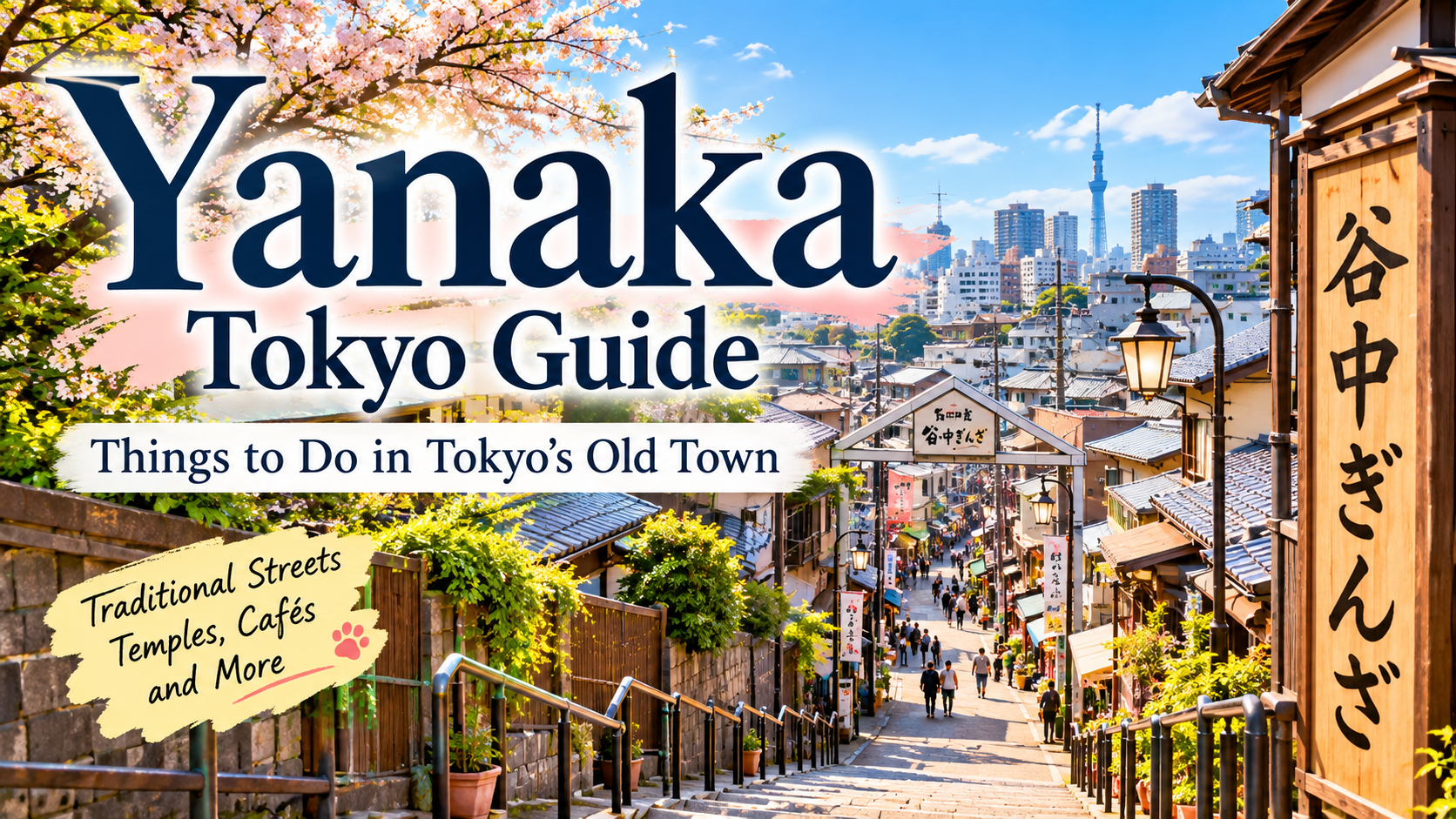
Tokyo is famous for neon-lit streets, skyscrapers, busy stations, and some of the world’s most recognizable urban neighborhoods. But not every part of the city moves at the same pace.
Yanaka offers a very different side of Tokyo.
Located near Ueno and Nippori, Yanaka is known for traditional streets, small temples, independent shops, cafés, and a quieter atmosphere that feels far removed from areas such as Shibuya and Shinjuku.
Rather than rushing between major attractions, the appeal of Yanaka is simply walking through the neighborhood, stopping when something catches your attention, and experiencing a more residential and nostalgic side of the city.
This guide explains what to do in Yanaka, how much time to spend there, when to visit, how it compares with Asakusa, and whether Yanaka deserves a place in your Tokyo itinerary.
Is Yanaka Worth Visiting?
Yes — if you want to experience a slower and more traditional side of Tokyo.
Yanaka is not packed with major landmarks. That is part of its appeal.
The neighborhood is better suited to travelers who enjoy walking, small shops, temples, local streets, cafés, traditional architecture, and discovering places without following a strict sightseeing checklist.
Yanaka is particularly worth considering if you have already included busy areas such as Shibuya, Shinjuku, or Ginza in your itinerary and want to see a contrasting side of Tokyo.
Yanaka may be a good choice if you:
- Enjoy exploring neighborhoods on foot
- Want to see a quieter side of Tokyo
- Like traditional streets and small temples
- Prefer independent shops and cafés to large shopping complexes
- Want an easy area to combine with Ueno
- Have already visited Tokyo’s major attractions
- Are returning to Tokyo for a second or later trip
Yanaka may be less suitable if you:
- Have very limited time on your first Tokyo trip
- Want major landmarks and famous attractions
- Prefer nightlife and entertainment districts
- Want large-scale shopping
- Prefer a tightly scheduled day with many major sights
Miruvia’s take: For a first trip of only two or three days, Tokyo’s major areas will usually be a higher priority. If you have four or more days, enjoy walking, or are returning to Tokyo, Yanaka becomes much easier to recommend.
What Makes Yanaka Different?
Yanaka belongs to the broader area often called Yanesen, a name formed from Yanaka, Nezu, and Sendagi.
Unlike many central Tokyo districts that have undergone extensive redevelopment, parts of this area retain a traditional neighborhood atmosphere.
You will find temples, narrow streets, older buildings, small galleries, local shops, cafés, and everyday residential life mixed together.
The experience is therefore different from visiting a single famous attraction.
In Yanaka, the neighborhood itself is the attraction.
This is important when planning your visit. Do not approach Yanaka with a long checklist. Give yourself enough time to walk slowly and explore streets that look interesting.
Best Things to Do in Yanaka
Walk Through Yanaka Ginza
Yanaka Ginza is the neighborhood’s best-known shopping street and one of the easiest places to start exploring.
The approximately 170-meter street contains around 60 shops, including businesses selling snacks, sweets, tea, handicrafts, and everyday goods.
It is much smaller than Tokyo’s major shopping districts, but that is precisely why it works well in a Yanaka itinerary.
Instead of department stores and international brands, the experience is about browsing small shops and trying something that catches your attention.
Do not plan your visit around one specific food stall unless it is especially important to you. Shop hours vary, so Yanaka Ginza works better as a place to explore than as a rigid food checklist.
See Yuyake Dandan
Before reaching Yanaka Ginza from the Nippori side, you will encounter Yuyake Dandan, a staircase overlooking the shopping street.
Its name is associated with sunset, and the steps provide one of the neighborhood’s recognizable views.
It is not a major attraction that requires much time. Think of it instead as a natural part of the walk into Yanaka Ginza.
If your schedule allows, late afternoon can be particularly pleasant because you can explore the neighborhood before reaching the steps closer to sunset.
Walk Through Yanaka Cemetery
A cemetery may not normally appear on a Tokyo sightseeing itinerary, but Yanaka Cemetery is an important part of the neighborhood.
Its tree-lined paths create a quiet walking route between Nippori and the surrounding temple district.
The cemetery contains the graves of notable historical figures, including Tokugawa Yoshinobu, the last shogun of the Tokugawa shogunate. The central Sakura-dori is also lined with cherry trees and becomes particularly attractive during spring.
Visit respectfully. This remains a cemetery rather than simply a tourist attraction.
Explore the Temple Streets
One of the pleasures of Yanaka is encountering temples while walking through the neighborhood.
You do not need to visit every temple.
Instead, allow the temple streets to become part of the walk itself. The quieter lanes, walls, gates, and older buildings contribute to the atmosphere that makes Yanaka different from Tokyo’s modern commercial districts.
This is also where having a less rigid itinerary helps.
If an interesting street leads away from your planned route, Yanaka is a good place to follow it.
Look for Small Cafés, Shops and Galleries
Yanaka and neighboring Nezu have a mixture of small cafés, galleries, traditional businesses, and renovated older buildings. GO TOKYO specifically highlights the area’s narrow backstreets, galleries and quiet cafés as part of the experience.
Rather than choosing every café before arriving, leave space in your itinerary for spontaneous stops.
That flexibility is one of the biggest differences between exploring Yanaka and visiting an attraction-heavy area.
Continue to Nezu Shrine
If you have more time, extend your walk beyond Yanaka toward Nezu Shrine.
The shrine is one of the major historical attractions in the wider Yanesen area and is known for its traditional architecture and rows of red torii gates. It is particularly popular during the azalea season in spring.
Adding Nezu transforms a short Yanaka visit into a more complete exploration of Yanesen.
For travelers who enjoy walking, this is preferable to returning immediately to the train after visiting Yanaka Ginza.
How Much Time Do You Need in Yanaka?
For most travelers, two to four hours is a practical amount of time.
Around 2 hours
Best if you mainly want to experience:
- Yanaka Cemetery
- Yuyake Dandan
- Yanaka Ginza
- A short neighborhood walk
This works well when combining Yanaka with Ueno on the same day.
Around 3–4 hours
Better if you want to:
- Walk slowly
- Stop at cafés or small shops
- Explore temple streets
- Continue toward Sendagi or Nezu
- Visit Nezu Shrine
Half a day
A good choice for travelers who specifically enjoy neighborhoods, photography, cafés, traditional streets, art, or slow travel.
Do not give Yanaka a full day simply because you think you need to see everything. For most visitors, combining it with Ueno or the wider Yanesen area makes better use of the day.
A Simple Yanaka Walking Route
A straightforward route for a first visit is:
Nippori Station
→ Yanaka Cemetery
→ temple streets
→ Yuyake Dandan
→ Yanaka Ginza
→ Sendagi
→ Nezu Shrine
The exact route does not need to be followed perfectly.
The point is to create a general direction while leaving enough flexibility to explore interesting streets along the way.
GO TOKYO also provides a Yanesen walking course connecting Nippori, Yanaka Cemetery, Yanaka Ginza, Sendagi, and Nezu Shrine, so these areas naturally work as one continuous walk.
Short version
If you have limited time:
Nippori → Yanaka Cemetery → Yanaka Ginza
Longer version
If you have more time:
Nippori → Yanaka → Sendagi → Nezu Shrine
The longer version gives you a better sense of the wider Yanesen neighborhood rather than treating Yanaka Ginza as the only destination.
Yanaka vs Asakusa: Which Should You Visit?
Both areas can show you a more traditional side of Tokyo, but the experience is different.
| Yanaka | Asakusa | |
|---|---|---|
| Main appeal | Neighborhood atmosphere | Major historic sightseeing |
| Famous landmark | Fewer major landmarks | Senso-ji |
| Crowds | Generally quieter | Usually busier around major sights |
| Shopping | Small local shops | Tourist shopping and traditional goods |
| Best for | Walking and exploring | First-time sightseeing |
| Time needed | Around 2–4 hours | Around half a day |
| First Tokyo trip | Optional depending on time | Higher priority |
| Repeat Tokyo trip | Excellent choice | Still worthwhile |
Choose Asakusa if:
This is your first trip, you want a major temple, or you have limited sightseeing time.
Choose Yanaka if:
You have already covered Tokyo’s major attractions or prefer quieter streets and neighborhood exploration.
Visit both if:
You have enough time and want to compare two different versions of traditional Tokyo.
They are not substitutes for each other. Asakusa is more landmark-driven; Yanaka is more about atmosphere and walking.
Yanaka for First-Time vs Repeat Visitors
First-Time Visitors
Yanaka can work very well on a first trip, but it should usually come after your highest-priority Tokyo experiences.
If you have only three days, neighborhoods such as Shibuya, Shinjuku, Asakusa, and your other personal priorities may fill the itinerary quickly.
If you are still deciding how to organize your days, see our Tokyo Itinerary for First-Time Visitors: 3, 5 & 7 Days.
With five or more days, Yanaka becomes easier to include because it adds contrast without requiring an entire day.
Repeat Visitors
Yanaka is particularly attractive for repeat visitors.
If you have already experienced Tokyo’s major landmarks, spending several hours walking through a neighborhood can reveal a different side of the city.
This is exactly the type of Tokyo experience that becomes more valuable once you no longer feel pressure to check off every famous attraction.
How to Combine Yanaka with Ueno
Ueno is one of the best areas to combine with Yanaka.
The two areas are close, but they provide very different experiences.
Ueno offers major museums, Ueno Park, Ameyoko, and busier sightseeing. Yanaka provides smaller streets, temples, shops, and a slower atmosphere.
A simple day could look like:
Morning: Ueno Park and a museum
Lunch: Ueno or nearby
Afternoon: Walk toward Yanaka
Late afternoon: Yanaka Ginza and Yuyake Dandan
This combination creates more variety than spending the entire day moving between similar commercial districts.
If Ueno is already part of your Tokyo plans, adding Yanaka can therefore be relatively easy.
Best Time to Visit Yanaka
Best time of day
Late morning through late afternoon works well for most visitors.
Arriving too early may mean some shops are not yet open, while arriving too late can limit your ability to browse smaller businesses.
Because opening hours vary by shop, check any specific place that matters to you before visiting.
Late afternoon
Consider late afternoon if you want to finish around Yuyake Dandan near sunset.
Spring
Spring adds cherry blossoms to parts of the area, particularly around Yanaka Cemetery.
However, seasonal scenery can also attract more visitors, so do not expect the area to feel completely quiet at popular times.
How to Get to Yanaka
Nippori Station is one of the most convenient starting points.
It is served by JR lines including the Yamanote Line, as well as Keisei services. From Tokyo Station, the journey to Nippori is roughly 12–15 minutes depending on the service, according to Tokyo’s official tourism information.
For the wider Yanesen area, Sendagi Station and Nezu Station on the Tokyo Metro Chiyoda Line are also useful.
Which station should you use?
Start at Nippori if you want to walk through Yanaka first.
Use Sendagi or Nezu if you are approaching from the other side or specifically want to explore the wider Yanesen area.
For a first visit, starting at Nippori and gradually walking toward Yanaka Ginza is straightforward.
Practical Tips for Visiting Yanaka
Wear comfortable shoes
Yanaka is best explored on foot, and the experience often involves walking beyond the main shopping street.
Do not over-plan
Choose a few anchors — such as Yanaka Cemetery and Yanaka Ginza — and leave space between them.
Respect residential areas
Yanaka is not an outdoor theme park. People live and work throughout the neighborhood.
Avoid blocking narrow streets, entering private property, or creating unnecessary noise.
Check individual opening hours
Small businesses may have different opening days and hours. If one specific café, gallery, or shop is essential to your visit, check its current information before traveling.
Carry some cash
Cashless payment is common in Tokyo, but carrying some yen remains useful when visiting smaller shops.
Keep your schedule flexible
Yanaka works best when you can stop for a snack, enter a small shop, or change direction without worrying about missing the next reservation.
Is Yanaka Good for Families?
It can be, especially for families who enjoy walking and exploring neighborhoods together.
However, Yanaka does not have the same concentration of child-focused attractions as areas built around entertainment facilities.
Families with very young children should also consider how much walking they want to do.
For older children who enjoy snacks, cats, small shops, photography, or discovering unusual streets, the area can be more interesting.
Is Yanaka Good for Solo Travelers?
Yes.
Yanaka is particularly easy to explore alone because the main activity is walking rather than participating in a scheduled attraction.
Solo travelers can change plans easily, spend longer in a café, browse small shops, or take photographs without coordinating with a group.
It also works well as a lighter day between more intensive sightseeing days.
Frequently Asked Questions
Is Yanaka worth visiting on a first trip to Tokyo?
Yes, particularly if you have at least four or five days in Tokyo and enjoy walking or traditional neighborhoods. With a very short itinerary, major areas such as Asakusa, Shibuya, and Shinjuku may be higher priorities.
How long should I spend in Yanaka?
Around two to four hours is enough for most travelers. Allow longer if you want to continue through Sendagi and Nezu.
Is Yanaka better than Asakusa?
Neither is universally better. Asakusa is stronger for major historical sightseeing, while Yanaka is better for quieter neighborhood exploration.
Is Yanaka close to Ueno?
Yes. Yanaka is close enough to Ueno to combine the two areas in the same day, making this one of the most practical ways to include Yanaka in a Tokyo itinerary.
What is Yanesen?
Yanesen is a name commonly used for the connected neighborhoods of Yanaka, Nezu, and Sendagi. Exploring all three provides a broader experience than visiting Yanaka Ginza alone.
What is Yanaka famous for?
Yanaka is known for its traditional neighborhood atmosphere, Yanaka Ginza shopping street, Yanaka Cemetery, temples, small shops, cafés, and its connection to the wider Yanesen area.
Final Thoughts
Yanaka is not the Tokyo neighborhood to choose if you want the biggest attractions, brightest lights, or busiest nightlife.
That is exactly why it can be worth visiting.
The area provides a chance to slow down and experience Tokyo at street level — walking through residential lanes, passing temples, browsing small shops, stopping for food or coffee, and discovering places that were not necessarily on your itinerary.
For first-time visitors with enough time, Yanaka can provide valuable contrast to Tokyo’s major sightseeing districts.
For repeat visitors, it can be even more rewarding.
If your Tokyo itinerary already contains the famous city, consider making room for the quieter one too.
