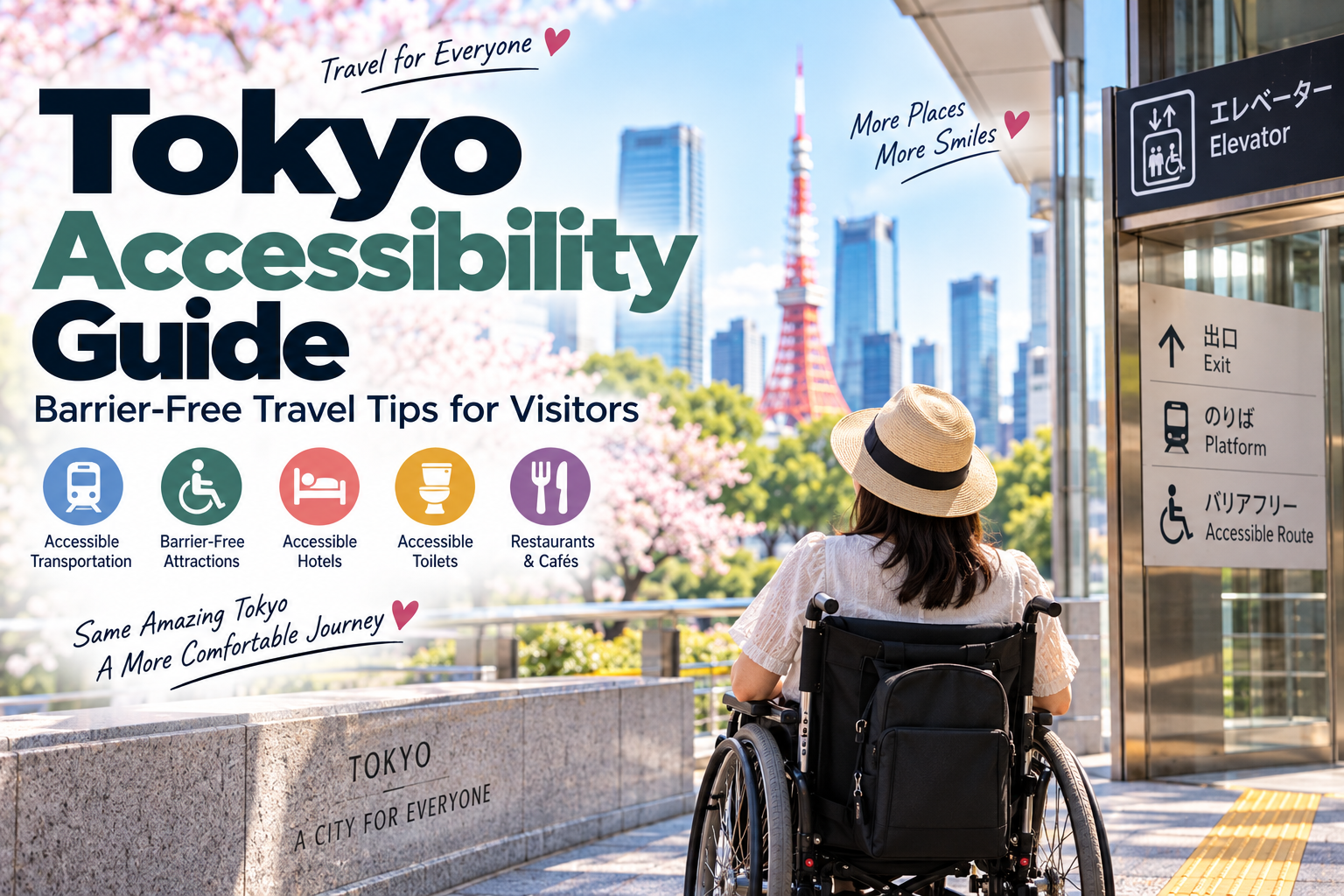
Tokyo is one of the world’s largest cities, but it has also become increasingly accessible for travelers with different mobility needs.
Many train stations have elevators, major attractions provide accessible entrances, and accessible toilets can be found throughout the city. However, Tokyo can still present challenges.
Stations can be enormous, elevators may be far from the most convenient exit, older buildings sometimes have steps, and crowded trains can make transportation more difficult.
For wheelchair users, travelers who use walking aids, older visitors, or anyone who has difficulty walking long distances, planning ahead can make a major difference.
This Tokyo accessibility guide explains how to navigate transportation, stations, hotels, attractions, toilets, restaurants, and other parts of the city more comfortably.
Tokyo Accessibility at a Glance
Tokyo can be relatively accessible, particularly in major transportation hubs and modern commercial areas.
However, accessibility varies significantly between locations.
Travelers should expect a combination of:
- Modern barrier-free stations
- Elevators and escalators
- Accessible toilets
- Step-free entrances
- Older buildings with stairs
- Narrow restaurants and shops
- Crowded trains and stations
- Long walking distances
The most important strategy is not to assume that every route will be equally accessible.
A small amount of advance planning can prevent major problems during your trip.
Is Tokyo Wheelchair Accessible?
Many parts of Tokyo can be explored by wheelchair, but the experience depends heavily on the specific route.
Major stations, shopping centers, museums, observation decks, and newer attractions are often designed with accessibility in mind.
Older neighborhoods and small independent businesses can be more challenging.
You may encounter:
- Steps at entrances
- Narrow doorways
- Small elevators
- Steep slopes
- Limited space inside restaurants
- Uneven surfaces
Rather than asking whether Tokyo as a whole is wheelchair accessible, it is more useful to evaluate each part of your itinerary individually.
Tokyo Requires a Lot of Walking
Even travelers without mobility limitations are often surprised by how much walking Tokyo requires.
A journey that looks short on a map may involve walking:
- Through large train stations
- Between platforms
- Through underground passages
- From stations to attractions
- Around shopping complexes
- Inside large tourist sites
For travelers with limited mobility, this can become exhausting.
Avoid planning your itinerary based only on geographic distance.
The amount of walking required inside stations and attractions can be just as important as the distance between destinations.
Elevators at Tokyo Train Stations
Many Tokyo train and subway stations have elevators.
However, elevators are not always located near the exit you originally intended to use.
A station may have several exits, but only certain routes may provide step-free access between the platform and street level.
This means that choosing the correct exit can be extremely important.
When planning a journey, consider:
- Which station entrance has an elevator.
- Whether there is step-free access from the platform.
- Whether transfers require long distances.
- Which exit is closest to your destination.
- Whether the route includes stairs or steep slopes after leaving the station.
Following accessibility signs inside the station can sometimes result in a longer route, but it may be significantly easier.
Ask Station Staff for Help
Station staff can be extremely helpful for passengers who require assistance.
If you use a wheelchair or need help boarding a train, speak with staff at the station.
Depending on the railway and situation, staff may assist with boarding and arrange support at your destination station.
Portable ramps may be used when there is a gap or height difference between the train and platform.
Allow extra time for this process, especially at large or busy stations.
Wheelchair Boarding Assistance
Wheelchair users may need assistance when boarding certain trains.
The exact procedure varies depending on the railway company, station, train, and platform.
In many situations, station staff can guide you to an appropriate boarding position and provide a portable ramp when necessary.
At your destination, staff may also be prepared to assist with leaving the train.
Because procedures can vary, ask station staff rather than assuming the same process applies everywhere.
Transfers Can Be More Complicated Than Expected
Tokyo’s rail network is extensive, but transferring between lines can involve significant walking.
Two lines shown as connected on a transportation map may require traveling through long corridors or moving between different sections of a large station.
For travelers with limited mobility, a route with fewer transfers may be preferable even if it takes slightly longer.
When comparing routes, consider:
- Number of transfers
- Walking distance
- Elevator availability
- Station size
- Crowd levels
The fastest route is not always the easiest route.
For a complete overview of trains, subways, IC cards, transfers, and getting around the city, see our Tokyo Transportation Guide.
Major Stations Can Be Huge
Stations such as Shinjuku, Tokyo, Shibuya, Ikebukuro, and Ueno can feel like small cities.
They contain multiple railway lines, underground passages, shopping areas, department stores, and numerous exits.
For travelers with mobility concerns, navigating these stations can require additional time.
Do not schedule extremely tight connections.
If possible, identify your preferred exit before arriving at the station.
Avoid Rush Hour When Possible
Tokyo’s trains can become extremely crowded during weekday commuting periods.
Crowding can make travel more difficult for wheelchair users, travelers using walking aids, older visitors, families with strollers, and anyone who needs additional space or time.
If your itinerary is flexible, consider avoiding the busiest commuting periods.
Traveling later in the morning can make the experience considerably more comfortable.
Priority Seating
Many trains have priority seating areas intended for passengers who may need a seat, including older passengers, people with disabilities, injured passengers, pregnant passengers, and passengers traveling with small children.
Priority seating does not guarantee that a seat will always be available.
If standing for long periods is difficult, avoiding crowded travel times can be particularly helpful.
Using Buses in Tokyo
Buses can sometimes provide a useful alternative to trains, especially when they reduce walking between a station and your destination.
Many city buses are designed with accessibility features, but vehicle types and boarding conditions can vary.
If you require wheelchair access or boarding assistance, check the relevant bus operator’s current information when planning an important journey.
Buses can also be affected by traffic, so allow additional travel time.
Using Taxis
Taxis can be valuable for travelers who have difficulty walking long distances.
They may be particularly useful:
- After a tiring sightseeing day
- When traveling with luggage
- Between locations that require inconvenient train transfers
- When your hotel is far from the nearest accessible station exit
However, not every standard taxi can accommodate every type of wheelchair without transferring from the wheelchair.
Accessible vehicle availability can also vary.
If you require a specific vehicle configuration, arrange or verify it in advance rather than relying on finding one immediately.
Accessible Transportation from the Airport
Your accessibility planning should begin before you reach central Tokyo.
Both Haneda and Narita airports provide transportation options into the city, but the easiest choice depends on your hotel, luggage, mobility requirements, and arrival time.
A direct route may be more comfortable than choosing the fastest route with multiple transfers.
If you are traveling with mobility equipment, consider contacting your airline and transportation provider before departure to confirm available assistance.
Choosing an Accessible Hotel
Hotel accessibility should be checked carefully before booking.
Do not assume that a hotel described as modern or convenient will meet your specific needs.
Important questions include:
- Is there step-free access from the street?
- Is the entrance door wide enough?
- Is there an elevator?
- Are accessible guest rooms available?
- Is the bathroom suitable for your needs?
- Is there enough space around the bed?
- Is the shower accessible?
- Are grab bars available?
- How far is the hotel from an accessible station entrance?
If accessibility is essential, contact the hotel directly and explain your requirements.
Accessible Rooms May Be Limited
Hotels may have only a small number of accessible rooms.
These rooms can differ significantly from standard rooms.
Booking early is therefore important.
Before paying for a non-refundable reservation, confirm that the room you are booking—not simply the hotel building—meets your requirements.
Hotel Location Matters More Than You Think
A hotel located five minutes from a station may sound ideal.
However, that distance may be measured from an exit with stairs.
The accessible elevator exit could be farther away.
When comparing hotels, investigate the route between the station and hotel rather than relying only on the advertised walking time.
A slightly more expensive hotel with an easier route can significantly improve your daily experience.
Accessible Toilets in Tokyo
Accessible toilets are widely available in many modern public facilities.
You may find them in:
- Major train stations
- Airports
- Department stores
- Shopping centers
- Museums
- Large tourist attractions
- Public buildings
They may be labeled as accessible toilets, multipurpose toilets, or similar terms.
Facilities vary, but some provide additional space, handrails, changing facilities, or other accessibility features.
For more advice on finding and using restrooms throughout the city, see our Tokyo Public Toilet Guide.
Do Not Wait Until the Last Minute
Although accessible toilets are common, they are not available everywhere.
Small restaurants, older buildings, and independent shops may have compact restrooms that are difficult to access.
When visiting large stations, department stores, museums, or shopping centers, consider using accessible facilities before continuing to smaller locations.
Accessible Restaurants
Restaurants can be one of the more difficult parts of accessible travel in Tokyo.
Many restaurants are small.
Some are located:
- Upstairs without elevators
- Down narrow staircases
- Inside older buildings
- Behind raised entrances
- In spaces with fixed seating
This is especially common in entertainment districts and older neighborhoods.
Larger restaurants inside shopping centers, department stores, hotels, and modern commercial buildings may be easier to access.
Check Restaurant Entrances
A restaurant may appear accessible online but still have a small step at the entrance.
Interior layouts can also be narrow.
If a restaurant is particularly important to your trip, check recent photos or contact the business directly.
Do not rely solely on general descriptions such as “wheelchair friendly” without understanding what facilities are actually available.
Convenience Stores Can Be Useful
Convenience stores can be extremely useful during an accessible trip.
They provide drinks, snacks, simple meals, toiletries, and other essentials without requiring a long restaurant visit.
However, individual store layouts vary.
Some older or smaller locations may have narrow aisles.
Larger stores in modern buildings are generally easier to navigate.
Shopping Centers and Department Stores
Large shopping centers and department stores can be excellent destinations for travelers who need a more accessible environment.
They often provide:
- Elevators
- Accessible toilets
- Restaurants
- Seating areas
- Climate control
- Wide corridors
- Multiple shops in one building
They can also be useful on rainy days or when you want to reduce outdoor walking.
Accessibility at Tourist Attractions
Many major Tokyo attractions provide accessibility information, but facilities differ.
Before visiting an important attraction, check its official website for information about:
- Step-free entrances
- Elevators
- Wheelchair routes
- Accessible toilets
- Wheelchair rentals
- Accessible parking
- Assistance services
- Areas that may be inaccessible
Accessibility conditions can change because of construction, maintenance, or renovations.
Current official information should take priority over older travel reports.
Temples and Shrines
Tokyo’s temples and shrines vary considerably in accessibility.
Some major sites have paved or step-free routes, while others include:
- Gravel
- Stone paths
- Stairs
- Slopes
- Raised structures
Even when the main grounds are accessible, individual buildings may not be.
Check the specific site if visiting it is a major priority.
Parks and Gardens
Parks can provide a relaxing break from crowded urban areas, but surfaces vary.
Some routes may be paved and relatively flat, while others may include gravel, slopes, bridges, or uneven ground.
Large parks may also require significant walking.
Reviewing a park map before visiting can help you choose the most suitable entrances and routes.
Observation Decks and Modern Attractions
Modern observation decks, museums, aquariums, and large entertainment facilities are often easier to navigate than older buildings.
Elevators and accessible toilets are commonly available.
However, entry procedures, elevator routes, and accessible viewing areas vary.
Check the official accessibility information when available.
Older Neighborhoods
Traditional neighborhoods can be rewarding to explore, but accessibility may be less consistent.
You may encounter narrow sidewalks, small shops, steps, older buildings, and uneven surfaces.
This does not necessarily mean you should avoid these neighborhoods.
Instead, allow more time and choose your route carefully.
Sidewalks and Streets
Tokyo has many well-maintained sidewalks, but street conditions vary.
Some smaller streets have no separate sidewalk.
You may also encounter:
- Utility poles
- Bicycle parking
- Construction
- Crowded pedestrian areas
- Slopes
- Narrow passages
Busy districts can be particularly difficult during peak periods.
Traveling earlier in the day may provide more space.
Tactile Paving
Yellow tactile paving is common throughout Japan.
It is designed to assist people with visual impairments and can be found at stations, pedestrian crossings, sidewalks, and public facilities.
Travelers should avoid blocking tactile paving with luggage, bags, or other belongings.
This is an important part of considerate public-space behavior in Japan.
Escalators Are Not a Substitute for Elevators
If stairs are difficult for you, it may be tempting to depend on escalators.
However, escalators may not be suitable for every mobility need.
If you require a stable, step-free route, follow elevator signs even when the elevator requires a longer detour.
Traveling with a Mobility Scooter
Mobility scooter rules and compatibility can vary across transportation providers and facilities.
Some railway operators may have specific requirements regarding dimensions, turning ability, or other conditions.
If you plan to use a mobility scooter on public transportation, check directly with the relevant railway companies before your trip.
Do not assume that all mobility devices are handled in exactly the same way.
Traveling with a Walking Cane or Walker
Travelers using canes or walkers may find Tokyo manageable with careful pacing.
The main challenges are often:
- Long station corridors
- Crowded trains
- Limited seating
- Stairs
- Long sightseeing days
Plan regular breaks and avoid combining too many large attractions in one day.
Using taxis selectively can also reduce fatigue.
Traveling with Luggage
Large luggage makes accessibility more complicated.
Even when a station has elevators, navigating crowded platforms and narrow passages with large suitcases can be tiring.
Consider:
- Packing lighter
- Using luggage forwarding services
- Storing bags before hotel check-in
- Using airport delivery services when appropriate
Reducing the amount of luggage you carry can make transportation significantly easier.
For practical ways to manage suitcases before check-in, after check-out, or while sightseeing, see our Tokyo Luggage Storage Guide.
Build More Time into Your Schedule
Accessible routes are sometimes longer than the fastest route.
You may need extra time to:
- Find elevators
- Wait for assistance
- Navigate large stations
- Avoid stairs
- Use accessible toilets
- Enter attractions through designated routes
Avoid building an itinerary around exact minute-by-minute schedules.
Extra time reduces stress when unexpected obstacles appear.
Plan Fewer Areas Per Day
Tokyo’s size makes it tempting to visit many neighborhoods in one day.
For travelers with mobility limitations, this can quickly become exhausting.
A better strategy may be to focus on one or two main areas each day.
For example:
Morning: Explore one major attraction.
Lunch: Eat nearby.
Afternoon: Visit a second attraction or shopping area in the same district.
Evening: Return to your hotel or take a taxi to dinner if needed.
Reducing unnecessary transportation can make the trip much more enjoyable.
Use Rest Stops Strategically
Department stores, cafés, shopping centers, museums, and hotel lobbies can provide useful opportunities to rest.
Do not wait until you are exhausted.
Regular short breaks can help you maintain your energy throughout the day.
Weather Can Affect Accessibility
Tokyo’s weather can significantly change travel conditions.
Summer
Summer can be extremely hot and humid.
Heat can increase fatigue and make long outdoor routes more difficult.
Use air-conditioned indoor spaces for regular breaks.
Rainy Weather
Wet surfaces can become slippery, and using umbrellas while managing mobility equipment can be inconvenient.
Indoor attractions and shopping complexes can simplify rainy-day planning.
Winter
Winter is generally dry, but cold temperatures may affect travelers who need frequent outdoor breaks.
Snow
Heavy snow is relatively uncommon in central Tokyo, but even small amounts can disrupt transportation and make surfaces slippery.
Check current conditions when necessary.
Keep Your Phone Charged
A smartphone can be particularly important for accessible travel.
You may use it for:
- Maps
- Translation
- Train routes
- Elevator information
- Attraction accessibility pages
- Taxi services
- Hotel communication
Carry a portable battery if you depend heavily on your phone.
Reliable mobile internet access is also valuable when plans need to change unexpectedly.
Save Important Information Before Leaving the Hotel
Before starting each day, consider saving:
- Hotel address
- Destination names
- Station exits
- Attraction websites
- Reservation information
- Transportation routes
Screenshots can be useful if your internet connection becomes unreliable.
Useful Japanese Words
A few Japanese words may help when asking for assistance.
Erebētā — Elevator
Toire — Toilet
Kuruma isu — Wheelchair
Deguchi — Exit
Eki — Station
You do not need to speak Japanese fluently.
Translation apps and simple gestures can also make communication easier.
What to Do If a Route Is Not Accessible
Even with careful planning, you may encounter an unexpected staircase, closed elevator, construction area, or inaccessible entrance.
Do not assume that your trip has reached a dead end.
Try:
- Looking for another station exit.
- Asking station or facility staff.
- Checking for another entrance.
- Using a nearby station.
- Taking a taxi for part of the journey.
- Adjusting your itinerary.
Flexibility is one of the most useful tools for accessible travel.
Confirm Critical Accessibility Information
Accessibility information can change.
Elevators may be temporarily unavailable, construction may alter routes, and attraction procedures can be updated.
If a particular accessibility feature is essential for you, confirm it through the official transportation provider, hotel, attraction, or facility before relying on it.
This is especially important for:
- Accessible hotel rooms
- Wheelchair transportation
- Mobility scooter use
- Attraction access
- Airport assistance
- Special medical or mobility requirements
A Simple Accessible Tokyo Strategy
A comfortable Tokyo trip does not require complicated planning.
Use this basic strategy:
Choose accommodation near a convenient accessible station.
Plan one or two main areas each day.
Prefer routes with fewer transfers.
Identify elevator exits before traveling.
Use taxis when they meaningfully reduce fatigue.
Take regular breaks.
Confirm essential accessibility features in advance.
This approach can make Tokyo much easier to navigate.
Final Thoughts
Tokyo can be an exciting and rewarding destination for travelers with mobility needs, but preparation matters.
The city offers extensive public transportation, elevators, accessible toilets, modern attractions, and helpful station staff. At the same time, large stations, long walking distances, crowded trains, older buildings, and small restaurants can create challenges.
The goal is not to create a perfectly obstacle-free itinerary.
Instead, build flexibility into your schedule, reduce unnecessary transfers, choose accommodation carefully, and confirm the accessibility features that are essential for your individual needs.
With thoughtful planning and enough time, many travelers can experience Tokyo at a comfortable pace and enjoy far more of the city without turning every day into a physical challenge.
For more essential information when planning your first visit, continue with our Tokyo Travel Guide.
