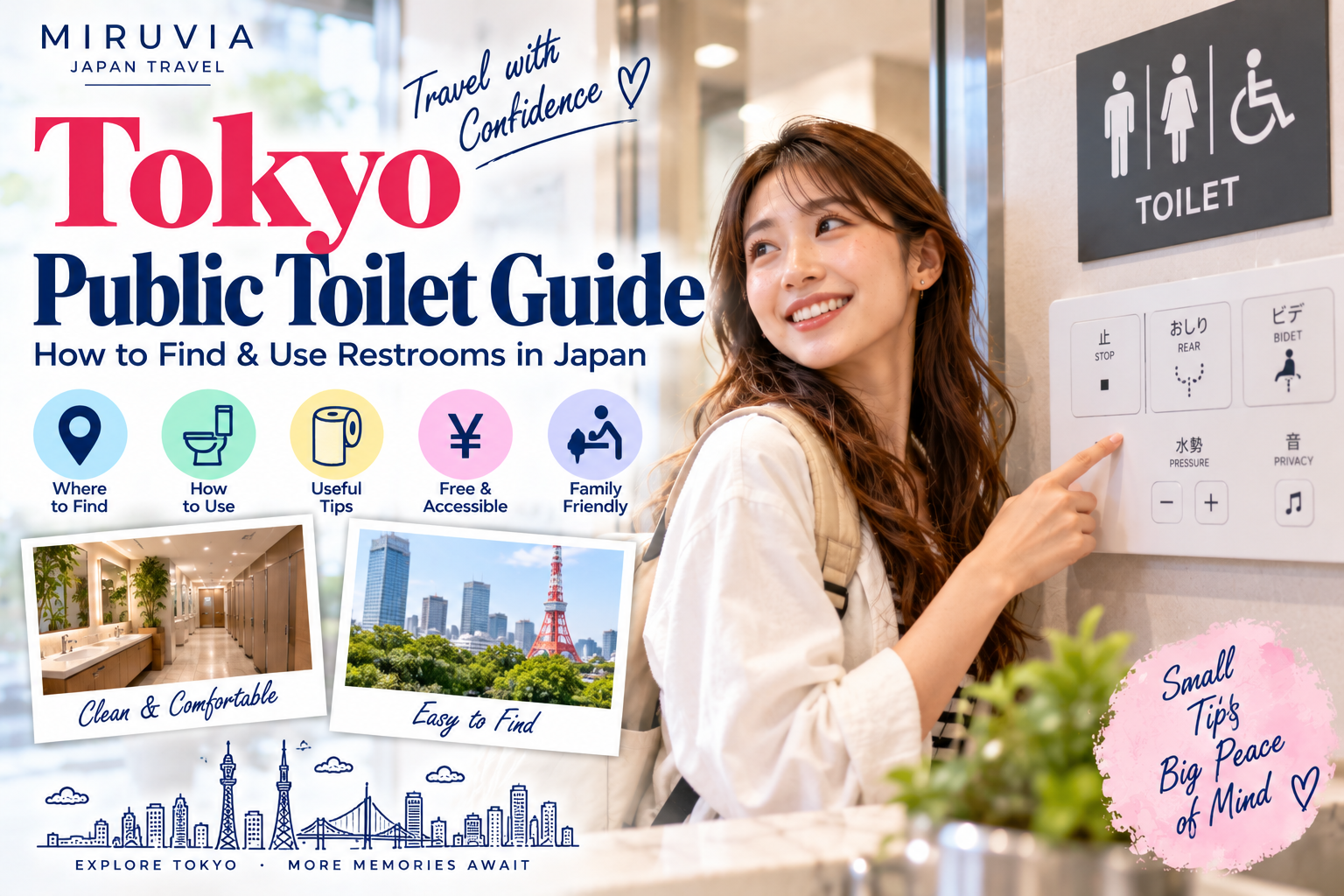
Finding a restroom in Tokyo is usually easier than many first-time visitors expect.
Public toilets are widely available at train stations, shopping centers, department stores, parks, museums, tourist attractions, and many other places. Most are free to use, and many are clean and well maintained.
However, Japanese toilets can still be confusing for international travelers. Electronic control panels, unfamiliar symbols, squat toilets, multipurpose restrooms, and different ways of flushing can make a simple bathroom visit feel surprisingly complicated.
This guide explains where to find toilets in Tokyo, how to use Japanese toilets, what the buttons mean, and the basic restroom etiquette travelers should know.
Tokyo Public Toilets at a Glance
| Topic | What Travelers Should Know |
|---|---|
| Availability | Toilets are widely available throughout Tokyo |
| Cost | Most public toilets are free |
| Easy places to find them | Train stations, shopping centers, department stores and parks |
| Toilet type | Western-style toilets are common |
| Electronic toilets | Common in hotels, malls and many public facilities |
| Toilet paper | Usually provided |
| Flushing | Method varies by toilet |
| Accessible toilets | Available at many stations and major facilities |
| Best advice | Look for restroom signs before it becomes urgent |
Are Public Toilets Easy to Find in Tokyo?
Generally, yes.
Tokyo has a large number of toilets available to travelers, particularly around major stations and commercial districts.
You can often find restrooms in:
- Train and subway stations
- Department stores
- Shopping malls
- Large commercial buildings
- Museums
- Tourist attractions
- Parks
- Airports
- Hotels
- Some convenience stores
- Highway and transport facilities
Availability varies by location, so it is better not to assume that every small shop or restaurant has a restroom available to non-customers.
Are Public Toilets Free in Tokyo?
Most toilets that travelers encounter in Tokyo are free to use.
You generally do not need to carry coins specifically for public restroom access.
This can make sightseeing considerably easier compared with destinations where paid public toilets are common.
However, access may depend on the facility. For example, a toilet inside a station’s ticketed area may require you to pass through the ticket gates.
Best Places to Find a Toilet in Tokyo
If you need a restroom while sightseeing, certain locations are particularly reliable.
Train and Subway Stations
Stations are one of the most useful places to look.
Large stations usually have multiple restroom areas, although their locations can be confusing because major Tokyo stations are enormous.
Some toilets are inside the ticket gates, while others may be located in surrounding station buildings.
Follow signs showing:
- Toilets
- Restrooms
- WC
- Male/female restroom symbols
If you cannot find one, ask station staff.
Department Stores
Department stores are an excellent option because their restrooms are often clean and well equipped.
They may also have:
- Accessible facilities
- Baby-changing areas
- Family-friendly facilities
- Powder areas
- Electronic toilets
Keep the building’s opening hours in mind.
Shopping Malls
Large shopping centers are another reliable option.
Restrooms are usually shown on floor maps and directory signs.
Parks
Many larger parks have public toilets.
Facilities can be more basic than those inside department stores or modern commercial buildings, but they are useful when sightseeing outdoors.
Museums and Tourist Attractions
Museums, observation decks, temples, gardens and other attractions often have visitor restrooms.
It can be useful to visit the restroom before leaving a major attraction, particularly if your next destination requires a longer journey.
Convenience Stores
Some convenience stores have customer toilets, but availability is not guaranteed.
Stores in busy central areas may restrict restroom access or may not provide public toilets at all.
Do not assume every convenience store will have one available.
If you are unsure, ask staff before attempting to use it.
If you are using convenience stores during your trip, see our Tokyo Convenience Store Guide for practical tips on shopping, food, payments, and useful services.
If you are unfamiliar with Tokyo’s train and subway system, our Tokyo Transportation Guide explains how to navigate stations, trains, IC cards, and transfers.
How to Search for a Public Toilet
Your smartphone can help if you cannot immediately see one nearby.
Try searching your preferred map application for terms such as:
- Public toilet
- Restroom
- Toilet
- 公衆トイレ
However, map information may occasionally be outdated or incomplete.
In busy areas, looking inside the nearest station, department store, mall, or major public facility may be faster.
Useful Japanese Words
Knowing a few basic words can help.
トイレ — toire — toilet
お手洗い — otearai — restroom
化粧室 — keshōshitsu — restroom / lavatory
公衆トイレ — kōshū toire — public toilet
If you need to ask someone:
トイレはどこですか?
Toire wa doko desu ka?
This means:
“Where is the restroom?”
Even if you do not speak Japanese, saying “toire” while politely asking for directions will often be understood.
What Are Japanese Toilets Like?
Travelers may encounter several types of toilets in Tokyo.
The most common are:
- Western-style toilets
- Electronic bidet toilets
- Traditional squat toilets
- Accessible or multipurpose toilets
Western-style toilets are now widespread, particularly in hotels, stations, shopping centers and modern buildings.
Electronic Toilets in Japan
One of the most famous features of Japanese bathrooms is the electronic toilet.
These toilets may include functions such as:
- Bidet washing
- Rear washing
- Water-pressure adjustment
- Seat heating
- Deodorizing
- Sound or privacy functions
The controls may appear on:
- A panel attached to the toilet
- A control panel on the wall
- A remote-style panel beside the toilet
Many newer models include symbols or English labels.
Understanding Japanese Toilet Buttons
You do not need to use every function.
For most travelers, the most important controls are the washing functions, stop button, and flush mechanism.
Stop
Look for:
止
This generally means stop.
If you accidentally activate a washing function, press the stop button.
Rear Wash
You may see:
おしり
This refers to the rear washing function.
Bidet
You may see:
ビデ
This generally refers to a bidet washing function.
Water Pressure
Some toilets allow you to adjust the strength of the water spray.
If you are unfamiliar with the system, start with a lower setting.
How Do You Flush a Japanese Toilet?
This is one of the most common sources of confusion for first-time visitors.
There is no single universal flushing system.
You may encounter:
- A traditional flush lever
- A push button
- Buttons on a wall-mounted panel
- A sensor
- Automatic flushing
Look for a flush symbol or the Japanese characters associated with flushing.
Two characters you may encounter are:
大 — large flush
小 — small flush
If the toilet flushes automatically when you stand up, you may not need to press anything.
Do Not Confuse the Flush Button With Other Controls
Electronic toilets can have many buttons.
Avoid pressing random controls if you only want to flush.
If you are unsure, look for:
- A flush icon
- English text
- 大 or 小
- A separate wall control
Camera translation on your phone can also help.
What Is the Privacy Sound Button?
Some Japanese toilets include a sound function designed to provide privacy.
It may play artificial flushing or water sounds.
This is not necessarily the actual flush control.
If you hear a sound after pressing a button but nothing flushes, you may have activated the privacy sound instead.
Look for a separate flush control.
Are Squat Toilets Still Used in Tokyo?
Yes, although they are much less common in modern tourist facilities than Western-style toilets.
You may occasionally encounter a traditional Japanese squat toilet, particularly in older facilities.
If both Western and squat toilets are available, restroom doors may display symbols showing which type is inside.
Travelers unfamiliar with squat toilets can simply choose a Western-style stall when one is available.
How to Use a Japanese Squat Toilet
If you need to use one, face toward the raised hood or front section of the toilet.
Position yourself over the basin and squat carefully.
Be particularly cautious if the floor is wet or slippery.
If you are uncomfortable using a squat toilet, look for another stall or restroom with a Western-style toilet.
Is Toilet Paper Available?
Most public restrooms in Tokyo provide toilet paper.
You generally do not need to carry your own supply.
However, carrying a small packet of tissues can still be useful when traveling because availability can never be guaranteed everywhere.
Can You Flush Toilet Paper in Japan?
In ordinary Japanese toilets, toilet paper is generally designed to be flushed.
Unless signs specifically instruct otherwise, used toilet paper should normally go into the toilet rather than a waste bin.
Do not flush items such as:
- Wet wipes
- Sanitary products
- Diapers
- Paper towels
- Facial tissues in large quantities
- Other rubbish
Follow any instructions posted in the restroom.
What Are Multipurpose Toilets?
You may see larger restrooms described as multipurpose or accessible toilets.
Depending on the facility, they may include features for:
- Wheelchair users
- People with mobility needs
- Parents with babies
- People requiring additional space
- Ostomy equipment users
These facilities can be especially spacious and well equipped.
Travelers should be considerate and avoid occupying an accessible restroom unnecessarily when standard facilities meet their needs.
Baby-Changing Facilities
Major stations, department stores, shopping centers and tourist facilities often provide baby-changing facilities.
Some larger facilities also have dedicated nursing rooms or family areas.
Parents traveling with children should check floor directories or facility maps because these services may be located separately from ordinary restrooms.
Restrooms at Tokyo Train Stations
Station toilets are extremely useful, but there is one important complication:
Some are located inside the ticket gates.
If you have already exited a station, do not automatically enter through the gates again just to look for a restroom.
Instead, check:
- Station maps
- Nearby commercial buildings
- Department stores
- Shopping centers
- Public toilets outside the station
At very large stations, asking staff may save considerable time.
Restrooms at Restaurants and Cafés
Restaurants and cafés usually provide restrooms for customers, although smaller establishments may have limited facilities.
If you are already eating or drinking somewhere, using the restroom before leaving can be a practical habit.
Do not enter a restaurant solely to use its restroom without asking.
Restrooms at Convenience Stores
Convenience-store toilet policies vary.
Some stores allow customers to use their restroom.
Others may:
- Require you to ask staff
- Restrict use
- Have no public restroom
- Temporarily close the restroom
Follow signs and store instructions.
When appropriate, making a small purchase is a considerate gesture if you use a store’s facilities.
Public Toilet Etiquette in Tokyo
Japanese public restrooms are generally shared spaces, and basic courtesy goes a long way.
Keep the Stall Clean
Leave the toilet in a condition you would be comfortable finding it.
Flush After Use
Check that the toilet has flushed properly before leaving.
Dispose of Rubbish Correctly
Do not put inappropriate items into the toilet.
Use designated disposal bins where provided.
Do Not Occupy Accessible Facilities Unnecessarily
Use standard facilities when they meet your needs.
Respect Queues
Busy station and shopping-center restrooms may have lines.
Wait your turn and follow any floor markings or signs.
Women’s Restrooms
Women’s restrooms in busy tourist areas, stations, and event locations can sometimes have longer queues.
If you see a restroom before a long train ride or attraction visit, consider using it rather than waiting until the last moment.
Large department stores and shopping centers may have multiple restroom locations across different floors.
Men’s Restrooms
Men’s restrooms may include both urinals and private stalls.
In larger facilities, signs may indicate stall availability or accessible facilities.
As with any shared restroom, follow posted signs and keep the area clean.
What If You Cannot Understand the Toilet Controls?
Do not panic.
First, look for familiar symbols or English text.
If that does not help:
- Look for a traditional lever.
- Check the wall for a separate control panel.
- Look for 大 and 小.
- Use your phone’s camera translation.
- Avoid pressing multiple unfamiliar buttons quickly.
Modern Japanese toilets can look complicated, but the basic functions are usually straightforward once you identify the correct control.
Using Restrooms During a Busy Sightseeing Day
A small amount of planning can make sightseeing more comfortable.
Good opportunities to use a restroom include:
- Before leaving your hotel
- At a major station before a long journey
- When visiting a museum
- During a department-store stop
- Before joining a tour
- Before boarding longer-distance transportation
- Before leaving a major tourist attraction
This is particularly useful when traveling with children or older family members.
Public Toilets at Night
Finding toilets can become slightly more difficult late at night because department stores, shopping malls, museums, and other commercial facilities may be closed.
Train stations remain useful while services are operating, but access varies.
If you are staying out late, consider using a restroom before leaving a restaurant, station, or entertainment venue.
For more practical ideas for exploring the city after dark, see our guide to the best things to do in Tokyo at night.
Public Toilets During Festivals and Events
Large festivals, fireworks displays, and other events can create long restroom queues.
Temporary toilets may be provided, but demand can be high.
If attending a major event:
- Use the restroom before arriving
- Do not wait until it becomes urgent
- Follow event signs
- Expect queues
- Carry tissues and hand sanitizer as practical backups
Handwashing Facilities
Most restrooms provide sinks for handwashing.
Soap and hand dryers are common in many modern facilities, but availability varies.
Carrying a small hand towel or handkerchief can be useful because drying facilities are not identical everywhere.
Hand sanitizer can also be useful while sightseeing.
Common Mistakes First-Time Visitors Make
Waiting Until the Last Minute
Even in Tokyo, the nearest toilet may be inside a large station or building that takes time to navigate.
Assuming Every Convenience Store Has a Toilet
Policies vary by store.
Entering Station Gates Just to Find a Restroom
Check whether facilities are available outside the gates first.
Pressing Random Electronic Toilet Buttons
Identify the stop and flush controls before experimenting.
Confusing the Privacy Sound With the Flush
A water sound does not necessarily mean the toilet has flushed.
Flushing Items Other Than Toilet Paper
Use waste bins for products that should not enter the plumbing system.
Ignoring Facility Closing Times
A department store that was convenient during the afternoon may be closed late at night.
Practical Toilet Tips for First-Time Visitors
Use restrooms when convenient, not only when urgent.
Tokyo is easy to explore, but major stations and attractions can involve a lot of walking.
Department stores are particularly useful.
Their facilities are often easy to locate from floor directories.
Remember the word “toire.”
It is simple and widely understood.
Learn the stop symbol: 止.
It can be useful if you accidentally activate an electronic toilet function.
Look for 大 and 小 when flushing.
These commonly indicate large and small flush options.
Keep tissues with you.
Toilet paper is usually available, but tissues remain useful for many situations while traveling.
Use camera translation when necessary.
It is safer than guessing unfamiliar controls.
Check restroom locations before long journeys.
This is particularly useful before airport transfers or long-distance trains.
Are Tokyo’s Public Toilets Tourist-Friendly?
Overall, Tokyo is a relatively convenient city when it comes to restroom access.
Major transport hubs, commercial facilities, tourist attractions, and public spaces provide many options.
Electronic toilets may initially look complicated, but travelers usually need only a few basic functions.
Once you know where to look and how to identify the flush controls, using a restroom in Tokyo becomes routine.
Final Thoughts
Finding and using a toilet in Tokyo is usually straightforward, even for first-time visitors.
Train stations, department stores, shopping malls, parks, museums, and tourist attractions provide many restroom options, and most public toilets are free.
The main things to remember are simple: look for restrooms before the need becomes urgent, do not assume every convenience store has one, identify the flush control before pressing unfamiliar buttons, and follow any posted instructions.
Learning a few Japanese words such as “toire” and recognizing symbols such as 止, 大, and 小 can also make the experience easier.
With these basics understood, Japanese toilets are far less intimidating than they may first appear—and you can get back to enjoying Tokyo without worrying about where to find the next restroom.
Continue planning your trip with our complete Tokyo Travel Guide for First-Time Visitors.
