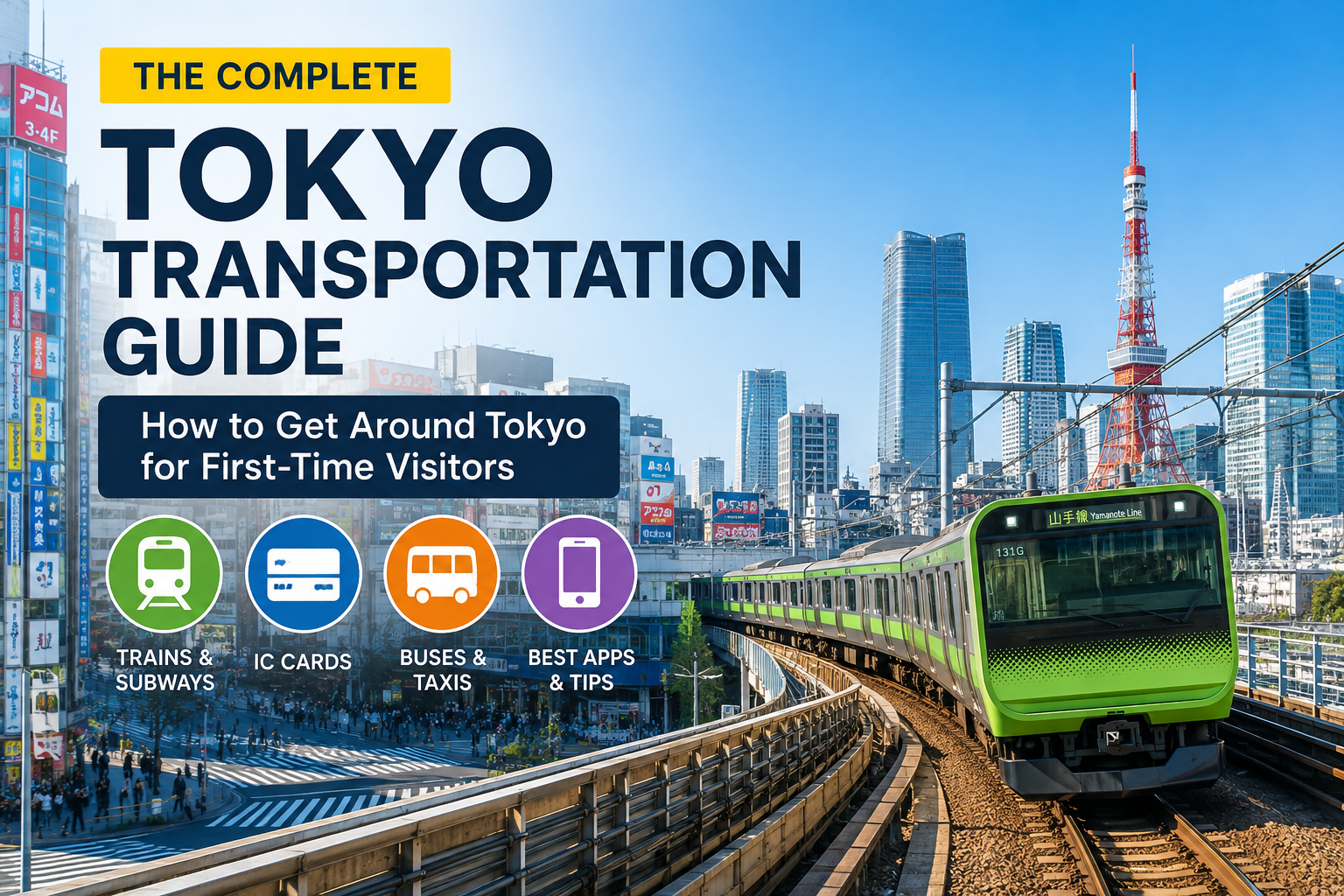
Tokyo has one of the most extensive and efficient public transportation systems in the world. Trains and subways can take you almost anywhere in the city, making it possible to explore neighborhoods such as Shinjuku, Shibuya, Asakusa, Ginza, and Ueno without renting a car.
For first-time visitors, however, Tokyo’s transportation network can look overwhelming. There are JR trains, multiple subway operators, private railway lines, buses, and dozens of stations where several lines connect. Even figuring out which ticket to buy can seem complicated at first.
The good news is that getting around Tokyo becomes much easier once you understand a few basic rules. In most cases, you can simply use an IC card such as Suica or PASMO, follow signs in English, and use a navigation app to find the best route.
This guide explains how Tokyo’s transportation system works, how to use trains and subways, how to pay for your journeys, and how to avoid common mistakes. By the end, you should be able to travel around Tokyo with much more confidence.
If you are still planning the overall structure of your trip, start with our Tokyo Travel Guide for First-Time Visitors for an overview of where to go, what to do, and how to plan your stay.
Understanding Tokyo’s Transportation System
Tokyo’s transportation network is made up of several different train and subway operators. This may seem confusing at first, but you do not need to understand every company or railway line to travel around the city.
For most visitors, the three main types of rail transportation to understand are JR trains, Tokyo’s subway system, and private railway lines. Together, they provide convenient access to almost every major sightseeing area in Tokyo.
JR Trains
JR trains are especially useful for traveling between Tokyo’s major neighborhoods. The JR Yamanote Line is one of the most convenient lines for visitors, connecting popular areas such as Tokyo Station, Ueno, Shinjuku, Shibuya, and Ikebukuro in a large loop around central Tokyo.
Other JR lines, including the Chuo and Sobu lines, can also be useful depending on your destination.
Tokyo Metro and Toei Subway
Tokyo has two main subway operators: Tokyo Metro and Toei Subway. Together, their lines cover a large part of central Tokyo and are often the easiest way to reach places that are not directly served by the JR network.
Stations and lines are identified by names, colors, letters, and numbers. For example, a station may be shown as G09, making it easier to follow your route even if you are unfamiliar with Japanese station names.
Private Railway Lines
Several private railway companies also operate trains in and around Tokyo. These lines become particularly useful when traveling from central Tokyo to destinations outside the main JR and subway networks.
For a first-time visitor, there is no need to memorize the different operators. A navigation app can usually tell you exactly which train to take, where to transfer, and which station exit to use.
Suica and PASMO: The Easiest Way to Pay
Tokyo’s transportation system has many different operators, but you usually do not need to buy a separate ticket for every journey. An IC card makes traveling around the city much simpler.
Suica and PASMO are rechargeable IC cards that can be used on most trains, subways, and buses in Tokyo. Instead of calculating the fare and buying a paper ticket each time, you simply tap your card at the ticket gate when entering and leaving a station.
What Are Suica and PASMO?
Suica and PASMO are prepaid transportation cards. Although they are issued by different companies, they work in very similar ways and can be used across most of Tokyo’s public transportation network.
They can also be used for many small purchases at convenience stores, vending machines, station shops, and other participating businesses.
For most visitors, there is little practical difference between Suica and PASMO. You generally do not need both.
Welcome Suica and Mobile IC Cards
International visitors may also encounter options designed specifically for travelers, such as Welcome Suica. Availability, purchase locations, validity periods, and other conditions can change, so it is a good idea to check the latest official information before your trip.
Mobile IC cards can also be convenient for compatible smartphones, allowing you to use your phone at ticket gates and add funds digitally. Compatibility and setup options depend on your device and payment method.
How to Use an IC Card
Using an IC card is simple:
- Add money to your card or mobile IC card.
- Tap it on the reader when entering the station.
- Take your train and transfer if necessary.
- Tap again when leaving your destination station.
- The correct fare is automatically deducted from your balance.
You can also check your remaining balance at many ticket machines and when passing through ticket gates.
Tip: Keep enough balance on your IC card before traveling. If your balance is too low when you reach your destination, you can usually add money at a fare adjustment or charging machine before exiting.
How to Ride Trains and Subways in Tokyo
Once you understand the basic transportation system, riding trains and subways in Tokyo is relatively straightforward. Most major stations have signs and announcements in English, and station numbers make it easier to identify where you are.
The key is to check your route before entering the station and pay attention to the line name, direction, platform number, and destination.
Finding the Right Station and Line
Large stations such as Shinjuku, Tokyo, and Shibuya serve multiple railway and subway lines, so simply arriving at the correct station is not always enough.
Before entering, check:
- The name of the railway or subway line
- The direction of travel
- Your platform number
- The station where you need to get off
- Any transfers along the way
Navigation apps are especially useful because they can show which line to take and where to transfer.
Entering and Exiting the Ticket Gates
If you are using an IC card, tap it on the reader at the ticket gate when entering the station. You do not need to insert the card into the machine.
At your destination, tap the same card again when leaving. The fare is calculated automatically based on your journey.
If the gate does not open, do not force your way through. Check the message on the gate or ask station staff for assistance.
Making Transfers
Some transfers are as simple as walking to another platform, while others may require a longer walk through a large station.
Follow the signs for the line you need next. In major stations, signs usually include English as well as line colors, symbols, and station numbers.
Also pay attention to your navigation app during transfers. Tokyo’s largest stations can have many platforms and exits, so knowing the next line and platform in advance can save time.
Rush Hour and Train Etiquette
Tokyo trains can become extremely crowded during weekday commuting hours, particularly in the morning and early evening.
If possible, visitors carrying large luggage should avoid the busiest commuter periods and allow extra time for travel.
While riding trains, keep your voice low, avoid blocking the doors, and wait for passengers to exit before boarding. When using escalators, follow local signs and avoid blocking people around you.
JR vs. Subway: Which Should You Use?
For most visitors, there is no need to choose only JR trains or only the subway. The best option depends on where you are going.
JR trains are often convenient for traveling between major areas such as Shinjuku, Shibuya, Ueno, and Tokyo Station. The JR Yamanote Line, in particular, is useful because it connects many popular neighborhoods around central Tokyo.
Tokyo Metro and Toei Subway are often better for destinations that are not directly served by the JR network, including areas such as Asakusa, Ginza, and Roppongi.
A simple rule for first-time visitors is:
- Use JR when it offers a direct and convenient route.
- Use the subway when it gets you closer to your destination or reduces unnecessary walking and transfers.
- Use a navigation app instead of trying to memorize which operator is best.
If you are using an IC card such as Suica or PASMO, switching between different transportation operators is much easier. In most situations, you can simply follow the route suggested by your navigation app and tap your IC card as required.
Not sure which neighborhoods to include in your trip? Our Tokyo Itinerary for First-Time Visitors: 3, 5 & 7 Days shows how to combine Tokyo’s major areas into a practical sightseeing route.
Getting from Tokyo’s Airports to the City
Tokyo is served by two major international airports: Haneda Airport and Narita International Airport. Both offer several ways to reach central Tokyo, but the best option depends on your destination, budget, luggage, and arrival time.
For first-time visitors, trains are usually the fastest and most convenient choice, while airport buses can be useful when they provide direct access to your hotel or nearby area.
From Haneda Airport
Haneda Airport is much closer to central Tokyo than Narita and offers convenient public transportation connections.
The main options are:
- Tokyo Monorail — Convenient for reaching Hamamatsucho, where you can transfer to JR lines.
- Keikyu Line — Useful for reaching areas such as Shinagawa and for connections toward central Tokyo.
- Airport buses — Convenient when there is a direct service to your hotel or destination.
- Taxi — Comfortable with heavy luggage, but considerably more expensive than public transportation.
Because Haneda is relatively close to central Tokyo, many travelers can reach their accommodation without a long journey.
From Narita Airport
Narita Airport is farther from central Tokyo, so choosing the right transportation option is more important.
Common options include:
- Narita Express (N’EX) — A convenient JR service for destinations including Tokyo, Shinjuku, and Shibuya.
- Keisei Skyliner — A fast option for reaching Ueno and Nippori.
- Airport buses — Useful for some hotels and major transportation hubs.
- Taxi — Usually the most expensive option because of the distance from central Tokyo.
For most first-time visitors, the easiest approach is to choose the airport service that takes you closest to your accommodation with the fewest transfers, especially when traveling with large luggage.
Tip: Train schedules, fares, ticket products, and airport bus routes can change. Check the latest information on the operator’s official website before traveling.
Buses, Taxis and Other Ways to Get Around
Trains and subways will cover most journeys in Tokyo, but they are not always the best option. Depending on your destination, luggage, or time of day, buses, taxis, and walking can also be useful.
Local Buses
Local buses are useful for reaching places that are farther from train or subway stations. However, routes can be more difficult to understand than the rail network for first-time visitors.
For most sightseeing trips, trains and subways should be your first choice. Use a bus when your navigation app recommends one or when it provides a more direct route to your destination.
Many buses accept IC cards such as Suica and PASMO, making payment easier.
Taxis
Taxis are widely available throughout Tokyo and can be convenient when traveling with heavy luggage, returning to your hotel late at night, or covering a short distance that would require inconvenient transfers.
They are generally more expensive than public transportation, so most visitors will not need to rely on them for everyday sightseeing.
Taxi doors are often opened and closed automatically by the driver, so you usually do not need to operate the rear passenger door yourself.
Walking
Walking is an important part of exploring Tokyo. Many attractions, restaurants, shops, and smaller streets are best discovered on foot once you arrive in the right neighborhood.
However, Tokyo is much larger than it may appear on a map. Two places that look relatively close can still involve a long walk.
A practical approach is to use trains or subways between neighborhoods and explore each neighborhood on foot.
This works particularly well in areas such as Shibuya, Shinjuku, Asakusa, Ginza, and Ueno.
Choosing the right area to stay can also reduce unnecessary travel time. See our Where to Stay in Tokyo for First-Time Visitors guide to compare Tokyo’s most convenient neighborhoods.
Best Apps for Getting Around Tokyo
A navigation app can make getting around Tokyo much easier. Instead of memorizing train lines and transfer stations, you can search for your destination and follow a suggested route.
For most first-time visitors, these tools are particularly useful:
Google Maps
Google Maps is one of the easiest options for navigating Tokyo. It can show train and subway routes, transfer stations, estimated journey times, walking directions, and station exits.
When checking a route, pay attention to:
- Line name
- Departure time
- Platform information
- Transfer stations
- Recommended station exit
Large stations can have many exits, and choosing the right one can significantly reduce walking time after leaving the station.
Japan Travel by NAVITIME
Japan Travel by NAVITIME is designed specifically for traveling in Japan and can be useful for comparing transportation routes and planning journeys between destinations.
It can be especially helpful when your trip includes destinations outside central Tokyo or when you want more Japan-specific transportation information.
Google Maps and a Japan-Specific App Work Well Together
You do not need many transportation apps for a first trip to Tokyo. For most travelers, Google Maps can handle everyday navigation, while a Japan-specific app can serve as a useful second option for more complicated journeys.
Tip: Check your route before leaving your hotel and make sure you have internet access during the day. An eSIM, SIM card, or pocket Wi-Fi can make navigating Tokyo considerably easier.
How Much Does Transportation Cost in Tokyo?
Tokyo’s public transportation is generally affordable compared with taxis, especially when you use trains and subways for most of your sightseeing.
The exact cost depends on the distance traveled, the railway operator, and the route you take. Rather than trying to calculate every fare in advance, most first-time visitors will find it easier to use an IC card and let the system automatically deduct the correct fare for each journey.
If you plan to take several subway rides in one day, certain unlimited-ride passes may sometimes offer better value. However, a pass is not automatically cheaper for every traveler. It depends on your itinerary and which train or subway operators you use.
For budgeting purposes, it is better to think about transportation as a daily travel expense rather than planning every individual fare before your trip.
Transportation is only one part of your overall travel expenses. For a complete breakdown of accommodation, food, transportation, sightseeing, and daily costs, see our Tokyo Travel Budget: How Much Does a Trip to Tokyo Cost?
Should You Buy a Transportation Pass?
Tokyo has various transportation passes, but you do not necessarily need one.
An IC card such as Suica or PASMO is usually the simplest option if your itinerary includes a mixture of JR trains, subways, and other transportation.
A day pass may be worth considering when:
- You expect to make many journeys in a single day.
- Most of those journeys are covered by the same pass.
- The pass costs less than paying for each journey separately.
Before purchasing a pass, compare its coverage with your planned itinerary. A cheaper pass is not useful if it does not cover the routes you actually need.
Tip: Fares and available passes can change, so check current prices and conditions on the relevant transportation operator’s official website before your trip.
Common Transportation Mistakes to Avoid
Tokyo’s transportation system is reliable and convenient, but first-time visitors can still lose time by making a few common mistakes. Knowing what to expect can make your journeys much smoother.
Entering the Wrong Railway or Subway Area
Large stations may serve JR trains, Tokyo Metro, Toei Subway, and private railway lines in the same general area.
Before going through a ticket gate, check the operator and line name shown in your navigation app. Entering the wrong gate can lead to unnecessary walking or confusion.
Taking the Right Line in the Wrong Direction
The line may be correct, but the train may be traveling in the opposite direction.
Check the destination or major stations shown for each direction before boarding. Station numbers can also help you confirm whether you are traveling the right way.
Choosing the Wrong Station Exit
Major stations can have many exits, and some are surprisingly far apart.
Before leaving the station, check which exit is closest to your destination. Google Maps or station signs can help you choose the correct one.
Underestimating Large Stations
Stations such as Shinjuku and Tokyo Station are enormous. Transferring between lines or simply reaching the correct exit can take longer than expected.
Allow extra time when your route involves a major station, particularly if you are unfamiliar with it or carrying luggage.
Traveling with Large Luggage During Rush Hour
Crowded commuter trains can be difficult to navigate with large suitcases.
When possible, avoid the busiest periods, allow additional travel time, and consider luggage delivery services if moving between hotels with large bags.
Assuming the Last Train Runs All Night
Tokyo has an extensive rail network, but most trains do not operate 24 hours a day.
If you plan to stay out late, check your last train in advance. Missing it may leave you relying on a taxi until train services resume.
Tokyo Transportation Tips for First-Time Visitors
Tokyo’s transportation system may seem complicated at first, but you do not need to understand every train line or railway company. A few simple habits can make getting around the city much easier.
Check Your Route Before Entering the Station
Before passing through the ticket gates, check your navigation app for the line name, direction, platform, and transfer stations.
This is especially useful at large stations where several railway operators share the same area.
Use an IC Card for Everyday Travel
Using Suica or PASMO eliminates the need to calculate fares and buy individual tickets for most journeys.
Keep enough balance on your card and recharge it when necessary.
Pay Attention to Station Numbers and Exit Numbers
Tokyo’s subway stations use letters and numbers that can make navigation easier even if you do not remember Japanese station names.
Exit numbers are also important. Choosing the correct exit can save a surprising amount of walking.
Allow Extra Time at Major Stations
Shinjuku, Shibuya, Ikebukuro, Ueno, and Tokyo Station can take time to navigate.
Do not assume that arriving at the station means you are only a minute or two away from your platform or destination.
Avoid Unnecessary Transfers
The fastest route on an app is not always the easiest route for a visitor.
If two routes have similar travel times, choosing the one with fewer transfers can be more comfortable—especially when carrying luggage.
Keep Internet Access Available
Reliable internet access makes transportation significantly easier because you can check routes, train times, station exits, and alternative routes while traveling.
Consider arranging an eSIM, SIM card, or pocket Wi-Fi before or shortly after arriving in Japan.
Don’t Worry About Memorizing the Network
Tokyo has too many railway and subway lines for most visitors to memorize.
Instead, learn the basic system, use an IC card, follow station signs, and check a navigation app when necessary. After your first few journeys, traveling around Tokyo will usually feel much more manageable.
Final Thoughts
Getting around Tokyo can look complicated when you first see the city’s enormous network of trains, subways, and stations. In practice, however, most visitors quickly become comfortable with the system after making their first few journeys.
You do not need to memorize every line or understand every railway operator. Start with an IC card such as Suica or PASMO, use a navigation app to plan your route, and pay attention to line names, station numbers, platforms, and exits.
For most sightseeing trips, trains and subways will be your main transportation, with walking, buses, and taxis filling in the gaps when necessary.
Once you understand these basics, Tokyo’s transportation network becomes one of the city’s greatest advantages—allowing you to explore very different neighborhoods quickly and efficiently.
Ready to plan your days in Tokyo? Use our Tokyo Itinerary for First-Time Visitors: 3, 5 & 7 Days to build a practical route around the city.
Arriving in Tokyo by plane? See our Tokyo Airport Guide: Haneda vs Narita for First-Time Visitors to compare airport transportation, travel times, costs, and the best options for reaching central Tokyo.
