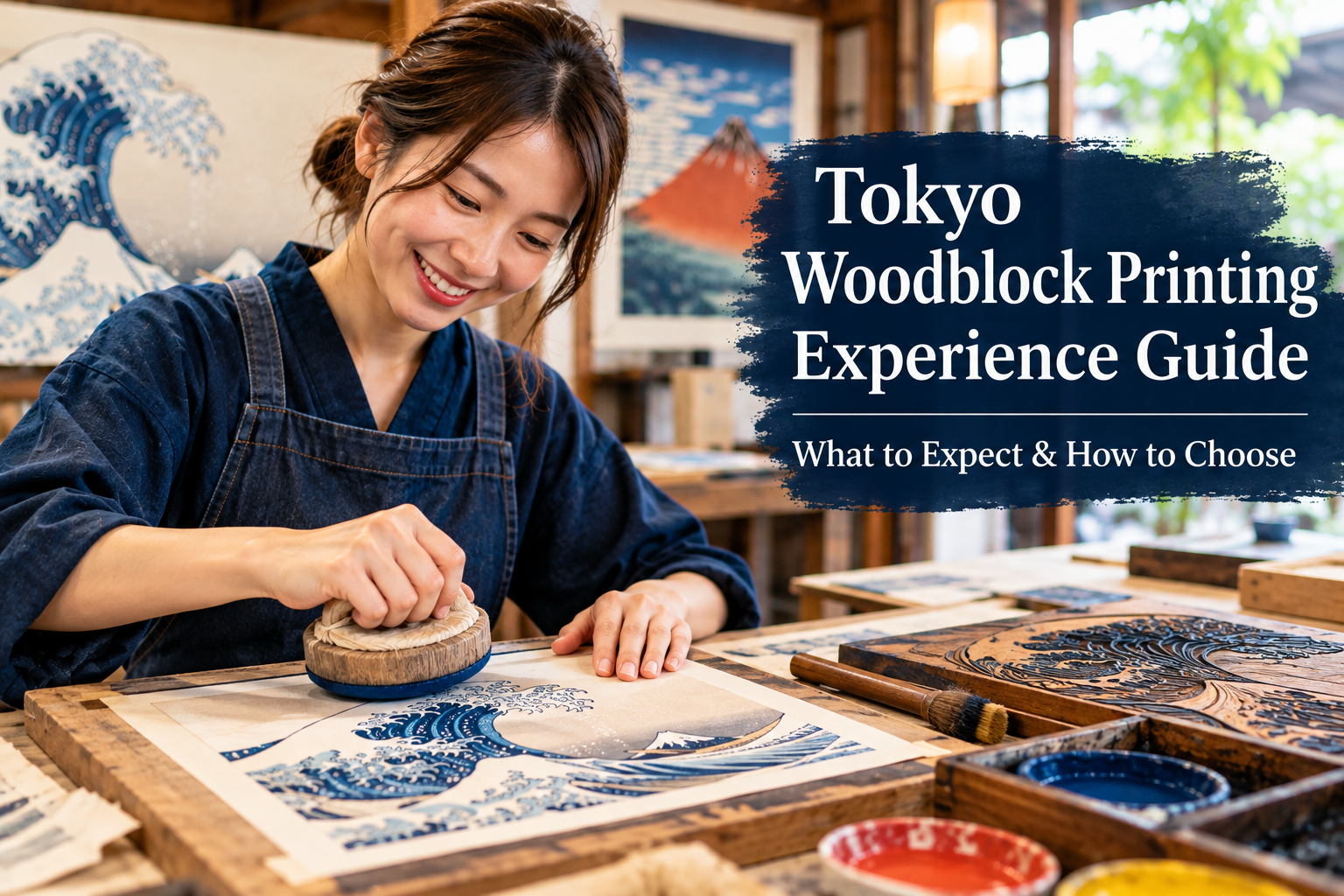
Why Try a Woodblock Printing Experience in Tokyo?
Tokyo is one of the best places to explore the history and culture of Japanese art. While many travelers visit museums to admire traditional prints, a woodblock printing workshop offers a different way to experience this artistic heritage.
Instead of simply looking at a finished print, you can learn how an image is transferred from a carved wooden block onto paper.
Japanese woodblock printing is especially associated with ukiyo-e, the colorful prints depicting landscapes, actors, everyday life, and scenes from historic Japan.
In a beginner-friendly workshop, you may have the opportunity to apply ink or pigment, position paper, and create a print using traditional tools.
The experience offers a closer look at the craftsmanship behind some of Japan’s most recognizable artworks.
This guide explains what happens during a woodblock printing workshop in Tokyo, how to choose an experience, what you can make, and what to check before booking.
Miruvia’s Take: Choose the Printing Process, Not Just the Artwork
Not every woodblock printing experience involves the same activities.
Some workshops allow participants to print an image using wooden blocks that have already been carved.
Others introduce carving techniques or offer a more detailed explanation of traditional printmaking.
The distinction matters because printing and carving require different skills, equipment, and amounts of time.
For first-time visitors, a workshop using pre-carved blocks is often the most practical choice.
It allows you to focus on the printing process without spending most of your session learning to carve.
Before booking, ask one important question:
Will I actually print an image myself, and which parts of the process will I perform?
The answer will help you choose an experience that matches your expectations.
What Is Japanese Woodblock Printing?
Japanese woodblock printing is a printmaking technique in which an image is transferred from a carved wooden surface onto paper.
Areas of the block are carved away, leaving raised surfaces that can receive ink or pigment.
Paper is placed against the prepared block, and pressure is applied to transfer the image.
Traditional Japanese techniques may use water-based pigments and a handheld printing tool called a baren.
For multicolored prints, separate blocks are generally used for different colors.
The paper must be carefully aligned during repeated printing.
This combination of carving, coloring, alignment, and printing makes traditional Japanese woodblock printing a highly skilled craft.
What Is Ukiyo-e?
Ukiyo-e is a genre of Japanese art that became especially prominent during the Edo period.
It is widely associated with woodblock prints depicting subjects such as:
- Famous landscapes
- Kabuki actors
- Beautiful women
- Everyday urban life
- Historical and literary scenes
- Nature and seasonal subjects
Some ukiyo-e works are paintings, but woodblock prints are among the genre’s most recognizable forms.
Traditional ukiyo-e print production often involved several specialists.
An artist created the design, a carver prepared the wooden blocks, and a printer transferred the image onto paper.
A publisher frequently coordinated the production and distribution process.
This division of labor helps explain the technical sophistication of historic Japanese prints.
Woodblock Printing vs Ukiyo-e: What’s the Difference?
The terms are related but not interchangeable.
Woodblock printing refers to the technique used to reproduce images from carved wooden blocks.
Ukiyo-e refers to a genre of Japanese art.
Many famous ukiyo-e artworks were produced using woodblock printing, but not every woodblock print is ukiyo-e.
Likewise, a modern woodblock printing workshop may feature contemporary designs rather than traditional ukiyo-e subjects.
If you specifically want to reproduce an ukiyo-e-style image, confirm the available designs before booking.
Why Is Woodblock Printing Important in Japanese Culture?
Woodblock printing played an important role in the development of Japanese visual culture.
During the Edo period, printed images became a popular form of art and entertainment.
Prints could depict famous places, performers, fashion, and aspects of everyday life.
Japanese woodblock prints also influenced artists outside Japan.
Today, the craft remains important as both a historical technique and a contemporary artistic practice.
A workshop offers a way to appreciate the physical work behind these images.
You can discover how the pressure of a baren, the amount of pigment, and the placement of paper influence the finished result.
What Happens During a Woodblock Printing Workshop?
The exact structure depends on the studio and type of experience.
However, many beginner-friendly printing workshops follow a similar sequence.
1. Introduction to the Craft
The instructor explains the basic principles of Japanese woodblock printing.
You may learn about the history of ukiyo-e, the materials used, and the role of the printer.
Some workshops display examples of finished prints or demonstrate the printing process.
2. Learn About the Tools
The instructor introduces the equipment used during the activity.
Depending on the workshop, these may include:
- Carved wooden blocks
- Brushes
- Pigments or ink
- Japanese paper
- A baren
- Registration guides
- Protective materials
The tools available depend on the method being taught.
3. Prepare the Printing Surface
In a traditional-style printing workshop, the instructor may demonstrate how pigment is applied to a carved block.
You may use a brush to distribute pigment across the printing surface.
The amount and consistency of pigment can affect the final image.
4. Position the Paper
Paper is carefully placed over the block.
For multicolored prints, alignment is especially important.
Traditional registration marks, known as kento, help position the paper consistently.
A beginner workshop may simplify this step.
5. Transfer the Image
The image is transferred by applying pressure to the back of the paper.
In Japanese woodblock printing, this may involve rubbing the paper with a baren.
The instructor demonstrates how to apply pressure without damaging the paper.
6. Add Additional Colors
If the design uses multiple blocks, the printing process may be repeated.
Each block contributes another color or part of the image.
Some workshops use simplified designs with only a few colors.
Others demonstrate more complex traditional techniques.
7. Reveal Your Print
After printing, you can examine the finished image.
You may notice subtle variations in color, texture, or alignment.
These differences help illustrate why printing requires skill and attention.
8. Prepare the Artwork for Taking Home
The finished print may need drying time.
Some workshops provide protective sleeves or other packaging.
Ask whether you can take the artwork home immediately and how it should be handled.
What Is a Baren?
A baren is a handheld tool traditionally used in Japanese woodblock printing.
It applies pressure to the back of the paper to transfer pigment from the wooden block.
The printer moves the baren across the paper using controlled pressure.
Different amounts of pressure can influence the appearance of the print.
Some modern workshops use alternative tools or simplified equipment.
If learning to use a traditional baren is important to you, confirm that it is included.
What Are Kento Registration Marks?
Kento are registration marks used to align paper during Japanese woodblock printing.
They are particularly important when producing multicolored prints.
Each color may be printed from a separate block.
Without consistent alignment, the colors may not match the intended design.
A workshop that demonstrates kento can help participants understand one of the technical challenges of traditional printmaking.
What Is Japanese Washi Paper?
Washi is a general term for traditional Japanese paper.
Certain types of washi are used in Japanese woodblock printing because of their properties and suitability for printing.
However, not every workshop uses the same paper.
Some beginner sessions use modern paper or other materials.
If working with traditional Japanese paper is important to you, check what is included.
Do You Carve the Wooden Blocks Yourself?
Not always.
This is one of the most important details to confirm before booking.
Many introductory experiences use pre-carved blocks.
Participants focus on applying pigment, aligning paper, and printing.
Other workshops may include carving.
Carving requires additional time, specialized tools, and safety instruction.
Do not assume a workshop includes carving simply because it is described as a woodblock printing experience.
Printing Workshops vs Carving Workshops
These activities offer different experiences.
Printing Workshop
A printing-focused workshop typically involves:
- Learning about traditional tools
- Applying pigment or ink
- Positioning paper
- Using a baren or printing tool
- Creating a finished print
This is often suitable for beginners with limited time.
Carving Workshop
A carving-focused workshop may involve:
- Preparing a design
- Transferring the image onto wood
- Learning carving techniques
- Using carving tools
- Printing from the completed block
Carving workshops may take longer and have stricter age or safety requirements.
Choose according to whether you are more interested in creating the block or learning how prints are produced.
Can Beginners Try Woodblock Printing in Tokyo?
Yes.
Many workshops designed for visitors welcome complete beginners.
You generally do not need previous printmaking experience.
A beginner-friendly instructor should explain each step and demonstrate the necessary techniques.
However, difficulty varies.
Printing from prepared blocks is usually more accessible than carving detailed designs.
Before booking, check whether the activity is explicitly described as suitable for beginners.
Do You Need Artistic Skills?
No.
Many introductory workshops provide prepared designs and carved blocks.
You do not need to draw or carve your own image.
The main skills involve following instructions, applying pigment, positioning paper, and using the printing tool.
Small differences in technique can affect the result, but that is part of the learning experience.
What Can You Make During a Woodblock Printing Workshop?
The finished product depends on the workshop.
Possible projects include:
- Small art prints
- Ukiyo-e-style reproductions
- Postcards
- Greeting cards
- Decorative paper
- Contemporary printed designs
- Original prints from participant-created blocks
Some studios allow you to choose from several designs.
Others use one fixed image for all participants.
Confirm the artwork and paper size before booking.
Can You Make a Famous Ukiyo-e Print?
Some workshops offer designs inspired by or based on well-known Japanese prints.
However, the available artwork varies.
A short introductory workshop may use simplified blocks rather than a full reproduction of a complex historical print.
If you want to print a particular image, confirm the design directly with the operator.
Do not assume every workshop offers famous works such as The Great Wave.
Can You Choose Your Own Design?
Sometimes.
Some workshops offer a selection of prepared designs.
Others allow participants to create original artwork.
Custom designs may require additional time or advance preparation.
For a short workshop, the choices may be limited to pre-carved blocks.
If creative freedom is important, check whether participants can design or carve their own blocks.
How Many Colors Will You Print?
The number of colors depends on the workshop.
A simple introductory activity may involve one or two colors.
A more detailed experience may demonstrate multiple color blocks.
Traditional multicolored woodblock printing can involve many separate printing stages.
More colors generally increase the complexity of registration and printing.
Ask how many blocks and colors are included if you want a more technical experience.
Will Your Finished Print Look Exactly Like the Example?
Not necessarily.
Variations may result from:
- Pigment application
- Pressure
- Paper placement
- Moisture
- Registration
- Printing technique
Even when participants use the same blocks, their finished prints may differ.
This is normal.
Approach the activity as a chance to learn the process rather than to reproduce a perfect commercial print.
Do Woodblock Printing Workshops Offer English Instruction?
Some do.
Tokyo has cultural workshops designed for international visitors, but language support varies by operator.
Before booking, confirm:
- Whether the instructor speaks English
- Whether translated materials are available
- Whether demonstrations are easy to follow
- Whether safety instructions are provided in a language you understand
- Whether questions can be answered during the session
Clear instruction is especially important if the workshop includes carving tools.
How Long Does a Woodblock Printing Experience Take?
Many introductory printing experiences may take approximately one to two hours.
More detailed workshops can take longer.
The duration depends on:
- Number of printing colors
- Complexity of the design
- Whether carving is included
- Number of participants
- Drying requirements
- Amount of historical explanation
Allow extra time for travel and check-in.
If the artwork needs additional drying, confirm whether that affects collection.
How Much Does Woodblock Printing Cost in Tokyo?
Prices vary by operator, materials, class duration, and workshop complexity.
As a general planning estimate:
- Short introductory printing experiences: approximately ¥3,000–¥6,000
- More detailed or multicolor workshops: approximately ¥5,000–¥10,000
- Specialized or private experiences: ¥10,000 or more
These figures are indicative planning ranges, not verified prices for particular workshops.
Actual prices may fall outside these ranges.
Always check current prices and inclusions before booking.
What Is Usually Included in the Price?
Inclusions depend on the studio.
A workshop may provide:
- Wooden printing blocks
- Pigments or ink
- Brushes
- Paper
- Printing tools
- Instructor guidance
- Protective equipment
- Packaging for the finished print
Some workshops charge extra for additional prints or premium paper.
Check whether the advertised price includes everything needed to complete the activity.
Can You Take Your Finished Print Home?
Many workshops allow participants to take their artwork home on the same day.
However, the print may need time to dry.
Some studios provide a protective sleeve or folder.
Others may have different arrangements for specialized projects.
Confirm the collection process before booking, especially if you are leaving Tokyo soon.
How Should You Pack a Woodblock Print?
Printed paper can be vulnerable to bending, moisture, and surface damage.
Follow the studio’s handling instructions.
Useful precautions may include:
- Keeping the print flat
- Using a protective folder
- Avoiding contact with wet items
- Preventing heavy objects from pressing against it
- Allowing sufficient drying time
If you plan to travel with a small backpack, consider whether the finished artwork will fit safely.
Is Woodblock Printing a Good Souvenir Experience?
Yes.
A handmade print can be a meaningful souvenir because you participated in its creation.
Unlike a mass-produced item, the finished artwork reflects your printing technique.
Small prints and postcards may be especially convenient for travelers with limited luggage space.
If you want a souvenir that is easy to transport, choose a workshop producing a compact print.
Is Woodblock Printing Suitable for Children?
Some workshops welcome children.
Others have minimum age requirements.
Suitability depends on the tools and techniques involved.
A printing-only workshop using prepared blocks may be more accessible than a carving workshop involving sharp tools.
Before booking, confirm:
- Minimum age
- Adult supervision requirements
- Tools used
- Difficulty level
- Workshop duration
- Whether the activity is designed for families
Do not assume every woodblock printing experience is appropriate for young children.
Is Woodblock Printing Good for Solo Travelers?
Yes.
A printing workshop can be an enjoyable activity for solo travelers.
You can focus on creating your own artwork while following a structured process.
Group sessions may also provide opportunities to interact with other participants.
Check whether single-person reservations are accepted.
Is Woodblock Printing Good for Couples?
Yes.
Couples can enjoy learning the same technique while producing individual prints.
Some workshops may allow participants to choose different designs or colors.
If you prefer a quieter experience, check whether private sessions are available.
Is Woodblock Printing a Good Rainy-Day Activity?
Usually, yes.
Most woodblock printing workshops take place indoors.
This makes the activity a practical option when outdoor sightseeing is less appealing.
However, check the venue details before booking.
Where Can You Try Woodblock Printing in Tokyo?
Woodblock printing experiences may be available through traditional craft studios, cultural organizations, museums, and specialist workshops.
Availability varies, and some venues offer classes only on selected dates.
Check current listings and reservation requirements.
Asakusa and Eastern Tokyo
Eastern Tokyo is worth exploring for traditional cultural activities.
A workshop in or near Asakusa may fit well with visits to temples, shopping streets, and historic neighborhoods.
Confirm the exact location before planning your route.
Ueno and Surrounding Areas
Ueno is known for museums and cultural attractions.
If you find a suitable printing workshop nearby, you may be able to combine it with an art-focused day.
Do not assume museum admission includes a workshop.
Central Tokyo
Central locations may be convenient for travelers staying near major transport hubs.
Compare accessibility with the actual workshop content.
A convenient location is useful, but the printing method and level of instruction matter more.
Can You Combine Woodblock Printing with Museum Visits?
Yes.
A workshop can complement a visit to a museum featuring Japanese art.
Viewing historic prints before or after your class may help you appreciate the technical process.
A practical cultural itinerary might include:
- Visiting an art museum
- Exploring nearby streets
- Having lunch
- Attending a woodblock printing workshop
- Returning to your hotel with your finished artwork
Check museum hours, workshop schedules, and travel times before finalizing your plan.
Woodblock Printing vs a Traditional Craft Workshop
Woodblock printing is one type of traditional Japanese craft experience.
A broader traditional craft workshop may focus on other materials and techniques, including:
- Pottery
- Indigo dyeing
- Paper crafts
- Textile making
- Decorative arts
Choose woodblock printing if you are interested in visual art, prints, and traditional Japanese printing techniques.
Choose another craft if you prefer working with clay, fabric, or other materials.
Woodblock Printing vs Calligraphy
Both activities involve traditional Japanese artistic techniques.
However, the creative process is different.
Woodblock printing focuses on transferring images from a prepared block to paper.
Calligraphy focuses on creating characters through brushwork and ink.
Choose woodblock printing if you enjoy:
- Japanese art
- Printed images
- Color and composition
- Learning a reproduction technique
Choose calligraphy if you enjoy:
- Japanese characters
- Brush techniques
- Expressive writing
- Creating artwork directly by hand
Woodblock Printing vs Indigo Dyeing
Both experiences involve applying color to a material.
Woodblock printing generally produces an image on paper.
Indigo dyeing produces colored textile designs.
Choose woodblock printing if you want:
- A paper artwork
- A connection to ukiyo-e
- A compact souvenir
- An introduction to printmaking
Choose indigo dyeing if you want:
- A fabric souvenir
- Pattern experimentation
- A wearable or usable item
- An introduction to textile dyeing
Woodblock Printing vs Pottery
Woodblock printing and pottery offer very different hands-on experiences.
Woodblock printing focuses on image transfer and paper.
Pottery focuses on shaping clay and producing ceramic objects.
A printing workshop may allow same-day collection.
Pottery often requires additional firing or glazing after the class.
Choose according to the material you enjoy and the type of souvenir you want.
How to Choose a Woodblock Printing Experience in Tokyo
Before booking, compare the following factors.
1. Confirm What You Will Actually Do
Find out whether you will print, carve, or both.
2. Check the Available Designs
Ask whether the workshop offers ukiyo-e-style images, contemporary artwork, or original designs.
3. Confirm the Number of Colors
A multicolor workshop may provide a more detailed introduction to traditional printing.
4. Check the Instruction Language
Make sure you can understand the process and any safety requirements.
5. Review the Duration
Choose a class that fits comfortably into your itinerary.
6. Confirm the Total Price
Check whether materials, paper, and the finished print are included.
7. Ask About Drying and Collection
Make sure you can collect your artwork before leaving Tokyo.
8. Consider Group Size
Smaller groups may provide more opportunities to ask questions.
9. Check Age Requirements
This is especially important if carving tools are used.
10. Read the Cancellation Policy
Understand the operator’s refund and rescheduling conditions.
What to Check Before Booking
Before making a reservation, confirm:
- Exact workshop location
- Start time
- Duration
- Printing or carving activities
- Available artwork
- Number of colors
- Instruction language
- Minimum age
- Total price
- Included materials
- Finished print size
- Drying requirements
- Collection arrangements
- Cancellation conditions
These details will help you choose an experience that matches your expectations.
How Far in Advance Should You Book?
Specialist workshops may have limited spaces or operate only on certain dates.
If a particular class is important to your trip, booking in advance is sensible.
Weekend sessions and private experiences may require additional planning.
Check the operator’s current availability.
Do not assume walk-in participation is possible.
What If You Need to Cancel?
Cancellation rules vary by operator.
Some workshops allow changes before a stated deadline.
Others may have stricter policies because materials and instructors are reserved in advance.
Read the terms before booking.
Keep your confirmation email or reservation details.
Arrive on Time
Woodblock printing workshops may begin with an explanation of tools and techniques.
Arriving late can mean missing important instructions.
Allow sufficient time to find the venue and check in.
If the workshop is inside a small studio or multi-use building, locating the entrance may take extra time.
First-Time Visitor Recommendation
For a first woodblock printing experience, choose a workshop that offers:
- Pre-carved wooden blocks
- Clear English instruction
- A manageable number of colors
- Step-by-step guidance
- A small finished print
- Same-day collection
- Transparent pricing
A printing-focused workshop is usually a more practical introduction than a complex carving session.
It allows you to experience the essential technique without requiring advanced artistic skills.
Repeat Visitor Recommendation
If you have already tried basic woodblock printing, consider a more specialized workshop.
Look for experiences involving:
- More colors
- Detailed registration techniques
- Traditional tools
- Different paper types
- Original designs
- Carving instruction
- Advanced printing methods
These activities may provide a deeper appreciation of the craftsmanship involved.
Common Mistakes to Avoid
Assuming Every Workshop Includes Carving
Many experiences focus on printing from prepared blocks.
Check the activity description carefully.
Choosing Only by the Artwork Photo
A beautiful finished print does not necessarily indicate which steps participants will perform.
Confirm the actual hands-on activities.
Expecting a Perfect Reproduction
Handmade prints can vary in color, alignment, and texture.
Treat these variations as part of the learning process.
Forgetting About Drying Time
A freshly printed artwork may need careful handling.
Confirm when and how you can collect it.
Ignoring the Finished Print Size
A large print may be difficult to transport safely.
Check the dimensions before booking.
Overlooking Language Support
Understanding the process is important, particularly if carving tools are involved.
Booking a Workshop That Is Too Advanced
Choose a difficulty level that matches your experience and available time.
Forgetting the Cancellation Policy
Read the booking conditions before paying.
Who Should Try a Woodblock Printing Experience?
Woodblock printing is especially suitable for:
- Art enthusiasts
- Travelers interested in ukiyo-e
- Visitors interested in Japanese history
- Couples
- Solo travelers
- Repeat visitors
- People who enjoy hands-on activities
- Travelers looking for handmade souvenirs
It can also appeal to visitors who want a deeper understanding of Japanese visual culture.
Who Might Skip It?
A woodblock printing workshop may not be the best choice if:
- You have little interest in visual art
- You prefer sightseeing to hands-on activities
- You want a physically active experience
- You cannot find a suitable instruction language
- Your schedule is too limited
- You expect to create a complex original artwork in a short session
Tokyo offers many other cultural experiences, so choose the activity that best matches your interests.
For more ideas, explore our guide to traditional Japanese experiences in Tokyo.
Frequently Asked Questions
What is Japanese woodblock printing?
Japanese woodblock printing is a technique that transfers images from carved wooden blocks onto paper using ink or pigment.
Is woodblock printing the same as ukiyo-e?
No. Woodblock printing is a technique, while ukiyo-e is a genre of Japanese art. Many famous ukiyo-e works were produced as woodblock prints.
Can beginners try woodblock printing in Tokyo?
Yes. Many introductory workshops are designed for beginners and use pre-carved blocks.
Do I need to carve a wooden block?
Not necessarily. Many workshops focus on printing rather than carving.
How much does a woodblock printing workshop cost?
As a general estimate, introductory experiences may cost around ¥3,000–¥6,000, while more detailed or specialized sessions can cost more. Confirm current prices with individual operators.
How long does a woodblock printing experience take?
Many introductory workshops take approximately one to two hours, although duration varies.
Can I take my finished print home?
Many workshops offer same-day collection, but drying and handling requirements vary.
Are woodblock printing workshops available in English?
Some are. Confirm the instruction language before booking.
Can children participate?
Some workshops welcome children, but age requirements depend on the tools and techniques used.
Is woodblock printing suitable for solo travelers?
Yes. Many printing-focused workshops can be enjoyed individually, although booking requirements vary.
What is a baren?
A baren is a handheld tool used to apply pressure during traditional Japanese woodblock printing.
Can I make a famous ukiyo-e design?
Some workshops offer ukiyo-e-inspired or historical designs. Check the available artwork before booking.
Is a woodblock printing workshop worth it in Tokyo?
For travelers interested in Japanese art and hands-on cultural experiences, a woodblock printing workshop can be a rewarding activity and a way to create a personalized souvenir.
Final Thoughts
A woodblock printing experience in Tokyo offers an opportunity to discover the craftsmanship behind Japanese prints.
By applying pigment, positioning paper, and transferring an image from a carved block, you can gain a new appreciation for the technical skill involved in traditional printmaking.
For first-time visitors, a beginner-friendly workshop using prepared blocks is often the best starting point.
For travelers with a deeper interest in Japanese art, a more specialized session may offer additional insight into carving, multicolor printing, and traditional techniques.
Before booking, confirm what you will actually do, which designs are available, the instruction language, the total price, and how you will take your finished artwork home.
With the right workshop, woodblock printing can become a memorable part of your Tokyo trip—and leave you with a handmade reminder of Japanese artistic culture.
