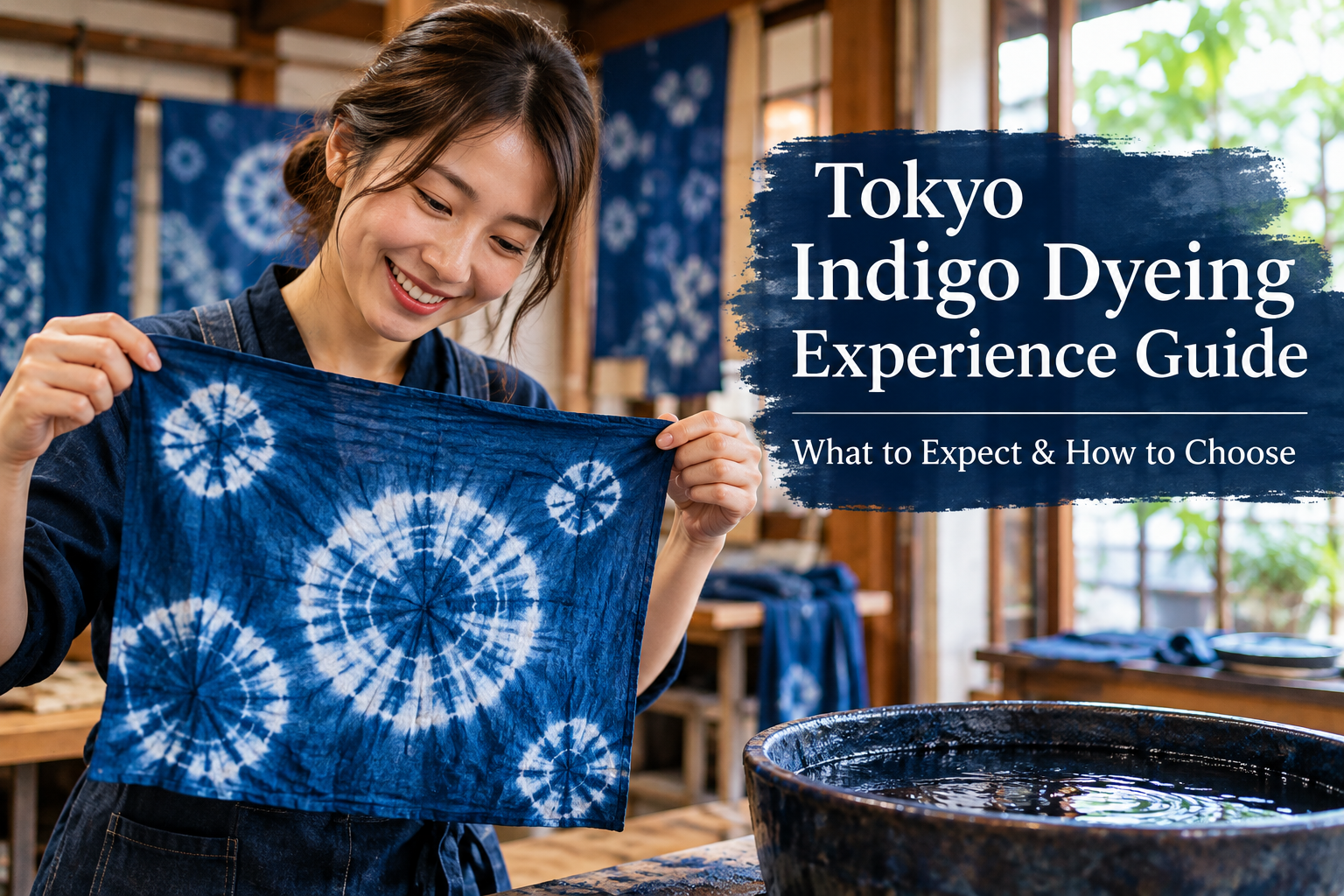
Why Try an Indigo Dyeing Experience in Tokyo?
Tokyo is famous for its modern attractions, but the city also offers opportunities to explore traditional Japanese craftsmanship.
One particularly memorable activity is Japanese indigo dyeing, known as aizome.
Indigo dyeing uses blue dye to transform fabric into distinctive patterns and shades. Depending on the workshop, participants may fold, tie, twist, or clamp fabric before dyeing it.
The result is a handmade textile that reflects your own choices.
For travelers, an indigo dyeing workshop offers something different from conventional sightseeing.
Instead of simply looking at Japanese crafts, you participate in the creative process and may leave with something you made yourself.
This guide explains what happens during an indigo dyeing experience in Tokyo, how to choose a beginner-friendly workshop, what you can make, and what to check before booking.
Miruvia’s Take: Choose the Item Before Choosing the Workshop
Indigo dyeing experiences can look similar in promotional photographs, but the finished products may be very different.
Some workshops focus on small handkerchiefs.
Others offer tote bags, scarves, T-shirts, or larger fabric pieces.
The item you choose affects several parts of the experience:
- How much creative freedom you have
- How long the workshop takes
- How much the activity costs
- How easy the finished item is to carry home
- Whether you will actually use it after your trip
Our recommendation is to choose the item you want to make before comparing workshops.
For a first experience, a handkerchief or small cloth is often the most practical choice.
It is relatively easy to work with, lightweight, and convenient to pack.
If you want something you will use regularly, a tote bag or scarf may be more appealing.
The best workshop is not necessarily the one offering the most complicated design. It is the one that helps you create something meaningful within your available time.
What Is Japanese Indigo Dyeing?
Japanese indigo dyeing, or aizome, is a traditional textile dyeing practice associated with rich blue colors.
Historically, indigo-dyed fabrics were used in everyday clothing, workwear, and household textiles.
Japanese indigo traditions are closely associated with plant-based dyes, particularly those derived from Japanese indigo plants.
However, modern workshops may use different dye preparations.
Some use traditional fermentation-based dye vats, while others use simplified or prepared dye solutions.
These methods can produce different experiences, and not every workshop follows the same process.
If learning about traditional natural dyeing is important to you, confirm the method used before booking.
Why Is Indigo Dyeing Special in Japan?
Indigo dyeing has a long connection with Japanese textile culture.
The characteristic blue colors are often associated with traditional clothing, workwear, and decorative fabrics.
Indigo can produce a range of shades, from relatively light blue to deep navy.
The final appearance depends on factors such as:
- Dye concentration
- Number of dyeing cycles
- Fabric material
- Dyeing technique
- Exposure time
- Washing and finishing
The process combines craftsmanship with experimentation.
Even when participants follow the same instructions, their finished patterns may differ.
That individuality is part of the appeal.
What Happens During an Indigo Dyeing Workshop?
The exact process varies by studio, but many beginner-friendly workshops follow a similar structure.
1. Introduction to Indigo Dyeing
The instructor introduces the materials and explains the basic dyeing process.
You may learn about the cultural background of aizome and see examples of finished textiles.
The instructor should also explain how to handle the dye safely.
2. Choose Your Fabric Item
Depending on the workshop, you may select a handkerchief, scarf, tote bag, T-shirt, or another fabric item.
Some workshops have a fixed item included in the price.
Others offer upgrades for an additional fee.
3. Create Your Pattern
You prepare the fabric using techniques such as folding, tying, twisting, or clamping.
These methods prevent or reduce dye penetration in selected areas.
The protected sections create patterns after the fabric is dyed.
4. Dye the Fabric
You immerse the prepared fabric in the dye according to the instructor’s directions.
Depending on the dyeing method, the fabric may appear greenish or change color as it is exposed to air.
The instructor may guide you through repeated dipping and oxidation cycles.
5. Reveal the Design
After dyeing, the ties or clamps are removed.
This is often the most exciting part of the workshop because the finished pattern becomes visible.
Small differences in folding and tying can create surprisingly different results.
6. Rinse and Finish
The fabric is rinsed and treated according to the studio’s process.
Some workshops provide additional finishing steps.
The item may need drying time before it can be packed or used.
7. Take Your Creation Home
Many tourist-oriented workshops allow participants to take their finished textiles home on the same day.
However, drying and finishing requirements vary.
Confirm whether you can take the item immediately and whether the studio provides suitable packaging.
What Can You Make at an Indigo Dyeing Workshop?
The available items depend on the studio.
Common possibilities include:
- Handkerchiefs
- Small cotton cloths
- Tote bags
- Scarves
- T-shirts
- Tenugui towels
- Decorative fabric pieces
Some specialized workshops may offer more advanced textile projects.
Before booking, confirm whether the item shown in the promotional photographs is included in the standard price.
Indigo-Dyed Handkerchiefs
A handkerchief is one of the most approachable projects for beginners.
It is small, easy to manipulate, and convenient to pack.
A handkerchief workshop may be suitable if you:
- Have limited time
- Want an affordable introduction
- Are traveling with minimal luggage
- Prefer a simple first project
- Want to focus on learning basic patterns
Although the item is small, the experience can still provide a meaningful introduction to dyeing techniques.
Indigo-Dyed Tote Bags
A tote bag can be an excellent choice for travelers who want a practical souvenir.
Depending on the fabric and workshop, you may create bold patterns across a larger surface.
However, larger items can be more difficult to fold and dye evenly.
Check whether the workshop provides sufficient guidance for beginners.
Also confirm the size and material of the bag before booking.
Indigo-Dyed Scarves
Scarves are attractive because the finished fabric can be worn rather than simply displayed.
They may offer more room for creative patterns than small handkerchiefs.
However, the fabric material matters.
Different fibers absorb dye differently, and not every workshop offers the same materials.
Check the scarf’s dimensions and fabric composition before booking.
Indigo-Dyed T-Shirts
Some workshops allow participants to dye T-shirts.
This can be a memorable way to create clothing associated with your Tokyo trip.
Before booking, check:
- Available sizes
- Fabric material
- Whether the shirt is included
- Whether you can bring your own clothing
- Drying requirements
- Washing instructions
Do not assume personal clothing can be used unless the studio explicitly allows it.
What Is Shibori?
Shibori refers to Japanese resist-dyeing techniques that manipulate fabric to create patterns.
Methods may involve folding, binding, stitching, twisting, or clamping.
Shibori is not limited to indigo, although indigo is commonly associated with it.
In beginner workshops, participants may use simplified resist-dyeing methods to create patterns without needing advanced textile skills.
Common Indigo Dyeing Patterns
The designs available depend on the workshop.
Circular Patterns
Tying sections of fabric can create circular or ring-like shapes.
The results depend on the size and position of the tied areas.
Striped Patterns
Folding and binding fabric can produce linear designs.
These may appear as stripes or repeated geometric shapes.
Geometric Patterns
Careful folding and clamping can create angular or symmetrical patterns.
These designs may require more precise preparation.
Abstract Patterns
Twisting, bunching, or loosely binding fabric can produce less predictable designs.
This approach may appeal to travelers who enjoy experimentation.
Can You Choose Your Own Design?
Often, yes.
Many beginner-friendly workshops allow participants to choose from several patterns.
Some offer more creative freedom than others.
A short introductory class may provide a limited selection of designs to keep the activity manageable.
A longer workshop may allow more experimentation.
If creating a specific pattern is important to you, ask whether it is possible before booking.
Will Your Finished Item Look Like the Example?
Not exactly.
Indigo dyeing involves several variables, including fabric preparation, dye absorption, and finishing.
Two participants using similar techniques may produce different results.
This is normal.
It is better to approach the activity as a creative experience than to expect an identical reproduction of a sample.
Do You Need Previous Dyeing Experience?
No.
Many indigo dyeing workshops designed for visitors welcome complete beginners.
The instructor typically explains the process and demonstrates the necessary techniques.
You do not need to know how to sew, draw, or work with textiles.
However, some advanced workshops involve more complex preparation.
Check the stated difficulty level before booking.
Do You Need to Speak Japanese?
Not necessarily.
Some Tokyo indigo dyeing workshops offer English-language instruction.
Others may provide basic English explanations, visual demonstrations, or translated materials.
Language support varies by operator.
Before booking, confirm:
- Whether English instruction is available
- Whether the instructor can answer questions
- Whether safety instructions are understandable
- Whether written care instructions are provided
For a hands-on activity involving dye solutions, clear safety communication is particularly important.
How Long Does an Indigo Dyeing Experience Take?
Many introductory workshops can be completed in approximately one to two hours.
More detailed experiences may take longer.
The duration depends on:
- Fabric size
- Pattern complexity
- Dyeing method
- Number of dyeing cycles
- Rinsing and finishing
- Group size
Allow additional time for travel and check-in.
If your item requires drying or later collection, factor that into your itinerary.
How Much Does Indigo Dyeing Cost in Tokyo?
Prices vary depending on the studio, materials, item size, and duration.
As a general planning estimate:
- Small introductory projects: approximately ¥3,000–¥6,000
- Standard workshops with larger items: approximately ¥5,000–¥10,000
- Specialized or private experiences: ¥10,000 or more
These are indicative ranges rather than verified prices from specific studios.
Actual prices may fall outside these ranges.
Always confirm the current price and included materials before booking.
Are Materials Included in the Price?
Many workshops include basic materials and equipment.
However, inclusions vary.
Check whether the price covers:
- Fabric item
- Dye and other materials
- Protective equipment
- Instructor guidance
- Finishing and rinsing
- Packaging
- Optional upgrades
A larger scarf or tote bag may cost more than the standard handkerchief project.
Can You Take Your Finished Item Home Immediately?
Many workshops allow same-day collection.
However, the fabric may still be damp or require additional drying.
Some studios provide protective bags or other packaging.
Others may ask participants to return later or arrange delivery for certain projects.
Confirm the collection process before booking, especially if you are leaving Tokyo soon.
How Should You Pack Indigo-Dyed Fabric?
Follow the studio’s instructions.
If the item is damp, avoid placing it directly against other clothing or valuable belongings.
Ask whether it has been sufficiently rinsed and dried for packing.
For newly dyed fabric, separate packaging may be advisable until you understand the care requirements.
Do not assume a freshly dyed item is ready to be placed loosely in your suitcase.
Will Indigo Dye Transfer onto Other Clothes?
Indigo-dyed textiles can sometimes release excess color, particularly during early use or washing.
The risk depends on the dyeing and finishing process.
Ask the studio about:
- Initial washing
- Color transfer
- Drying
- Storage
- Washing separately
- Suitable detergents
Follow the specific care instructions provided with your item.
How Do You Wash Indigo-Dyed Fabric?
Care requirements vary by material and dyeing method.
The workshop should provide instructions for your particular item.
General precautions may include:
- Washing separately at first
- Using an appropriate mild detergent
- Avoiding unnecessary soaking
- Following recommended water temperatures
- Drying according to fabric instructions
Do not use bleach unless the manufacturer or workshop specifically confirms that it is appropriate.
Will Indigo Fade Over Time?
Some fading can occur with use, washing, and exposure to sunlight.
The extent depends on the dyeing method, fabric, and care.
For some people, gradual changes in color are part of the character of indigo textiles.
If maintaining the original shade is important, ask the instructor how to care for the finished item.
What Should You Wear to an Indigo Dyeing Workshop?
Wear comfortable clothing that you do not mind getting slightly messy.
Although many workshops provide aprons or gloves, accidental splashes may still occur.
Good choices include:
- Comfortable casual clothing
- Closed-toe shoes
- Short sleeves or sleeves that can be rolled up
- Clothing without delicate decorations
Avoid expensive or difficult-to-clean clothing.
Can Indigo Dye Stain Your Hands?
Yes.
Depending on the process and protective equipment, dye may temporarily stain the skin.
Many workshops provide gloves.
Follow the instructor’s guidance and use the protective equipment provided.
If you have skin sensitivities or concerns about the materials used, contact the studio before booking.
Is Indigo Dyeing Safe for Children?
Some workshops welcome children, while others have minimum age requirements.
Suitability depends on the techniques, materials, equipment, and supervision available.
Before booking, check:
- Minimum age
- Adult supervision requirements
- Protective equipment
- Dye handling procedures
- Whether children can complete the project
- Whether the class is designed for families
Do not assume every indigo dyeing workshop is appropriate for young children.
Is Indigo Dyeing Good for Solo Travelers?
Yes.
An indigo dyeing workshop can be a good activity for solo travelers.
You can work on your own project while following a structured process.
Group sessions may also provide opportunities to interact with other participants.
Check whether single-person reservations are accepted.
Is Indigo Dyeing Good for Couples?
Yes.
Couples can choose different patterns or items and compare their finished designs.
Because each result is individual, the activity can be enjoyable even when both participants follow the same instructions.
Some studios may also offer private sessions.
Is Indigo Dyeing a Good Rainy-Day Activity?
Usually, yes.
Many dyeing workshops take place indoors.
However, some studios may use outdoor workspaces or include activities affected by weather.
Check the venue details if you are booking specifically as a rainy-day activity.
Where Can You Try Indigo Dyeing in Tokyo?
Indigo dyeing experiences may be offered at craft studios, textile workshops, and cultural activity venues.
Availability can change, so check current workshop listings rather than assuming a specific studio offers regular sessions.
Asakusa and Eastern Tokyo
Eastern Tokyo is a practical area to investigate for traditional craft experiences.
If you find a suitable workshop near Asakusa, you can combine it with temples, traditional shopping streets, or other cultural activities.
Traditional Neighborhoods
Smaller studios in residential or traditional neighborhoods may offer a quieter experience.
These can be appealing if you want to explore areas beyond Tokyo’s busiest sightseeing districts.
Central Tokyo
Workshops in central Tokyo may be more convenient for travelers staying in major hotel areas.
However, convenience should not be the only factor.
Compare the workshop’s materials, techniques, language support, and finished products before booking.
Should You Choose a Traditional or Modern Workshop?
Both can be worthwhile.
A workshop emphasizing traditional methods may provide more background about natural dyes and historical techniques.
A modern beginner-friendly workshop may focus on accessible instructions, creative patterns, and a convenient visitor experience.
Choose based on your priorities.
If authenticity of the dyeing process is important to you, ask specific questions about the materials and methods used.
Do not assume that every workshop advertising aizome uses the same traditional technique.
Can You Combine Indigo Dyeing with Asakusa Sightseeing?
Yes, if your chosen workshop is located nearby.
A practical itinerary might include:
- Visiting Senso-ji
- Exploring traditional shopping streets
- Having lunch
- Attending an indigo dyeing workshop
- Continuing sightseeing or returning to your hotel
Check the workshop’s exact location before planning the route.
Indigo Dyeing vs a General Traditional Craft Workshop
Indigo dyeing focuses specifically on textiles, color, and pattern creation.
A general traditional craft workshop may offer activities such as:
- Woodblock printing
- Calligraphy
- Pottery
- Paper crafts
- Textile crafts
Choose indigo dyeing if you enjoy working with fabric and want a usable textile souvenir.
Choose another craft workshop if you prefer a different material or artistic technique.
Indigo Dyeing vs Pottery
Both experiences involve creating a physical object.
However, the process and finished products are different.
Indigo dyeing usually produces a textile item.
Pottery involves shaping clay and may require firing and glazing after the workshop.
Choose indigo dyeing if you want:
- A lightweight souvenir
- Textile design
- Pattern experimentation
- A potentially same-day finished item
Choose pottery if you want:
- To work with clay
- A ceramic object
- A different hands-on technique
- A craft experience centered on form and texture
Indigo Dyeing vs Calligraphy
Calligraphy focuses on brushwork, ink, and Japanese writing.
Indigo dyeing focuses on fabric manipulation and color.
Choose calligraphy if you enjoy:
- Brush techniques
- Japanese characters
- Writing-based artistic expression
Choose indigo dyeing if you enjoy:
- Textiles
- Wearable or usable souvenirs
- Pattern creation
- Color experimentation
Indigo Dyeing vs Kimono Rental
Kimono rental allows travelers to wear traditional Japanese clothing while exploring the city.
Indigo dyeing allows you to create a textile item yourself.
Choose kimono rental if your priority is:
- Wearing traditional clothing
- Photography
- Exploring historic streets
Choose indigo dyeing if your priority is:
- Learning a craft
- Making a personalized item
- Participating in a hands-on activity
The two experiences can complement each other, but they serve different purposes.
How to Choose an Indigo Dyeing Experience in Tokyo
Before booking, compare the following points.
1. Choose the Item You Want to Make
Decide whether you prefer a handkerchief, scarf, tote bag, T-shirt, or another product.
2. Check the Dyeing Method
Find out whether the workshop uses traditional natural indigo methods or a simplified process.
3. Confirm the Techniques
Check whether you can choose patterns or must follow a fixed design.
4. Check Language Support
Make sure you can understand the instructions and safety guidance.
5. Confirm the Total Price
Check whether the selected fabric item and all materials are included.
6. Ask About Drying and Collection
Confirm whether you can take the item home immediately.
7. Check Group Size
Smaller groups may offer more individual guidance.
8. Review Age Requirements
If traveling with children, confirm the studio’s policies.
9. Check the Location
Choose a workshop that fits your itinerary.
10. Read the Cancellation Policy
Understand refund and rescheduling conditions before paying.
What to Check Before Booking
Before making a reservation, confirm:
- Exact workshop location
- Start time and duration
- Minimum age
- Instruction language
- Fabric item included
- Available design choices
- Total cost
- Protective equipment
- Same-day collection
- Drying requirements
- Washing instructions
- Cancellation conditions
These details are more useful than relying on promotional photographs alone.
How Far in Advance Should You Book?
Small craft workshops may have limited capacity.
If a particular experience is important to your trip, booking in advance is sensible.
Weekend sessions, holidays, and private workshops may require additional planning.
Check the operator’s reservation schedule and availability.
Do not assume walk-in participation is possible.
What If You Need to Cancel?
Cancellation and rescheduling policies vary.
Some operators allow changes within a specified period.
Others may have stricter rules because materials and staff are prepared in advance.
Read the conditions before booking and keep your confirmation details.
Arrive on Time
Indigo dyeing workshops often follow a structured process.
Arriving late may mean missing important instructions.
Allow enough time to locate the studio and check in.
If the venue is in a residential neighborhood or inside a small building, finding the entrance may take longer than expected.
First-Time Visitor Recommendation
For a first indigo dyeing experience, choose a beginner-friendly workshop offering:
- Clear English instruction
- A small fabric item
- Simple pattern options
- A manageable duration
- Same-day collection
- Transparent pricing
A handkerchief or small cloth is a practical starting point.
It allows you to experience the process without committing to a complicated project.
Repeat Visitor Recommendation
If you have already tried basic indigo dyeing, consider a more specialized experience.
Look for workshops offering:
- Advanced shibori techniques
- Larger textile projects
- More detailed explanations of traditional dyeing
- Greater freedom in pattern design
- Private or small-group instruction
A second workshop can help you appreciate how different preparation techniques affect the final result.
Common Mistakes to Avoid
Choosing Based Only on the Finished Photo
Confirm what you will actually make and which techniques are included.
Assuming Every Workshop Uses Traditional Natural Indigo
Dyeing methods vary.
Ask about the process if traditional materials are important to you.
Wearing Delicate Clothing
Dye can stain fabrics.
Wear suitable clothing and use protective equipment.
Forgetting About Drying Time
Some items may still be damp after the activity.
Confirm the collection and packing process.
Expecting an Identical Pattern
Handmade results vary.
Approach the workshop as a creative activity rather than a process of copying an exact design.
Ignoring Washing Instructions
Newly dyed textiles may require special care.
Follow the studio’s guidance.
Booking Without Checking Language Support
Clear instructions matter, especially when handling dye solutions.
Choosing an Inconvenient Location
A long journey can make a short workshop take up much of your day.
Who Should Try an Indigo Dyeing Experience?
Indigo dyeing is especially suitable for:
- Travelers interested in Japanese crafts
- Textile and fashion enthusiasts
- Couples
- Solo travelers
- Repeat visitors
- People who enjoy creative activities
- Travelers looking for handmade souvenirs
- Visitors interested in traditional Japanese culture
You do not need artistic experience to enjoy a beginner-friendly session.
Who Might Skip It?
An indigo dyeing workshop may not be the best choice if:
- You have little interest in hands-on activities
- You prefer sightseeing to crafting
- You cannot find a suitable language option
- You are uncomfortable working with dyes
- You need an activity with no possibility of staining
- Your schedule does not allow enough time
Tokyo offers many cultural experiences, so choose the activity that matches your interests.
For more ideas, explore our guide to traditional Japanese experiences in Tokyo.
Frequently Asked Questions
What is Japanese indigo dyeing?
Japanese indigo dyeing, or aizome, is a textile dyeing practice associated with blue-colored fabrics and traditional Japanese craftsmanship.
Can beginners try indigo dyeing in Tokyo?
Yes. Many introductory workshops are designed for beginners and provide step-by-step instruction.
How much does indigo dyeing cost in Tokyo?
As a general estimate, small introductory projects may cost around ¥3,000–¥6,000, while larger or specialized workshops can cost more. Check current prices with individual operators.
How long does an indigo dyeing workshop take?
Many beginner experiences take approximately one to two hours, although duration varies by project and dyeing method.
Can I take my finished fabric home the same day?
Many workshops offer same-day collection, but drying and finishing requirements vary. Confirm before booking.
Do indigo dyeing workshops offer English instruction?
Some do. Language support varies, so confirm the instruction language before reserving.
What can I make during an indigo dyeing experience?
Depending on the workshop, you may be able to make a handkerchief, tote bag, scarf, T-shirt, tenugui, or another fabric item.
Will indigo dye stain my clothes?
Dye can stain clothing and skin. Follow the studio’s safety instructions and wear appropriate clothing.
Can children participate in indigo dyeing?
Some workshops welcome children, but minimum ages and supervision requirements vary.
Is indigo dyeing suitable for solo travelers?
Yes. Many workshops are suitable for individual participants, although reservation requirements vary.
What is the difference between indigo dyeing and shibori?
Indigo dyeing refers to dyeing fabric with indigo, while shibori refers to resist-dyeing techniques used to create patterns. Shibori can be combined with indigo or other dyes.
Is an indigo dyeing workshop worth it in Tokyo?
For travelers who enjoy crafts, textiles, and hands-on cultural experiences, an indigo dyeing workshop can be a rewarding way to create a personalized souvenir.
Final Thoughts
An indigo dyeing experience in Tokyo offers an opportunity to explore Japanese craftsmanship through direct participation.
Instead of purchasing a finished souvenir, you can create a textile item using your own choices of folds, bindings, and patterns.
For beginners, a short workshop with a small fabric item is often the most practical starting point.
For travelers with a deeper interest in textiles, a more specialized class can provide greater insight into dyeing methods and traditional techniques.
Before booking, confirm the item you will make, the dyeing process, language support, total price, and collection arrangements.
With the right workshop, indigo dyeing can become a memorable part of your Tokyo trip—and leave you with something you can continue using after returning home.
