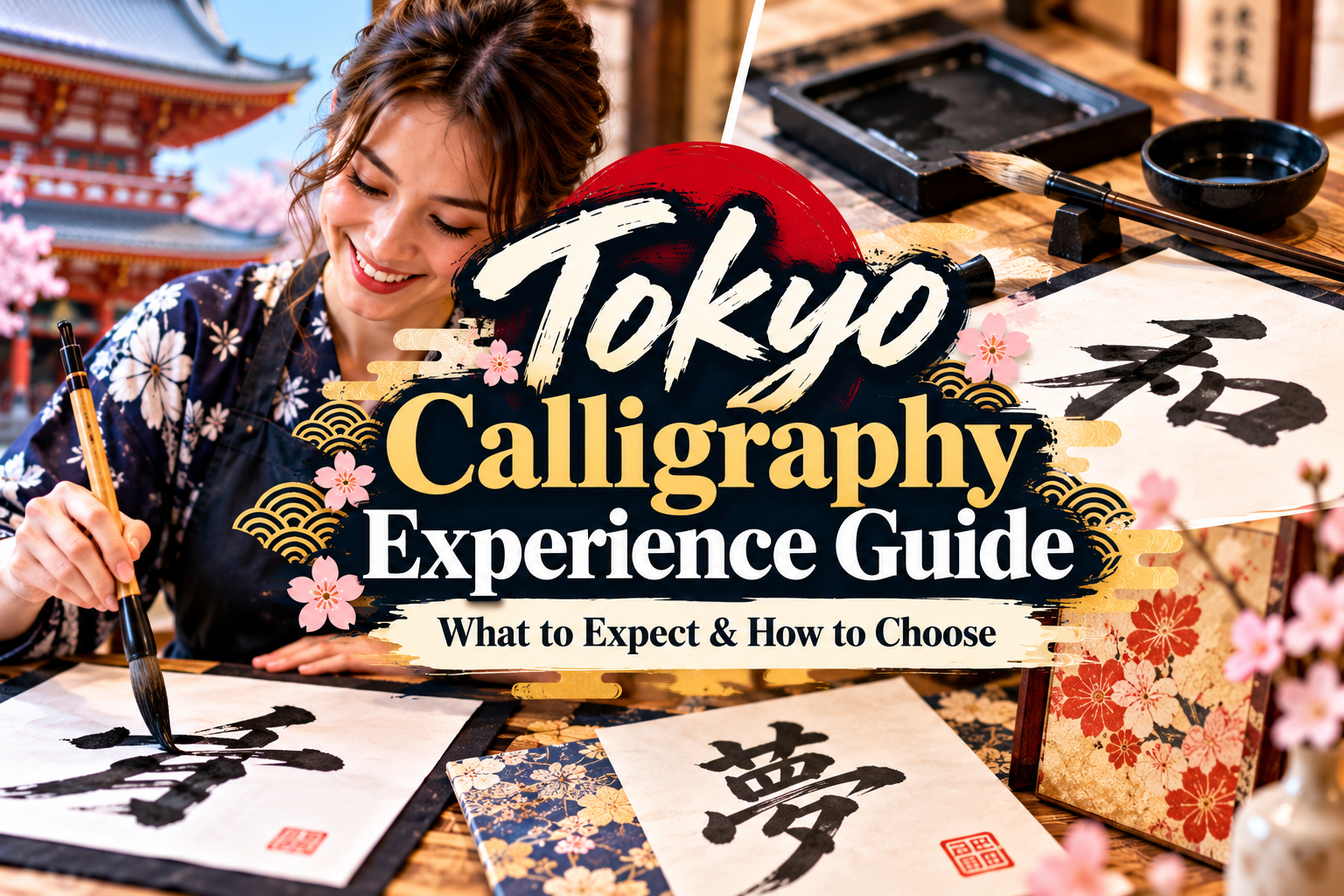
Why Try a Calligraphy Experience in Tokyo?
Japanese calligraphy, known as shodo, is more than simply writing Japanese characters with a brush.
It combines movement, concentration, balance, ink, paper, and personal expression. Even a single character can reveal differences in pressure, speed, rhythm, and brush direction.
For travelers, a calligraphy experience offers something different from simply looking at traditional Japanese art in a museum.
You participate in the process yourself.
Most beginner-friendly workshops do not require previous calligraphy experience or knowledge of Japanese. An instructor guides you through the basic techniques before you create your own finished piece.
Miruvia’s Take: Calligraphy Is About the Process, Not Perfect Characters
First-time participants sometimes worry that their Japanese characters will look bad.
That is the wrong way to approach the experience.
Your first attempt is not supposed to look like the work of an experienced calligrapher.
The interesting part is learning how much control goes into what initially appears to be a simple brushstroke.
How you hold the brush, how much ink it contains, where you place it on the paper, how quickly you move, and when you lift it all affect the result.
Instead of trying to create a perfect souvenir immediately, pay attention to the technique.
The final piece becomes more meaningful because you understand how it was made.
What Is Japanese Calligraphy?
Japanese calligraphy is traditionally called shodo, which can be translated as “the way of writing.”
It uses tools such as:
- Brush
- Ink
- Inkstone
- Paper
- Paperweight
- Felt or another protective surface
Rather than using a pen to form letters mechanically, the brush allows significant variation in line thickness and texture.
A single stroke can change depending on:
- Brush angle
- Pressure
- Speed
- Amount of ink
- Movement
- Rhythm
This is one reason calligraphy is considered an art rather than simply handwriting.
What Happens During a Tokyo Calligraphy Experience?
The exact structure depends on the workshop, but a beginner experience often follows a simple progression.
Introduction
The instructor may explain the basic tools and the role of calligraphy in Japanese culture.
You may also learn how to sit, position the paper, and hold the brush.
Basic Brush Practice
Before writing a complete character, you may practice simple lines and individual strokes.
This helps you understand how the brush responds to pressure and movement.
Choosing a Character
Many traveler-oriented workshops allow participants to choose a kanji or Japanese word.
The instructor may suggest characters based on their meanings.
Practicing the Character
You normally write the character several times rather than immediately creating the final piece.
The instructor may correct:
- Stroke order
- Proportions
- Brush angle
- Pressure
- Balance
Creating the Final Work
After practicing, you create a final version on better paper or another material.
Depending on the workshop, you may be able to take this piece home.
Do You Need to Know Japanese?
No.
You do not need to speak, read, or write Japanese to try a beginner calligraphy workshop designed for international visitors.
The instructor can demonstrate how each stroke should be made.
Calligraphy is highly visual, so many basic techniques can be understood by watching.
However, understanding the meaning of the character you write makes the finished work more personal.
What Japanese Character Should You Choose?
Choosing a character is often one of the most enjoyable parts of the experience.
Common themes may include concepts such as:
- Love
- Dream
- Peace
- Happiness
- Strength
- Beauty
- Harmony
- Journey
- Heart
- Samurai
Available characters vary by workshop.
Instead of choosing only because a character looks attractive, ask what it means and why it is written that way.
A character connected to your trip, personality, or values can make the finished piece more memorable.
Kanji, Hiragana or Katakana?
Japanese uses several writing systems, and a calligraphy workshop may introduce more than one.
Kanji
Kanji are characters with meanings and are often the most visually distinctive choice for beginner calligraphy experiences.
A single kanji can represent an idea or concept.
Hiragana
Hiragana has flowing shapes and is used extensively in Japanese writing.
Its curves can produce a different calligraphic feeling from kanji.
Katakana
Katakana is another phonetic writing system and is commonly used for foreign words and names.
Some workshops may show you how your name can be represented in Japanese.
However, transliterating a foreign name and choosing a meaningful kanji are two different things.
Ask the instructor if you are unsure.
Can You Write Your Name in Japanese Calligraphy?
Possibly.
Foreign names are often represented phonetically using katakana.
For example, an instructor may help convert the sounds of your name into Japanese characters.
Some tourist experiences may also offer kanji associated with a meaning or sound.
Be careful with websites or souvenirs that claim a particular kanji is simply “your Japanese name.”
Kanji carry specific meanings, and combinations chosen only for sound can sometimes feel unnatural.
A knowledgeable instructor can explain the difference.
Is Japanese Calligraphy Difficult?
The basic activity is accessible.
Mastering calligraphy is extremely difficult.
This combination makes it particularly suitable for travelers.
You can understand the basic concept and create something within a short workshop while still recognizing the depth of the art.
The first challenge is often controlling the brush.
A brush behaves very differently from a pen.
Small changes in pressure can produce dramatically different lines.
Do not expect complete control immediately.
Do You Need Artistic Ability?
No.
You do not need to be good at drawing or painting.
Calligraphy has its own techniques, and everyone begins by learning basic movements.
An instructor is more interested in helping you understand the process than judging your artistic ability.
Travelers who do not consider themselves creative can still enjoy the experience.
How Long Does a Calligraphy Experience Take?
Many beginner experiences can be completed in approximately one to two hours.
Some may be shorter, while more detailed private lessons can take longer.
A typical workshop needs time for:
- Introduction
- Tool explanation
- Brush practice
- Character selection
- Repeated practice
- Final artwork
- Photos or packaging
Do not schedule another reservation immediately afterward.
Allow additional time for finding the studio and traveling to your next destination.
How Much Does a Calligraphy Experience Cost in Tokyo?
Prices vary depending on:
- Workshop duration
- Group size
- Private or shared instruction
- Materials
- Instructor
- Location
- Finished artwork
- Additional cultural elements
A simple group workshop may cost less than a private lesson with detailed instruction.
When comparing prices, check what is included rather than looking only at the headline fee.
Possible inclusions are:
- Brush and ink use
- Practice paper
- Final paper
- Instructor guidance
- Finished artwork
- Decorative mounting
- Name card or seal-style finishing
Some premium options may include additional cultural activities.
Group vs Private Calligraphy Experience
Both can work well for travelers.
Group Experience
A group workshop is usually more affordable.
It can be a good choice if:
- You want a casual introduction
- Your budget is limited
- You enjoy learning alongside others
- Calligraphy is one activity among many on your trip
Private Experience
Private instruction provides more individual attention.
It may be better if:
- You have a strong interest in calligraphy
- You want detailed corrections
- You want more cultural explanation
- You are traveling as a couple or family
- You prefer a quiet environment
For most first-time visitors, a well-designed small-group workshop is sufficient.
Are Calligraphy Experiences Available in English?
Yes, some workshops are designed specifically for international visitors.
However, the level of English support varies.
You may encounter:
- English-speaking instructors
- Bilingual staff
- Interpreters
- English instruction sheets
- Visual demonstrations with limited spoken English
Because calligraphy is visual, perfect language fluency is not always necessary.
Still, confirm the language arrangements before booking if detailed explanations are important to you.
What Tools Are Used in Japanese Calligraphy?
Traditional calligraphy involves several characteristic tools.
Understanding them can make the workshop more interesting.
Brush
The brush is the main writing instrument.
Different brushes vary in size, shape, softness, and material.
The flexible tip allows the writer to create lines of different thicknesses.
Ink
Traditional black ink is used to create the characters.
Some workshops may use prepared liquid ink, while others may introduce traditional ink preparation.
Inkstone
An inkstone is traditionally used when preparing ink.
In some beginner workshops, this step may be simplified to save time.
Paper
Different types of paper respond differently to ink.
Ink can spread quickly, which means hesitation and excessive correction are difficult.
This encourages deliberate movement.
Paperweight
A paperweight helps prevent the sheet from moving while you write.
These tools may appear simple, but learning how they work together is part of understanding calligraphy.
Why Is Brush Control So Important?
Unlike writing with a ballpoint pen, a calligraphy brush changes continuously as you move it.
Press harder and the line becomes wider.
Reduce pressure and the line becomes thinner.
Move quickly and the stroke may feel energetic.
Move slowly and it can become heavier.
The brush also retains and releases ink differently throughout a stroke.
Learning to control these variables is one of the central challenges of calligraphy.
Why Does Stroke Order Matter?
Japanese characters are generally written using an established stroke order.
For beginners, this may seem like an unnecessary rule.
However, stroke order affects how one movement flows naturally into the next.
In calligraphy, rhythm matters.
Following the conventional sequence can make the character easier to write and visually more balanced.
Your instructor will normally demonstrate the order before you begin practicing.
What Is the Red Stamp on Japanese Calligraphy?
You may notice a red mark on traditional calligraphy works.
This is commonly associated with a seal, often called a hanko or in artistic contexts an artist’s seal.
The red impression creates a visual contrast with black ink and can function as a signature or identifying mark.
Some traveler-oriented workshops may allow you to add a seal-style finishing touch to your work.
The exact process varies, so ask what is included.
Can You Take Your Calligraphy Home?
Usually, yes.
This is one advantage calligraphy has over crafts that require firing, drying, or complicated finishing.
Paper artwork is also relatively easy to carry in luggage.
The workshop may provide:
- Protective paper
- A folder
- A tube
- Decorative mounting
Ask how the final work should be transported.
Avoid folding the piece unless the instructor specifically says it is appropriate.
How to Protect Your Calligraphy While Traveling
Paper is lightweight but can still be damaged.
Keep the artwork away from:
- Water
- Food
- Excessive humidity
- Crushed luggage
- Sharp objects
A rigid folder can be useful.
If the work is rolled, avoid placing heavy items on top of it.
Wait until the ink is completely dry before packing it.
What Should You Wear?
Normal comfortable clothing is usually fine.
However, remember that you will be working with black ink.
Avoid wearing something you would be extremely upset to stain.
Some studios provide an apron or other protection.
Loose sleeves can also be inconvenient because they may touch the ink or paper.
If necessary, roll them up or follow the instructor’s advice.
Can You Wear a Kimono During a Calligraphy Experience?
Potentially, but think carefully about practicality.
A kimono can create a beautiful cultural atmosphere and photographs, but calligraphy uses permanent-looking black ink.
If you are wearing a rental kimono, staining it could create a serious problem.
Check with both the calligraphy studio and kimono rental provider before combining the two experiences.
If your main priority is learning calligraphy comfortably, ordinary clothing may be the better choice.
Can Children Try Japanese Calligraphy?
Many children can enjoy calligraphy, particularly if the workshop is designed for families.
However, check:
- Minimum age
- Workshop duration
- Required concentration
- Whether adults must participate
- Ink handling
- Language support
Children who enjoy drawing, writing, or hands-on activities may find it particularly engaging.
A shorter workshop may be better for younger participants.
Is Calligraphy Good for Solo Travelers?
Yes.
Calligraphy works particularly well as a solo activity because you do not need a partner or group to participate.
A solo traveler can join a shared workshop or book a private lesson.
The activity itself requires concentration, so attending alone does not feel unusual.
It can also provide a structured opportunity to interact with a local instructor.
Can You Take Photos During the Workshop?
Often yes, but always confirm first.
Studios may allow you to photograph:
- Your own practice
- Your finished work
- The tools
- Parts of the demonstration
Do not automatically photograph the instructor, other participants, or private areas of the studio.
If you want a photo of yourself writing, ask whether someone can take one after you have learned the basic technique.
Where Should You Try Calligraphy in Tokyo?
There is no single district that is automatically best.
The right location depends on the rest of your itinerary.
Asakusa
Asakusa works naturally with traditional cultural experiences.
You can combine calligraphy with:
- Senso-ji
- Traditional streets
- Japanese sweets
- Kimono rental
- Souvenir shopping
This makes it convenient for first-time visitors.
Yanaka and Eastern Tokyo
Older neighborhoods can complement the slower, traditional atmosphere of a calligraphy experience.
This works particularly well for travelers who want to see a quieter side of Tokyo.
Central Tokyo
A centrally located workshop can be easier to include between major sightseeing areas.
If you have limited time, convenience may matter more than finding the most atmospheric neighborhood.
Combine Calligraphy with a Temple or Shrine Visit
Calligraphy can pair naturally with visiting temples and shrines.
Both experiences introduce aspects of Japanese tradition, but from different perspectives.
A temple or shrine visit focuses more on religious spaces, customs, architecture, and history.
Calligraphy gives you a hands-on activity.
Some travelers interested in Japanese writing may also enjoy learning about goshuin, the distinctive seals and calligraphy collected at many temples and shrines.
Remember that goshuin are connected to visits to religious sites and should be treated respectfully rather than simply as decorative souvenirs.
Combine Calligraphy with a Japanese Garden
A Japanese garden and calligraphy workshop can create a calm cultural half-day.
The two experiences share an emphasis on:
- Balance
- Space
- Seasonality
- Attention to detail
- Traditional aesthetics
A garden visit also provides a useful contrast after spending time indoors concentrating on brushwork.
Calligraphy vs Traditional Craft Workshop
A general traditional craft workshop may involve pottery, dyeing, printing, paper, textiles, or other materials.
Calligraphy is more focused.
Choose calligraphy if you are especially interested in:
- Japanese writing
- Brush techniques
- Kanji
- Minimalist art
- Quiet concentration
Choose another craft workshop if you would rather make a three-dimensional or practical object.
Calligraphy vs Tea Ceremony
Both can be quiet, structured cultural experiences.
However, they emphasize different things.
A tea ceremony focuses on:
- Hospitality
- Matcha
- Ritual
- Movement
- Seasonal aesthetics
Calligraphy focuses on:
- Writing
- Brush control
- Ink
- Composition
- Personal creation
If you enjoy calm activities, they can work very well together on the same trip.
Calligraphy vs Kimono Rental
Kimono rental is primarily a sightseeing and clothing experience.
Calligraphy is primarily a learning and creative experience.
Choose kimono rental if your priority is:
- Wearing traditional clothing
- Photography
- Walking through historic areas
Choose calligraphy if your priority is:
- Learning a technique
- Creating something
- Interacting with an instructor
You can potentially do both, but be careful about ink near rented clothing.
Calligraphy vs Kabuki
Kabuki is something you primarily observe.
Calligraphy is something you create.
Kabuki offers:
- Theater
- Music
- Costumes
- Dramatic performance
- Stagecraft
Calligraphy offers:
- Direct participation
- Quiet concentration
- Brush technique
- A finished piece to take home
They provide very different ways of engaging with traditional Japanese culture.
How to Choose a Calligraphy Experience in Tokyo
Do not book solely based on the first attractive photo you see.
Compare the following factors.
1. Is It Designed for Beginners?
Look for clear statements that no previous experience is required.
2. What Will You Actually Do?
Some experiences may involve substantial brush practice.
Others may focus more on creating a quick souvenir.
Choose according to your interests.
3. What Language Support Is Available?
Confirm whether instruction is available in English or another language you understand.
4. How Large Is the Group?
Smaller groups generally allow more individual correction.
5. How Long Is the Workshop?
Make sure the duration fits comfortably into your itinerary.
6. What Is Included?
Check whether the price includes all materials and the final artwork.
7. Can You Choose Your Character?
If this matters to you, verify the available options.
8. Where Is the Studio?
A convenient location can save substantial travel time.
What to Check Before Booking
Before confirming your reservation, check:
- Date
- Start time
- Meeting point
- Duration
- Price
- Language
- Group size
- Minimum age
- Materials included
- Finished artwork
- Photography rules
- Clothing recommendations
- Cancellation policy
- Late-arrival policy
Also check whether you need to remove shoes when entering the studio.
How Far in Advance Should You Book?
If you have a specific workshop in mind, booking in advance is sensible.
This is especially important for:
- Private lessons
- Small-group workshops
- Weekends
- Cherry blossom season
- Golden Week
- Autumn travel periods
- Other peak tourism dates
A flexible traveler may find availability closer to the date, but a culturally focused itinerary should not depend on last-minute openings.
Arrive on Time
Calligraphy instruction often begins with a demonstration.
If you arrive late, you may miss the explanation that shows you how to hold and move the brush.
Tokyo’s rail system is extensive, but large stations can take longer to navigate than expected.
Check your route beforehand and allow extra time.
First-Time Visitor Recommendation
For your first calligraphy experience, prioritize simplicity.
Choose a workshop that offers:
- Beginner-friendly instruction
- Clear English support
- Approximately one to two hours
- A convenient location
- A small or manageable group
- A finished work to take home
You do not need the most advanced or traditional course to have a meaningful first experience.
Repeat Visitor Recommendation
If you have already tried basic calligraphy, consider going deeper.
Look for:
- Private instruction
- Longer sessions
- More advanced brush techniques
- Different writing styles
- Ink preparation
- More detailed cultural explanations
- Workshops led by experienced calligraphers
A second experience can shift your attention from simply completing a character to understanding how the writing itself is expressed.
Common Mistakes to Avoid
Trying to Make the First Attempt Perfect
Practice is part of the experience.
Allow yourself to make imperfect strokes.
Choosing a Character Without Understanding It
Ask about its meaning and context.
Assuming Your Name Can Be Directly Converted into Kanji
Japanese naming and writing systems are more complicated than simple letter substitution.
Wearing Delicate Clothing
Black ink and expensive clothing are not a good combination.
Arriving Late
You may miss the most important demonstration.
Booking Too Much Around the Workshop
Leave enough time to enjoy the activity without watching the clock.
Treating the Final Piece as the Only Goal
The value comes from learning how the character is created.
Who Should Try a Tokyo Calligraphy Experience?
Calligraphy is particularly suitable for travelers interested in:
- Japanese culture
- Art
- Language
- Kanji
- Traditional aesthetics
- Hands-on activities
- Mindful experiences
- Lightweight handmade souvenirs
It is also useful when you want an indoor activity during bad weather.
Who Might Skip It?
Calligraphy may be less suitable if:
- You strongly dislike quiet activities
- You have no interest in writing or visual art
- You want a highly energetic experience
- Your itinerary is extremely short
- You prefer completely spontaneous travel without reservations
Tokyo offers many other cultural experiences, so there is no need to participate simply because it feels traditional.
Frequently Asked Questions
Do I need to know Japanese to try calligraphy in Tokyo?
No. Beginner workshops for international visitors generally do not require Japanese reading or writing ability.
Is Japanese calligraphy difficult?
The basic experience is accessible to beginners, but mastering calligraphy takes years of practice.
How long does a calligraphy workshop take?
Many beginner experiences take around one to two hours, although this varies by workshop.
Can I take my calligraphy home?
Usually yes. Many workshops allow participants to take their final paper artwork home.
Can I write my name in Japanese?
Often, but foreign names are normally represented phonetically in katakana. Ask the instructor about available options.
Are calligraphy workshops available in English?
Some are. Check whether the workshop offers an English-speaking instructor, interpreter, English materials, or visual instruction.
What should I wear?
Comfortable clothing is usually appropriate. Avoid delicate clothing because black ink can stain.
Is calligraphy suitable for children?
Some workshops welcome children, but minimum ages and class formats vary.
Should I book in advance?
Yes, particularly for private lessons, small-group experiences, weekends, and busy tourism periods.
Final Thoughts
A calligraphy experience offers a quiet but highly interactive way to explore Japanese culture in Tokyo.
At first, writing a single character may appear simple.
Once you hold the brush yourself, you begin to notice the pressure, timing, balance, stroke order, and concentration involved in every line.
That is what makes the experience valuable.
The finished artwork is a souvenir, but it also records something you learned and created during your trip.
For first-time visitors, choose a beginner-friendly workshop with clear language support and enough time to practice without rushing.
For travelers who already know the basics, a longer or more specialized lesson can reveal much more depth.
Do not worry about producing perfect calligraphy.
Focus on understanding the movement of the brush, the meaning of the character, and the experience of creating it yourself.
