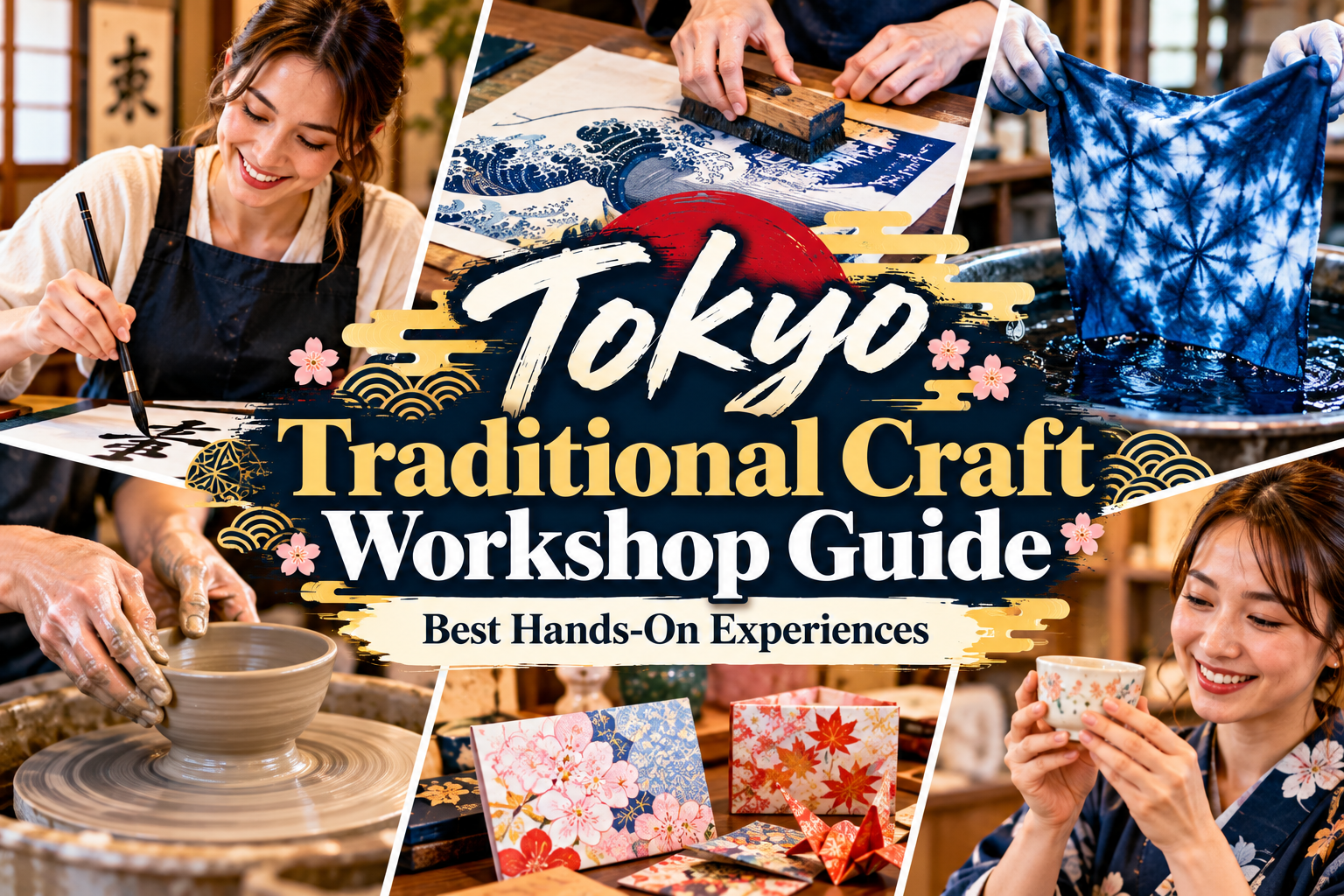
Why Try a Traditional Craft Workshop in Tokyo?
Tokyo is famous for modern technology, skyscrapers, shopping, and entertainment, but the city also offers many opportunities to experience traditional Japanese craftsmanship firsthand.
Instead of simply buying a souvenir, a craft workshop allows you to understand how Japanese objects are made, learn directly from an instructor, and often take home something you created yourself.
For international visitors, these workshops can also provide a more personal connection with Japanese culture than sightseeing alone.
You do not need previous artistic experience. Many workshops are specifically designed for beginners and travelers.
Miruvia’s Take: Choose the Experience, Not Just the Souvenir
It can be tempting to choose a workshop based only on what you will take home.
However, the most memorable part is often the process itself.
Watching an instructor demonstrate a traditional technique, trying unfamiliar tools, making mistakes, and gradually creating something with your own hands can become one of the most distinctive memories of a Tokyo trip.
When comparing workshops, consider three things:
- What you actually want to learn
- How involved the hands-on process is
- Whether the atmosphere matches the experience you want
A small handmade object can be a wonderful souvenir, but the story behind making it is often even more valuable.
What Traditional Crafts Can You Experience in Tokyo?
Tokyo offers workshops covering both crafts historically associated with the city and traditional techniques practiced throughout Japan.
Common experiences include:
- Woodblock printing
- Indigo dyeing
- Washi paper crafts
- Pottery and ceramics
- Calligraphy
- Traditional decorative crafts
- Japanese fabric crafts
- Small woodworking experiences
Availability varies considerably between studios.
Some workshops focus on preserving traditional techniques, while others adapt those techniques into shorter experiences that are easier for travelers to join.
Woodblock Printing
Japanese woodblock printing is one of the most visually recognizable traditional art forms.
Travelers may know the technique through ukiyo-e prints, but participating in a workshop reveals how much craftsmanship is involved in creating even a relatively simple image.
Depending on the workshop, you may work with carved woodblocks, apply ink or pigments, position paper, and create a print by hand.
Why Choose Woodblock Printing?
Woodblock printing is particularly suitable for travelers interested in:
- Japanese art
- Ukiyo-e
- Illustration
- Printmaking
- Traditional design
The finished print is usually relatively easy to carry home compared with heavier crafts.
Is It Difficult?
Beginner workshops generally simplify the process.
You are unlikely to carve an elaborate professional woodblock from beginning to end during a short tourist workshop. Instead, the experience may focus on printing from prepared blocks or completing selected parts of the process.
This still provides a useful introduction to the technique without requiring advanced artistic skills.
Indigo Dyeing
Indigo dyeing is another highly visual craft experience.
Japanese indigo, commonly associated with deep blue colors, has been used in clothing, textiles, and everyday objects for generations.
During a workshop, participants may dye items such as:
- Handkerchiefs
- Small cloths
- Bags
- Scarves
- Other fabric products
Different folding, tying, or resisting techniques can create unique patterns.
Why Choose Indigo Dyeing?
Indigo dyeing is a strong choice if you want a workshop where the final result feels personal.
Even when participants use similar materials, variations in folding and dyeing can produce different designs.
It is also a good option for travelers who prefer making something practical that they may continue using after returning home.
What Should You Wear?
Follow the studio’s instructions carefully.
Dye workshops generally take precautions to protect clothing, but working with strong pigments naturally creates some risk of staining.
Avoid wearing an outfit you would be extremely upset to damage.
Washi Paper Crafts
Washi is traditional Japanese paper known for its texture, durability, and versatility.
Depending on the workshop, you may experience actual papermaking or use prepared washi to create decorative objects.
Possible activities include:
- Making sheets of paper
- Decorating paper
- Creating postcards
- Making small accessories
- Producing decorative items
Why Choose a Washi Workshop?
Washi experiences can be approachable for visitors who want something creative without requiring complex tools.
Finished pieces are often lightweight, which also makes them convenient souvenirs for international travelers with limited luggage space.
Pottery and Ceramics
Pottery workshops offer a very different experience because you work directly with clay.
Depending on the studio, you may:
- Shape clay by hand
- Use a pottery wheel
- Create a cup or bowl
- Decorate an existing ceramic piece
- Select a glaze for your finished item
Is Pottery Good for Beginners?
Yes, if you choose a beginner-friendly class.
Using a pottery wheel can initially feel difficult, but instructors usually guide participants through the essential movements.
Hand-building experiences can be even more approachable.
Do not expect your first piece to look professionally manufactured. The small imperfections are part of what makes a handmade object personal.
Important: Your Pottery May Not Be Ready the Same Day
This is one of the most important details for travelers.
Many ceramic pieces need to be:
- Dried
- Fired
- Glazed
- Fired again
The process can take days or weeks.
Before booking, check whether:
- You can take the item immediately
- The studio can ship internationally
- The studio can send it to a hotel in Japan
- Shipping costs are included
- Your travel schedule allows enough time
Do not assume you will leave the workshop carrying your finished pottery.
Japanese Calligraphy
Japanese calligraphy, or shodo, turns writing into an artistic experience.
Participants typically use a brush, ink, and paper while learning how individual strokes are created.
A workshop may introduce:
- Brush handling
- Ink preparation
- Basic stroke techniques
- Japanese characters
- Composition and balance
You may eventually create a finished piece featuring a character or word.
Do You Need to Speak Japanese?
Usually not for beginner experiences designed for international travelers.
Understanding the meaning behind the characters can make the activity more interesting, but you do not need to know how to read or write Japanese before participating.
Why Choose Calligraphy?
Calligraphy works particularly well for travelers interested in Japanese language, philosophy, design, or traditional aesthetics.
It also requires relatively little physical activity, making it easy to include between sightseeing stops.
Traditional Fabric and Textile Crafts
Japan has a long history of textile craftsmanship.
Tokyo workshops may introduce techniques involving:
- Dyeing
- Decorative stitching
- Pattern making
- Fabric accessories
- Traditional cloth
The exact technique varies considerably between studios.
Some experiences are strongly connected to traditional craftsmanship, while others use traditional materials in contemporary designs.
Read the workshop description carefully if historical authenticity is important to you.
Small Decorative Craft Workshops
Not every traditional craft experience requires several hours of complicated work.
Some studios offer shorter activities where visitors create small decorative objects or accessories using traditional materials or techniques.
These can be useful if:
- Your itinerary is already busy
- You are traveling with children
- You want an easy introduction to Japanese crafts
- You prefer a compact souvenir
However, shorter does not necessarily mean better.
If craftsmanship is a major reason for your visit, a longer workshop with more instruction may provide a deeper experience.
How Long Do Traditional Craft Workshops Take?
A typical traveler-oriented workshop may take roughly one to three hours.
Simple activities can be shorter, while more detailed workshops may require half a day.
Always check the stated duration before booking.
Remember to include additional time for:
- Finding the studio
- Registration
- Introductions
- Changing clothes or preparing materials
- Packing your finished item
- Traveling to your next destination
Avoid scheduling another reservation immediately afterward.
How Much Do Craft Workshops Cost in Tokyo?
Prices vary widely depending on the craft, materials, instructor, class size, and duration.
Simple group activities may be relatively affordable, while private instruction or workshops using expensive materials can cost considerably more.
When comparing prices, check what is actually included.
A workshop fee may include:
- Materials
- Instructor guidance
- Use of tools
- Finished item
- Protective clothing
- Packaging
Other workshops may charge separately for additional materials or shipping.
The cheapest option is not automatically the best value.
Can Beginners Join?
In many cases, yes.
Tourist-oriented workshops usually assume that participants have little or no previous experience.
A good instructor will demonstrate the process and help when necessary.
When booking, look for descriptions such as:
- Beginner friendly
- No experience required
- English support available
- Suitable for international visitors
If the workshop appears to be aimed at experienced practitioners, confirm requirements before reserving.
Are Craft Workshops Available in English?
Some are, but English support varies.
Possible formats include:
- English-speaking instructor
- Bilingual instructor
- Interpreter
- English instruction sheets
- Visual demonstrations with limited English
A workshop does not necessarily require fluent conversation if the process is highly visual.
However, language becomes more important when the craft involves detailed explanations or complicated safety instructions.
Check the language information on the booking page instead of assuming English will be available.
Private vs Group Workshops
Both formats have advantages.
Group Workshop
A group workshop is usually more affordable and can have a relaxed social atmosphere.
It is suitable if you:
- Want a casual introduction
- Do not need constant instructor attention
- Enjoy meeting other travelers
Private Workshop
A private workshop may offer more direct interaction with the instructor and greater flexibility.
It can be worth considering if:
- The craft is a major interest
- You want detailed explanations
- You are traveling as a couple or family
- You prefer a quieter experience
Private workshops generally cost more.
Can Children Join Traditional Craft Workshops?
Many workshops welcome children, but minimum ages vary.
Activities involving simple paper, fabric, or decorative crafts may be easier for younger participants.
Pottery, cutting tools, hot equipment, chemicals, or complex processes may have stricter age requirements.
Families should check:
- Minimum age
- Whether adults must participate
- Workshop duration
- Safety requirements
- Whether the activity requires long periods of concentration
A hands-on craft can be an excellent break from sightseeing for children when the activity matches their age.
What Should You Wear?
For most workshops, comfortable everyday clothing is sufficient.
However, the appropriate clothing depends on the activity.
For dyeing, pottery, ink, and painting experiences, avoid especially delicate or expensive clothing.
Studios may provide:
- Aprons
- Gloves
- Protective sleeves
Long hair may need to be tied back for certain activities.
Follow any specific safety instructions provided by the workshop.
Can You Take Photos?
Many workshops allow photography, but rules vary.
Some instructors may allow photos during most of the experience while restricting photography during particular demonstrations.
Others may be happy to help take a photo of you working.
Always ask before photographing:
- The instructor
- Other participants
- Private studio areas
- Specialized techniques
A craft workshop is a working environment, not simply a tourist photo location.
Can You Take Your Finished Craft Home?
Often yes, and this is one of the attractions of participating.
However, you should confirm this before booking.
There are three common possibilities.
Take It Home Immediately
This is common for paper crafts, prints, small fabric items, and some decorative crafts.
Pick It Up Later
Some pieces require drying or additional processing.
This can be inconvenient for travelers leaving Tokyo soon.
Have It Shipped
Pottery and other crafts requiring finishing may need to be shipped.
Check whether international shipping is available and how much it costs.
Think About Your Luggage Before Choosing a Workshop
A beautiful handmade object becomes less convenient if it is fragile, heavy, or difficult to pack.
Before choosing a workshop, consider:
- Size
- Weight
- Fragility
- Drying time
- International shipping
- Customs restrictions in your destination country
Travelers with limited luggage may prefer prints, fabric items, calligraphy, or small paper crafts.
Where Can You Find Craft Workshops in Tokyo?
Traditional craft experiences are spread across the city rather than concentrated in a single district.
However, certain parts of Tokyo work particularly well with cultural activities.
Asakusa
Asakusa is one of the easiest areas to combine traditional culture with sightseeing.
A workshop can be paired with:
- Senso-ji
- Traditional shopping streets
- Japanese sweets
- Kimono rental
- Nearby historic neighborhoods
This makes Asakusa particularly convenient for first-time visitors.
Yanaka and Eastern Tokyo
Older neighborhoods can provide an atmospheric setting for craft-focused exploration.
Yanaka in particular offers a slower side of Tokyo that pairs naturally with traditional culture.
Central Tokyo
Studios in central areas can be easier to fit into busy itineraries because they connect conveniently with major neighborhoods.
The atmosphere may feel less historic, but accessibility can be more important when your schedule is limited.
Combine a Craft Workshop with Traditional Tokyo
A workshop does not need to occupy an entire day.
It works particularly well as one component of a broader cultural itinerary.
For example:
Morning
Traditional neighborhood walk
Late morning or early afternoon
Craft workshop
Afternoon
Japanese garden or temple visit
Evening
Dinner in a nearby neighborhood
This creates variety without making the day feel rushed.
Craft Workshop vs Tea Ceremony
Both offer hands-on access to Japanese culture, but the experience is different.
Choose a craft workshop if you want to:
- Make something yourself
- Work with tools or materials
- Learn a production technique
- Take home a personal object
Choose a tea ceremony if you are more interested in:
- Ritual
- Hospitality
- Matcha
- Traditional aesthetics
- A structured cultural experience
Travelers with enough time can easily experience both during the same Tokyo trip.
Craft Workshop vs Kimono Rental
Kimono rental is primarily about wearing traditional clothing while exploring Tokyo.
A craft workshop is more focused on making and learning.
Choose kimono rental if photography and sightseeing atmosphere are priorities.
Choose a craft workshop if you prefer a hands-on activity where you actively create something.
Combining both is possible, but check whether the craft activity could stain or damage rented clothing.
Craft Workshop vs Kabuki
Kabuki is a performance you watch.
A craft workshop is an experience you actively participate in.
Kabuki may appeal more to travelers interested in:
- Theater
- Costumes
- Music
- Performing arts
Craft workshops may appeal more to travelers interested in:
- Design
- Materials
- Making things
- Traditional techniques
They offer two very different perspectives on Japanese cultural heritage.
Craft Workshop vs Sumo
Sumo provides a window into one of Japan’s most distinctive sporting traditions.
Craft workshops provide a quieter and more personal experience.
If your itinerary has room for several cultural activities, there is little reason to choose only one.
The contrast between them can actually make your Tokyo experience more varied.
How to Choose the Right Traditional Craft Workshop
Before booking, compare workshops using the following factors.
1. What Do You Actually Make?
Look beyond generic descriptions such as “Japanese craft experience.”
Find out exactly what you will create.
2. How Hands-On Is the Workshop?
Some experiences allow you to perform most of the process yourself.
Others involve watching the instructor perform the more difficult stages.
Neither format is necessarily bad, but know what you are booking.
3. How Long Does It Take?
Choose a duration that fits comfortably into your itinerary.
4. Is English Support Available?
Confirm the actual level of language support.
5. Can You Take the Item Home?
This is especially important for pottery.
6. Are Materials Included?
Check for additional charges.
7. Where Is the Studio?
A workshop that requires a long detour may not be practical on a short trip.
8. What Is the Cancellation Policy?
Travel plans change.
Understand the cancellation and late-arrival rules before paying.
How Far in Advance Should You Book?
Popular workshops, private experiences, and classes with very small capacities can fill up.
Booking in advance is particularly useful during busy travel periods.
These may include:
- Cherry blossom season
- Golden Week
- Summer holiday periods
- Autumn foliage season
- New Year travel periods
If a specific workshop is important to your trip, do not leave the reservation until the last minute.
What to Check Before Booking
Before confirming a reservation, verify:
- Date
- Start time
- Meeting location
- Duration
- Language
- Minimum age
- Materials included
- Clothing requirements
- Finished-item policy
- Shipping options
- Photography rules
- Cancellation policy
- Late-arrival policy
Also check how early you should arrive.
Small studios may operate on strict schedules between groups.
Arrive on Time
Punctuality matters for workshops.
An instructor may need to explain safety procedures or demonstrate a technique to the entire group at the beginning.
Arriving late can mean missing essential instructions.
Plan your route in advance and leave extra time for navigating unfamiliar stations and streets.
Respect the Craftsperson and Studio
Traditional craft workshops sometimes take place in active studios rather than purpose-built tourist facilities.
Treat the space accordingly.
Avoid:
- Touching tools without permission
- Interrupting demonstrations
- Photographing restricted areas
- Handling finished works carelessly
- Ignoring safety instructions
Showing curiosity is welcome. Treating the studio merely as a photo backdrop is not.
First-Time Visitor Recommendation
For a first trip to Tokyo, choose a workshop that is:
- Around one to two hours
- Beginner friendly
- Conveniently located
- Clearly available in English
- Easy to combine with sightseeing
- Able to provide a finished item you can carry home
A straightforward experience reduces logistical complications while still giving you meaningful exposure to Japanese craftsmanship.
Repeat Visitor Recommendation
Repeat visitors can go deeper.
Instead of choosing the easiest tourist workshop, consider:
- Longer classes
- Smaller studios
- Specialized techniques
- Private instruction
- Neighborhood-based workshops
- Crafts connected to a specific artisan tradition
This can reveal a side of Tokyo that is easy to miss on a sightseeing-focused first trip.
Common Mistakes to Avoid
Choosing Only by Price
A cheaper workshop may include less instruction or fewer materials.
Compare the actual experience.
Ignoring the Finished-Item Timeline
This is particularly important for ceramics.
Your item may not be ready before you leave Japan.
Booking Too Far from the Rest of Your Day
Tokyo is large.
A workshop can consume much more time than expected if you need to cross the city twice.
Assuming English Is Available
Confirm language support before booking.
Wearing Delicate Clothing
Ink, clay, dyes, and paints can be messy.
Arriving Late
You may miss instructions or lose part of your workshop time.
Overplanning the Same Day
Hands-on experiences are more enjoyable when you are not constantly checking the clock.
Who Should Try a Traditional Craft Workshop in Tokyo?
A workshop is particularly suitable for travelers who enjoy:
- Japanese culture
- Art and design
- Hands-on activities
- Learning new skills
- Meeting local instructors
- Unique souvenirs
- Slower travel experiences
It can also be a good activity on a rainy day because many workshops take place indoors.
Who Might Skip It?
A craft workshop may be less suitable if:
- Your Tokyo itinerary is extremely short
- You dislike structured activities
- You prefer sightseeing without reservations
- You have little interest in making things
- Your schedule is too unpredictable for a fixed booking
There are many ways to experience traditional culture in Tokyo, so choose activities that genuinely interest you.
Frequently Asked Questions
Do I need experience to join a traditional craft workshop in Tokyo?
Usually not. Many workshops designed for travelers are beginner friendly and provide step-by-step instruction.
Are traditional craft workshops available in English?
Some offer English-speaking instructors or English materials, while others rely mainly on demonstrations. Check the language details before booking.
How long does a traditional craft workshop take?
Many experiences take around one to three hours, although duration varies by craft and workshop.
Can I take my finished craft home?
Often yes, but some items require drying, firing, or additional finishing. Pottery may need to be collected later or shipped.
Are craft workshops suitable for children?
Some are. Minimum ages and safety requirements vary depending on the activity.
What should I wear?
Comfortable clothing is usually sufficient. For activities involving dye, ink, clay, or paint, avoid clothing that would be difficult to clean or replace.
Should I book in advance?
Booking ahead is recommended for popular workshops, private experiences, small-group classes, and busy travel seasons.
What is the best traditional craft workshop for first-time visitors?
There is no single best option. Choose based on your interests, available time, location, language support, and whether you want to take the finished item home immediately.
Final Thoughts
A traditional craft workshop can turn Japanese culture from something you observe into something you actively experience.
Whether you print an image, dye fabric, shape clay, practice calligraphy, or work with washi, the value goes beyond the object you create.
You learn about materials, techniques, patience, and the decisions involved in making something by hand.
For first-time visitors, a short beginner-friendly workshop can add variety to a sightseeing-heavy itinerary.
For repeat visitors, a more specialized class can provide a deeper connection with Tokyo’s quieter cultural side.
Choose the craft that genuinely interests you, confirm the practical details before booking, and leave enough time to enjoy the process rather than rushing through it.
