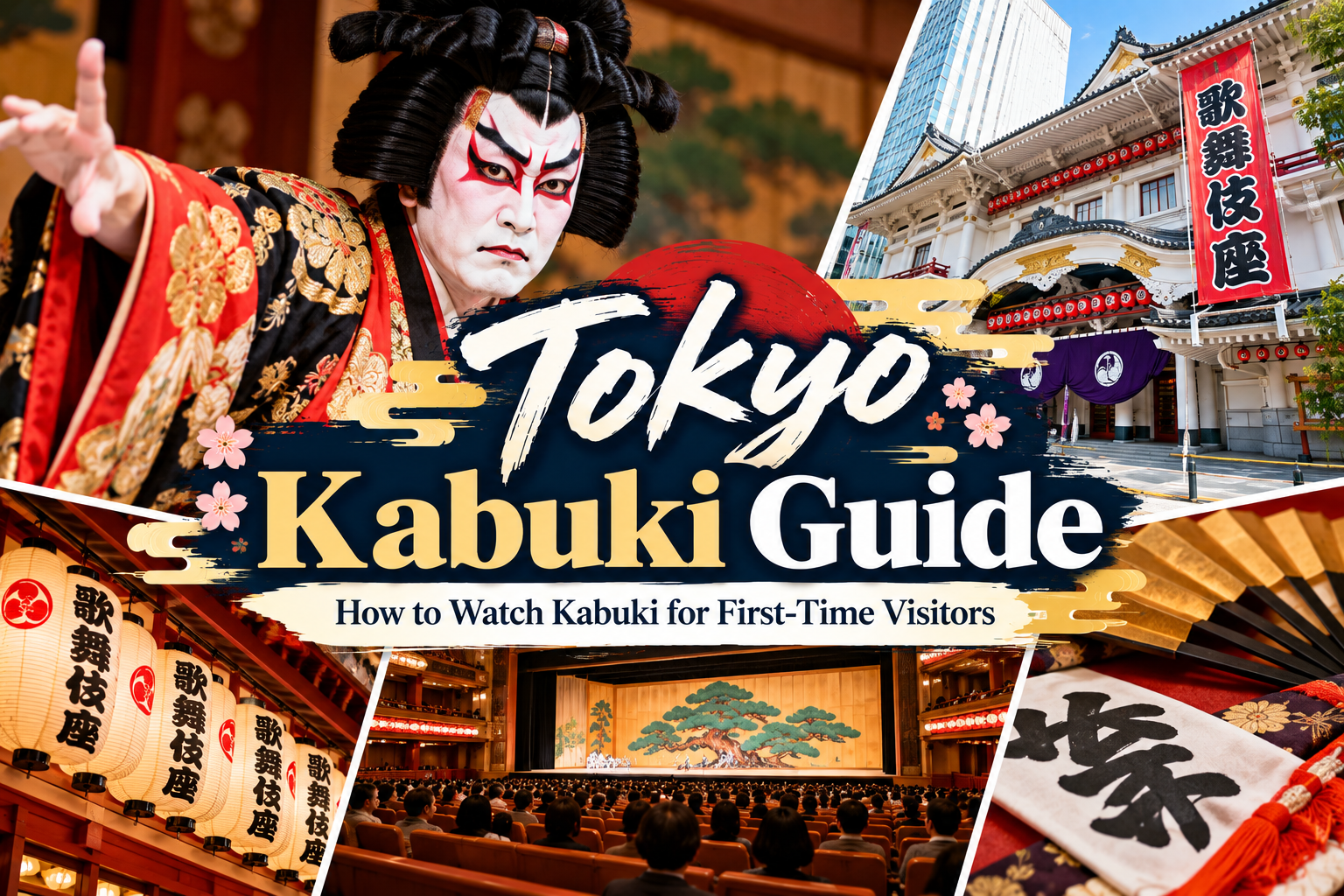
Why Watch Kabuki in Tokyo?
Kabuki is one of Japan’s most distinctive traditional performing arts, combining dramatic acting, elaborate costumes, stylized movement, music, and striking stage techniques.
For international travelers, watching kabuki can seem intimidating at first.
The performances are in Japanese, some productions are long, and the traditions surrounding the theater may be unfamiliar.
However, you do not need to understand every word or know the history of kabuki to enjoy the experience.
Tokyo is one of the easiest places to see kabuki, particularly because Kabukiza in Ginza provides travelers with an opportunity to experience this traditional art form in the middle of one of the city’s most accessible neighborhoods.
This guide explains what kabuki is, what to expect at the theater, how tickets and seating work, how long performances last, and how first-time visitors can choose an experience that fits their Tokyo trip.
Miruvia’s Take: You Do Not Need to Understand Everything
The biggest mistake first-time visitors make is assuming they need extensive knowledge of kabuki before attending.
You do not.
Kabuki is highly visual.
Costumes, makeup, movement, stage design, music, entrances, and dramatic poses all communicate part of the story.
Understanding the basic plot before the performance can make the experience easier to follow, but trying to understand every spoken line is unnecessary.
For most international travelers, the goal should be to experience kabuki rather than study it.
Choose a performance that fits your schedule, learn a little about the story beforehand, and allow yourself to enjoy the spectacle.
What Is Kabuki?
Kabuki is a traditional form of Japanese theater that developed during the Edo period.
It is known for its highly stylized presentation.
Common features include:
- Elaborate costumes
- Dramatic makeup
- Exaggerated movement
- Traditional music
- Stylized speech
- Large stage sets
- Distinctive poses
- Dramatic entrances and exits
Kabuki stories may involve historical events, family conflicts, romance, loyalty, revenge, comedy, or tragedy.
The performance style can feel very different from modern Western theater.
That difference is part of the appeal.
Is Kabuki Worth Seeing for International Visitors?
For travelers interested in Japanese culture, theater, history, costume, or performing arts, kabuki can be a memorable experience.
It is especially suitable for visitors who want to experience traditional culture without participating directly in an activity.
Unlike a tea ceremony or kimono rental, kabuki allows you to sit back and observe.
The main limitation is language.
Performances are generally in Japanese, so international visitors should expect that they may not understand all of the dialogue.
Fortunately, understanding every line is not necessary to appreciate the visual performance.
Where to Watch Kabuki in Tokyo
The most famous place to watch kabuki in Tokyo is Kabukiza in Ginza.
Its traditional-inspired exterior stands out among Ginza’s modern buildings and luxury stores.
For first-time international visitors, Kabukiza is the natural starting point when considering a kabuki performance in Tokyo.
The surrounding location also makes it relatively easy to combine theater with other sightseeing, dining, and shopping.
Kabukiza in Ginza
Kabukiza is strongly associated with kabuki in Tokyo.
The theater hosts kabuki performances and provides a setting where visitors can experience the art form in a purpose-built venue.
Its Ginza location is particularly convenient.
Travelers can combine a performance with:
- Ginza shopping
- Japanese dining
- Nearby department stores
- Hamarikyu Gardens
- Tokyo Station area
- Other central Tokyo attractions
This makes kabuki easier to incorporate into a sightseeing day than an activity located far outside central Tokyo.
What Happens at a Kabuki Performance?
The exact structure depends on the program.
Kabuki performances can include multiple acts or different pieces within the same program.
You may see:
- Dramatic dialogue
- Dance
- Traditional music
- Elaborate entrances
- Fight scenes
- Comic moments
- Scene changes
- Highly stylized acting
Some performances may feel slow compared with modern entertainment.
Others can become visually dramatic very quickly.
Do not expect the pacing of a movie or contemporary stage production.
Kabuki follows its own theatrical rhythm.
How Long Does Kabuki Last?
This is one of the most important questions for travelers.
A full kabuki program can take several hours and may include breaks between acts or performances.
Exact schedules vary.
For visitors with limited time in Tokyo, this matters considerably.
Before buying a ticket, check:
- Performance start time
- Expected finishing time
- Number of acts
- Intermission schedule
- Entry conditions
Do not build your itinerary around an assumed two-hour theater experience without checking the actual program.
Can You Watch Only Part of a Kabuki Performance?
Ticket structures and viewing options can vary depending on the theater and current performance system.
Some travelers specifically look for shorter ways to experience kabuki rather than attending an entire program.
Availability and ticketing arrangements can change, so check the current official information for your performance date.
If a shorter viewing option is available, it can be useful for travelers who are curious about kabuki but do not want to dedicate several hours to it.
However, a full program provides a more complete theatrical experience.
How Do Kabuki Tickets Work?
Ticket availability depends on the production and performance date.
Popular performances and desirable seats may sell earlier than others.
Before purchasing, confirm:
- Date
- Start time
- Theater
- Program
- Seat category
- Ticket collection method
- Entry rules
- Cancellation conditions
For international travelers, buying through an official or clearly authorized source is the safest approach.
Avoid assuming that good seats will always be available on the day of the performance.
Do You Need to Book Kabuki in Advance?
Advance booking is recommended if kabuki is a priority for your trip.
This is especially useful when:
- Your Tokyo schedule is fixed
- You want a specific performance
- You prefer a particular seat category
- You are traveling during a busy period
- You have only one possible day available
Travelers with flexible schedules may have more options, but waiting until the last minute introduces unnecessary uncertainty.
How Far in Advance Should You Book?
There is no universal booking window for every performance.
The practical approach is to check the performance schedule once your Tokyo dates are confirmed.
If a suitable program is available and kabuki is important to you, there is little advantage in deliberately waiting.
Always verify the official sales schedule for your specific performance.
Kabuki Seating Explained
Theater seating varies by venue and performance.
At Kabukiza, different seating categories generally offer different combinations of proximity, viewing angle, and price.
You do not necessarily need the most expensive seat.
For a first-time visitor, a seat with a clear overall view of the stage can be more useful than simply sitting as close as possible.
Kabuki uses the full stage environment, so seeing the broader visual composition has value.
What Is the Hanamichi?
One distinctive feature associated with kabuki theaters is the hanamichi.
This is a walkway extending through part of the audience area and connecting with the stage.
Performers may use it for dramatic entrances, exits, and important scenes.
If your seat has a good view of the hanamichi, it can add another dimension to the performance.
However, you do not need a seat directly beside it to enjoy kabuki.
Which Seats Are Best for First-Time Visitors?
For most first-time visitors, prioritize:
- A comfortable seat
- A clear stage view
- A price that fits your budget
- A location where you can see the overall performance
Do not automatically buy the most expensive category.
If you are uncertain whether you will enjoy several hours of kabuki, a reasonably priced seat can be a sensible introduction.
The goal is to experience the performance comfortably.
Can You Enjoy Kabuki Without Speaking Japanese?
Yes, but your expectations matter.
You will probably miss details in the dialogue if you do not understand Japanese.
However, kabuki communicates through much more than words.
Pay attention to:
- Facial expressions
- Body movement
- Costumes
- Makeup
- Music
- Stage effects
- Character interactions
- Dramatic poses
Reading a short plot summary before the performance can dramatically improve your understanding.
Should You Read the Story Before Watching?
Yes.
This is one of the easiest ways to make kabuki more accessible.
You do not need a detailed academic explanation.
Knowing the following can be enough:
- Who the main characters are
- Their relationships
- The central conflict
- The basic sequence of events
- How the story ends, if spoilers do not bother you
Unlike a mystery film, kabuki does not depend on avoiding spoilers.
Knowing the story often helps you appreciate how it is performed.
Are English Guides Available?
Language support varies by theater, production, and period.
Some performances or venues may offer information designed for international visitors.
Do not assume that English subtitles, audio guides, or other translation services will always be available.
Check the current official information before your visit.
Even without translation support, reading an English synopsis beforehand can make a significant difference.
Kabuki Makeup
One of the most recognizable visual elements of kabuki is its makeup.
Certain characters use bold makeup patterns to emphasize personality, status, or dramatic qualities.
The striking red, black, and other visual elements can make characters easier to distinguish even when you do not understand the dialogue.
Not every kabuki character uses the same style of makeup.
The appearance depends on the role and type of production.
Kabuki Costumes
Costumes are another major reason kabuki can appeal to international visitors.
They may feature:
- Rich colors
- Elaborate patterns
- Traditional textiles
- Layered garments
- Dramatic silhouettes
Costume changes and visual transformations can also become part of the theatrical experience.
Even if the story is difficult to follow, the craftsmanship and visual design remain accessible.
Why Are Kabuki Movements So Dramatic?
Kabuki acting is intentionally stylized.
Movements may appear exaggerated compared with realistic modern acting.
This allows emotion and character to be communicated visually across a large theater.
Some dramatic moments involve performers holding powerful poses.
Rather than expecting naturalistic acting, think of movement itself as part of the artistic language of kabuki.
Music and Sound in Kabuki
Traditional instruments and vocal performances contribute significantly to the atmosphere.
Music can:
- Establish mood
- Accompany movement
- Emphasize dramatic moments
- Support scene transitions
For first-time visitors, listening to the relationship between movement and sound can be as interesting as following the dialogue.
Stage Effects in Kabuki
Kabuki has a long tradition of creative stagecraft.
Depending on the production, audiences may encounter:
- Rapid scene changes
- Moving stage elements
- Trapdoors
- Dramatic entrances
- Special visual effects
These techniques developed long before modern cinema.
Part of the enjoyment comes from seeing how traditional theater creates spectacle in a live environment.
Kabuki Etiquette for Visitors
Theater etiquette is generally straightforward.
Arrive on Time
Give yourself enough time to find the theater, collect tickets if necessary, locate your seat, and settle in.
Keep Your Phone Quiet
Turn off sounds and avoid disturbing other spectators.
Follow Photography Rules
Photography and recording restrictions may apply during performances.
Follow theater instructions.
Avoid Talking During the Performance
Even if you are confused by the story, save discussions for the interval.
Return Promptly After Breaks
Kabuki programs may include intermissions.
Pay attention to the restart time.
Can You Take Photos During Kabuki?
Do not assume that photography or video recording is allowed during the performance.
Theater rules should be followed carefully.
You may be able to take photographs in permitted areas of the building before or after the performance, but stage photography can be restricted.
Check the current rules at the venue.
What Should You Wear to Kabuki?
International visitors do not need formal Japanese clothing.
Smart casual or normal clean travel clothing is generally sufficient unless a specific event states otherwise.
You may see some audience members wearing kimono, but this is not required.
Choose clothing that will remain comfortable while sitting for an extended period.
Can You Wear a Kimono to Kabuki?
Yes, wearing kimono can complement the experience, but it is completely optional.
If you plan to rent a kimono before the performance, consider the logistics carefully.
Check:
- Rental return time
- Theater start time
- Travel time
- Sitting comfort
- Weather
- How long you will wear the kimono
Do not create a rushed schedule simply to combine both activities.
Can Children Watch Kabuki?
This depends on the child and the performance.
Kabuki can be visually interesting, but long programs and unfamiliar language may be difficult for younger children.
Consider:
- Performance length
- Seat comfort
- The child’s interest in theater
- Breaks
- Evening finishing time
A shorter experience may be more suitable for families trying kabuki for the first time.
Accessibility Considerations
Travelers with mobility or other accessibility requirements should check current theater information before purchasing tickets.
Consider:
- Accessible seating
- Elevators
- Restrooms
- Entrance routes
- Performance length
- Intermission timing
Contact the venue directly if you need specific accommodations.
How Much Does Kabuki Cost?
Ticket prices depend on the performance, seat category, and viewing option.
Rather than using one fixed budget, decide how important kabuki is to your trip.
A traveler who is simply curious may prefer an affordable introduction.
Someone with a strong interest in Japanese performing arts may consider paying more for a preferred seat or fuller experience.
Always check current official ticket prices before booking.
What to Do During Intermission
Longer programs may include breaks.
Use the time to:
- Visit the restroom
- Stretch
- Get food if available and permitted
- Review the next part of the story
- Look around the theater
Pay attention to the time.
You do not want to miss the beginning of the next act.
Food and Kabuki
Food traditions have historically been part of Japanese theater-going culture.
Current dining and food rules can vary, so check the venue’s latest guidance.
Ginza also provides many dining options before or after the performance.
For travelers, this makes it easy to turn kabuki into part of a larger cultural evening.
Kabuki and Ginza
One advantage of watching kabuki at Kabukiza is its location.
Ginza is one of Tokyo’s major shopping and dining districts.
You can combine kabuki with:
- Department store shopping
- Japanese sweets
- Restaurants
- Cafés
- Stationery
- Cosmetics
- Souvenir shopping
This makes the experience practical even for travelers with limited days in Tokyo.
Combining Kabuki with a Japanese Garden
Hamarikyu Gardens can work well as part of a culture-focused day in central Tokyo.
A relaxed schedule might include a garden visit followed by Ginza and an evening performance.
The exact plan depends on performance time.
Avoid rushing through the garden simply to reach the theater.
Combining Kabuki with a Tea Ceremony
A tea ceremony and kabuki can create a strong traditional culture-focused day.
However, both activities may involve fixed reservation times.
Leave sufficient time between them.
A better approach is to choose one as the main scheduled experience and arrange the other with a comfortable buffer.
Combining Kabuki with Kimono Rental
Wearing kimono to the theater can create a memorable experience.
However, practicality matters.
A long kabuki performance combined with several hours of kimono rental can become tiring.
Check rental deadlines carefully and consider whether you will remain comfortable.
The combination should improve your day rather than make it stressful.
Best Time of Day to Watch Kabuki
There is no single best time.
Choose based on the available performance schedule and your sightseeing plans.
A daytime performance can work well when you want a culture-focused day.
An evening performance may allow you to sightsee earlier and finish the day at the theater.
The most important consideration is avoiding an overly packed schedule.
How to Fit Kabuki Into Your Tokyo Itinerary
Treat kabuki as a major scheduled activity.
Do not place multiple fixed-time attractions immediately before it.
A simple approach could be:
Morning: Explore central Tokyo.
Lunch: Eat around Ginza or nearby.
Afternoon: Shopping, a garden, or another relaxed activity.
Performance: Watch kabuki at Kabukiza.
Afterward: Dinner or return to your accommodation.
Adjust the order according to the actual performance time.
A Ginza Culture Half-Day
For travelers who do not want to devote the entire day to traditional culture, a half-day works well.
For example:
- Arrive in Ginza
- Explore the neighborhood
- Visit a department store or café
- Head to Kabukiza
- Watch the performance
- Have dinner nearby
This minimizes travel and keeps the day easy to manage.
Kabuki vs Sumo
Both kabuki and sumo offer distinctive ways to experience Japanese tradition, but they are very different.
Choose Kabuki If You Prefer:
- Theater
- Costumes
- Music
- Storytelling
- Stagecraft
- Performing arts
Choose Sumo If You Prefer:
- Sport
- Competition
- Ritual
- Athleticism
- Crowd atmosphere
Travelers with enough time can experience both.
There is no need to choose one as more authentically Japanese than the other.
Kabuki vs Tea Ceremony
A tea ceremony is participatory and intimate.
Kabuki is observational and theatrical.
Choose tea ceremony if you want:
- Direct cultural participation
- A smaller setting
- Matcha and wagashi
- A calm experience
Choose kabuki if you want:
- A live performance
- Dramatic visuals
- Traditional music
- A larger-scale cultural experience
Both can fit well into a Tokyo trip without duplicating each other.
First-Time Visitor Recommendation
For your first kabuki experience, keep it simple.
Choose a performance at Kabukiza that fits comfortably into your schedule.
Read a basic synopsis before attending.
Select a seat within your budget with a clear overall stage view.
Arrive early enough to find your seat without stress.
Most importantly, do not worry about understanding every line.
Focus on the performance as a combination of movement, costume, music, stagecraft, and storytelling.
Repeat Visitor Recommendation
Repeat visitors can explore kabuki more deeply.
You might:
- Attend a longer program
- Learn more about specific actors
- Compare different types of plays
- Study the story beforehand
- Choose seats based on the hanamichi
- Combine the performance with other traditional experiences
Your second visit can become much richer once the basic structure feels familiar.
Common Mistakes to Avoid
Assuming You Need Fluent Japanese
You do not.
Basic preparation can make the performance accessible.
Not Checking the Running Time
Kabuki can take much longer than travelers expect.
Booking Too Many Activities on the Same Day
Fixed performance times reduce flexibility.
Choosing Seats Only by Price
Consider comfort and view as well.
Arriving Late
Give yourself enough time to enter and find your seat.
Ignoring the Plot Beforehand
A short synopsis can dramatically improve your experience.
Assuming Photography Is Allowed
Always follow current theater rules.
Expecting Modern Theater Pacing
Kabuki has its own rhythm and style.
Approach it on its own terms.
What to Check Before Booking
Before purchasing a ticket, confirm:
- Performance date
- Start time
- Approximate finishing time
- Theater
- Program
- Seat category
- Ticket price
- Ticket collection method
- Language support
- Photography rules
- Intermission information
- Accessibility
- Cancellation conditions
This prevents most common planning problems.
Who Should Watch Kabuki in Tokyo?
Kabuki is particularly suitable for travelers interested in:
- Japanese culture
- Theater
- Traditional clothing
- History
- Music
- Stage design
- Performing arts
It can also appeal to photographers, designers, and travelers interested in visual culture.
Who Might Skip It?
You may prefer another experience if:
- You strongly dislike theater
- Sitting for long periods is difficult
- You have very limited time
- Language barriers significantly reduce your enjoyment
- You prefer hands-on cultural activities
Tokyo offers many traditional experiences, so kabuki does not need to be included in every trip.
Frequently Asked Questions
Can tourists watch kabuki in Tokyo?
Yes. International visitors can purchase tickets and attend kabuki performances in Tokyo.
Where should first-time visitors watch kabuki?
Kabukiza in Ginza is the most recognizable starting point for travelers interested in watching kabuki in Tokyo.
Do I need to speak Japanese?
No. You may not understand all of the dialogue, but costumes, movement, music, stagecraft, and a basic plot summary can help you follow the performance.
How long does kabuki last?
Performance length varies considerably. Some programs can last several hours, so always check the schedule before booking.
Do I need to dress formally?
No special traditional clothing is generally required. Comfortable, presentable clothing is a practical choice.
Can I wear kimono to Kabukiza?
You may choose to wear kimono, but it is not required. Consider comfort and rental return times if using a rental service.
Can I take photos during the performance?
Photography and recording restrictions may apply. Follow the theater’s current rules.
Should I read the story before watching?
Yes. Reading a basic synopsis can make kabuki significantly easier to understand.
Is kabuki suitable for children?
It can be, but consider the performance length, language, and the child’s interest in theater.
Is Kabukiza easy to combine with sightseeing?
Yes. Its Ginza location makes it convenient to combine with shopping, dining, gardens, and other central Tokyo attractions.
Final Thoughts
Kabuki can initially appear difficult for international travelers because of the language, unfamiliar performance style, and potentially long running times.
In practice, you do not need to understand everything to enjoy it.
A little preparation goes a long way.
Choose a performance that fits your schedule, read the basic story beforehand, select a comfortable seat, and focus on the visual and theatrical elements rather than trying to translate every word.
For first-time visitors, Kabukiza in Ginza provides a convenient introduction to one of Japan’s most distinctive performing arts.
Approached with the right expectations, kabuki can become one of the most memorable traditional cultural experiences of a Tokyo trip.
