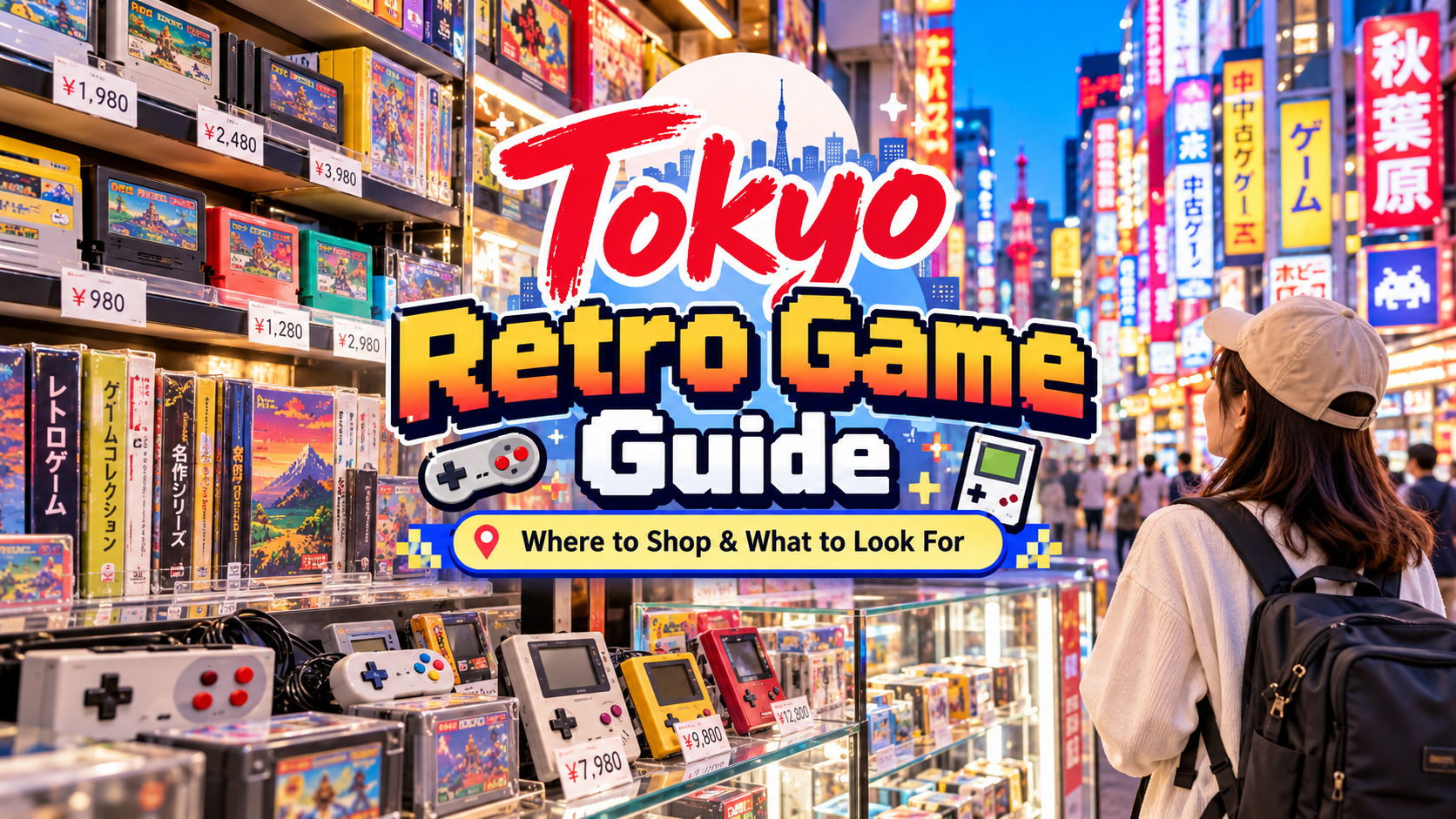
Tokyo is one of the best cities in the world for retro game shopping.
From classic Nintendo and Sega titles to old PlayStation games, cartridges, consoles, strategy guides, and game-related merchandise, Tokyo offers a wide range of places where collectors and casual visitors can search for older games.
However, retro game shopping in Tokyo is not as simple as visiting one famous store.
Prices can vary significantly, inventory changes constantly, Japanese versions of games may not work the same way as international versions, and the best area depends on whether you are looking for common games, rare collectibles, consoles, or simply a nostalgic browsing experience.
This guide explains where to shop for retro games in Tokyo, what to look for, how to compare stores, and what international visitors should know before buying Japanese games.
Why Shop for Retro Games in Tokyo?
Japan played a major role in the history of video games.
Companies such as Nintendo, Sega, Sony, Capcom, Konami, Namco, Square, and many others created games and hardware that became popular around the world.
As a result, Tokyo’s secondhand and specialty stores can contain decades of gaming history.
You may find:
- Famicom games
- Super Famicom games
- Nintendo 64 titles
- Game Boy games
- Game Boy Advance games
- Nintendo DS and 3DS games
- Sega Saturn games
- Dreamcast games
- Mega Drive titles
- PlayStation games
- PlayStation 2 games
- PSP games
- Older consoles
- Controllers
- Memory cards
- Strategy guides
- Soundtracks
- Game magazines
- Character merchandise
- Limited-edition products
For collectors, the appeal is obvious.
For casual travelers, simply browsing shelves filled with games from previous generations can be a fun experience.
Miruvia’s Take: Retro Game Shopping Is About the Search
The most important thing to understand is that retro game shopping in Tokyo is not only about finding the cheapest possible game.
The experience itself is part of the appeal.
You may discover:
- A Japanese version of a childhood favorite
- A console you have never seen in person
- Box art that differs from overseas releases
- Old gaming magazines
- Rare accessories
- Soundtracks
- Strategy books
- Limited-edition hardware
- Games from Japanese series that were never widely released abroad
Inventory changes frequently.
That means the best retro game shop on one trip may not have the same selection several months later.
Approach the experience as treasure hunting rather than guaranteed shopping.
Best Areas for Retro Game Shopping in Tokyo
Several parts of Tokyo are useful for retro game shopping.
The most important areas include:
- Akihabara
- Nakano
- Shinjuku
- Ikebukuro
- Other secondhand retail areas
Each area offers a different experience.
Akihabara
Akihabara is the most obvious starting point.
The district is famous for electronics, anime, manga, games, arcades, and pop culture.
For first-time visitors interested in retro games, Akihabara is usually the easiest place to begin because several relevant stores can be visited within the same area.
You may find:
- Retro game specialists
- Large secondhand chains
- Console stores
- Game merchandise
- Arcades
- Electronics shops
The main advantage is convenience.
You can compare multiple stores without traveling across Tokyo.
Two Retro Game Stores to Visit in Akihabara
If you want to shop for retro games in Tokyo, these two Akihabara stores are practical starting points.
1. Super Potato Akihabara
Super Potato is a well-known specialist store for Japanese retro video games, including Famicom, Super Famicom, Sega, PlayStation, and other classic systems.
The store occupies three floors, with games and consoles on the third and fourth floors and a retro arcade on the fifth floor. It is a particularly enjoyable stop for visitors who want to experience Japanese gaming nostalgia.
Address: Kitabayashi Building, 3F–5F, 1-11-2 Sotokanda, Chiyoda City, Tokyo.
Best for: Classic Nintendo and Sega games, vintage consoles, and retro arcade experiences.
2. SURUGA-YA Akihabara Game Store
SURUGA-YA is a Japanese secondhand retailer with a dedicated game store in Akihabara. The store relocated and reopened in September 2026 with an expanded selection.
You can browse retro and modern games, gaming magazines, strategy guides, soundtracks, and related collectibles.
Address: 2F, 3-15-4 Sotokanda, Chiyoda City, Tokyo.
Best for: Comparing secondhand games, exploring different console generations, and finding game-related collectibles.
Shopping tip: Visit both stores before making an expensive purchase. Prices and stock can differ, even for the same title. Check the stores’ official websites for current opening hours and locations before visiting.
Is Akihabara Always the Cheapest?
No.
Akihabara is convenient and famous, but famous tourist areas do not always offer the lowest prices.
Popular retro games and collectible items may carry higher prices, especially in stores that attract many international visitors.
Do not assume the first store you enter has the best deal.
If you are buying something expensive, compare several stores.
Nakano Broadway
Nakano Broadway is another useful destination for collectors.
It is better known for anime, manga, toys, and vintage collectibles, but retro gaming items can also appear in specialist stores.
Nakano is particularly interesting for travelers who enjoy broader collecting.
You may find games alongside:
- Vintage toys
- Figures
- Manga
- Trading cards
- Pop-culture memorabilia
- Older Japanese media
The selection is less predictable than Akihabara, which can make the search more interesting.
Shinjuku
Shinjuku is not primarily known as a retro gaming district, but large secondhand retailers and electronics stores can make it useful.
This is especially convenient if you are already staying in or visiting Shinjuku.
You may find older games mixed with modern consoles, CDs, DVDs, books, and electronics.
Shinjuku is better suited to opportunistic browsing than a dedicated retro gaming trip.
Ikebukuro
Ikebukuro is primarily associated with anime, character goods, manga, and modern pop culture.
However, secondhand chains and entertainment stores may also carry games.
It is worth checking if you are already exploring the area.
For a dedicated retro game day, Akihabara is usually stronger.
For a mixed anime and game-shopping day, Ikebukuro can work well.
Should You Visit More Than One Area?
Yes, if you are searching for something specific or expensive.
Different areas can have different inventory and pricing.
For casual visitors, one area may be enough.
For collectors, comparing Akihabara with Nakano can be worthwhile.
What Retro Games Can You Buy in Tokyo?
The selection depends heavily on the store.
Some shops focus on mainstream Nintendo and PlayStation titles.
Others may carry more specialized products.
Common categories include:
- Cartridge games
- Disc-based games
- Handheld games
- Consoles
- Accessories
- Controllers
- Boxed games
- Loose cartridges
- Strategy guides
- Game soundtracks
- Limited-edition products
Availability changes constantly.
Famicom Games
The Famicom was the Japanese version of the Nintendo Entertainment System.
Famicom cartridges are visually distinctive and are often inexpensive compared with some other retro systems.
Travelers may recognize Japanese versions of internationally famous games.
Collectors may also find titles that were never released outside Japan.
Super Famicom Games
The Super Famicom corresponds to the Super Nintendo era.
Japanese Super Famicom games can often be cheaper than equivalent North American or European versions.
Popular categories include:
- RPGs
- Platformers
- Fighting games
- Racing games
- Action games
Some games may require Japanese language ability.
Others are relatively easy to play without reading much text.
Nintendo 64
Japanese Nintendo 64 games are also common in retro shops.
Collectors may find:
- Loose cartridges
- Boxed games
- Controllers
- Accessories
- Limited colors
Compatibility can be an important issue, so check your hardware before buying.
Game Boy and Game Boy Advance
Handheld games are particularly easy for travelers to pack.
You may find:
- Game Boy
- Game Boy Color
- Game Boy Advance
Loose cartridges are often easier to find than complete boxed copies.
Collectors interested in original packaging should expect higher prices.
Nintendo DS and 3DS
DS and 3DS games are now becoming part of the retro and collector market.
These systems are particularly important for international buyers because region restrictions can vary.
Check compatibility before purchasing.
Sega Systems
Tokyo can be an excellent place to explore older Sega hardware and games.
Possible systems include:
- Mega Drive
- Sega Saturn
- Dreamcast
- Game Gear
Sega products can be especially interesting for collectors because many Japanese releases differ from their overseas versions.
PlayStation
Older PlayStation systems are extremely important to Japanese gaming history.
You may find games from:
- PlayStation
- PlayStation 2
- PlayStation 3
- PSP
- PS Vita
Many older Japanese RPGs, fighting games, and niche titles can still be found secondhand.
Japanese Versions vs International Versions
This is one of the most important issues for travelers.
A Japanese copy of a game may differ from the version sold in your home country.
Differences may include:
- Language
- Packaging
- Region compatibility
- Content
- Voice acting
- Censorship
- Release date
- Bonus materials
Do not buy only because the cover looks familiar.
Confirm what version you are purchasing.
Region Locking
Some older consoles and games are region-locked.
This means a Japanese game may not work on a console from another region.
Region restrictions depend on the system.
Before buying, confirm:
- Your console model
- Your console region
- The game’s region
- Whether an adapter or modification is required
This is especially important for collectors who actually intend to play the games rather than simply display them.
Language Considerations
Many Japanese games are only available in Japanese.
This matters most for text-heavy genres.
Games that may require more Japanese ability include:
- RPGs
- Visual novels
- Adventure games
- Simulation games
- Strategy games
Games that may be easier without Japanese include:
- Fighting games
- Racing games
- Puzzle games
- Action games
- Platformers
Check gameplay videos or language information before purchasing unfamiliar titles.
Loose vs Boxed Games
Retro games are commonly sold in different conditions.
You may encounter:
Loose: Game only, without original packaging.
Boxed: Includes the original box.
Complete: May include the box, manual, inserts, and other original materials.
Collectors usually value complete copies more highly.
Casual players may prefer cheaper loose versions.
Condition Matters
Condition can dramatically affect price.
Check:
- Cartridge label
- Disc scratches
- Box damage
- Manual condition
- Missing inserts
- Yellowing
- Fading
- Writing or stickers
- Corrosion
- Battery condition where relevant
Japanese secondhand stores often provide condition notes.
Use them.
What Does “Junk” Mean?
You may encounter products labeled as “junk.”
This does not necessarily mean literal trash.
In Japanese secondhand stores, “junk” generally means the item is sold without normal guarantees.
It may:
- Be untested
- Have cosmetic damage
- Be incomplete
- Need repair
- Have unknown functionality
Junk sections can be interesting for experienced collectors, but they are risky for travelers who cannot test or repair hardware.
Consoles
Tokyo stores may also sell older consoles.
Possible finds include:
- Famicom
- Super Famicom
- Nintendo 64
- GameCube
- Game Boy systems
- Sega Saturn
- Dreamcast
- PlayStation systems
- PSP
- PS Vita
Before buying hardware, consider:
- Region compatibility
- Voltage
- Power supply
- Cables
- Controller availability
- Condition
- Weight
- Luggage space
A cheap console can become inconvenient if you need several additional accessories.
Voltage and Power
Japanese electronics operate on Japanese electrical standards.
Some retro consoles may require additional consideration when used abroad.
Depending on your destination country, you may need:
- Plug adapters
- Voltage converters
- Replacement power supplies
Research your specific console before buying.
Controllers and Accessories
Retro accessories can sometimes be more interesting than games.
You may find:
- Original controllers
- Memory cards
- Multitaps
- Link cables
- Light guns
- Handheld accessories
- Carrying cases
- Replacement parts
Some accessories may be difficult to find outside Japan.
Strategy Guides
Japanese strategy guides can be excellent collectibles.
Even if you cannot read Japanese, they often contain:
- Maps
- Artwork
- Character illustrations
- Screenshots
- Item lists
- Developer information
Older guidebooks can also offer a nostalgic look at Japanese gaming culture.
Game Soundtracks
Video game music is a major part of Japanese gaming culture.
Secondhand stores may carry soundtrack CDs from:
- RPGs
- Fighting games
- Anime games
- Arcade titles
- Classic franchises
Some soundtracks have become collectible items.
Gaming Magazines
Old Japanese gaming magazines can also be interesting souvenirs.
They may contain:
- Reviews
- Advertisements
- Early screenshots
- Developer interviews
- Strategy information
- Artwork
For gaming-history enthusiasts, these can be more interesting than the games themselves.
Game Merchandise
Retro gaming stores may also sell:
- Keychains
- Posters
- Plush toys
- Figures
- Pins
- T-shirts
- Promotional items
- Store displays
These can be easier to use as souvenirs than original hardware.
Rare Games
Rare games can be expensive.
Before buying:
- Compare multiple stores
- Check condition
- Confirm authenticity
- Understand the market price
- Confirm the correct version
- Think about whether you truly want it
A high price does not automatically mean an item is rare or fairly priced.
How Much Do Retro Games Cost in Tokyo?
Prices vary widely.
Common loose cartridges may be inexpensive.
Boxed classics, cult titles, rare editions, or limited hardware can cost significantly more.
A practical budget might look like this:
Casual browsing: Small purchases and common games.
Collector shopping: Multiple boxed games, accessories, or specialist items.
High-end collecting: Rare games, complete-in-box copies, limited consoles, or highly sought-after merchandise.
Set a budget before entering several stores.
Compare Prices
If an item costs more than you expected, photograph or note the product name and compare prices elsewhere.
For high-value purchases, check:
- Condition
- Completeness
- Edition
- Price
- Return policy
- Tax-free eligibility
Do not rush unless the item is genuinely difficult to find.
Tax-Free Shopping
Some stores offer tax-free shopping to eligible international visitors.
Bring your passport if you plan to make larger purchases.
Rules can vary by store.
Look for tax-free signs and confirm the procedure before paying.
Cash or Card?
Cards are widely accepted in many major stores.
However, smaller or specialist shops may have different policies.
Carrying some Japanese yen is useful.
A combination of cash and card provides the most flexibility.
Can You Test Games Before Buying?
Usually not.
Some stores test hardware internally or provide condition ratings, but customers may not always be able to test products.
This is why store reputation and condition labels matter.
For expensive hardware, ask staff if functionality has been confirmed.
Should You Buy Hardware as a Souvenir?
Only if you have a clear reason.
Retro consoles can be fun souvenirs, but they also create practical problems.
Consider:
- Weight
- Luggage space
- Cables
- Power
- Region compatibility
- Repairs
- Storage at home
For many travelers, games or smaller accessories are easier purchases.
Best Time of Day for Retro Game Shopping
Late morning through afternoon is generally the most practical time.
This gives you enough time to compare several stores.
If you arrive late in the evening, you may rush through shops.
For serious shopping, start earlier.
Weekdays vs Weekends
Weekdays are usually more comfortable.
Benefits include:
- Less crowded stores
- Easier browsing
- More time at display cases
- Less pressure when comparing products
Weekends can still be enjoyable but may feel busier, especially in Akihabara.
How Long Should You Spend?
For casual travelers:
1–2 hours: Quick Akihabara browsing.
2–4 hours: Visit multiple stores and compare prices.
Half a day: Serious retro game shopping.
Full day: Combine retro gaming with anime, arcades, electronics, and other pop-culture stops.
Collectors can easily spend longer than expected.
Akihabara vs Nakano Broadway for Retro Games
These areas offer different experiences.
Choose Akihabara if you want:
- More game-focused shops
- Easy store comparison
- Electronics
- Arcades
- Modern and retro games
- A classic Tokyo gaming atmosphere
Choose Nakano Broadway if you want:
- Broader collecting
- Vintage merchandise
- Toys
- Anime collectibles
- More unpredictable finds
- Treasure-hunting atmosphere
For most first-time retro game shoppers, Akihabara is the better starting point.
For collectors, visiting both is worthwhile.
Retro Games vs Anime Shopping
These interests overlap, but not completely.
Anime shops may carry game-related merchandise.
Game shops may carry anime-related titles.
However, travelers focused specifically on retro hardware and software should prioritize stores with clear gaming sections rather than only general character shops.
First-Time Visitors: What Should You Prioritize?
A simple first-time strategy is:
- Start in Akihabara
- Visit several different stores
- Compare common game prices
- Look at Japanese packaging
- Check compatibility before buying
- Buy small items first
- Return for expensive items later
This reduces impulsive mistakes.
Serious Collectors: Go Beyond the Famous Stores
Well-known stores are convenient, but serious collectors should explore smaller secondhand shops too.
Look at:
- Upper floors
- Side streets
- Junk sections
- Specialist stores
- Less tourist-oriented shops
Rare or unusual items may appear outside the most famous retail locations.
Common Retro Game Shopping Mistakes
Buying Without Checking Region Compatibility
A game may not work on your console.
Ignoring Language
A text-heavy Japanese game may be difficult to play.
Assuming Akihabara Is Always Cheapest
Convenience and popularity can affect prices.
Buying Hardware Without Checking Voltage
Power issues can create problems at home.
Ignoring Condition Notes
Small differences can significantly affect collector value.
Buying Large Items Too Early in the Trip
Consoles and boxed games take up luggage space.
Focusing Only on Famous Games
Less famous Japanese titles can be some of the most interesting discoveries.
Packing Retro Games
Cartridges are generally easy to pack.
Disc cases and boxed games require more care.
Useful tips:
- Protect cardboard boxes
- Avoid crushing manuals
- Keep fragile items in hand luggage when practical
- Use clothing as padding
- Avoid excessive moisture
- Photograph expensive items before packing
Collector-grade boxes can lose value if damaged during travel.
Customs and Import Rules
Personal-use video games are generally straightforward to travel with, but large or expensive purchases may be subject to customs regulations in your home country.
Check local import rules if you buy high-value items.
A Simple Retro Game Shopping Itinerary
Step 1: Arrive in Akihabara
Begin with the main shopping streets.
Step 2: Visit a Large Secondhand Store
Use this to understand general pricing.
Step 3: Visit Specialist Game Shops
Compare inventory and condition.
Step 4: Browse Side Streets and Upper Floors
Do not stay only on the main street.
Step 5: Take a Break
Retro shopping can become surprisingly tiring.
Step 6: Return to the Best Store
Buy expensive items only after comparing alternatives.
Step 7: Add an Arcade or Game-Themed Stop
Finish the day with a gaming experience rather than only shopping.
Should You Add Nakano Broadway?
Yes, if you have more time.
Nakano Broadway is especially useful for people who also enjoy:
- Anime
- Manga
- Vintage toys
- Character goods
- Collectibles
It offers a different atmosphere from Akihabara and can reveal unusual items.
Is Retro Game Shopping Good for Repeat Tokyo Visitors?
Very much so.
Repeat visitors often enjoy niche experiences more than major attractions.
Retro game shopping is ideal because inventory changes over time.
A store you visited on a previous trip may offer completely different items on your next visit.
Is Retro Game Shopping Good for Non-Gamers?
Potentially.
Even non-gamers may enjoy:
- Nostalgic design
- Colorful box art
- Old electronics
- Gaming history
- Japanese pop culture
However, people with no interest in games may find specialist stores less engaging.
Frequently Asked Questions
Where is the best place to buy retro games in Tokyo?
Akihabara is the easiest starting point because multiple game and secondhand stores are concentrated in one area.
Are retro games cheap in Tokyo?
Some common Japanese games are inexpensive, but rare and collectible titles can be expensive.
Can Japanese retro games work on overseas consoles?
Sometimes, but not always. Region compatibility depends on the console and game.
Are Japanese games only in Japanese?
Many are. Language support varies by title.
Is Nakano Broadway good for retro games?
Yes, especially as part of broader collectible shopping, though Akihabara generally offers more concentrated game shopping.
Should I buy a retro console in Japan?
Only after checking region compatibility, power requirements, condition, and luggage space.
Can I find Nintendo games in Tokyo?
Yes. Famicom, Super Famicom, Nintendo 64, Game Boy, DS, and other Nintendo products are commonly found in secondhand stores.
Can I find Sega games?
Yes. Mega Drive, Sega Saturn, Dreamcast, and other Sega products can appear in retro game stores.
Are secondhand games reliable?
Many Japanese secondhand stores inspect products carefully, but condition varies. Always check store notes and guarantees.
Should I visit Akihabara and Nakano Broadway?
Yes, especially if you are a collector. They offer different shopping experiences.
Final Thoughts
Tokyo is an excellent destination for anyone interested in retro games.
The city offers much more than old cartridges.
You can explore decades of Japanese gaming history through consoles, magazines, soundtracks, strategy guides, accessories, and collectible merchandise.
Akihabara is the easiest place to start.
Nakano Broadway adds a more unpredictable, collector-oriented experience.
The best approach is not to rush.
Compare stores, check compatibility, understand condition labels, and leave room in your luggage.
Retro game shopping in Tokyo is most enjoyable when you treat it as exploration.
You may not find exactly what you expected.
But you may find something far more interesting.
