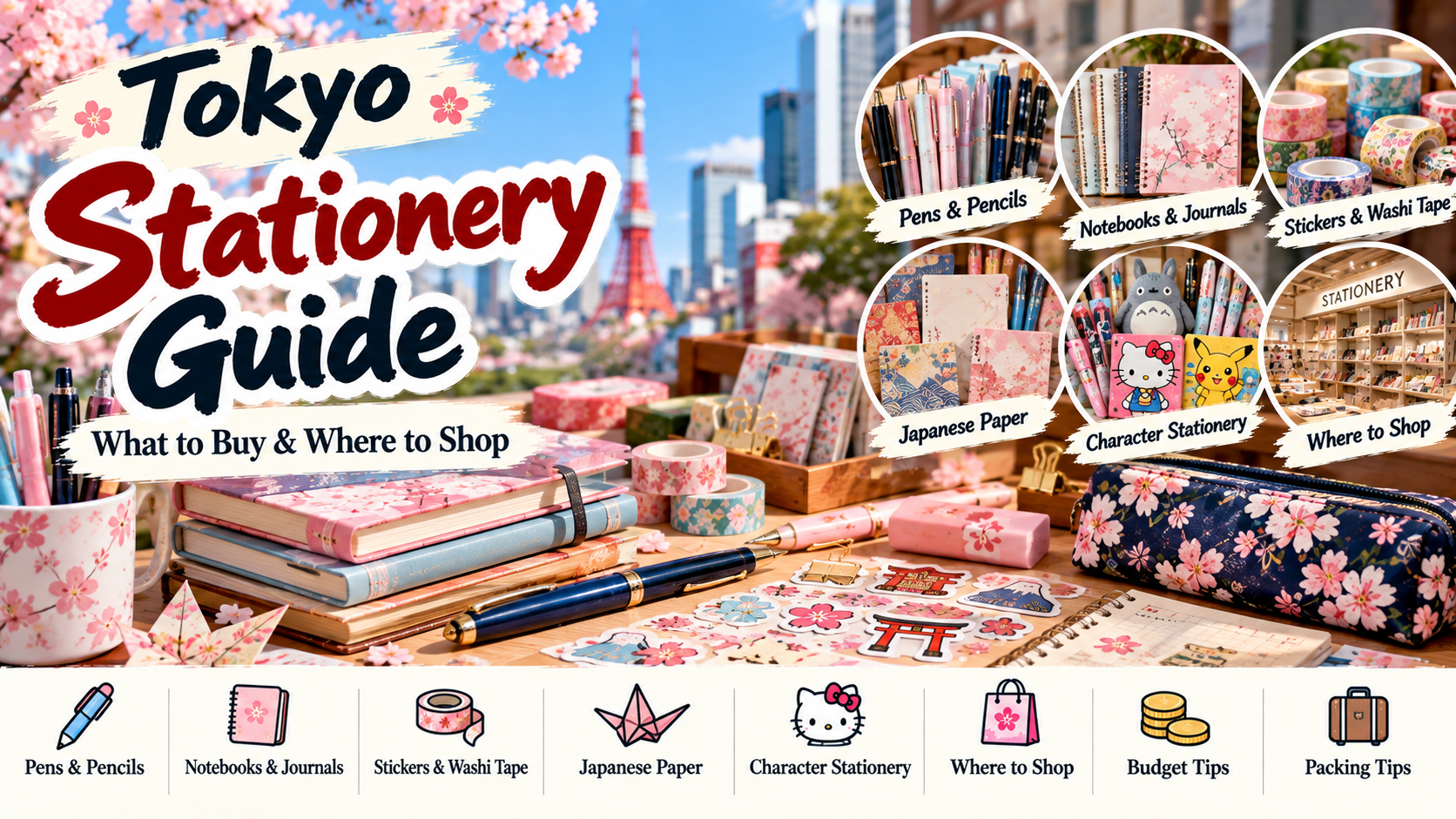
Tokyo is one of the most exciting cities in the world for stationery lovers.
Japanese stationery is known for combining practical design, attention to detail and an enormous variety of products. Even something as simple as choosing a pen or notebook can become part of the travel experience.
But the selection can also be overwhelming.
Which Japanese stationery is actually worth buying? What makes Japanese pens and notebooks different? What should you choose as a souvenir? And where should you look if you are a casual shopper rather than a serious stationery enthusiast?
This guide explains what stationery to buy in Tokyo, how to choose it, and how to make stationery shopping fit naturally into your trip.
Why Buy Stationery in Tokyo?
Stationery is particularly convenient for travelers because it combines several advantages.
It is usually:
- Lightweight
- Compact
- Easy to pack
- Available at many price points
- Practical after returning home
- Suitable as a souvenir
- Easy to browse without speaking much Japanese
You can spend a small amount on a useful pen or build an entire shopping trip around specialist notebooks, paper products and writing tools.
That flexibility makes stationery one of Tokyo’s most accessible shopping experiences.
Miruvia’s Take
You do not need to be a stationery enthusiast to enjoy stationery shopping in Tokyo.
For most first-time visitors, the appeal is simple: ordinary objects such as pens, notebooks and stickers often offer far more choice than expected.
Start with products you already use at home rather than trying to understand every stationery category at once.
What Stationery Should You Buy in Tokyo?
There is no single must-buy item.
The best choice depends on whether you want something practical, collectible, giftable or connected to Japanese design.
The following categories are good places to start.
Japanese Pens
Pens are one of the easiest stationery products to buy in Tokyo.
You may encounter many types, including:
- Gel pens
- Ballpoint pens
- Fineliners
- Brush pens
- Multi-color pens
- Erasable pens
- Fountain pens
Even within one category, differences in tip size, ink color, body design and writing feel can be significant.
What Should First-Time Visitors Look For?
If you are not already a pen enthusiast, focus on three things:
- How the pen feels in your hand
- The line thickness
- Whether you will realistically use it at home
It is easy to buy too many inexpensive pens simply because the selection is large.
Testing a few carefully can be more rewarding than filling a basket immediately.
Mechanical Pencils
Mechanical pencils are another strong Japanese stationery category.
You may find models designed for:
- Everyday writing
- Technical drawing
- Students
- Long writing sessions
- Precise drafting
Differences can include grip design, weight, lead size and mechanisms intended to improve writing consistency.
For travelers who regularly use pencils for study, work or drawing, a mechanical pencil can be a practical souvenir rather than a decorative one.
Fountain Pens
Fountain pens occupy the more premium side of stationery shopping.
Tokyo can be particularly interesting for travelers who already enjoy writing instruments and want to compare:
- Nib sizes
- Body designs
- Ink systems
- Writing feel
- Different price ranges
A fountain pen can become a memorable personal souvenir, but beginners should not feel obligated to buy an expensive model.
Miruvia’s Take
If you have never used a fountain pen, Tokyo is a good place to explore them, but not necessarily a reason to purchase the most expensive one.
Try different writing styles first.
A pen you genuinely enjoy using is a better souvenir than one purchased only because it looks premium.
Japanese Notebooks
Notebooks are another major category.
Travelers may encounter differences in:
- Paper texture
- Paper thickness
- Binding
- Page layout
- Size
- Cover design
- Compatibility with different inks
Common layouts include:
- Blank
- Lined
- Grid
- Dot grid
The right notebook depends heavily on how you plan to use it.
A compact notebook may be ideal for travel notes, while a larger grid notebook may suit planning, study or illustration.
Travel Journals
A notebook can become part of the trip itself.
Instead of waiting until you return home, consider buying one near the beginning of your Tokyo visit and using it as a travel journal.
You can add:
- Daily notes
- Small sketches
- Tickets
- Stickers
- Stamps
- Receipts
- Restaurant names
- Places you want to remember
This turns stationery shopping into an experience rather than simply another purchase.
Planners and Diaries
Japanese planners can attract travelers because of their detailed layouts and organizational formats.
However, planners require more careful consideration than ordinary notebooks.
Before buying, check:
- Calendar year
- Start month
- Page format
- Language
- Size
- Whether dates are already printed
A beautifully designed planner is not useful if its layout does not fit the way you actually organize your life.
Stickers
Stickers are among the easiest small stationery souvenirs.
They are:
- Lightweight
- Inexpensive
- Easy to distribute
- Available in many styles
- Useful for journals and planners
Designs may include:
- Food
- Animals
- Japanese motifs
- Characters
- Seasonal themes
- Travel
- Decorative patterns
They can be particularly useful when you need several inexpensive gifts.
Washi Tape
Decorative masking tape, often called washi tape, is another popular stationery category.
It can be used for:
- Journaling
- Scrapbooking
- Gift wrapping
- Decorating notebooks
- Craft projects
Because rolls are small, travelers can easily carry several designs without using much luggage space.
Who Is Washi Tape Best For?
It works particularly well for:
- Journal enthusiasts
- Craft lovers
- Students
- Children
- People who enjoy decorative stationery
If the recipient does not use stationery or crafts, however, a practical pen may be a safer gift.
Japanese Paper Products
Travelers interested in traditional design may want to explore Japanese paper products.
Depending on the store, these can include:
- Letter paper
- Envelopes
- Cards
- Decorative paper
- Origami paper
- Traditional-pattern notebooks
- Gift wrapping materials
Paper products can offer a connection to Japanese aesthetics without requiring a large budget.
They are also generally easy to pack flat inside luggage.
Letter Sets and Postcards
Letter sets can make elegant small gifts.
Postcards are even simpler.
Instead of taking every postcard home, consider writing one during your trip and sending it from Japan.
This creates a different kind of souvenir: one connected to the actual journey rather than something simply purchased and packed.
Stamps and Ink
Stamp-related stationery can be interesting for travelers who enjoy journaling, crafts or illustration.
Products may include:
- Rubber stamps
- Decorative stamps
- Ink pads
- Small stamp sets
- Date stamps
These can become highly collectible, so it helps to decide how you plan to use them before purchasing several sets.
Calligraphy and Brush Pens
Travelers interested in Japanese writing or art may encounter:
- Brush pens
- Calligraphy brushes
- Ink
- Practice paper
- Calligraphy accessories
Brush pens are generally easier for travelers to transport than traditional liquid ink and larger calligraphy equipment.
They can also be used for drawing and illustration, not only Japanese calligraphy.
Erasers and Small Accessories
Small stationery accessories are easy to overlook.
Examples include:
- Erasers
- Pencil sharpeners
- Rulers
- Clips
- Sticky notes
- Page markers
- Pencil cases
- Pen holders
These products can be inexpensive but surprisingly useful.
They also make good additions when you want a small gift rather than a major souvenir.
Pencil Cases and Pouches
A pencil case can be a practical souvenir that continues to be useful after the trip.
Look at:
- Capacity
- Number of compartments
- Material
- Weight
- How easily it fits in a bag
Some designs prioritize minimal size, while others are intended to organize a large collection of writing tools.
Choose based on how the recipient actually uses stationery.
Japanese Stationery as Souvenirs
Stationery works particularly well as a souvenir because it avoids many of the problems associated with food or fragile products.
It usually does not have:
- Expiration dates
- Refrigeration requirements
- Significant weight
- High breakage risk
Good stationery souvenirs include:
- Pens
- Small notebooks
- Stickers
- Washi tape
- Letter sets
- Pencil cases
- Traditional-pattern paper products
For a broader look at gift ideas beyond stationery, see our Tokyo Souvenir Guide.
Stationery for Coworkers
If you need small gifts for coworkers, consider practical and inexpensive products.
Examples include:
- Pens
- Sticky notes
- Small notebooks
- Page markers
These are easy to distribute and do not require knowing someone’s food preferences.
Stationery for Children
Possible options include:
- Stickers
- Erasers
- Colorful pens
- Small notebooks
- Character stationery
Check age suitability where necessary, particularly for products with small components.
Stationery for Artists and Designers
Travelers with creative interests may want to spend more time exploring:
- Drawing pens
- Markers
- Brush pens
- Specialty paper
- Sketchbooks
- Cutting tools
- Design accessories
For these shoppers, stationery shopping can easily become a major part of a Tokyo itinerary rather than a quick souvenir stop.
Miruvia’s Take
If stationery is one of your main interests, allow enough time to test and compare products.
If it is not, do the opposite.
Give yourself a clear shopping window so a huge stationery floor does not unexpectedly consume half your sightseeing day.
Stationery for Journal Lovers
Journal enthusiasts may particularly enjoy combining:
- Notebooks
- Washi tape
- Stickers
- Stamps
- Colored pens
- Page markers
Tokyo offers enough variety that it is easy to buy products that do essentially the same job.
Think in terms of a complete journaling setup rather than collecting every attractive item individually.
Character Stationery
Character stationery is widely appealing because it combines practical products with entertainment merchandise.
Depending on the store, you may find:
- Pens
- Notebooks
- Stickers
- Pencil cases
- Memo pads
- Folders
For dedicated anime and manga shopping beyond stationery, see our Tokyo Anime & Manga Guide.
Traditional-Style Stationery
Not all Japanese stationery has a modern or character-focused design.
Travelers may also find products inspired by:
- Traditional patterns
- Japanese nature
- Seasonal motifs
- Ukiyo-e-style artwork
- Calligraphy
- Washi paper
These can work particularly well when you want a gift that feels distinctly connected to Japan without buying a conventional tourist souvenir.
Where to Buy Stationery in Tokyo
The best place depends on how deeply you want to explore the category.
A casual shopper and a serious pen collector do not necessarily need the same type of store.
Large Stationery Stores
Dedicated stationery stores are ideal when you want the broadest selection.
They may offer multiple floors or departments covering:
- Pens
- Pencils
- Notebooks
- Paper
- Art supplies
- Office products
- Journaling
- Premium writing instruments
These are best for travelers who want stationery shopping to be an activity in itself.
Lifestyle Stores
Large lifestyle stores are useful for casual shoppers.
They often combine stationery with:
- Household products
- Travel accessories
- Beauty items
- Bags
- Gifts
- Design goods
This makes them practical when people in your group have different shopping interests.
Department Stores
Department stores may be useful for:
- Premium pens
- Gift items
- Traditional paper products
- Higher-end stationery
- Well-presented gifts
They are particularly convenient if you are already shopping for food, cosmetics or fashion in the same building.
Bookstores
Large bookstores sometimes include substantial stationery sections.
This can be useful if you are interested in both:
- Books and magazines
- Notebooks
- Pens
- Journals
- Reading accessories
For travelers who enjoy books, Tokyo’s bookstore culture can be worth exploring beyond stationery alone.
Our Jimbocho Tokyo Guide introduces one of the city’s best-known areas for bookstores and book culture.
Variety Stores
Variety stores can be useful for inexpensive and playful stationery.
The selection may include:
- Stickers
- Pens
- Small notebooks
- Character products
- Desk accessories
These stores are useful for casual browsing but may offer less depth than specialist stationery retailers.
100-Yen and Budget Stores
Budget stores can be interesting for inexpensive stationery.
You may find:
- Pens
- Notebooks
- Sticky notes
- Stickers
- Folders
- Basic craft supplies
Quality and selection vary, so choose products based on usefulness rather than buying simply because they are inexpensive.
Should You Visit a Specialist Stationery Store?
For most travelers, it depends on interest level.
Visit One If:
- You already love stationery.
- You want specific Japanese pens or notebooks.
- You enjoy journaling.
- You are interested in art supplies.
- You want stationery shopping to be part of your Tokyo experience.
You May Not Need One If:
- You only want one or two souvenirs.
- You have limited time.
- Stationery is not a major interest.
- You are already visiting large shopping areas with general stores.
Miruvia’s Take
Do not cross Tokyo just to buy an ordinary pen that is available in many major shopping districts.
Special trips make sense for specialist interests, limited products or the experience of visiting a particular store.
For casual shopping, integrate stationery into places already on your itinerary.
How Much Does Stationery Cost in Tokyo?
Stationery can fit almost any shopping budget.
Budget Purchases
Examples include:
- Individual pens
- Erasers
- Stickers
- Sticky notes
- Simple notebooks
These are useful for small gifts or casual purchases.
Mid-Range Purchases
Examples include:
- Better notebooks
- Pencil cases
- Pen sets
- Journaling products
- Higher-quality mechanical pencils
Premium Purchases
Examples include:
- Fountain pens
- Premium notebooks
- Leather stationery accessories
- Specialty writing tools
The important point is that price does not automatically determine usefulness.
An inexpensive pen you use every day may become a better souvenir than a premium item left in a drawer.
Can You Test Pens Before Buying?
Some stationery retailers provide sample pens or testing areas for certain products.
If testing is available, use it.
Compare:
- Line thickness
- Ink flow
- Grip
- Weight
- Writing resistance
Do not test products that are clearly packaged for sale unless the store provides a designated sample.
How to Choose a Japanese Pen
A simple decision process is:
- Decide what you will use it for.
- Choose your preferred line thickness.
- Test the grip if possible.
- Compare writing feel.
- Check refill availability if that matters to you.
- Buy one or two before purchasing many variations.
This prevents a common stationery-shopping problem: buying several similar pens without knowing which one you actually prefer.
How to Choose a Japanese Notebook
Consider:
- Purpose
- Size
- Weight
- Page layout
- Paper
- Binding
- Number of pages
For travel, portability matters.
For use at home, paper quality and layout may be more important.
If you use fountain pens or specific inks, paper compatibility may also influence your choice.
How Much Time Should You Spend Stationery Shopping?
For casual visitors:
30–60 minutes can be enough.
For people who enjoy stationery:
1–2 hours can disappear surprisingly quickly.
For serious enthusiasts visiting a large specialist retailer:
A stationery store can become a destination in itself.
Miruvia’s Take
Decide which type of shopper you are before entering.
Tokyo rewards deep browsing, but time is one of the most limited resources on a first trip.
First-Time Visitors vs Stationery Enthusiasts
First-Time Visitors
Focus on accessible products such as:
- Pens
- Notebooks
- Stickers
- Washi tape
- Small paper goods
These give you a good introduction without requiring specialist knowledge.
Stationery Enthusiasts
You may want to explore:
- Premium writing instruments
- Fountain pen inks
- Specialty paper
- Mechanical pencils
- Limited designs
- Journaling systems
- Art supplies
The goal is different.
First-time casual shoppers benefit from variety. Enthusiasts benefit from depth.
When Should You Buy Stationery During Your Trip?
Stationery is easier to transport than many souvenirs, so timing is flexible.
However, there are advantages to shopping earlier.
If you buy a notebook, stickers or pens near the beginning of the trip, you can actually use them while traveling.
For general gifts, buying later can reduce how long you need to carry them.
A useful strategy is:
- Early trip: buy travel-journal items.
- During sightseeing: browse interesting stores naturally.
- Final days: buy gifts and products you decided you still want.
How to Avoid Buying Too Much Stationery
Stationery products are often individually inexpensive.
That makes overspending surprisingly easy.
Use these rules:
- Do not buy five products that perform the same function.
- Test pens before buying several versions.
- Think about how many notebooks you already own.
- Choose gifts for specific people.
- Set a rough budget.
- Carry a small shopping list.
Miruvia’s Take
The biggest stationery-shopping risk is not one expensive purchase.
It is twenty inexpensive purchases.
Small items accumulate quickly in both cost and luggage.
Stationery vs Other Tokyo Souvenirs
Stationery is particularly strong when compared with other souvenir categories because it is practical and portable.
Stationery vs Food
Stationery has no expiration date and usually creates fewer customs concerns.
Food may feel more immediately connected to Japanese flavors.
Stationery vs Traditional Crafts
Stationery is usually cheaper and easier to transport.
Traditional crafts may feel more distinctive or special.
Stationery vs Character Goods
Stationery can suit almost anyone.
Character goods work better when you know the recipient’s interests.
For a broader comparison of souvenir categories, see our Tokyo Souvenir Guide.
How Stationery Shopping Fits Into a Tokyo Trip
Stationery shopping works best when connected to your existing itinerary.
If you are already visiting a major commercial district, look for stationery there rather than creating unnecessary journeys across the city.
For broader shopping planning, see our Tokyo Shopping Guide.
If your priority is gifts for friends, family or coworkers, our Tokyo Souvenir Guide provides a wider range of ideas beyond stationery.
Book lovers may also enjoy combining stationery shopping with the bookstores and literary atmosphere covered in our Jimbocho Tokyo Guide.
The best Tokyo shopping experiences usually happen when the products match your actual interests rather than a generic checklist.
A Simple First-Time Tokyo Stationery Strategy
Use this process:
- Decide whether you want stationery for yourself, gifts or both.
- Set a rough budget.
- Start with pens and notebooks you already understand.
- Test writing tools when samples are available.
- Add one or two uniquely Japanese paper products or designs.
- Choose lightweight items for gifts.
- Avoid buying multiple products that serve the same purpose.
- Combine stationery shopping with areas already on your itinerary.
- Leave specialist products for stores where you can compare them properly.
- Use something you bought during the trip.
The final step matters.
Using a Tokyo notebook or pen while you are still in Japan turns it from merchandise into part of your travel experience.
Frequently Asked Questions
Is Japanese stationery worth buying in Tokyo?
Yes, especially if you enjoy writing, journaling, drawing or practical design. Tokyo offers a broad range of stationery across many price points.
What stationery should I buy in Japan?
Pens, notebooks, mechanical pencils, stickers, washi tape and Japanese paper products are accessible choices for first-time shoppers.
Is stationery a good souvenir from Tokyo?
Yes. It is generally lightweight, practical and easy to pack, making it particularly convenient for international travelers.
What Japanese stationery is good for coworkers?
Pens, sticky notes, page markers and small notebooks are simple, practical options.
What should stationery lovers look for in Tokyo?
Stationery enthusiasts may want to explore premium pens, specialty notebooks, mechanical pencils, fountain pen inks, paper products, journaling tools and art supplies.
Can I buy inexpensive stationery in Tokyo?
Yes. Tokyo has stationery across a wide range of price points, including products at budget and variety stores.
Should I visit a specialist stationery store?
Yes if stationery is a major interest. Casual shoppers can usually find plenty of options in major shopping districts without making a dedicated trip.
Is Japanese stationery easy to pack?
Most stationery is compact and lightweight. Flat notebooks, pens, stickers and paper products are especially easy to transport.
Final Thoughts
Tokyo stationery shopping can be as simple or as deep as you want it to be.
A first-time visitor might leave with a good pen, a compact notebook and a few stickers. A dedicated stationery enthusiast could spend hours comparing paper, mechanical pencils, fountain pens and journaling tools.
Neither approach is better.
The key is to buy stationery that fits how you actually write, work, study or create.
Start with familiar products, test what you can, avoid buying duplicates simply because they are inexpensive, and integrate shopping into places you already plan to visit.
And if you buy a notebook or pen for yourself, use it before leaving Tokyo.
A few pages filled during the journey can turn an ordinary stationery purchase into one of the most personal souvenirs from your trip.
