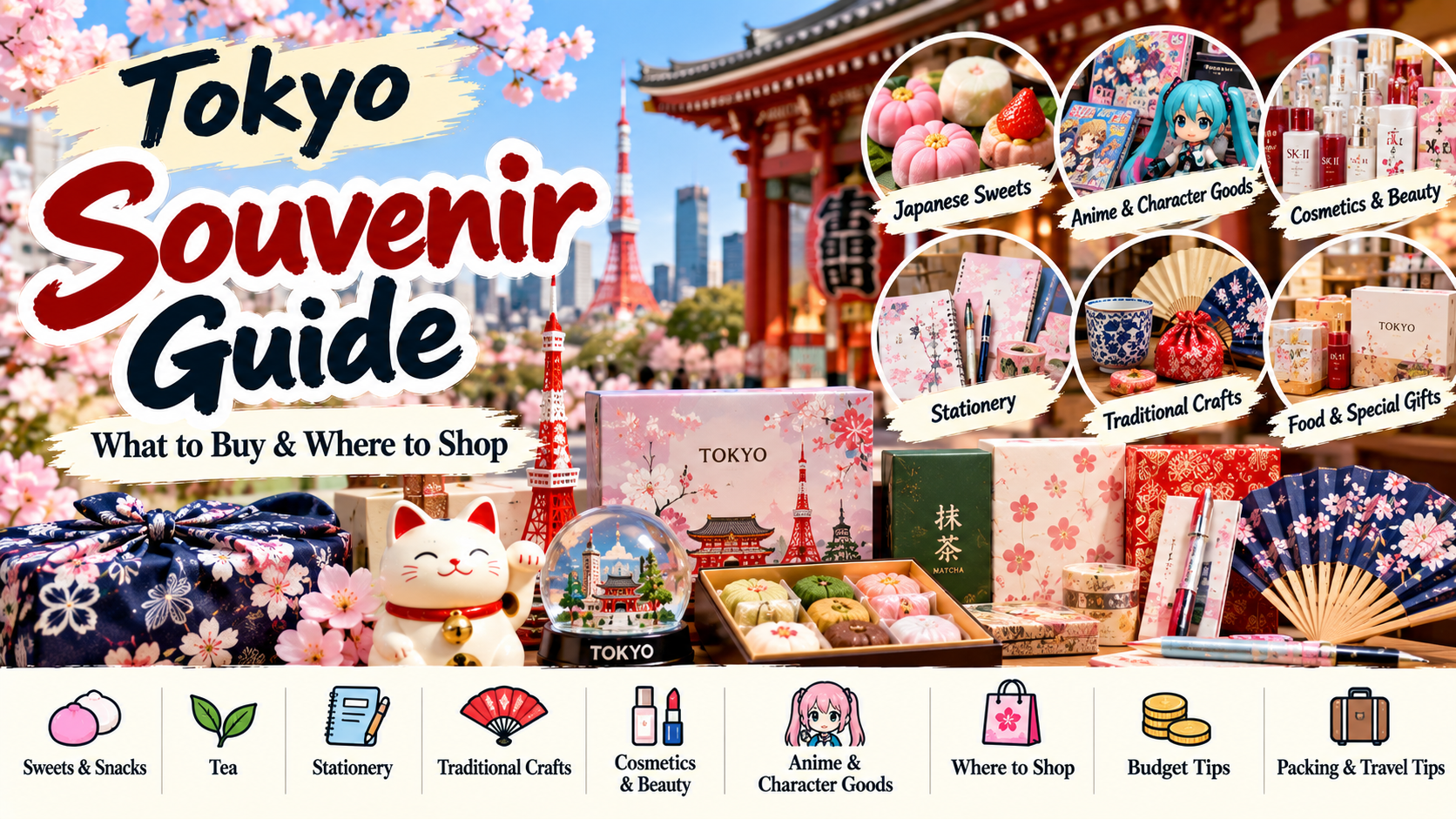
Tokyo is one of the best cities in Japan for souvenir shopping.
From beautifully packaged sweets and traditional crafts to stationery, cosmetics, anime goods and everyday Japanese products, the city offers an enormous range of gifts for almost every budget.
But that variety can also make souvenir shopping surprisingly difficult.
What should you buy? Where should you shop? Which souvenirs are easy to take home? And should you buy everything at the beginning of your trip or wait until the end?
This guide explains what to buy in Tokyo, where to look for souvenirs, and how to choose gifts that are practical, memorable and suitable for the people you are buying for.
What Makes a Good Tokyo Souvenir?
The best souvenir is not necessarily the most expensive or the most obviously Japanese item.
For most travelers, a good souvenir should meet several practical criteria:
- It represents something about Japan or Tokyo.
- It is easy to carry home.
- It fits your budget.
- It is suitable for the person receiving it.
- It will survive the rest of your trip.
- It complies with the customs rules of your destination country.
Food can be an excellent gift, for example, but fragile cakes or products requiring refrigeration may be inconvenient on a long journey.
Traditional ceramics can be memorable, but they require more careful packing.
Stationery, small crafts and packaged sweets are often easier choices because they combine Japanese character with portability.
Miruvia’s Take
Do not try to find one “perfect Japanese souvenir.”
Instead, divide your shopping into three groups:
- Gifts for other people
- Small souvenirs for several people
- One memorable item for yourself
This makes shopping much easier and helps prevent unnecessary purchases.
Best Souvenirs to Buy in Tokyo
Tokyo offers far more than the standard keychains and magnets found in tourist shops.
Here are some of the most useful categories to consider.
Japanese Sweets and Snacks
Food is one of the easiest souvenir categories for first-time visitors.
Popular options include:
- Cookies
- Chocolate
- Rice crackers
- Matcha-flavored sweets
- Mochi-style packaged sweets
- Candy
- Regional snack varieties
- Premium department store confectionery
Japanese gift packaging is often attractive, making packaged sweets especially convenient when buying gifts for coworkers, friends or family.
Individually wrapped products can also be useful when you need to distribute souvenirs among several people.
Who Are Japanese Sweets Best For?
They work particularly well for:
- Coworkers
- Friends
- Families
- Groups
- People who enjoy trying new foods
Before buying, check the expiration date and storage instructions.
Some fresh sweets are designed to be eaten quickly and may not be appropriate for an international flight.
If you want to explore traditional Japanese sweets in greater depth, see our Tokyo Wagashi Guide.
Wagashi
Wagashi are traditional Japanese sweets and can make a more distinctive souvenir than ordinary packaged snacks.
Examples include:
- Yokan
- Monaka
- Manju
- Dorayaki
- Mochi-based sweets
- Seasonal sweets
However, not every type of wagashi travels equally well.
Fresh products may have short shelf lives, while packaged yokan, monaka and similar products can be easier to transport.
Miruvia’s Take
If the souvenir needs to survive several days of travel, prioritize shelf life over appearance.
You can enjoy delicate fresh wagashi while you are in Tokyo and choose more durable packaged varieties for the flight home.
Japanese Tea
Tea is compact, relatively easy to pack and strongly associated with Japanese food culture.
Common choices include:
- Sencha
- Matcha
- Hojicha
- Genmaicha
Tea can work especially well as a gift for someone who prefers something practical rather than decorative.
Premium packaging also makes it suitable for more formal gifts.
If you buy matcha, remember that quality and intended use vary. Some products are designed primarily for drinking, while others are better suited to cooking and desserts.
Japanese Stationery
Japan is famous among stationery enthusiasts for its combination of practical design and attention to detail.
Popular souvenir choices include:
- Pens
- Mechanical pencils
- Notebooks
- Stickers
- Washi tape
- Letter sets
- Erasers
- Pencil cases
- Small desk accessories
Stationery has several advantages for travelers.
It is usually lightweight, easy to pack and available at many price points.
A small pen or notebook can also feel more useful than a generic tourist souvenir.
Who Is Japanese Stationery Best For?
Stationery is particularly suitable for:
- Students
- Coworkers
- Children
- Artists
- Journal enthusiasts
- People who enjoy practical gifts
For travelers who enjoy shopping, stationery can easily become an experience in itself rather than simply a souvenir purchase.
Traditional Japanese Crafts
Traditional crafts can be excellent souvenirs when you want something more meaningful or decorative.
Depending on the shop, you may find:
- Chopsticks
- Folding fans
- Furoshiki wrapping cloths
- Tenugui towels
- Small ceramics
- Lacquerware
- Traditional-pattern accessories
- Small wooden items
These products vary significantly in price and quality.
A mass-produced item using a Japanese design and a genuine artisan-made product are not necessarily the same thing, so check product information if craftsmanship is important to you.
Furoshiki and Tenugui
Furoshiki and tenugui deserve special attention because they are particularly travel-friendly.
They are:
- Lightweight
- Flat
- Easy to pack
- Available in many designs
- Practical after returning home
Furoshiki can be used for wrapping, carrying items or decoration.
Tenugui can be used as a towel, cloth or decorative item.
For travelers with limited suitcase space, these are among the easiest traditional-style souvenirs to recommend.
Chopsticks
Chopsticks are another popular souvenir because they are compact and recognizably connected to Japanese dining culture.
Prices range from inexpensive everyday sets to more elaborate products.
They can work well for:
- Couples
- Families
- Home cooks
- People interested in Japanese food
If you are buying several pairs, check whether the store offers individual boxes or gift packaging.
Japanese Ceramics
Cups, bowls, plates and sake ware can become memorable souvenirs.
The disadvantage is obvious: ceramics are heavier and more fragile than stationery or packaged food.
If you buy ceramics:
- Choose smaller pieces when possible.
- Ask whether protective packaging is available.
- Pack them carefully inside clothing.
- Avoid placing fragile pieces near the outside of your suitcase.
Miruvia’s Take
Ceramics make more sense as a personal souvenir or special gift than as something to buy for ten different people.
One carefully chosen cup or bowl can carry more meaning than several generic souvenirs.
Japanese Cosmetics and Beauty Products
Beauty products are another major shopping category in Tokyo.
Travelers often look for:
- Sunscreen
- Face masks
- Skincare
- Cleansing products
- Makeup
- Haircare
- Beauty accessories
Drugstores offer many affordable products, while department stores and specialty stores provide premium options.
Because formulas, labeling and availability can change, avoid assuming that every viral product you see online will still be the best option when you arrive.
Consider what the recipient actually uses rather than buying something only because it is popular.
Anime and Manga Goods
For anime and manga fans, Tokyo offers an enormous range of merchandise.
Possible souvenirs include:
- Character keychains
- Acrylic stands
- Figures
- Manga
- Art books
- Plush toys
- Pins
- Stationery
- Limited-edition merchandise
The best choice depends heavily on the person’s favorite series or character.
Generic anime merchandise is usually less meaningful than something connected to a title the recipient actually follows.
For a broader introduction to this side of Tokyo, see our Tokyo Anime & Manga Guide.
Secondhand Anime Goods
Secondhand shopping can also be useful for anime fans.
Tokyo’s resale market may offer older merchandise, discontinued items and products that are difficult to find in ordinary stores.
Condition can vary, so inspect items and labels carefully before purchasing.
For collectors, however, searching can become part of the experience.
Japanese Character Goods
Not every character souvenir needs to be connected to anime.
Tokyo shops sell merchandise featuring a wide range of Japanese characters and franchises.
Common products include:
- Towels
- Pouches
- Stationery
- Small plush toys
- Keychains
- Kitchen goods
These are often easy to pack and can work particularly well for children or casual gifts.
Everyday Japanese Products
Some of the most interesting souvenirs are ordinary products Japanese residents use in daily life.
Examples might include:
- Kitchen accessories
- Lunch boxes
- Small household tools
- Towels
- Storage items
- Reusable bags
- Simple tableware
These products may not look like traditional souvenirs, but they can become practical reminders of your trip.
Miruvia’s Take
If you enjoy discovering local life, visit at least one ordinary Japanese store rather than shopping exclusively in tourist areas.
A useful object you continue using at home can become a better memory than something designed only to sit on a shelf.
Tokyo-Themed Souvenirs
Travelers who specifically want a reminder of Tokyo can look for products featuring:
- Tokyo landmarks
- Train motifs
- Tokyo street scenes
- Local neighborhood designs
- Tokyo-exclusive packaging
- City-themed stationery
These are useful when you want the souvenir to represent Tokyo specifically rather than Japan in general.
Food Souvenirs from Depachika
Department store food halls, commonly called depachika, can be excellent places to look for premium food gifts.
You may find:
- Boxed sweets
- Traditional confectionery
- Tea
- Premium snacks
- Seasonal products
- Gift sets
Presentation is often an important part of these products.
For a detailed explanation of how Japanese department store food halls work, see our Tokyo Depachika Guide.
Convenience Store Souvenirs
Convenience stores are not primarily souvenir shops, but they can be useful for inexpensive snacks.
They can work well when:
- You forgot to buy something earlier.
- You want inexpensive Japanese snacks.
- You need a few additional gifts.
- You want products you personally enjoyed during the trip.
However, selection varies by store.
For a broader explanation of what travelers can find there, see our Tokyo Convenience Store Guide.
Supermarket Souvenirs
Supermarkets can be an underrated option for food souvenirs.
Possible finds include:
- Tea
- Candy
- Snacks
- Seasonings
- Packaged foods
- Instant products
Prices can sometimes be more everyday-oriented than those at dedicated souvenir shops.
Supermarkets are particularly interesting if you want products that local residents might actually buy.
See our Tokyo Supermarket Guide for more information about using Japanese supermarkets.
Where to Buy Souvenirs in Tokyo
There is no single best souvenir-shopping district for every traveler.
The right place depends on what you want to buy.
Department Stores
Department stores are useful when you want:
- Premium food gifts
- Beautiful packaging
- Cosmetics
- Fashion
- Traditional-style products
- Higher-end gifts
They are particularly convenient when you need several types of gifts in one location.
Their basement food halls are especially useful for food-related souvenirs.
Large Variety and Lifestyle Stores
Large multi-floor stores can be excellent for browsing.
Depending on the retailer, you may find:
- Stationery
- Household goods
- Beauty products
- Travel accessories
- Character merchandise
- Japanese design products
These stores are useful when you do not yet know exactly what you want.
Drugstores
Drugstores are practical for:
- Skincare
- Cosmetics
- Face masks
- Haircare
- Personal-care products
- Some snacks
They are common throughout central Tokyo, so you usually do not need to make a special trip just to visit one.
Specialty Shops
Specialty stores are better when you have a specific interest.
Examples include stores focused on:
- Tea
- Stationery
- Traditional crafts
- Anime
- Kitchenware
- Ceramics
These shops can offer more depth than general souvenir stores.
Airports
Tokyo’s airports can be useful for final souvenir shopping.
Advantages include:
- Convenient last-minute shopping
- Travel-friendly packaging
- Popular gift products
- No need to carry purchases around Tokyo for several days
The main disadvantage is that waiting until the airport reduces your options and leaves little room to recover if you cannot find what you want.
Miruvia’s Take
Use the airport as your backup, not your entire souvenir strategy.
Buy meaningful or specific items in Tokyo, then use the airport for additional packaged sweets or forgotten gifts.
How Much Should You Spend on Tokyo Souvenirs?
There is no correct souvenir budget.
A practical approach is to divide purchases by recipient.
Small Gifts
For coworkers, acquaintances or larger groups, inexpensive packaged snacks or small stationery items are usually sufficient.
Mid-Range Gifts
For friends and family, consider:
- Premium sweets
- Tea
- Stationery sets
- Small crafts
- Beauty products
Special Gifts
For a partner, close family member or yourself, you might consider:
- Ceramics
- Artisan crafts
- Premium food
- Higher-end stationery
- Special character merchandise
Miruvia’s Take
Set the number of people you need to buy for before you start shopping.
Otherwise, Tokyo’s enormous selection makes it very easy to overspend.
Souvenirs for Coworkers
When buying for a workplace, individually wrapped snacks are often one of the easiest options.
They are:
- Easy to distribute
- Relatively inexpensive
- Compact
- Simple to share
Check how many individual pieces are included before buying a box.
Souvenirs for Family
Family gifts can be more personal.
Consider:
- Tea
- Traditional sweets
- Chopsticks
- Crafts
- Cosmetics
- Kitchen goods
- Ceramics
Think about what the person will actually use rather than choosing the most stereotypically Japanese product.
Souvenirs for Children
Possible choices include:
- Character goods
- Stickers
- Stationery
- Small toys
- Snacks
Avoid fragile items when possible.
Also consider age suitability and any food allergies.
Souvenirs for Yourself
Do not forget to buy something for yourself.
A personal souvenir can be connected to a specific memory:
- A cup from a neighborhood you enjoyed
- Stationery discovered while exploring Tokyo
- A print or cloth with a design you like
- Merchandise from a favorite series
- A kitchen item you will use at home
These items often become more meaningful over time than generic souvenirs.
What Souvenirs Are Easiest to Pack?
If luggage space is limited, prioritize:
- Stationery
- Tea
- Furoshiki
- Tenugui
- Small packaged sweets
- Flat accessories
- Small character goods
More difficult items include:
- Large boxes
- Fragile ceramics
- Fresh food
- Refrigerated products
- Bulky plush toys
Leave some suitcase space before arriving in Tokyo if shopping is an important part of your trip.
Be Careful With Food, Plants and Other Restricted Items
International travelers should remember that customs and import regulations differ by destination.
Certain countries restrict or prohibit particular:
- Meat products
- Fresh fruit
- Vegetables
- Plants
- Seeds
- Animal products
- Other food items
Rules can change.
Before taking food or plant-related products home, check the official customs or border-control guidance for your destination country.
Do not assume that an item is permitted simply because a store sells it to tourists.
Should You Buy Souvenirs at the Beginning or End of Your Trip?
For most travelers, neither extreme is ideal.
Buying everything on the first day means carrying purchases for the rest of the trip.
Waiting until the final hour creates unnecessary pressure.
A better strategy is to shop in stages.
Early in the Trip
Browse and learn what is available.
Buy something immediately only if it is unusual or difficult to find again.
Middle of the Trip
Purchase distinctive items connected to neighborhoods and experiences.
Final One or Two Days
Buy:
- Packaged sweets
- General gifts
- Remaining stationery
- Beauty products
- Easy-to-find souvenirs
Airport
Use it for final additions and forgotten gifts.
First-Time Visitors vs Repeat Visitors
Souvenir shopping often changes as travelers become more familiar with Tokyo.
First-Time Visitors
You may naturally be drawn toward:
- Famous Japanese snacks
- Landmark-themed items
- Traditional crafts
- Character goods
- Classic gift boxes
There is nothing wrong with this.
These products can be enjoyable reminders of a first trip.
Repeat Visitors
You may prefer:
- Neighborhood-specific items
- Independent shops
- Specialty stationery
- Vintage products
- Artisan crafts
- Everyday Japanese goods
Repeat trips make it easier to shop around personal interests rather than a checklist of famous souvenirs.
How Long Should You Spend Souvenir Shopping?
If shopping is not a major priority, one or two dedicated shopping sessions may be enough.
If shopping is part of the travel experience, it can easily occupy half a day or more.
Rather than creating a separate journey across Tokyo solely for souvenirs, combine shopping with areas already on your itinerary.
For example, browse stores after sightseeing or before dinner.
This reduces unnecessary transportation and keeps souvenir shopping from taking over your trip.
A Simple Tokyo Souvenir Shopping Strategy
For a first trip, use this process:
- Make a list of the people you want to buy for.
- Set an approximate total budget.
- Decide which gifts should be food and which should be non-food.
- Browse during the first half of your trip.
- Buy unusual or neighborhood-specific items when you find them.
- Save common packaged gifts for later.
- Check expiration dates and luggage requirements.
- Leave room in your suitcase.
- Review customs restrictions before buying questionable food products.
- Use the airport only for final additions.
This approach prevents most of the common problems travelers experience with souvenir shopping.
Common Souvenir Shopping Mistakes
Buying Too Much Too Early
Tokyo has many shopping areas.
You do not need to purchase everything at the first store you visit.
Ignoring Luggage Space
A large souvenir may look manageable in the shop but become inconvenient once you need to pack it.
Buying Fragile Items Without a Packing Plan
Consider transportation before purchasing ceramics, glass or other delicate products.
Forgetting Expiration Dates
This is particularly important for Japanese sweets and other food gifts.
Buying for Everyone Without a List
Small purchases add up quickly.
Know roughly how many gifts you actually need.
Assuming Every “Japanese” Product Is Made in Japan
If origin or craftsmanship matters to you, check the label and product information.
Is Tax-Free Shopping Available?
Some shops in Japan offer tax-free shopping to eligible international visitors when applicable requirements are met.
However, rules, procedures and eligibility can change.
Look for current information at the store and follow official Japanese guidance rather than assuming every purchase qualifies.
Do not choose a shop only because of tax-free availability.
Convenience, selection and the actual product are usually more important for ordinary souvenir shopping.
How Souvenir Shopping Fits Into a Tokyo Trip
Souvenir shopping works best when integrated into your itinerary.
If you are already exploring major shopping areas, you can browse department stores, specialty shops and lifestyle stores along the way.
Our Tokyo Shopping Guide provides a broader overview of shopping in the city.
Food-focused travelers can combine souvenir shopping with department store food halls using our Tokyo Depachika Guide.
Anime fans can explore merchandise through our Tokyo Anime & Manga Guide.
The key is not to cross Tokyo repeatedly just to buy common products that are available in many neighborhoods.
Frequently Asked Questions
What is the best souvenir to buy in Tokyo?
There is no single best souvenir. Packaged sweets, tea, stationery, small traditional crafts and character goods are practical choices for many travelers.
What are easy souvenirs to bring home from Japan?
Stationery, tea, furoshiki, tenugui, small packaged sweets and compact accessories are generally easy to pack.
Where can I buy souvenirs in Tokyo?
Department stores, specialty shops, lifestyle stores, drugstores, supermarkets, tourist areas and airports all offer different types of souvenirs.
Should I buy souvenirs at the airport?
Airports are convenient for last-minute packaged gifts, but it is better to buy distinctive or specific items while exploring Tokyo.
Are Japanese sweets good souvenirs?
Yes, particularly packaged products with suitable expiration dates. Check storage requirements before purchasing.
What should I buy for coworkers?
Individually wrapped snacks are a convenient option because they are easy to distribute among a group.
What should I buy for someone who does not want food?
Stationery, furoshiki, tenugui, chopsticks, small crafts, cosmetics and character goods are common alternatives.
Can I bring Japanese food back to my country?
It depends on the destination and the product. Check the official customs and border-control rules of your destination before traveling with food.
Final Thoughts
Tokyo souvenir shopping does not need to become a search for the most famous or most traditionally Japanese object.
The best purchases usually match three things: the person receiving the gift, the experience you had in Tokyo, and the practical realities of taking it home.
Packaged sweets and tea work well for easy gifts. Stationery and everyday Japanese products are useful and compact. Traditional crafts can become meaningful keepsakes. Anime and character merchandise can be ideal when you know exactly what the recipient likes.
Most importantly, do not leave every purchase until the airport.
Browse early, buy distinctive items when you find them, and save easy packaged gifts for the final part of your trip.
That approach makes souvenir shopping part of the Tokyo experience rather than a stressful task at the end of it.
