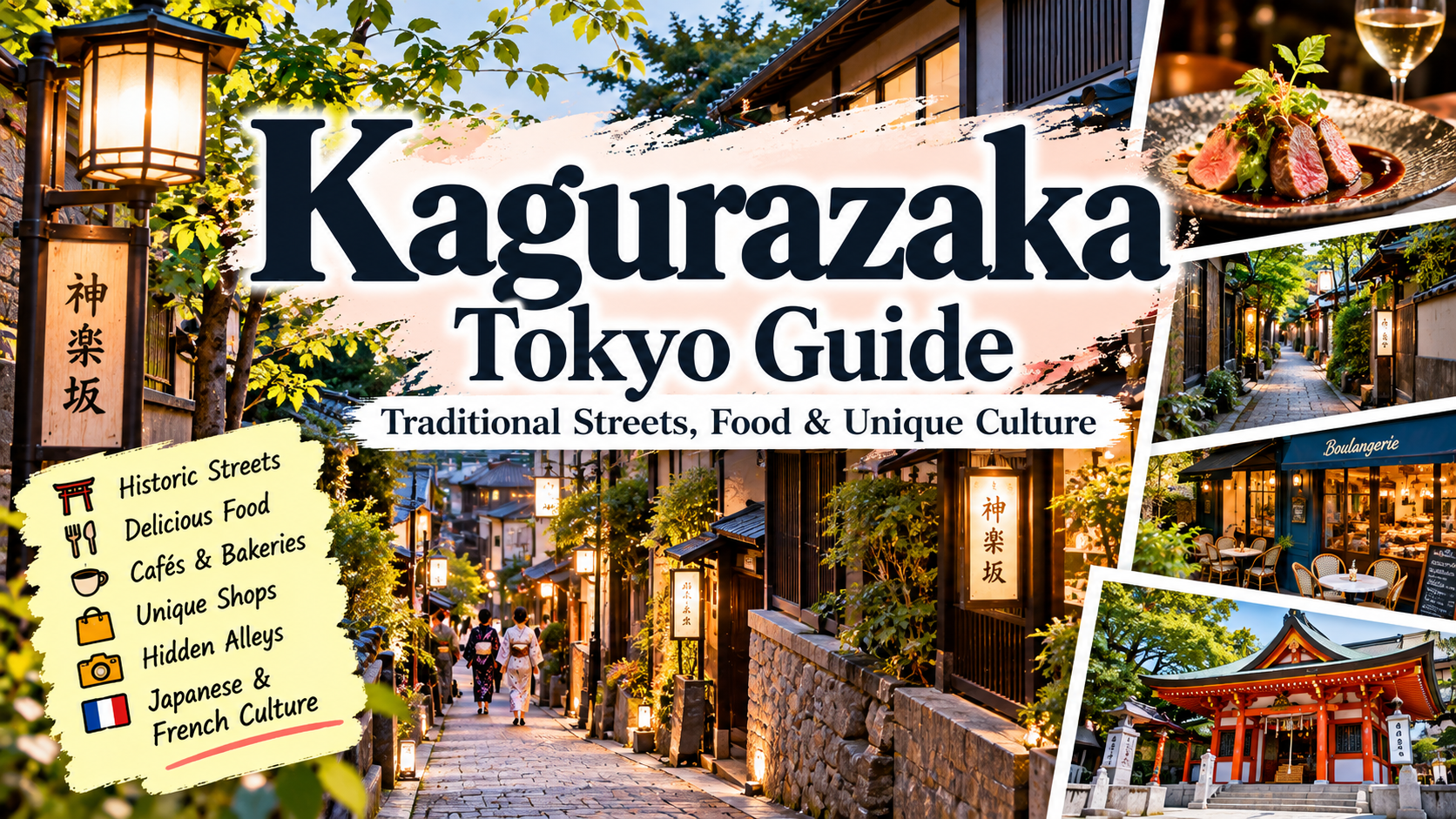
Tokyo is often associated with skyscrapers, neon streets, and busy train stations, but some neighborhoods reveal a quieter and more traditional side of the city.
Kagurazaka is one of them.
Located near central Tokyo, Kagurazaka is known for its sloping main street, narrow back alleys, traditional restaurants, shrines, cafés, and a distinctive atmosphere shaped by both Japanese and French influences.
Once associated with geisha culture and traditional entertainment, the neighborhood has evolved without completely losing its historic character. Today, visitors can wander through stone-paved alleys, stop at small restaurants, explore local shops, and experience a side of Tokyo that feels very different from Shinjuku or Shibuya.
This guide covers the best things to do in Kagurazaka, what to eat, how long to spend there, and whether the neighborhood deserves a place in your Tokyo itinerary.
Is Kagurazaka Worth Visiting?
Yes, especially if you enjoy exploring neighborhoods on foot rather than moving from one major attraction to another.
Kagurazaka is a good choice if you:
- Enjoy traditional streets and narrow alleys
- Want to explore a quieter side of central Tokyo
- Like discovering restaurants, cafés, and small shops
- Are interested in neighborhoods with both historical and modern character
- Have already visited Tokyo’s major sightseeing districts
- Prefer atmosphere and exploration over famous landmarks
However, Kagurazaka may be less suitable if you have very limited time in Tokyo and still have major attractions such as Asakusa, Shibuya, or Shinjuku on your list.
Miruvia’s Take
Kagurazaka is not a neighborhood you visit for one spectacular landmark.
The neighborhood itself is the experience.
Its appeal comes from walking slowly, turning into small alleys, discovering restaurants and shops, and noticing how traditional Tokyo blends with contemporary city life.
For repeat visitors in particular, Kagurazaka can be an excellent way to experience Tokyo beyond the standard sightseeing route.
What Makes Kagurazaka Different?
Kagurazaka has an unusual combination of characteristics.
You can find busy streets filled with shops and restaurants, but just a short walk away are narrow lanes that feel considerably quieter.
Traditional Japanese architecture appears alongside modern cafés and restaurants.
The neighborhood is also known for its connection to French culture, partly influenced by French institutions in the surrounding area. As a result, French restaurants, bakeries, and cafés have become part of Kagurazaka’s modern identity.
This mixture gives the neighborhood a character that is difficult to compare directly with other parts of Tokyo.
Yanaka feels more strongly connected to Tokyo’s old-town atmosphere.
Shimokitazawa emphasizes vintage fashion and creative youth culture.
Koenji offers a more alternative local environment built around vintage shopping, music, and nightlife.
Kagurazaka, by comparison, feels more refined and understated, with food, traditional streets, and quiet exploration at the center of the experience.
Best Things to Do in Kagurazaka
Walk Up Kagurazaka-dori
The easiest way to begin exploring the neighborhood is simply to walk along Kagurazaka-dori, the area’s main street.
The sloping road is lined with restaurants, cafés, shops, and businesses.
It is considerably more active than the small alleys nearby, making it a useful introduction to the neighborhood before exploring its quieter side streets.
Do not rush through it.
Part of Kagurazaka’s appeal is noticing the smaller businesses and entrances that might otherwise be easy to miss.
Explore the Narrow Back Alleys
The back alleys are one of the main reasons to visit Kagurazaka.
Leave the main street and you can quickly find narrow pedestrian lanes, stone paving, traditional-looking buildings, hidden restaurants, and quiet residential corners.
Some of the most memorable moments in Kagurazaka come from exploring these smaller streets without trying to follow a rigid sightseeing route.
Rather than treating the neighborhood as a checklist of attractions, allow some time to wander.
Walk Through Hyogo Yokocho
Hyogo Yokocho is one of Kagurazaka’s atmospheric side streets.
The narrow lane and stone paving help preserve the neighborhood’s traditional character, while restaurants tucked into the surrounding streets add to the feeling of discovering somewhere hidden within central Tokyo.
It is not a large attraction that requires a long visit.
Instead, it works best as part of a broader walk through Kagurazaka’s network of alleys.
Visit Akagi Shrine
Akagi Shrine offers an interesting example of how traditional and contemporary Tokyo can coexist.
The shrine has a modern architectural character that distinguishes it from many more conventional shrine complexes.
It is relatively easy to incorporate into a Kagurazaka walk and provides a quiet change of pace from the restaurants and shops along the main street.
Visitors should remember that this remains an active religious site, so explore respectfully.
Visit Zenkokuji Temple
Zenkokuji Temple is another important religious site in the neighborhood and sits conveniently close to Kagurazaka’s main street.
Its location makes it easy to visit while exploring the district rather than requiring a separate trip.
Even if temples are not your primary reason for visiting Kagurazaka, stopping here helps add historical context to the neighborhood walk.
Discover Kagurazaka’s Small Shops
Kagurazaka is not primarily a major shopping destination like Ginza, Shibuya, or Shinjuku.
That is part of its appeal.
Instead of huge department stores and shopping complexes, you can discover smaller specialty shops, food stores, boutiques, and businesses integrated into the neighborhood.
Shopping here is more about browsing and discovery than completing a large shopping list.
Kagurazaka’s Food Scene
Food is one of the strongest reasons to spend extra time in Kagurazaka.
The neighborhood contains a wide variety of restaurants, ranging from casual establishments to more refined dining experiences.
Want to explore Japanese cuisine beyond Kagurazaka? See our Tokyo Food Guide for First-Time Visitors for dishes, dining areas, budgets, and practical restaurant tips.
Traditional Japanese Food
Kagurazaka’s historical connection to entertainment and dining culture remains visible through its restaurant scene.
Visitors can find Japanese cuisine in settings that often feel more intimate than the large commercial dining districts elsewhere in Tokyo.
Some restaurants are located inside narrow alleys or traditional-style buildings, adding atmosphere to the meal itself.
French Restaurants and Cafés
One of Kagurazaka’s most distinctive characteristics is its French influence.
French restaurants, bakeries, cafés, and other European-inspired establishments can be found around the neighborhood.
This creates an unusual contrast with the traditional Japanese streets nearby.
For travelers who enjoy food-focused neighborhood exploration, this combination is one of the features that separates Kagurazaka from many other Tokyo districts.
Casual Lunches and Cafés
You do not need to plan an expensive dinner to enjoy Kagurazaka.
The neighborhood also works well for a relaxed lunch or café break during a walking route.
Exploring during the daytime gives you the opportunity to combine sightseeing with cafés, bakeries, sweets, or a casual meal.
How Much Time Do You Need in Kagurazaka?
The amount of time you need depends heavily on whether you plan to eat in the neighborhood.
1–2 Hours
Enough for:
- Walking along Kagurazaka-dori
- Exploring several back alleys
- Visiting a shrine or temple
- Briefly browsing local shops
This works well if Kagurazaka is one stop in a larger day of sightseeing.
3–4 Hours
A better choice for most travelers.
You can:
- Explore the main street
- Wander through the back alleys
- Visit Akagi Shrine and Zenkokuji Temple
- Browse local shops
- Stop at a café
- Have lunch or an early dinner
This allows you to experience the neighborhood without rushing.
Half Day or Longer
Consider spending half a day if food is one of your main interests.
A slower visit gives you more time to explore side streets, visit cafés, browse shops, and enjoy a proper meal.
Miruvia’s Take
For most visitors, around three hours is a good balance.
Kagurazaka is compact enough that you do not need an entire day, but rushing through it in less than an hour misses much of the reason for visiting.
A Simple Kagurazaka Walking Plan
You do not need a complicated itinerary.
A flexible walking route works better.
Short Visit
- Arrive near Kagurazaka
- Walk along Kagurazaka-dori
- Explore the surrounding back alleys
- Walk through Hyogo Yokocho
- Visit Zenkokuji Temple
- Stop for coffee or a snack
Allow approximately 1–2 hours.
Half-Day Visit
- Begin around Kagurazaka-dori
- Explore the side streets slowly
- Visit Akagi Shrine
- Browse small shops
- Stop for lunch or a café
- Visit Zenkokuji Temple
- Explore Hyogo Yokocho and nearby alleys
- Stay into the early evening if you want to experience the restaurant atmosphere
Allow approximately 3–5 hours.
The exact route matters less than leaving enough time to explore streets that catch your attention.
Kagurazaka vs Yanaka: Which Should You Visit?
Both neighborhoods offer alternatives to Tokyo’s modern commercial districts, but the experiences are different.
| Kagurazaka | Yanaka | |
|---|---|---|
| Main appeal | Food, alleys and refined local atmosphere | Old Tokyo streets and traditional neighborhood life |
| Atmosphere | Elegant and understated | Nostalgic and relaxed |
| Food | Strong restaurant and café scene | Casual local food and snacks |
| Walking | Compact alleys and sloping streets | Wider neighborhood exploration |
| Traditional feel | Mixed with modern and French influences | Stronger old-town character |
| Best for | Food lovers and repeat visitors | First-time old-Tokyo exploration |
Choose Kagurazaka If:
- Food is an important part of your trip
- You enjoy narrow alleys and hidden restaurants
- You want a quieter but sophisticated neighborhood
- You have already explored Tokyo’s most famous districts
Choose Yanaka If:
- You want a stronger old-Tokyo atmosphere
- Traditional neighborhood scenery is your priority
- You enjoy temples and slower residential streets
- You want to combine sightseeing with Yanaka Ginza
Miruvia’s Take
For a first introduction to Tokyo’s traditional neighborhoods, Yanaka may be easier to understand immediately.
Kagurazaka becomes particularly interesting when you want something more subtle: good food, small streets, and a neighborhood that rewards slow exploration.
They are different enough that visiting both is worthwhile on a longer Tokyo trip.
Kagurazaka for First-Time vs Repeat Visitors
First-Time Visitors
Kagurazaka can fit into a first Tokyo trip, but it should usually come after the city’s major experiences.
If you have only three days, neighborhoods such as Shibuya, Shinjuku, Asakusa, and central Tokyo will generally occupy most of your schedule.
With five to seven days, Kagurazaka becomes much easier to include.
See our Tokyo Itinerary for First-Time Visitors to compare practical 3-, 5-, and 7-day plans.
It is particularly useful when you want a quieter afternoon between busier sightseeing days.
Repeat Visitors
Kagurazaka is especially well suited to repeat visitors.
After seeing Tokyo’s major landmarks, neighborhood exploration often becomes a more rewarding way to experience the city.
Instead of asking, “What famous attraction should I see next?”, Kagurazaka encourages a different question:
“What does an ordinary afternoon in another part of Tokyo feel like?”
That is where the neighborhood becomes particularly interesting.
Best Time to Visit Kagurazaka
Kagurazaka changes noticeably throughout the day.
Late Morning
A good time for quiet walking and photography.
The neighborhood generally feels calmer, making it easier to explore the streets and temples.
However, some restaurants and shops may not yet be open.
Afternoon
The most balanced time for first-time visitors.
Shops and cafés are active, restaurants are serving lunch, and you can explore comfortably before the evening dining period.
Evening
Kagurazaka becomes particularly atmospheric around dinner time.
Restaurant entrances, lanterns, and smaller alleys create a different mood from the daytime neighborhood.
If food is a major reason for your visit, staying into the evening can be worthwhile.
Miruvia’s Take
For a first visit, arrive in the mid-afternoon and stay through early evening.
This lets you experience both sides of Kagurazaka: relaxed daytime exploration and the beginning of its evening dining atmosphere.
How to Combine Kagurazaka with Other Areas
Kagurazaka does not need to occupy your entire day.
Its central location makes it relatively easy to combine with other sightseeing.
One approach is to spend the morning at a larger attraction or district, then use Kagurazaka for a slower afternoon and dinner.
Another option is to treat Kagurazaka as the main food-focused stop of the day.
This is particularly useful if your itinerary already contains several busy commercial areas.
Instead of adding another large shopping district, Kagurazaka provides contrast.
How to Get to Kagurazaka
Kagurazaka is served by several nearby railway and subway stations, which makes the neighborhood accessible from different parts of Tokyo.
Kagurazaka Station is useful for approaching the northern side of the neighborhood.
Iidabashi Station is another convenient option and provides access to multiple train and subway lines.
Ushigome-Kagurazaka Station can also be useful depending on your route.
Because the neighborhood is best explored on foot, your arrival and departure stations do not necessarily need to be the same.
In fact, entering from one side and leaving from another can make your walk more efficient.
Practical Tips for Visiting Kagurazaka
Wear Comfortable Shoes
Kagurazaka includes slopes, narrow streets, and plenty of walking.
Comfortable footwear will make exploration much easier.
Do Not Follow Only the Main Street
Kagurazaka-dori is useful for orientation, but much of the neighborhood’s character is found in the smaller streets nearby.
Turn into the alleys when something looks interesting.
Leave Room for Food
Avoid scheduling Kagurazaka immediately after a large meal if food is one of your interests.
Restaurants, bakeries, cafés, and sweets are an important part of the experience.
Check Restaurant Details in Advance
Smaller restaurants may have limited seating, different opening days, or reservation requirements.
If there is a specific restaurant you want to visit, confirm current information before going.
Respect Residential Areas
Some of Kagurazaka’s attractive streets are also part of everyday residential life.
Keep noise levels reasonable and avoid blocking entrances while taking photographs.
Is Kagurazaka Good for Solo Travelers?
Yes.
Kagurazaka is particularly suitable for solo travelers who enjoy walking without a fixed schedule.
You can explore the streets at your own pace, stop at cafés, visit shrines and temples, and spend as much or as little time as you want browsing the neighborhood.
Solo travelers may also appreciate that the area offers plenty to observe without requiring a specific activity or attraction.
Is Kagurazaka Good for Families?
It can be, although Kagurazaka is generally more appealing to adults interested in food, architecture, cafés, and neighborhood exploration.
Families with older children who enjoy walking and food may find it interesting.
For younger children, Tokyo neighborhoods with parks, interactive attractions, or larger entertainment facilities may provide more obvious activities.
Frequently Asked Questions
Is Kagurazaka worth visiting for tourists?
Yes, particularly for travelers interested in food, traditional streets, cafés, and quieter neighborhood exploration. It is especially attractive for repeat Tokyo visitors.
What is Kagurazaka famous for?
Kagurazaka is known for its narrow alleys, traditional dining culture, historical atmosphere, shrines and temples, and distinctive French influence.
How long should I spend in Kagurazaka?
Around three hours is a good amount of time for most visitors. Allow longer if you plan to have a full meal or explore cafés and shops slowly.
Is Kagurazaka good at night?
Yes. The neighborhood becomes particularly atmospheric around dinner time when restaurants and small streets take on a more intimate evening character.
Is Kagurazaka better than Yanaka?
Neither is simply better because they offer different experiences. Yanaka has a stronger old-Tokyo atmosphere, while Kagurazaka combines traditional streets with a more refined food and café scene.
Is Kagurazaka good for first-time visitors?
Yes, especially if you have five or more days in Tokyo. Travelers with very limited time may want to prioritize the city’s major sightseeing districts first.
Final Thoughts
Kagurazaka demonstrates that exploring Tokyo does not always require a famous landmark.
Sometimes the experience comes from the neighborhood itself.
Walk along the sloping main street, turn into a stone-paved alley, visit a shrine, browse a small shop, stop for coffee, and stay for dinner.
Kagurazaka combines traditional Tokyo, contemporary local life, and an unusual French influence in a compact area that is easy to explore on foot.
For first-time visitors, it can provide a quiet contrast to Tokyo’s major sightseeing districts.
For repeat visitors, it offers something even more valuable: another layer of the city to discover.
Kagurazaka is not about seeing as much as possible.
It is about slowing down enough to notice what is around you.
