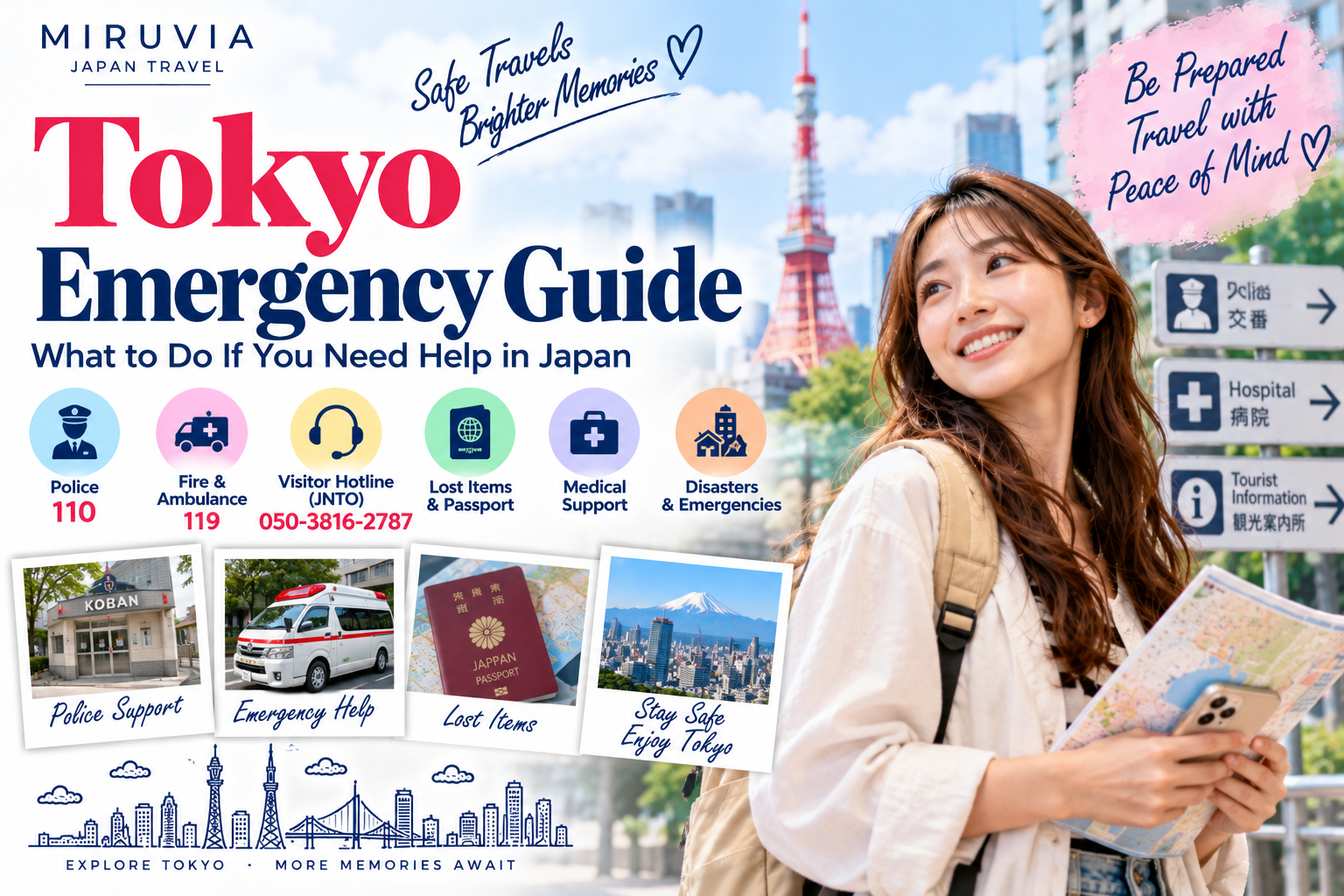
Traveling in Tokyo is generally straightforward, but unexpected problems can happen anywhere. You might lose your wallet, need medical assistance, misplace your passport, experience an earthquake, or simply find yourself unsure who to contact.
Knowing what to do before an emergency happens can make a stressful situation much easier to handle.
This Tokyo emergency guide explains the most important emergency numbers, where travelers can ask for help, and what to do in common situations while visiting Japan.
Tokyo Emergency Information at a Glance
Here are the most important numbers to remember:
- Police: 110
- Fire and ambulance: 119
- Japan Visitor Hotline: 050-3816-2787
- Japan Visitor Hotline from overseas: +81-50-3816-2787
The Japan Visitor Hotline is operated by the Japan National Tourism Organization (JNTO) and provides assistance to international travelers in English, Chinese, and Korean, 24 hours a day, 365 days a year.
For non-urgent problems, hotel staff, station staff, tourist information centers, and local police boxes can also be useful sources of assistance.
When to Call 110 in Japan
Call 110 when you need urgent police assistance.
Examples may include:
- Theft or robbery
- An immediate threat to your safety
- A serious traffic accident
- A crime in progress
- Another situation requiring urgent police assistance
When calling, try to explain what happened and where you are.
If you do not know the exact address, look for nearby station names, store names, intersections, buildings, or landmarks that may help identify your location.
When to Call 119 in Japan
Call 119 for an ambulance or fire emergency.
This includes situations such as:
- Serious illness
- Significant injury
- A medical emergency
- Fire
- Someone who is unconscious
- A situation requiring immediate emergency medical assistance
If you are staying at a hotel and the situation allows, hotel staff may also be able to help communicate your location and situation.
However, do not delay contacting emergency services in a serious emergency.
What If You Do Not Speak Japanese?
Language can feel like one of the biggest concerns during an emergency in Japan.
Keep your explanation simple.
Useful English information includes:
- What happened
- Your current location
- Whether someone is injured
- Your hotel name
- Your name and phone number
Translation apps can also be useful when speaking with police officers, station staff, pharmacists, hotel employees, or other people assisting you.
It can help to save your hotel name and address on your phone in both English and Japanese before heading out.
Use the Japan Visitor Hotline
International travelers who need assistance can contact the Japan Visitor Hotline operated by JNTO.
The hotline can provide support for situations involving:
- Accidents
- Illness
- Natural disasters
- Other emergencies
- General tourist information
The service operates 24 hours a day, 365 days a year, with support in English, Chinese, and Korean.
Save the number before your trip:
050-3816-2787
From overseas:
+81-50-3816-2787
Having this number stored in your phone can be useful even if you never need it.
Police Boxes in Tokyo
One useful feature of Japanese cities is the koban, or neighborhood police box.
You can find koban near many train stations, busy intersections, and shopping districts.
Travelers may visit a koban for help with situations such as:
- Lost belongings
- Theft
- Directions
- Reporting an incident
- Finding the appropriate police station
Look for signs marked POLICE or KOBAN.
For a non-life-threatening problem, visiting a nearby koban can sometimes be easier than trying to determine which larger police station to visit.
What to Do If You Lose Something in Tokyo
Losing a wallet, phone, passport, or bag can be stressful, but there are several places you can check.
First, think about where you last had the item.
If you lost something on a train, at a station, in a restaurant, inside a department store, or at another specific facility, contact that location first.
Major train stations and airports often have dedicated lost-and-found services.
If the item cannot be found, contact the police or visit a nearby koban.
When reporting a lost item, provide as much detail as possible, including:
- What the item looks like
- Where you may have lost it
- Approximately when you lost it
- Distinguishing features
- Your contact information
Keep any report or reference information you receive.
What to Do If Your Wallet Is Lost or Stolen
If your wallet disappears, act quickly.
Start by checking the last places you visited.
If you believe it was lost on public transportation, contact the relevant railway or transport operator.
If you believe it was stolen, or you cannot recover it, contact the police.
You should also contact your card providers to block or suspend missing credit or debit cards.
Keeping at least one backup payment method separately from your main wallet can reduce the impact of losing it.
Avoid keeping every card and all of your cash in one place.
What to Do If You Lose Your Phone
Your phone is particularly important while traveling because it may contain maps, hotel information, tickets, reservations, payment apps, and communication tools.
If your phone is missing:
- Retrace your recent route.
- Ask the facility or station where you may have lost it.
- Use your device’s location service if available.
- Contact the relevant lost-and-found office.
- Report the loss to police if necessary.
- Contact your mobile provider if the phone cannot be recovered.
Before traveling, consider enabling device tracking and protecting your phone with a passcode or biometric lock.
It is also useful to keep important travel information somewhere other than your phone.
If staying connected is a concern during your trip, see our Tokyo Internet Guide for information about eSIMs, SIM cards, and pocket Wi-Fi.
What to Do If You Lose Your Passport
A lost passport requires more attention than most lost belongings.
If you lose your passport, contact the police and your country’s embassy or consulate.
A police report may be necessary when arranging a replacement passport.
Your embassy or consulate can explain the requirements for obtaining an emergency or replacement travel document.
Before traveling, it is useful to keep a separate copy or secure digital record of:
- Your passport information page
- Travel insurance details
- Flight information
- Important reservation information
Do not rely entirely on a single physical document or device.
Contacting Your Embassy or Consulate
Your country’s embassy or consulate may be able to assist with serious problems such as:
- Lost or stolen passports
- Emergency travel documents
- Certain legal or administrative problems
- Contacting family in serious situations
- Guidance during major emergencies
Embassies are not a replacement for Japanese emergency services.
For immediate police, fire, or ambulance assistance, use the appropriate Japanese emergency number first.
Before traveling, save the official contact details for your country’s embassy or consulate in Japan.
What to Do If You Become Sick
Not every illness requires an ambulance.
For mild problems, you may be able to speak with hotel staff, visit a pharmacy, or arrange a visit to a medical facility.
For more serious symptoms, seek professional medical assistance.
Call 119 when you believe the situation is a medical emergency.
When visiting a medical facility, bring useful information such as:
- Passport or identification
- Travel insurance information
- A list of medications you take
- Information about allergies
- A payment method
If you have travel insurance, check whether your provider has a medical assistance hotline.
For everyday medicine, toiletries, and other useful items, see our Tokyo Drugstore Guide for Travelers.
Travel Insurance
Travel insurance can be particularly valuable when dealing with unexpected medical treatment, trip disruption, theft, or other covered emergencies.
Before traveling, understand:
- What your policy covers
- How to contact the insurer
- Whether you need to contact them before receiving non-emergency treatment
- What documents are required for a claim
- Whether you need receipts or police reports
Save your policy number and emergency assistance contact details somewhere easily accessible.
What to Do During an Earthquake
Earthquakes occur in Japan, and travelers should know the basic response.
If you feel strong shaking:
- Stay calm.
- Protect your head.
- Move away from objects that could fall.
- Do not rush outside while strong shaking is occurring.
- Follow instructions from staff if you are in a hotel, station, shopping center, or other facility.
After the shaking stops, remain alert for aftershocks and possible secondary hazards.
Follow official information and instructions from local authorities or facility staff.
If you are near the coast and a tsunami warning is issued, follow evacuation instructions immediately and move toward the designated safe area.
Earthquakes on Trains and at Stations
Tokyo’s railway system may temporarily stop services following an earthquake or other major disruption.
If this happens:
- Remain calm.
- Follow announcements.
- Listen to station or train staff.
- Do not enter restricted areas or railway tracks.
- Check official transport information when available.
Avoid immediately joining large crowds if staff are directing passengers to remain where they are.
During major disruptions, transportation may take time to resume.
Emergency Alerts on Your Phone
Your phone can be an important source of information during natural disasters.
Depending on your device, network, and settings, you may receive emergency alerts.
Travelers should also know where to find reliable information about:
- Earthquakes
- Tsunamis
- Severe weather
- Volcanic activity
- Evacuation information
- Major transportation disruptions
Official information is preferable to relying solely on social media posts, where outdated or inaccurate information can spread quickly.
What to Do During a Typhoon or Severe Weather
Typhoons and severe weather can affect trains, flights, attractions, and other services.
If severe weather is forecast:
- Check official weather information.
- Check your airline and railway operator.
- Avoid unnecessary travel during dangerous conditions.
- Follow instructions from your hotel or local authorities.
- Allow extra time in your schedule.
Transportation services may be reduced or suspended before conditions become severe.
Do not assume that a scheduled train or flight will operate normally during a major storm.
What to Do During a Major Disaster
During a large earthquake, typhoon, flood, or other major disaster, your original travel plans may no longer be realistic.
Focus first on safety.
Follow instructions from:
- Local authorities
- Police
- Fire departments
- Hotel staff
- Station staff
- Facility staff
You may be directed toward an evacuation area or temporary shelter.
Keep your phone battery available for essential communication and information.
If Public Transportation Stops
Tokyo depends heavily on trains, so major disruptions can affect a large number of travelers.
If services stop:
- Check official operator information.
- Ask station staff when necessary.
- Consider waiting somewhere safe rather than immediately walking a very long distance.
- Contact your hotel if you expect a significant delay.
- Keep enough battery power for maps and communication.
During a large-scale emergency, it may take time before normal service resumes.
For more information about trains, subways, IC cards, and navigating the city, see our Tokyo Transportation Guide.
If You Are Separated From Your Travel Companion
Before exploring Tokyo, agree on what to do if your group becomes separated.
A simple plan might include:
- A designated meeting place
- Your hotel’s name and address
- Each person’s phone number
- An alternative messaging method
During a major disaster, mobile networks may become congested.
Having a meeting plan that does not depend entirely on immediate phone communication can be useful.
Keep Your Hotel Information With You
Your hotel can become an important point of reference during a problem.
Save:
- Hotel name
- Address
- Phone number
- Nearest station
Consider keeping a screenshot of this information on your phone.
A small printed copy can also be useful if your phone is lost, damaged, or out of battery.
Keep Important Information Offline
Internet access is usually convenient in Tokyo, but you should not assume you will always have a connection.
Before leaving your hotel, consider keeping offline copies of:
- Hotel information
- Passport details
- Insurance information
- Emergency contacts
- Important reservations
- Maps of essential areas
Screenshots are a simple way to keep critical information accessible.
Carry a Portable Battery
Your smartphone may become one of your most important tools during an unexpected problem.
It provides access to:
- Maps
- Translation
- Emergency contacts
- Transport information
- Hotel details
- Airline information
- Messaging
Carrying a charged portable battery can therefore be useful during long sightseeing days.
Remember to recharge both your phone and portable battery each night.
Useful Japanese Words in an Emergency
Knowing a few basic phrases can make communication easier.
Help:
助けてください
Tasukete kudasai
Police:
警察
Keisatsu
Ambulance:
救急車
Kyukyusha
Hospital:
病院
Byoin
I lost my wallet:
財布をなくしました
Saifu o nakushimashita
I lost my passport:
パスポートをなくしました
Pasupoto o nakushimashita
Please call an ambulance:
救急車を呼んでください
Kyukyusha o yonde kudasai
You do not need to memorize every phrase. Saving them on your phone can be enough.
Prepare Before Leaving Your Hotel Each Day
A few simple habits can make unexpected situations easier to handle.
Before sightseeing, check that you have:
- Your phone
- Enough battery
- Internet access or offline maps
- Hotel information
- A payment method
- Emergency contact information
If you are traveling with others, make sure everyone knows the hotel name.
Common Mistakes Travelers Should Avoid
One mistake is keeping every important item together.
If your passport copy, cards, cash, and backup information are all inside the same bag that disappears, your problem becomes much harder to solve.
Another mistake is relying entirely on internet access.
Keep essential information available offline.
Finally, do not wait too long to seek help during a genuine emergency.
Tokyo has police officers, station staff, hotel employees, tourist support services, and emergency responders who can assist.
A Simple Emergency Plan for Tokyo
Before your trip, prepare a basic emergency plan.
Save these numbers:
Police: 110
Fire/Ambulance: 119
Japan Visitor Hotline: 050-3816-2787
Also save:
- Your embassy or consulate
- Travel insurance assistance number
- Hotel contact details
- Airline contact information
- Emergency contact at home
Keep copies of important documents separately from the originals.
These preparations take only a few minutes but can make a major difference when something unexpected happens.
Final Thoughts
Most travelers will never need emergency services during a trip to Tokyo.
Still, knowing what to do if something goes wrong can make your visit much less stressful.
Remember the two most important emergency numbers: 110 for urgent police assistance and 119 for fire or ambulance emergencies.
Save your hotel information, insurance details, embassy contact information, and the Japan Visitor Hotline before your trip.
With a small amount of preparation, you can spend less time worrying about unexpected problems and more time enjoying Tokyo.
For more essential advice before your trip, continue with our complete Tokyo Travel Guide for First-Time Visitors.
