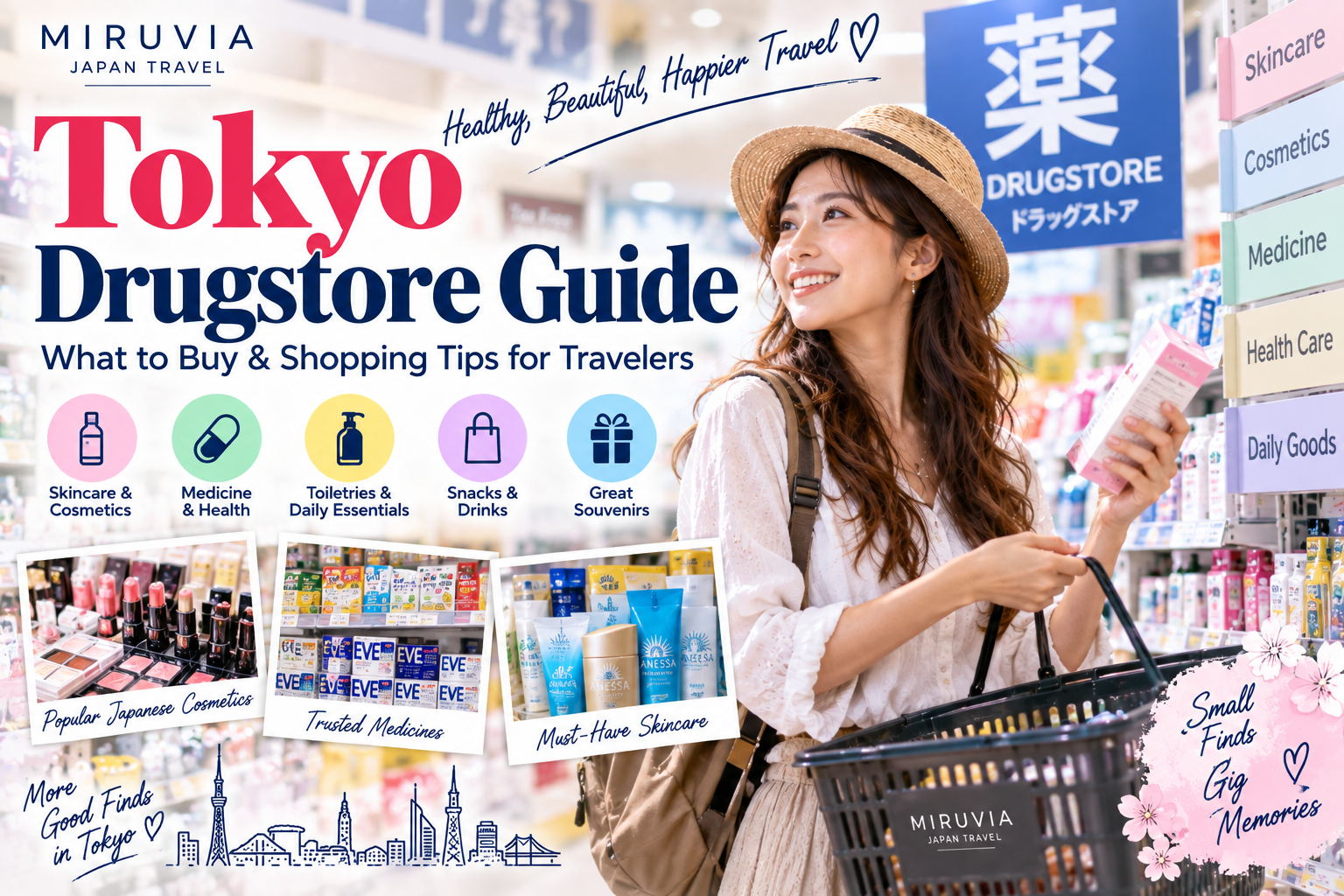
Tokyo’s drugstores are surprisingly useful places for travelers. They are not only places to buy medicine. Many stores also sell skincare products, cosmetics, sunscreen, toiletries, daily necessities, snacks, drinks, and other items that can be useful during a trip.
For first-time visitors, however, shopping at a Japanese drugstore can sometimes be confusing. Product labels may be mostly in Japanese, medicines can have unfamiliar ingredients or dosage instructions, and the difference between a drugstore, convenience store, and pharmacy may not be immediately clear.
This guide explains what travelers can buy at drugstores in Tokyo, how to shop safely, and what to know before purchasing medicine or everyday travel essentials.
Tokyo Drugstores at a Glance
| Topic | What Travelers Should Know |
|---|---|
| Best for | Toiletries, skincare, cosmetics, sunscreen, medicine and daily essentials |
| Locations | Common around major stations and shopping districts |
| Prices | Often competitive, but vary by store and location |
| Payment | Cash and major cashless methods are widely accepted |
| Medicine | Some products require help from qualified staff |
| Language | English support varies by location |
| Tax-free shopping | Available at some stores for eligible purchases |
| Best tip | Ask staff if you are unsure about a medicine or product |
What Is a Japanese Drugstore?
Japanese drugstores are retail stores that sell a wide range of health, beauty, and everyday products.
Although the word “drugstore” may suggest a shop focused mainly on medicine, many Japanese drugstores feel more like a combination of a pharmacy, beauty store, and small general store.
Depending on the location, you may find:
- Over-the-counter medicine
- Skincare products
- Cosmetics
- Sunscreen
- Shampoo and haircare products
- Toothbrushes and toothpaste
- Contact lens supplies
- Masks
- Personal hygiene products
- Travel-size toiletries
- Snacks and drinks
- Household items
This makes drugstores especially useful when you forget something at home or need to replace an item during your trip.
Drugstore vs Pharmacy in Japan
Travelers should understand that a drugstore and a pharmacy are not always the same thing in Japan.
A drugstore usually sells a broad range of health, beauty, and daily-use products. Many also sell over-the-counter medicines.
A pharmacy, particularly one associated with a clinic or hospital, may focus more on dispensing prescription medication.
If you need prescription medicine or medical advice, do not assume that every drugstore can provide the service you need.
For minor everyday purchases such as toiletries, sunscreen, skincare products, or commonly available over-the-counter products, a drugstore is often convenient.
Best Things to Buy at Tokyo Drugstores
Tokyo drugstores can be useful even if you do not need medicine. Here are some of the most practical categories for travelers.
For more ideas on what to buy in Tokyo, including souvenirs, fashion, electronics, and Japanese products, see our Tokyo Shopping Guide for First-Time Visitors.
1. Sunscreen
Japanese sunscreen is one of the most popular drugstore purchases among international visitors.
You can find products designed for different preferences, including lightweight formulas, water-resistant options, facial sunscreens, and products intended for everyday use.
Sunscreen can be particularly useful during Tokyo’s warmer months, but UV protection may also be worth considering throughout the year.
2. Skincare Products
Drugstores typically have extensive skincare sections.
Common products include:
- Facial cleansers
- Moisturizers
- Sheet masks
- Toners and lotions
- Cleansing oils
- Lip care
- Hand creams
The selection can be much larger than travelers expect.
Because product descriptions may primarily be in Japanese, use a translation app or ask staff when you are uncertain about ingredients or intended use.
3. Japanese Cosmetics
Cosmetics are another major reason travelers visit Japanese drugstores.
Depending on the store, you may find:
- Mascara
- Eyeliner
- Foundation
- Concealer
- Lip products
- Eyebrow products
- Makeup removers
- Beauty accessories
Some larger stores have multiple floors or large dedicated beauty sections.
4. Travel-Size Toiletries
Forgot shampoo, toothpaste, facial cleanser, or another basic item?
A drugstore is one of the easiest places to replace it.
Travel-size products can also be useful if you want to reduce the amount of toiletries you carry during your trip.
5. Toothbrushes and Dental Care
Japanese drugstores usually have a wide selection of:
- Toothbrushes
- Toothpaste
- Dental floss
- Mouthwash
- Other oral-care products
These items are easy to replace if you forget them at your hotel or need something during a longer stay.
6. Haircare Products
Shampoo, conditioner, hair treatments, styling products, and hair accessories are widely available.
However, full-size bottles can add considerable weight to your luggage, so consider how much space you have before buying several products.
7. Personal Hygiene Products
Drugstores are useful for purchasing everyday hygiene items such as:
- Tissues
- Wet wipes
- Masks
- Hand sanitizer
- Menstrual products
- Razors
- Deodorant
- Cotton swabs
These are particularly useful for travelers staying in Tokyo for several days or longer.
8. Contact Lens Supplies
Some drugstores sell contact lens care products and related supplies.
Availability varies, so travelers who depend on specific products should still bring sufficient supplies from home whenever possible.
9. Cooling and Warming Products
Depending on the season, Japanese drugstores may sell products designed to make hot or cold weather more comfortable.
In summer, you may see cooling wipes, cooling sprays, and other heat-related products.
During colder months, disposable pocket warmers known as “kairo” are widely available.
These inexpensive products can be useful when sightseeing outdoors for long periods.
10. Snacks and Drinks
Many drugstores also sell packaged snacks, bottled drinks, nutritional products, and sometimes basic food items.
The selection is generally smaller than a supermarket, but prices can sometimes be attractive.
Buying Medicine at a Tokyo Drugstore
Many Tokyo drugstores sell over-the-counter medicines, but travelers should be more careful when buying medicine than when purchasing ordinary toiletries.
Products may include remedies for common issues such as:
- Headaches
- Cold symptoms
- Stomach discomfort
- Motion sickness
- Allergies
- Minor aches and pains
However, medicines sold in Japan may contain different active ingredients, strengths, combinations, or dosage instructions from products with similar purposes in your home country.
Do not choose medicine based only on the package design or product category.
Ask the Staff Before Buying Medicine
If you are unsure which medicine is appropriate, ask a staff member for assistance.
Some medicines in Japan can only be sold when qualified personnel are available, and availability may therefore depend on the store and time of day.
When asking for help, explain your symptoms as clearly as possible.
A translation app can be helpful if there is a language barrier.
Useful information to communicate may include:
- Your symptoms
- How long you have had them
- Any allergies
- Other medicines you are taking
- Relevant medical conditions
If your symptoms are serious, unusual, or worsening, seek appropriate medical care rather than relying on a drugstore purchase.
Check the Active Ingredients
Do not assume that a familiar-looking Japanese product contains the same ingredients as a medicine sold in your country.
Before taking any medicine, confirm:
- Active ingredients
- Dosage
- Frequency
- Warnings
- Contraindications
- Age restrictions
If you cannot understand the instructions, ask qualified staff for help rather than guessing.
Bringing Medicine Into Japan
Travelers who already take medication should research Japan’s rules before departure.
Import rules can differ depending on the medicine, ingredient, quantity, and whether the medication is prescription or non-prescription.
Some medicines that are commonly available in other countries may be regulated differently in Japan.
For essential medication, check the applicable official Japanese requirements before traveling and keep medicines in their original packaging whenever practical.
Where Can You Find Drugstores in Tokyo?
Drugstores are common throughout central Tokyo.
You will frequently see them around:
- Major train stations
- Shopping streets
- Department store areas
- Tourist districts
- Busy commercial neighborhoods
Areas such as Shinjuku, Shibuya, Ueno, Asakusa, Ginza, Ikebukuro, and Akihabara generally have many shopping options.
You usually do not need to make a special trip across Tokyo just to find basic drugstore products.
Shopping at Drugstores Near Major Stations
Stores near major stations are convenient because you can combine shopping with sightseeing or your journey back to the hotel.
However, busy stores in major tourist districts may feel crowded, particularly during popular shopping hours.
If you only need a few basic items, a smaller store closer to your accommodation may be easier.
How to Find a Drugstore in Tokyo
The easiest method is to search your map application for terms such as:
- Drugstore
- Pharmacy
- ドラッグストア
Check the store information carefully because search results may include both general drugstores and pharmacies focused primarily on prescription services.
Opening hours also vary by location.
How Checkout Works
Checkout at a Japanese drugstore is generally straightforward.
Bring your items to the register and follow the instructions from the cashier or payment terminal.
Depending on the store, you may encounter:
- Staff-operated registers
- Semi-self-service payment machines
- Self-checkout systems
If you are confused, staff can usually indicate where to place your items or how to complete payment.
Payment Methods
Payment options vary by store, but many Tokyo drugstores accept several methods, including:
- Cash
- Major credit cards
- IC cards at some locations
- Mobile or QR-based payments at participating stores
Do not assume every payment method will be accepted everywhere.
Having a backup payment method is useful while traveling in Japan.
Shopping Bags
Stores may charge a small fee for plastic shopping bags.
If you already carry a reusable bag, you can use it for drugstore purchases.
This is especially useful if you plan to shop frequently during your trip.
Tax-Free Shopping at Tokyo Drugstores
Some larger drugstores offer tax-free shopping to eligible international visitors.
The rules and procedures can change, and not every store participates.
If you want to use tax-free shopping, check the current requirements and ask the store before completing your purchase.
You may need to present your passport or satisfy other eligibility requirements.
Do not assume that every item in the store qualifies.
Drugstore vs Convenience Store
Both can be useful, but they serve different purposes.
A convenience store is generally better for quick food, drinks, basic toiletries, ATMs, and everyday services.
A drugstore usually offers a much larger selection of skincare, cosmetics, personal-care products, health-related products, and medicine.
If you only need a toothbrush or a small packet of tissues, either may work.
If you want to compare several sunscreens or skincare products, a drugstore will usually offer more choice.
For food, ATMs, everyday services, and other useful konbini features, see our Tokyo Convenience Store Guide.
Drugstore vs Supermarket
Supermarkets are generally better for groceries, fresh food, prepared meals, fruit, drinks, and larger food purchases.
Drugstores focus more heavily on health, beauty, toiletries, and personal-care products, although some also sell snacks and drinks.
For travelers, using both can be practical: supermarkets for food and drugstores for toiletries and personal essentials.
For groceries, prepared meals, Japanese snacks, and everyday food shopping, read our Tokyo Supermarket Guide.
Drugstores for Beauty Shopping
Beauty products can take up a significant portion of a Japanese drugstore.
For travelers interested in Japanese skincare or cosmetics, this makes drugstores an easy place to browse several products in one visit.
However, avoid buying a product simply because it is popular online.
Check whether it is appropriate for your skin, how it should be used, and whether you understand the ingredients and instructions.
Can You Test Products?
Tester availability depends on the store and product.
Never open a sealed product unless it is clearly marked as a tester.
If you are unsure whether you can try something, ask a staff member.
Check Product Sizes Before Buying
Large shampoo bottles, skincare products, liquids, and multiple cosmetic items can quickly make your luggage heavier.
Before buying, consider:
- Remaining luggage space
- Airline baggage limits
- Liquid restrictions for carry-on baggage
- Whether the product is available at home
- How much you will realistically use
A product may be inexpensive but still inconvenient if it makes your luggage overweight.
Drugstores for Forgotten Travel Essentials
One of the most practical uses of a Tokyo drugstore is replacing forgotten items.
Common examples include:
- Toothpaste
- Sunscreen
- Shampoo
- Razor
- Hairbrush
- Menstrual products
- Contact lens solution
- Face wash
- Moisturizer
- Masks
- Wet wipes
You usually do not need to pack large quantities of ordinary toiletries “just in case” when they are easily available in Tokyo.
However, bring enough of any specialized or medically necessary product that may be difficult to replace.
Seasonal Items at Tokyo Drugstores
The products displayed prominently often change with the season.
Spring
You may see products related to pollen season, masks, tissues, and skincare.
Summer
Expect sunscreen, cooling wipes, cooling sprays, hydration-related products, and insect-related products.
Autumn
Skincare and moisturizing products become increasingly visible as the weather changes.
Winter
Hand cream, lip balm, moisturizing products, masks, and disposable warmers become particularly common.
Seasonal sections can be useful because they highlight products related to the weather conditions travelers are currently experiencing.
Food and Drinks at Drugstores
Some Japanese drugstores sell surprisingly large selections of snacks and drinks.
You may find:
- Bottled water
- Tea
- Coffee
- Soft drinks
- Chocolate
- Candy
- Biscuits
- Nutrition bars
- Packaged snacks
However, if food is your main purpose, a supermarket or convenience store will usually provide a more useful selection.
Common Drugstore Mistakes
Buying Medicine Without Checking Ingredients
Never choose medicine only because the package appears to match your symptoms.
Assuming Every Drugstore Has the Same Products
Stock, store size, and available services vary significantly.
Opening Sealed Cosmetics
Only use clearly designated testers.
Buying Too Many Heavy Products
Liquids and full-size toiletries can quickly increase luggage weight.
Assuming Everything Is Tax-Free
Eligibility depends on current rules, the store, the customer, and the purchase.
Waiting Until the Airport to Solve a Problem
If you need an important travel essential, buy it while you still have time to compare products or ask for assistance.
Practical Tips for First-Time Visitors
A few simple habits can make drugstore shopping easier.
Use a translation app.
Product labels may contain important information only in Japanese.
Take a photo of a product you need to replace.
Showing staff a photo can be easier than trying to explain the exact item.
Compare products carefully.
Japanese drugstores often have many similar-looking options.
Ask before buying medicine.
Qualified staff can help you avoid choosing an inappropriate product.
Keep your receipt.
This can be useful if you need to confirm what you purchased.
Check your luggage space.
Beauty and personal-care shopping can become surprisingly bulky.
Do not depend on a drugstore for serious medical problems.
Seek appropriate medical care when necessary.
Is Visiting a Tokyo Drugstore Worth It?
For most travelers, yes — especially if you need toiletries, sunscreen, skincare, cosmetics, or everyday travel essentials.
You do not necessarily need to include a drugstore as a major sightseeing destination. Instead, it can fit naturally into your itinerary while you are already exploring a shopping district or returning to your hotel.
Even a short visit can provide a useful look at everyday shopping in Japan.
Final Thoughts
Tokyo drugstores are much more than places to buy medicine.
They can help travelers replace forgotten toiletries, discover Japanese skincare and cosmetics, prepare for seasonal weather, and pick up practical everyday items during a trip.
The key is to treat medicines differently from ordinary shopping products. Check ingredients and instructions carefully, and ask qualified staff when you are unsure.
For everything else, a Tokyo drugstore can be one of the easiest and most convenient places to solve small travel problems while exploring the city.
Continue planning your trip with our complete Tokyo Travel Guide for First-Time Visitors.
