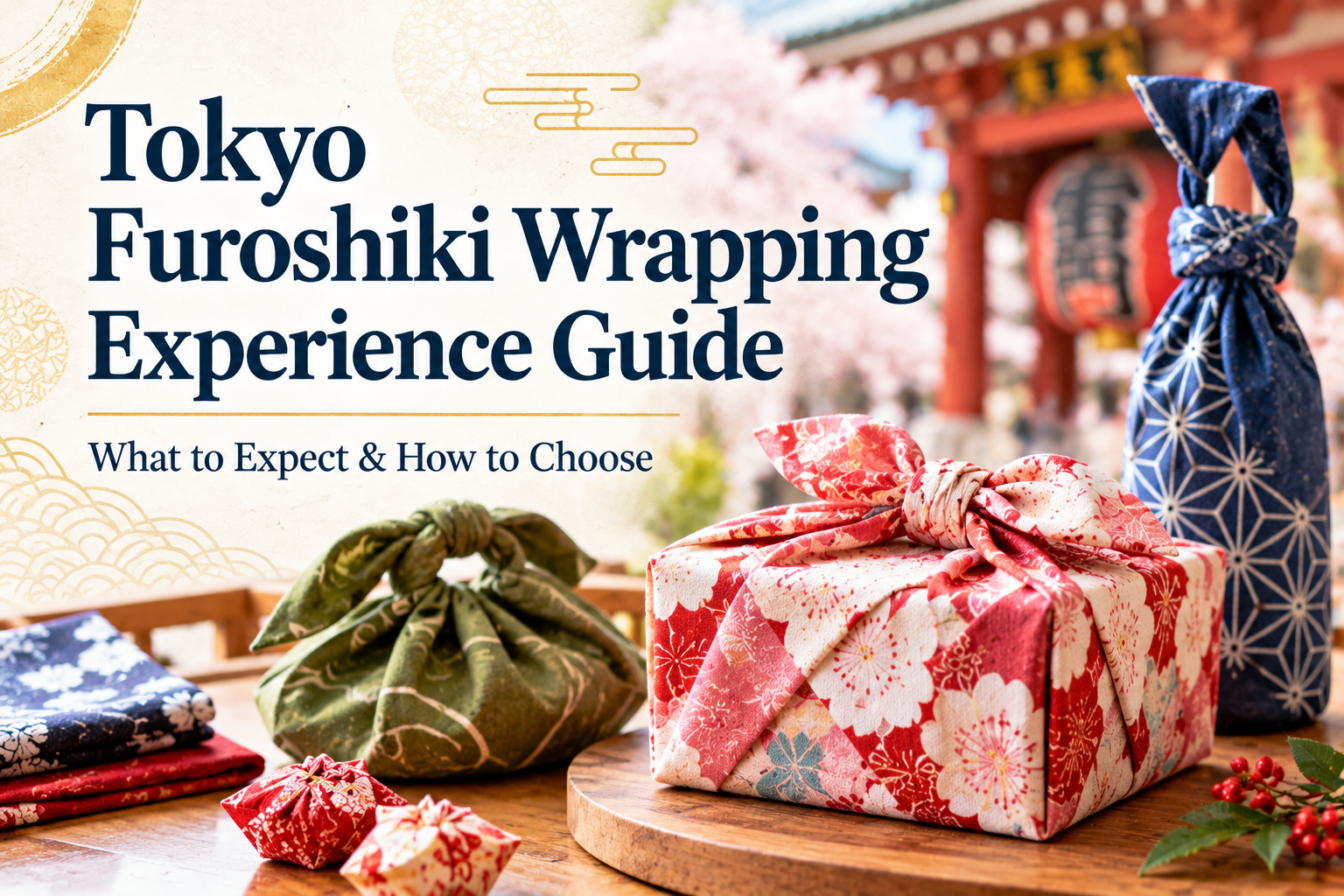
Discover Furoshiki: The Japanese Art of Wrapping with Cloth
Furoshiki is a traditional Japanese wrapping cloth used to carry, protect, and present objects. With a few simple folding and tying techniques, a square piece of fabric can become a reusable gift wrap, bottle carrier, shopping bag, or decorative package.
For travelers visiting Tokyo, a furoshiki wrapping experience offers a hands-on introduction to Japanese everyday culture. Unlike crafts that require specialized equipment, furoshiki focuses on practical skills that you can continue using after your trip.
A beginner-friendly workshop may teach you how to wrap gifts, carry bottles, tie secure knots, and choose suitable fabrics. Some experiences also include a furoshiki cloth that you can take home as a souvenir.
This guide explains what furoshiki is, what happens during a workshop, typical prices and durations, and how to choose a suitable experience in Tokyo.
What Is Furoshiki?
Furoshiki refers to a square piece of cloth traditionally used in Japan for wrapping and carrying belongings.
The cloth can be folded and tied in different ways depending on the size, shape, and purpose of the object being wrapped.
Unlike disposable wrapping paper, furoshiki can be untied, washed when appropriate, and reused.
Furoshiki is commonly associated with gift presentation, but it can also serve practical purposes in everyday life.
A Brief History of Furoshiki
Cloth wrapping has a long history in Japan.
Forms of wrapping cloth were used to protect and transport belongings, and the practice evolved over centuries.
The word “furoshiki” is associated with public bathing culture, when cloths were used to hold clothing and personal items.
Over time, furoshiki became widely used for carrying goods and presenting gifts.
Today, the practice remains part of Japanese culture and has attracted renewed interest as a reusable alternative to disposable packaging.
What Makes Furoshiki Special?
Furoshiki combines simplicity, flexibility, and visual presentation.
One square cloth can be used in many different ways without cutting, sewing, or permanent modifications.
The same fabric may function as:
- Reusable gift wrapping
- A shopping bag
- A bottle carrier
- A lunch box wrap
- A decorative package
- A protective covering for personal items
The possibilities depend on the cloth’s size, material, and the wrapping technique.
Why Try a Furoshiki Wrapping Experience in Tokyo?
A furoshiki workshop is a convenient cultural activity for travelers who want to learn something practical while exploring Japanese traditions.
Learn a Useful Japanese Skill
Unlike some craft activities that focus on creating a single decorative object, furoshiki teaches techniques you can use repeatedly.
Once you understand a few basic knots and folds, you can adapt them to different objects.
Create a Personal Travel Souvenir
Some workshops provide a furoshiki cloth for participants to keep.
You may be able to choose a pattern, color, or fabric that reflects your personal style.
A reusable wrapping cloth can be both a souvenir and a practical travel accessory.
Explore Japanese Gift-Giving Culture
Gift presentation is an important part of many social occasions in Japan.
Furoshiki provides an opportunity to learn how presentation, care, and consideration can be expressed through wrapping.
Instructors may also explain differences between everyday wrapping and more formal gift presentation.
Enjoy an Accessible Indoor Activity
Many furoshiki workshops take place indoors.
They can be a convenient option during rainy weather or when you want a break from outdoor sightseeing.
Because basic wrapping techniques require relatively little equipment, introductory sessions may also be suitable for travelers with limited time.
What Happens During a Furoshiki Workshop?
The exact activities vary depending on the instructor and workshop format.
A typical beginner-friendly experience may include the following stages.
Step 1: Introduction to Furoshiki
The instructor explains what furoshiki is and how it has been used in Japan.
You may learn about traditional patterns, common fabric materials, and the cultural background of cloth wrapping.
Some workshops also demonstrate how different cloth sizes affect the wrapping possibilities.
Step 2: Learn Basic Knots
Many furoshiki techniques rely on simple knots.
A commonly taught method is the ma-musubi, or square knot, which can create a secure tie when performed correctly.
The instructor may explain how to tie and untie the knot without damaging the fabric.
Practicing the basic knot is often the foundation for more advanced wrapping styles.
Step 3: Practice Gift Wrapping
You may learn how to wrap a small box or rectangular object.
The instructor demonstrates how to position the object, fold the fabric, and create a balanced presentation.
This technique is useful for gifts and souvenirs.
Step 4: Learn Bottle Wrapping
Bottle wrapping is a popular furoshiki technique.
Depending on the lesson, you may practice wrapping one bottle or carrying two bottles together.
The instructor will show how to create secure handles and prevent objects from shifting.
Step 5: Create a Simple Carrying Bag
Some workshops teach participants how to transform a cloth into a temporary bag.
This may involve tying corners together to form handles.
The result can be useful for carrying light purchases or personal belongings.
Step 6: Explore Different Designs
If time allows, the instructor may demonstrate decorative variations.
You may experiment with different cloth patterns, knot positions, and wrapping styles.
Some workshops encourage participants to photograph their finished arrangements for future reference.
How Long Does a Furoshiki Workshop Take?
Furoshiki experiences are often shorter than workshops involving pottery, lacquer, or other materials that require drying or curing.
However, duration depends on the number of techniques taught and whether the session includes cultural explanations.
| Workshop Type | Approximate Duration | What to Expect |
|---|---|---|
| Short introductory lesson | 30–60 minutes | Basic knots and simple wrapping |
| Beginner hands-on workshop | 60–90 minutes | Several wrapping techniques with guided practice |
| Extended cultural workshop | 90 minutes–2 hours | More techniques, fabric information, and cultural background |
| Private or customized session | Varies | Instruction adapted to participants’ interests |
These are general planning estimates rather than guaranteed schedules.
If you have a busy sightseeing itinerary, a one-hour workshop may be a convenient option.
Travelers who want to explore multiple wrapping styles may prefer a longer session.
How Much Does a Furoshiki Experience Cost in Tokyo?
Prices depend on the provider, session duration, group size, and whether a cloth is included.
For general trip planning, introductory furoshiki experiences may cost approximately ¥2,000–¥6,000 per person.
Private lessons, premium fabrics, and specialized cultural experiences may cost more.
These amounts are indicative estimates, not verified prices for specific workshops.
What Affects the Price?
Workshop costs may vary according to:
- Session duration
- Number of participants
- Private or group instruction
- English-language support
- Whether a furoshiki cloth is included
- Fabric quality and size
- Number of wrapping techniques taught
- Additional cultural activities
Always check the latest price and inclusions before booking.
Is the Furoshiki Cloth Included?
Not every workshop includes a cloth that participants can keep.
Some providers lend practice cloths during the lesson.
Others include a basic cloth in the participation fee or offer a selection of fabrics for an additional charge.
Before booking, confirm whether the cloth is included and whether you can choose its design.
Can Beginners Join a Furoshiki Workshop?
Yes. Many introductory furoshiki experiences are designed for people with no previous knowledge of Japanese wrapping techniques.
Most basic methods involve folding and tying fabric rather than using specialized tools.
An instructor can demonstrate each step and help you correct the position of the cloth or knot.
What Makes a Workshop Beginner-Friendly?
Look for an experience that offers:
- Step-by-step demonstrations
- Enough time to practice each technique
- Clear instructions
- Suitable cloth sizes
- A manageable number of wrapping styles
- Opportunities to ask questions
- Guidance on using the techniques at home
A well-structured introductory workshop should help you understand how to repeat the techniques independently.
Are English-Language Furoshiki Workshops Available?
Some cultural experience providers in Tokyo offer furoshiki instruction in English.
Others may provide Japanese-language lessons with translated materials or interpretation.
Language support can vary depending on the instructor and date.
Before booking, check whether:
- The instructor speaks English
- The entire session is conducted in English
- English-language printed instructions are included
- Interpretation is available
- A private English-language session can be arranged
Because wrapping is a visual activity, demonstrations can be helpful even when language support is limited.
However, clear instruction remains important, particularly when learning how to tie secure knots.
Where Can You Experience Furoshiki in Tokyo?
Furoshiki workshops may be offered by cultural experience providers, craft studios, specialty shops, and independent instructors.
Availability changes, so it is important to confirm current schedules rather than assuming a particular venue offers regular classes.
Asakusa
Asakusa is a popular area for travelers interested in traditional Japanese culture.
A furoshiki experience in or near Asakusa can fit naturally into a day exploring Senso-ji Temple, Nakamise shopping street, and nearby traditional shops.
The area’s cultural atmosphere makes it a convenient location for combining sightseeing with hands-on activities.
Ginza and Central Tokyo
Central Tokyo may offer convenient access to cultural workshops and specialty stores.
A furoshiki lesson can be combined with department store shopping, souvenir browsing, or visits to nearby attractions.
Check the exact meeting location and nearest train station before booking.
Other Tokyo Neighborhoods
Independent instructors and cultural studios may operate in residential or creative neighborhoods.
These experiences can be appealing if you prefer smaller groups or more personalized instruction.
However, check transportation options and reservation requirements carefully.
How to Choose the Right Furoshiki Workshop
Not every furoshiki experience teaches the same techniques or includes the same materials.
The following factors can help you select the right workshop.
1. Check Which Wrapping Techniques Are Taught
Some lessons focus on basic gift wrapping.
Others include bottle wrapping, bag-making, and decorative styles.
If you have a particular use in mind, choose a workshop that teaches the relevant technique.
2. Confirm the Workshop Duration
A short lesson may cover only a few methods.
Longer sessions may provide more practice time and cultural background.
Choose a duration that fits your schedule and learning goals.
3. Ask About the Cloth
Confirm whether you will receive a cloth to take home.
If a cloth is included, check its approximate size, material, and whether you can select a design.
4. Review Language Support
If you prefer English-language instruction, verify that the instructor or interpreter will be available for your chosen session.
5. Consider Group Size
Small groups may allow more personalized guidance.
Private workshops can be useful for travelers who want to focus on particular wrapping techniques.
6. Check the Location
Choose a workshop that fits your sightseeing route.
A convenient location can make a short cultural experience easier to include in your itinerary.
7. Review Cancellation Policies
Travel plans can change.
Check the cancellation deadline, refund conditions, and whether the provider allows rescheduling.
How to Choose a Furoshiki Cloth
If your workshop allows you to select a cloth, understanding a few basic differences can help.
Cotton Furoshiki
Cotton is a practical choice for many everyday uses.
It is often relatively easy to handle and may be washable, depending on the fabric and care instructions.
Cotton cloths can work well for reusable bags and casual gift wrapping.
Polyester Furoshiki
Polyester cloths are available in many colors and patterns.
They may be lightweight and relatively easy to maintain.
However, texture and slipperiness can vary.
Silk Furoshiki
Silk is associated with elegant presentation and may be used for special occasions.
Silk cloths can require more careful handling and cleaning.
For beginners, a more durable everyday fabric may be easier to practice with.
Choosing the Right Size
Furoshiki comes in different sizes.
Smaller cloths may be suitable for compact gifts or lunch boxes.
Medium-sized cloths can be useful for wrapping boxes and carrying small items.
Larger cloths may be used for bags or bulkier objects.
A workshop instructor can help you understand which size works best for your intended use.
Popular Furoshiki Wrapping Techniques
Different techniques are designed for different objects.
Otsukai Tsutsumi: Basic Gift Wrapping
Otsukai tsutsumi is a commonly taught wrapping style for rectangular boxes.
The cloth is positioned around the object and secured with a knot.
It is a useful starting point for beginners.
Bin Tsutsumi: Bottle Wrapping
Bin tsutsumi refers to wrapping techniques for bottles.
Depending on the method, the cloth can protect a bottle or create a carrying handle.
Bag-Style Wrapping
Some techniques transform a furoshiki into a simple carrying bag.
These methods can be useful for light shopping or transporting personal items.
Decorative Gift Presentation
Decorative wrapping styles emphasize the appearance of the finished package.
They may use different knot placements or fabric arrangements.
The most suitable method depends on the shape and size of the item.
Furoshiki as a Sustainable Travel Souvenir
One reason furoshiki appeals to modern travelers is its reusability.
A cloth can replace some forms of disposable gift wrapping and can be repurposed for different tasks.
However, the environmental impact of a furoshiki depends on factors such as its material, production, and how often it is reused.
A practical approach is to choose a cloth you genuinely like and expect to use repeatedly.
Ways to Use Furoshiki After Your Trip
You can use your furoshiki to:
- Wrap birthday or holiday gifts
- Carry small shopping purchases
- Wrap a lunch box
- Organize belongings in a suitcase
- Protect certain items during travel
- Create decorative packaging
- Store small personal objects
Learning several techniques during a workshop can make your souvenir more useful.
Can Children Join a Furoshiki Workshop?
Many basic furoshiki activities may be suitable for families.
The techniques generally do not require sharp tools or heated equipment.
However, minimum ages and participation rules vary by provider.
Younger children may need assistance with knots and more complicated folds.
Before booking, confirm:
- Minimum participant age
- Whether adults must accompany children
- Availability of smaller cloths
- Session duration
- Whether family-friendly instruction is provided
A short introductory workshop may be a practical option for families with younger children.
Is Furoshiki Wrapping Difficult?
Basic furoshiki techniques are generally accessible to beginners.
The main skills involve positioning the cloth, adjusting tension, and tying knots securely.
More elaborate wrapping styles may require practice.
The easiest way to improve is to repeat the same technique with objects of different sizes.
Common Beginner Mistakes
First-time participants may:
- Choose a cloth that is too small
- Position the object off-center
- Tie a knot too loosely
- Pull the fabric unevenly
- Use a slippery cloth for a difficult technique
- Try to learn too many styles at once
An instructor can help you recognize and correct these issues.
Furoshiki vs Other Traditional Japanese Experiences
Tokyo offers many hands-on cultural activities.
Comparing them can help you choose an experience that matches your interests.
Furoshiki vs Washi Paper Making
Washi paper making focuses on creating traditional Japanese paper from plant fibers.
Participants may learn how paper sheets are formed and decorated.
Furoshiki focuses on folding and tying reusable cloth.
Choose washi paper making if you enjoy working with paper and natural materials.
Choose furoshiki if you want to learn practical wrapping techniques.
Furoshiki vs Indigo Dyeing
Indigo dyeing involves coloring fabric with dye to create patterns.
Participants may use folding or binding techniques to produce different designs.
Furoshiki wrapping uses finished cloth and does not normally involve dyeing.
Indigo dyeing may appeal to travelers who want to create fabric patterns, while furoshiki is suitable for learning how to use cloth in different ways.
Furoshiki vs Traditional Craft Workshops
Furoshiki is one of many hands-on cultural activities available to travelers in Tokyo.
Other traditional craft workshops may involve ceramics, paper, printing, or textiles.
Furoshiki can be a good choice if you prefer an experience with minimal equipment and techniques you can practice at home.
Furoshiki vs Japanese Souvenir Shopping
Shopping for Japanese souvenirs allows you to explore local products, crafts, and gifts.
A furoshiki workshop adds an educational element by teaching you how to use a traditional Japanese item.
If you enjoy shopping, you can combine a workshop with a visit to a specialty store to find additional cloth designs.
Practical Tips for Your First Furoshiki Workshop
A few simple preparations can help you get more from the experience.
Book Ahead
Workshop schedules may be limited.
Advance booking is especially helpful if you need English-language instruction or want a private session.
Bring a Small Notebook or Phone
You may want to record the names of wrapping techniques or photograph the steps.
Always ask the instructor before recording videos or taking photographs.
Practice Each Knot More Than Once
Repeating the basic knot can help you remember it.
Focus on a few techniques you are likely to use rather than trying to memorize every variation.
Ask About Fabric Care
If you receive a cloth, ask how to wash and store it.
Care requirements depend on the material.
Check Your Travel Schedule
Allow enough time to reach the workshop and participate without rushing.
Confirm the meeting point and whether late arrivals are accepted.
Learn How to Reuse Your Cloth
Before leaving, try wrapping several different objects.
This can help you understand how to adapt the techniques once you return home.
Frequently Asked Questions About Furoshiki Experiences in Tokyo
What is furoshiki?
Furoshiki is a traditional Japanese square wrapping cloth used to carry, protect, and present objects.
Do I need experience to join a workshop?
No. Many furoshiki workshops are suitable for beginners and teach basic techniques step by step.
How long does a furoshiki workshop take?
Introductory sessions may take approximately 30–90 minutes, although longer cultural workshops are also available.
How much does a furoshiki workshop cost?
For planning purposes, introductory experiences may cost around ¥2,000–¥6,000 per person, with higher prices possible for private or specialized sessions.
Can I take my furoshiki home?
Some workshops include a cloth that participants can keep, while others use loaned practice materials. Confirm before booking.
Are English-language workshops available?
Some providers offer English-language instruction, but availability depends on the workshop and instructor.
Is furoshiki suitable for children?
Many basic activities may be suitable for children, but age requirements and supervision policies vary.
Can I use furoshiki instead of a shopping bag?
Yes. Certain wrapping techniques can turn a suitable cloth into a temporary carrying bag for lightweight items.
Is furoshiki the same as origami?
No. Origami typically involves folding paper, while furoshiki uses cloth and often incorporates knots to wrap or carry objects.
Can I buy furoshiki in Tokyo?
Yes. Furoshiki cloths may be available at specialty shops, department stores, and stores selling traditional Japanese goods.
Final Thoughts: Is a Furoshiki Experience Worth Trying in Tokyo?
A furoshiki wrapping workshop offers a practical introduction to Japanese culture through a simple and versatile craft.
It is particularly suitable for travelers who enjoy hands-on activities, traditional design, and souvenirs they can continue using after their trip.
Whether you want to learn elegant gift wrapping, create a reusable bag, or understand Japanese wrapping customs, a beginner-friendly workshop can provide useful skills and a memorable cultural experience.
Before booking, compare the techniques taught, workshop duration, language support, cloth inclusions, and location.
With the right workshop, you can leave Tokyo with both a traditional Japanese cloth and the knowledge to use it in everyday life.
