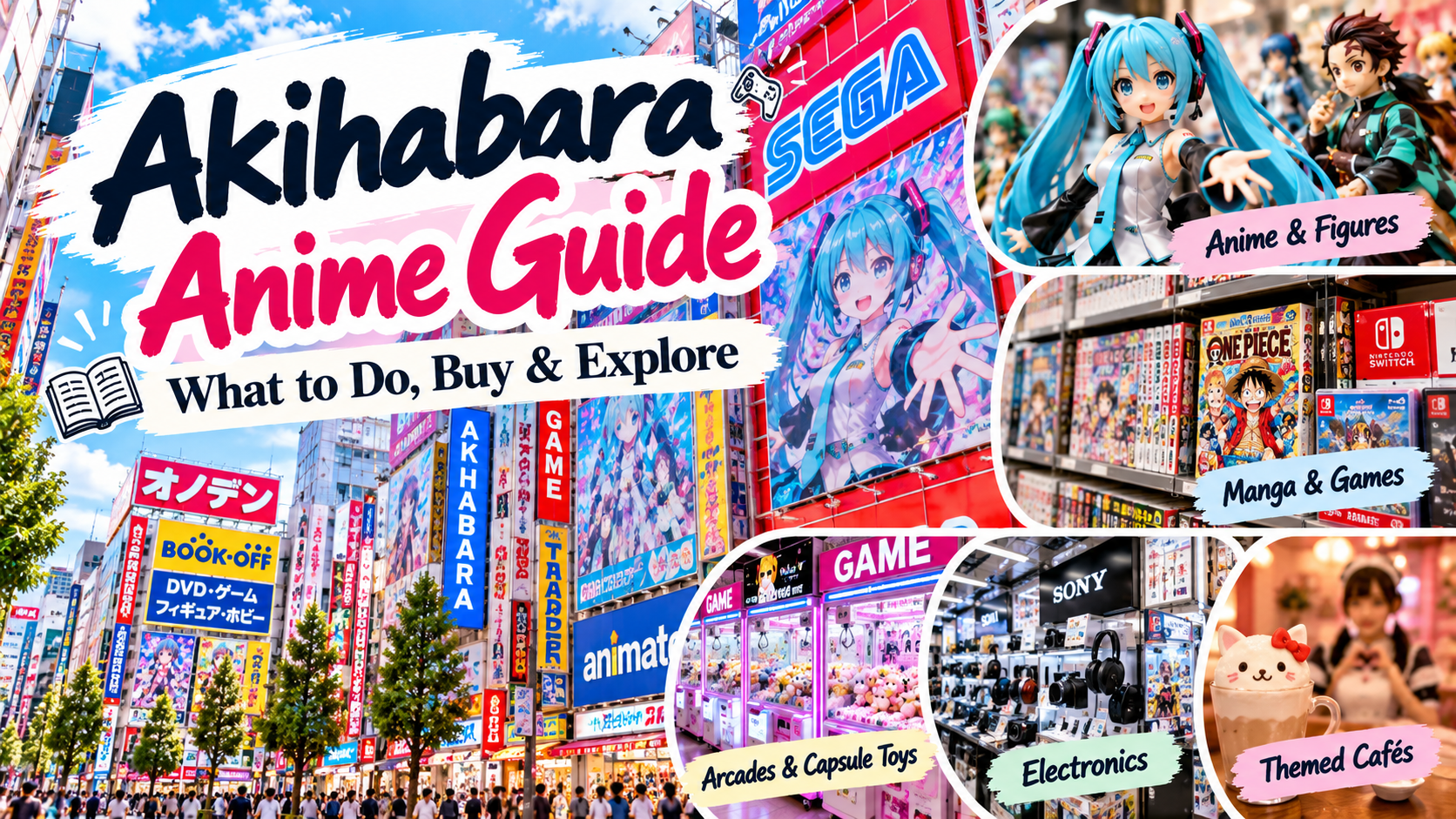
Akihabara is one of Tokyo’s most famous destinations for anime, manga, video games, figures, electronics, and Japanese pop culture.
For first-time visitors, however, the neighborhood can be surprisingly difficult to understand.
Colorful signs cover entire buildings, specialty stores are stacked across multiple floors, and similar-looking shops may sell completely different types of merchandise. It is easy to spend hours walking around without knowing where to focus.
The key is not trying to see everything.
This Akihabara anime guide explains what to do, what to buy, how to explore the area, how much time to spend, and how first-time and repeat visitors can get more from a visit.
Why Visit Akihabara?
Akihabara is closely associated with anime, manga, gaming, electronics, and otaku culture.
Visitors can explore:
- Anime merchandise
- Manga
- Figures
- Character goods
- Trading cards
- Retro video games
- Modern gaming products
- Arcades
- Capsule toys
- Electronics
- Collectibles
- Themed cafés
The neighborhood is particularly interesting because these categories exist side by side.
You can browse figures, play arcade games, search for an older video game, buy character merchandise, and explore electronics stores within the same general area.
Miruvia’s Take: Visit Akihabara With a Purpose
Akihabara is more enjoyable when you arrive with one or two priorities.
For example:
- Anime merchandise
- Figures
- Retro games
- Manga
- Trading cards
- Arcades
- Electronics
- General sightseeing
Without a priority, the enormous number of shops can become exhausting.
For a first visit, choose your main interests before arriving and treat everything else as optional discovery.
This still leaves room for spontaneous exploration while preventing the neighborhood from becoming overwhelming.
What Is Akihabara Best Known For?
Akihabara has changed significantly over time.
It developed a strong reputation for electronics before becoming internationally famous for anime, manga, games, and otaku culture.
Today, both identities remain visible.
Some visitors come specifically for character goods and collectibles, while others are interested in electronics, gaming, arcades, or simply experiencing the atmosphere.
You do not need to be a serious anime fan to enjoy walking through Akihabara.
However, travelers interested in Japanese pop culture will generally get the most from the area.
Anime Shopping in Akihabara
Anime shopping is one of the main reasons international visitors come to Akihabara.
Stores can contain merchandise related to:
- Current anime series
- Long-running franchises
- Manga
- Games
- Popular characters
- Idol culture
- Collectible franchises
Products may include:
- Acrylic stands
- Keychains
- Badges
- Posters
- Clear files
- Plush toys
- Figures
- Trading cards
- Character stationery
- Apparel
The selection can vary dramatically from one store to another.
If you are searching for a particular character or series, do not assume the first large store will have the best selection.
How to Shop for Anime Merchandise
Start by identifying the franchise or type of merchandise you want.
For example, searching for “anime goods” is much broader than searching for:
- A specific character
- A specific series
- Scale figures
- Used merchandise
- Trading cards
- Plush toys
Specialized shopping becomes much easier once you know your priority.
If you are simply browsing, set a rough time limit for each store.
Large multi-floor stores can consume much more time than expected.
New vs Secondhand Anime Goods
One important feature of Akihabara is the availability of both new and secondhand merchandise.
Secondhand does not necessarily mean poor condition.
Collectible shops may sell items that are:
- Unopened
- Like new
- Previously displayed
- Missing original packaging
- Older or discontinued
Condition and pricing vary.
Check labels carefully and inspect the item where possible before purchasing.
Secondhand stores can be particularly interesting for travelers searching for older series or merchandise that is no longer widely available.
Buying Anime Figures
Figures are among the most visually impressive products in Akihabara.
You may encounter:
- Prize figures
- Scale figures
- Action figures
- Character statues
- Limited-edition items
- Secondhand figures
- Older collectibles
Prices vary significantly.
A small prize figure and a premium scale figure belong to completely different price categories.
Before buying, consider more than the price.
What to Check Before Buying a Figure
Check:
- Box condition
- Product condition
- Whether the item is new or used
- Whether accessories are included
- Size
- Luggage space
- Price
- Authenticity
For secondhand products, read condition labels carefully.
Large figure boxes can occupy a surprising amount of suitcase space.
If you plan to buy several figures, leave room in your luggage before visiting Akihabara.
Watch Out for Counterfeit Merchandise
Travelers looking for collectibles should pay attention to authenticity.
Buying from established retailers and reputable specialty stores reduces the risk of purchasing counterfeit products.
Be cautious when a supposedly rare or expensive figure is offered at an unusually low price.
Packaging quality, manufacturer information, copyright markings, and overall product quality may provide useful clues, but they are not substitutes for buying from a reliable seller.
For valuable collectibles, store reputation matters.
Manga Shopping in Akihabara
Manga fans can also find extensive selections in Akihabara.
However, remember that most manga sold for the domestic market is in Japanese.
That can still make manga interesting as:
- A collectible
- A souvenir
- Japanese-language reading material
- Artwork reference
- A volume from a favorite series
If you specifically need English-language manga, check availability before assuming it will be easy to find.
Akihabara is primarily designed for the Japanese market.
Retro Games in Akihabara
Retro gaming is another reason travelers visit the neighborhood.
Depending on current inventory, shops may carry:
- Older Nintendo systems
- PlayStation games
- Sega products
- Handheld consoles
- Game cartridges
- Controllers
- Accessories
- Collectible gaming items
Inventory changes constantly, especially for secondhand products.
This means retro-game shopping is better approached as a treasure hunt than as a guaranteed way to find one exact item.
Planning to shop for classic video games? Read our Tokyo Retro Gaming Guide for recommended shopping areas, retro game stores, and practical tips on buying Japanese games and consoles.
Check Compatibility Before Buying Games
Before purchasing Japanese games or hardware, check compatibility with the system you use at home.
Consider:
- Region restrictions
- Language
- Voltage requirements
- Power plugs
- Online services
- Account compatibility
- Hardware condition
Older hardware deserves particular care.
A product being available in Japan does not automatically mean it will work exactly as expected in another country.
Arcades in Akihabara
Arcades add an interactive element to an Akihabara visit.
Depending on the venue, you may encounter:
- Crane games
- Rhythm games
- Fighting games
- Racing games
- Music games
- Other arcade machines
Even travelers who do not normally play games may enjoy visiting briefly to experience the atmosphere.
Crane Games
Crane games can look easier than they are.
The cost of repeated attempts can quickly exceed the value of the prize.
Treat crane games as entertainment rather than as a guaranteed way to obtain merchandise cheaply.
Set a spending limit before playing.
If your goal is simply to own the item, buying it directly from a store may sometimes be more economical.
Capsule Toys
Capsule toy machines are another easy way to experience Japanese character culture.
They may contain:
- Miniature figures
- Keychains
- Character goods
- Food miniatures
- Animals
- Everyday-object miniatures
- Novelty items
Individual purchases are relatively small, but repeated plays can add up.
They also make compact souvenirs compared with large figure boxes.
Electronics in Akihabara
Anime culture dominates much of Akihabara’s modern tourism image, but electronics remain part of the neighborhood’s identity.
Visitors may find:
- Cameras
- Computer accessories
- Audio equipment
- Components
- Cables
- Appliances
- Gaming hardware
- Electronic accessories
Before purchasing electronics for use outside Japan, check specifications carefully.
Buying Electronics for Use Abroad
Important points include:
- Voltage
- Plug type
- Warranty coverage
- Menu language
- Regional compatibility
- Available customer support
Some products designed for Japan may not provide international warranty service.
Do not assume that a lower price automatically makes an electronics purchase worthwhile.
Themed Cafés
Akihabara is known for themed cafés and entertainment-oriented dining experiences.
These may focus on:
- Characters
- Anime franchises
- Games
- Idols
- Maid café culture
The experience is often the main attraction rather than the food itself.
Prices, reservation systems, photography rules, and service formats vary considerably.
Check the current official information for any specific café you want to visit.
Maid Cafés
Maid cafés are strongly associated with Akihabara’s tourism image.
For some visitors, they are a memorable cultural entertainment experience.
For others, they may not be appealing.
You do not need to visit one to have a complete Akihabara experience.
If you do go, understand that the concept usually involves themed interaction and entertainment rather than simply having coffee.
Check:
- Entry or seating charges
- Time limits
- Menu prices
- Photography rules
- Additional service charges
before entering.
Photography Etiquette in Akihabara
Akihabara is highly photogenic, but not everything should be photographed.
Be particularly careful inside:
- Stores
- Arcades
- Cafés
- Specialty venues
Photography policies vary.
Some stores allow photos in certain areas while prohibiting them elsewhere.
When signs are unclear, ask staff before taking pictures.
Avoid photographing individual staff members or customers without permission.
How Much Time Do You Need in Akihabara?
The ideal amount of time depends heavily on your interests.
1–2 Hours
Suitable for travelers who mainly want to:
- See the neighborhood
- Walk the main streets
- Enter a few stores
- Take general photos
3–4 Hours
Better for most anime and gaming fans.
This gives you time to:
- Compare several stores
- Browse merchandise
- Visit an arcade
- Explore side streets
- Take a café or meal break
Half a Day or More
Best for collectors and serious fans.
You may want this much time if you plan to:
- Search for specific merchandise
- Compare secondhand stores
- Shop for figures
- Explore retro games
- Visit multiple specialty shops
- Spend significant time in arcades
Best Time of Day to Visit Akihabara
Late morning through afternoon is generally convenient for shopping because more businesses are likely to be operating.
Arriving very early may limit your options because Akihabara is primarily a shopping and entertainment district rather than an early-morning sightseeing area.
The neighborhood becomes visually striking toward evening as signs and lights stand out more strongly.
A practical approach is to arrive around late morning or early afternoon, shop during the day, and stay long enough to experience the evening atmosphere.
Always check current opening hours for specific stores or venues that matter to you.
Weekdays vs Weekends
Weekdays can be easier for browsing because popular areas may feel less crowded.
Weekends can feel more energetic but may also bring larger crowds.
If your priority is carefully searching stores for merchandise, a weekday may be more comfortable.
If your priority is experiencing Akihabara’s lively atmosphere, a weekend can also be enjoyable.
How to Explore Akihabara Efficiently
Do not try to enter every store you see.
Instead:
Step 1: Decide your main interest.
Step 2: Explore the major streets to understand the area.
Step 3: Choose several stores that match your interest.
Step 4: Compare prices and selections before making expensive purchases.
Step 5: Explore smaller streets and upper floors after covering your priorities.
Step 6: Leave time for an arcade, café, or spontaneous discovery.
This approach balances efficiency with the sense of exploration that makes Akihabara enjoyable.
Do Not Ignore Upper Floors
One of the easiest mistakes in Akihabara is judging a building only from its ground floor.
Many shops extend vertically.
Different floors may specialize in completely different products.
Look at floor directories before deciding that a store has nothing relevant to you.
Elevators and narrow stairways can lead to highly specialized sections that are not obvious from street level.
Main Streets vs Side Streets
The major roads provide the classic Akihabara atmosphere.
They are useful for:
- Large stores
- Recognizable retailers
- First-time sightseeing
- Electronics
- Easy navigation
Smaller streets can offer a different experience.
They may contain:
- Specialized shops
- Secondhand merchandise
- Smaller retailers
- Hobby products
- Collectibles
First-time visitors should experience both rather than staying exclusively on the largest street.
How Much Should You Budget?
There is no single useful Akihabara budget because spending depends almost entirely on your interests.
A traveler who buys a few capsule toys may spend very little.
A collector purchasing premium figures can spend substantially more.
Instead of setting one neighborhood-wide budget, divide your spending into categories:
- Merchandise
- Games
- Arcades
- Food and drinks
- Collectibles
- Electronics
For expensive items, compare prices before purchasing.
Cash or Card?
Many major stores accept cards and other electronic payment methods, but payment options can vary.
Smaller shops, machines, and certain entertainment activities may make cash useful.
Carry some Japanese yen even if you primarily use a card.
Coins can be particularly useful for certain machines and smaller purchases.
Tax-Free Shopping
Some retailers may offer tax-free shopping to eligible international visitors.
Requirements and procedures can change, so check the retailer’s current information when purchasing.
If you intend to shop tax-free, carrying your passport is important.
Do not assume every store participates.
What Should First-Time Visitors Prioritize?
For a first Akihabara visit, prioritize variety rather than depth.
A simple plan is:
- Walk through the main commercial area.
- Visit one large anime merchandise store.
- Browse one figure or hobby store.
- Explore one secondhand shop.
- Visit an arcade or capsule-toy area.
- Walk through smaller side streets.
- Stay into early evening if your schedule allows.
This gives you a broad understanding of Akihabara without spending the entire day inside similar stores.
What Should Repeat Visitors Do?
Repeat visitors can be much more selective.
Instead of repeating the standard sightseeing route, focus on:
- A specific anime franchise
- Secondhand collectibles
- Retro games
- Figures
- Trading cards
- Electronics
- Smaller specialty stores
This is where Akihabara becomes more rewarding.
The deeper you understand what you are looking for, the easier it becomes to notice stores that a casual visitor might overlook.
Is Akihabara Worth Visiting If You Do Not Watch Anime?
Possibly.
The neighborhood can still be interesting for:
- Gaming
- Electronics
- Photography
- Japanese pop culture
- Arcades
- Unusual shopping
- Urban atmosphere
However, travelers with little interest in anime, games, electronics, or pop culture may not need to spend several hours here.
In that case, a shorter visit may be enough.
Akihabara for Families
Families can enjoy parts of Akihabara, especially:
- Character merchandise
- Capsule toys
- Games
- Arcades
- Electronics
However, not every shop or floor is designed for children.
Some buildings may contain adult-oriented merchandise in particular sections.
Parents should check floor information and store signage rather than assuming every part of a multi-floor shop is family-oriented.
Eating in Akihabara
You do not need to choose a themed café for your meal.
The area also has ordinary restaurants and casual dining options.
If shopping is your priority, a quick lunch can help preserve time.
If a themed café is one of your main reasons for visiting, treat it as an attraction and allocate additional time.
Combining Akihabara With Other Tokyo Areas
Akihabara does not necessarily require an entire day.
It can fit naturally into a broader Tokyo itinerary.
Travelers interested in traditional Tokyo can combine the day with a contrasting neighborhood.
Travelers focused on anime and manga may prefer to make Akihabara the main activity and save other pop-culture districts for another day.
Avoid scheduling several intensive shopping neighborhoods back to back if you know you tire easily from browsing.
Akihabara vs Ikebukuro for Anime Fans
Both neighborhoods are important for anime shopping, but the experience differs.
Akihabara is particularly associated with:
- Electronics
- Gaming
- Figures
- Hobby culture
- Arcades
- Broad otaku culture
Ikebukuro has its own strong anime and character-shopping ecosystem.
Rather than treating one as a replacement for the other, serious anime fans may enjoy visiting both on different days.
First-time visitors with limited time can choose based on the franchises and merchandise they care about most.
Akihabara vs Nakano Broadway
Nakano Broadway offers another different experience.
Akihabara feels like a large entertainment and shopping district with anime culture visible throughout the streets.
Nakano Broadway is more concentrated and can be particularly interesting for collectors exploring older, secondhand, or niche merchandise.
Travelers interested in deeper collecting may eventually want to experience both.
Common Akihabara Mistakes
Trying to Visit Every Store
There are too many.
Prioritize your interests.
Buying the First Item You See
For expensive figures or collectibles, compare prices and condition.
Ignoring Secondhand Stores
They can be excellent for discontinued or unusual merchandise.
Forgetting Luggage Space
Large figure boxes can create packing problems.
Spending Too Much on Crane Games
Set a limit and treat them as entertainment.
Assuming Everything Is in English
Akihabara serves the Japanese market first.
Translation tools can be useful.
Ignoring Upper Floors
Some of the most specialized merchandise may be several floors above street level.
Visiting Too Early
Many shopping-oriented businesses are more useful from late morning onward.
A Simple Akihabara Plan
For most first-time visitors, this structure works well:
Late Morning: Arrive and walk through the main streets.
Lunch: Eat before intensive shopping or take a break after your first stores.
Early Afternoon: Browse anime merchandise, figures, manga, or games based on your priorities.
Mid-Afternoon: Explore secondhand and smaller specialty shops.
Late Afternoon: Visit an arcade, capsule-toy area, or café.
Early Evening: Walk through the illuminated streets and finish any final purchases.
You do not need to follow this schedule precisely.
Its purpose is simply to prevent your entire visit from disappearing inside the first large store.
Frequently Asked Questions
Is Akihabara worth visiting for anime fans?
Yes. Akihabara offers a dense concentration of anime merchandise, figures, games, collectibles, arcades, and other Japanese pop-culture experiences.
How long should I spend in Akihabara?
Casual visitors may need only one or two hours. Anime and gaming fans will often benefit from three to four hours, while serious collectors can easily spend half a day or longer.
What should I buy in Akihabara?
Popular purchases include anime merchandise, figures, character goods, manga, trading cards, retro games, capsule toys, and electronics. What is worth buying depends on your interests and luggage space.
Is anime merchandise in Akihabara expensive?
Prices vary considerably. Small character goods can be inexpensive, while rare collectibles and premium figures may be costly. Compare stores when buying expensive items.
Can I find secondhand anime goods in Akihabara?
Yes. Secondhand merchandise is an important part of Akihabara shopping and may include figures, character goods, games, collectibles, and older products.
Can I visit Akihabara if I do not speak Japanese?
Yes. International travelers regularly visit Akihabara. However, not all product information or store signage will be available in English, so a translation tool can be useful.
Is Akihabara good for retro games?
Akihabara remains popular with retro-game shoppers, although inventory and prices vary. Check hardware compatibility, game language, and region restrictions before purchasing.
Is Akihabara family-friendly?
Many parts can be enjoyed by families, particularly character stores, games, capsule toys, and electronics. However, some buildings or floors may contain adult-oriented products, so parents should check signage.
What time should I visit Akihabara?
Late morning through afternoon is generally practical for shopping. Staying into early evening also lets you experience the area’s illuminated signs and energetic atmosphere.
Is Akihabara only about anime?
No. Anime is a major part of modern Akihabara, but the area is also known for gaming, electronics, arcades, collectibles, hobby culture, and themed entertainment.
Final Thoughts
Akihabara can look chaotic at first, but that is part of its appeal.
The neighborhood contains far more than a simple list of anime shops. It brings together merchandise, figures, manga, games, electronics, arcades, collectibles, cafés, and several layers of Japanese pop culture within a relatively compact area.
The best way to experience it is not to try to see everything.
Choose the parts of Akihabara that match your interests, compare stores before making expensive purchases, and leave enough time for unexpected discoveries.
First-time visitors can focus on getting a broad sense of the neighborhood.
Repeat visitors and collectors can go much deeper.
In both cases, Akihabara is most rewarding when you treat it not as a checklist, but as a neighborhood to explore.
