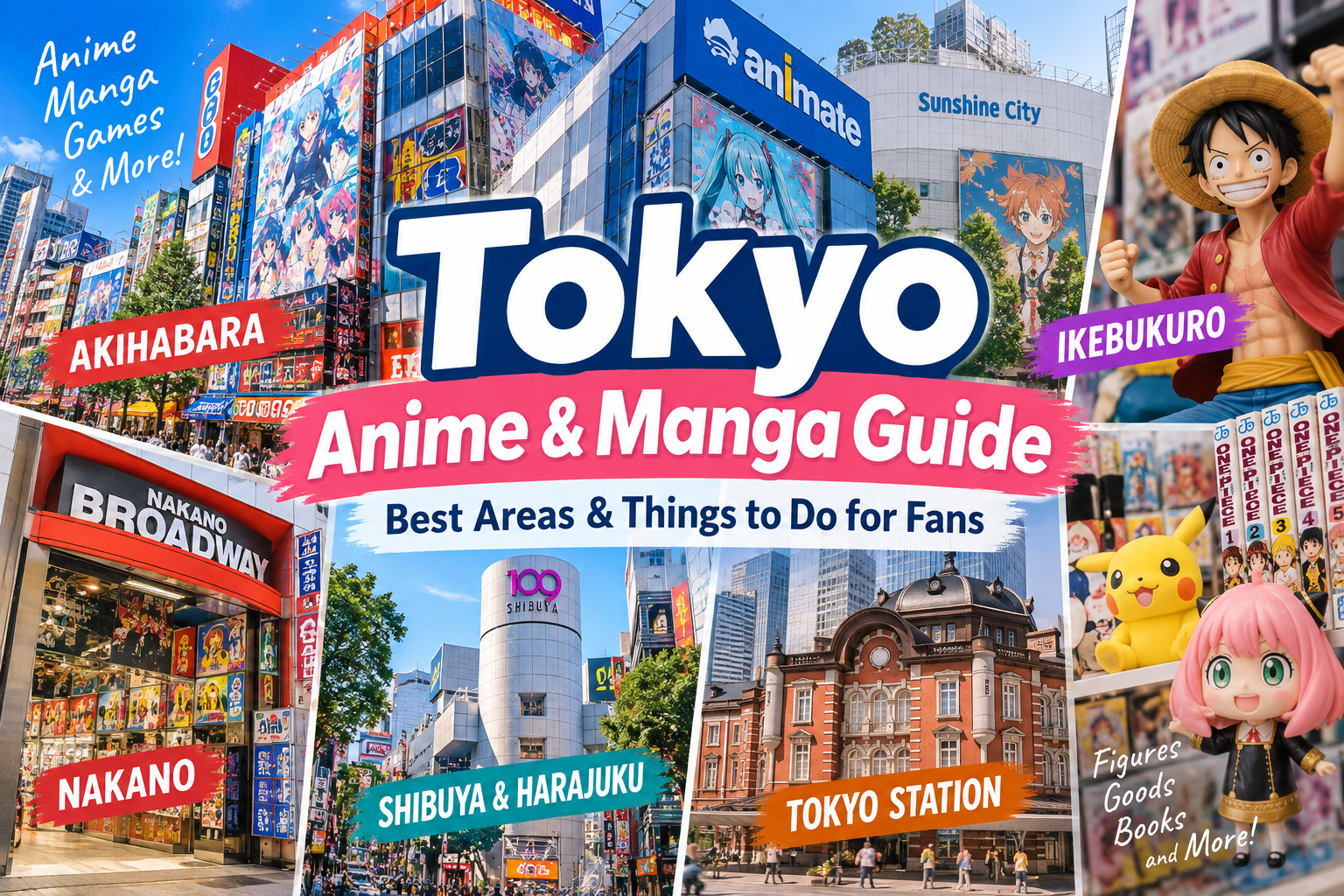
Tokyo Anime & Manga Guide: Best Areas & Things to Do for Fans
Tokyo is one of the best destinations in the world for anime and manga fans.
From the huge anime stores of Akihabara to the character shops of Ikebukuro and Tokyo Station, the city offers countless ways to experience Japanese pop culture beyond simply watching anime or reading manga.
But for first-time visitors, deciding where to go can be surprisingly difficult. Anime shops and attractions are spread across different parts of Tokyo, and each area has its own strengths.
This guide explains the best areas for anime and manga fans in Tokyo, what you can do in each neighborhood, where to shop for merchandise, and practical tips for planning your visit.
Tokyo Anime & Manga at a Glance
Tokyo does not have one single “anime district.”
Instead, several neighborhoods specialize in different parts of anime, manga, gaming, collectibles, and character culture.
The most important areas for first-time visitors are:
- Akihabara — anime, manga, figures, games, electronics, and collectibles
- Ikebukuro — anime merchandise, character stores, and a strong female-oriented fandom scene
- Nakano — rare collectibles, vintage merchandise, manga, and specialist stores
- Shibuya & Harajuku — modern character stores, collaborations, fashion, and pop culture
- Tokyo Station — convenient official character shops
- Odaiba and other areas — large-scale attractions, events, and character experiences
You do not need to visit all of them.
For most first-time visitors, choosing two or three areas that match your interests is better than trying to see everything.
1. Akihabara — The Classic Anime Destination
For many international visitors, Akihabara is the first place that comes to mind when thinking about anime in Tokyo.
The neighborhood is packed with stores selling manga, figures, trading cards, games, character merchandise, electronics, and secondhand collectibles.
Large advertisements and colorful anime signs cover many buildings, making simply walking through the area part of the experience.
What to Do in Akihabara
Popular activities include:
- Browse large anime and manga stores
- Shop for figures and collectibles
- Search secondhand stores for older merchandise
- Explore retro and modern video game shops
- Visit hobby and model stores
- Look for trading cards
- Try capsule toy machines
- Visit themed cafés and entertainment venues
Akihabara is particularly good if you enjoy exploring stores without having a specific item in mind.
You may find merchandise from major current series alongside older titles that are difficult to find elsewhere.
How Much Time Do You Need?
Allow at least half a day if anime shopping is important to you.
Fans who enjoy figures, games, trading cards, or secondhand merchandise can easily spend most of a day here.
2. Ikebukuro — A Major Anime Shopping Hub
Ikebukuro is another essential destination for anime fans.
The area around Sunshine City and Otome Road contains numerous anime stores, character shops, cafés, entertainment facilities, and specialty retailers.
Compared with Akihabara, Ikebukuro has traditionally been particularly popular with female anime and manga fans, although visitors of all interests can enjoy the area.
What to Do in Ikebukuro
You can:
- Shop for anime merchandise
- Browse manga and character goods
- Look for merchandise related to popular characters and series
- Visit specialty stores
- Explore Sunshine City
- Check for temporary exhibitions and collaborations
- Visit cafés and entertainment venues
Ikebukuro is also convenient because many stores and attractions are concentrated within a relatively walkable area.
Akihabara or Ikebukuro?
If you only have time for one, the best choice depends on your interests.
Choose Akihabara if you want a broad mix of anime, manga, figures, games, electronics, and collectibles.
Choose Ikebukuro if character merchandise, specialty anime shops, and modern fandom culture are your main priorities.
Serious fans should consider visiting both.
3. Nakano — Best for Collectors and Hidden Treasures
Nakano offers a different experience.
The main attraction for anime and manga fans is Nakano Broadway, a shopping complex known for specialist stores selling collectibles, manga, figures, toys, watches, and vintage items.
While Akihabara often feels energetic and highly visible, Nakano can feel more like a treasure hunt.
Why Visit Nakano?
Nakano is especially interesting for travelers searching for:
- Older anime merchandise
- Vintage toys
- Rare collectibles
- Secondhand figures
- Manga
- Character goods
- Niche hobby items
The selection can change constantly because many shops deal in secondhand products.
You may not find a particular item you want, but discovering unexpected merchandise is part of the appeal.
How Long Should You Spend?
For most travelers, two to three hours is enough.
Collectors may want considerably longer.
Nakano can also be combined with Shinjuku because the train journey between the two areas is relatively short.
4. Shibuya & Harajuku — Modern Pop Culture and Character Shops
Shibuya and Harajuku are not dedicated anime districts, but they have become increasingly important destinations for character and pop-culture shopping.
Here you can find major official stores, limited collaborations, fashion-related merchandise, and contemporary Japanese pop culture.
Why Visit Shibuya?
Shibuya works particularly well for travelers who want to combine anime shopping with mainstream Tokyo sightseeing.
You can spend part of your visit exploring character stores and then continue to:
- Shibuya Crossing
- Shibuya Sky
- Shopping centers
- Restaurants and cafés
- Harajuku
- Meiji Shrine
This makes Shibuya easier to include in a general Tokyo itinerary than some specialist anime districts.
For more ideas on where and what to buy across the city, see our Tokyo Shopping Guide.
Harajuku and Character Culture
Harajuku is famous for youth fashion and kawaii culture.
Depending on current store openings and collaborations, you may find character merchandise, pop-up stores, themed cafés, and limited products.
Because pop-up events change frequently, check current information before visiting.
5. Tokyo Station — Easy Character Shopping
Tokyo Station is one of the easiest places to add anime and character shopping to an existing sightseeing itinerary.
The station complex contains an area commonly associated with official character stores, where visitors can find merchandise from well-known Japanese franchises.
This is particularly useful if you:
- Have limited time
- Are already using Tokyo Station
- Want official merchandise
- Are looking for gifts
- Do not want to spend an entire day in an anime district
Because Tokyo Station is a major transportation hub, it is easy to combine with Ginza, Marunouchi, the Imperial Palace area, or onward travel.
If you are unsure how to navigate trains and stations while visiting these areas, our Tokyo Transportation Guide explains the basics for first-time visitors.
6. Odaiba and Large-Scale Anime Attractions
Not every anime experience in Tokyo involves shopping.
Odaiba and other parts of the city sometimes feature large character installations, themed attractions, exhibitions, and entertainment facilities connected with anime, games, or Japanese pop culture.
These experiences can be worth adding if they match a series or franchise you already enjoy.
However, exhibitions and temporary events change regularly.
Always check the attraction’s official website before planning your day around a specific event.
7. Anime Museums and Exhibitions
Tokyo regularly hosts anime, manga, and character exhibitions.
Some are permanent or long-running facilities, while others are temporary exhibitions connected to specific creators, franchises, anniversaries, or new releases.
Temporary events can be especially appealing because they may include:
- Original artwork
- Production materials
- Character displays
- Exclusive merchandise
- Photo spots
- Limited collaboration items
Popular exhibitions may require advance reservations or timed-entry tickets.
If there is a particular series you love, search for current Tokyo events before your trip.
8. Anime and Character Cafés
Character cafés are another popular way to experience anime culture in Tokyo.
Some cafés operate permanently, while others are limited-time collaborations.
Depending on the venue, you may find:
- Character-inspired food
- Themed drinks
- Exclusive merchandise
- Decorative interiors
- Character displays
- Limited souvenirs
Reservations are sometimes required, particularly for popular collaborations.
Do not assume you can simply walk in.
Check the official reservation system before visiting.
9. Buying Anime Merchandise in Tokyo
One of the biggest reasons anime fans visit Tokyo is shopping.
The amount of merchandise available can be overwhelming, so understanding the basic categories helps.
Official Stores
Official or franchise-operated stores are good for:
- Current merchandise
- Store-exclusive products
- Limited items
- Reliable product quality
They are usually the easiest option for first-time visitors.
Large Anime Retailers
Large specialty retailers carry merchandise from many different series.
They are useful when you want to compare several franchises in one place.
Secondhand Stores
Secondhand shopping is one of the most interesting parts of anime shopping in Japan.
Products may include:
- Figures
- Acrylic stands
- Badges
- Trading cards
- Plush toys
- Keychains
- Older merchandise
“Secondhand” does not necessarily mean poor condition. Many items are carefully graded and may appear almost unused.
Always check the condition label before purchasing.
10. Figures and Collectibles
Figures range from inexpensive prizes to high-end collector products.
If you plan to buy large figures, consider your luggage space before purchasing.
Boxes can be much larger than expected.
Collectors should also inspect secondhand products carefully for:
- Missing accessories
- Box damage
- Discoloration
- Previously opened packaging
Stores generally display condition information, although the amount of English varies.
11. Capsule Toys — Gachapon
Capsule toy machines are everywhere in Tokyo.
They are an inexpensive and entertaining way to collect small anime and character items.
Large gachapon areas may contain hundreds of machines covering:
- Anime
- Games
- Manga
- Animals
- Food miniatures
- Japanese culture
- Original characters
Keep some coins available, although payment systems vary by location.
It is very easy to buy more capsules than expected, so remember that even small souvenirs eventually take up luggage space.
12. Manga Shopping
Manga fans can find enormous selections of Japanese-language books throughout Tokyo.
Large bookstores and specialist shops may carry:
- Current manga
- Complete series
- Art books
- Illustration collections
- Magazines
- Doujinshi
- Older publications
Most manga sold in Japan is naturally in Japanese.
If you are looking for English editions, availability is much more limited and should not be assumed.
For many visitors, Japanese manga still makes an excellent souvenir even if they cannot read every page.
13. Doujinshi
Doujinshi are independently published works created by individual artists or groups.
They are an important part of Japanese fan culture and can be found in specialist stores and events.
Content varies widely.
Some works are suitable for general audiences, while others are intended only for adults.
Check age restrictions and store sections carefully.
14. Retro Games and Gaming Culture
Anime fans often overlap with gaming fans, making Tokyo’s game stores another major attraction.
Akihabara in particular offers both modern gaming products and retro games.
You may encounter:
- Older consoles
- Used games
- Game soundtracks
- Strategy guides
- Character merchandise
- Arcade-related products
Remember that older Japanese games may be region-specific or entirely in Japanese.
Check compatibility before purchasing hardware or software to use outside Japan.
15. Arcades and Crane Games
Japanese arcades offer another form of pop-culture entertainment.
Crane games are especially visible and often feature prizes connected with popular anime series.
Prizes may include:
- Figures
- Plush toys
- Keychains
- Character goods
- Limited designs
Winning can require multiple attempts, so set a spending limit before starting.
Arcades should be treated as entertainment rather than a guaranteed inexpensive way to obtain merchandise.
16. Trading Cards
Trading card stores are common in areas such as Akihabara and Ikebukuro.
Depending on the shop, you may find cards connected with popular Japanese games and franchises.
Collectors should remember that:
- Japanese cards may differ from international versions
- Prices vary significantly
- Rare cards can be expensive
- Condition matters
- Tax-free eligibility varies by store
If you are buying expensive collectibles, take time to understand exactly what you are purchasing.
17. Pop-Up Stores and Limited Collaborations
Limited-time collaborations are a major part of modern Japanese character culture.
A shopping mall, café, department store, convenience store, or entertainment venue may temporarily collaborate with a popular anime.
These events can include:
- Exclusive merchandise
- Special menus
- Character decorations
- Bonus items
- Photo spots
The challenge is that they change constantly.
Information in older travel articles can become outdated quickly.
For temporary events, always rely on current official announcements close to your travel dates.
18. How to Find Current Anime Events
Before your trip, search for:
- Your favorite anime title + Tokyo event
- Your favorite character + Tokyo collaboration
- Official franchise websites
- Official social media accounts
- Major store event pages
Search again shortly before visiting Tokyo because new events may be announced after you originally planned your itinerary.
19. Do You Need Reservations?
Normal retail stores generally do not require reservations.
However, reservations or advance tickets may be necessary for:
- Character cafés
- Popular exhibitions
- Special events
- Limited pop-up experiences
- Certain museums
- Timed-entry attractions
Some ticketing systems may be easier to use from Japan or may require specific registration procedures.
Read the official ticket instructions carefully.
20. Tax-Free Anime Shopping
Some stores offer tax-free shopping to eligible international visitors.
Rules and minimum purchase requirements depend on current Japanese tax regulations and the participating retailer.
You may need to present your passport or other required documentation.
Do not assume every anime store participates in tax-free shopping.
Check the store’s current policy before making a large purchase.
21. Cash, Cards, and Payment
Large anime stores generally offer multiple payment options, but smaller shops may have more limited systems.
It is useful to carry:
- A credit or debit card
- Some Japanese yen
- A mobile internet connection
Having internet access also makes it easier to compare prices, translate product descriptions, and search for other store branches.
22. Bringing Anime Purchases Home
Anime merchandise can consume luggage space surprisingly quickly.
Figures, plush toys, manga, and boxed collectibles are particularly bulky.
Before buying large items, think about:
- Suitcase space
- Weight limits
- Fragile packaging
- Customs rules in your home country
- Whether the box is important to you as a collector
A foldable extra bag can be useful for souvenirs, but check your airline’s baggage allowance before relying on this strategy.
23. Avoid Buying Everything on Your First Day
If Tokyo is the first stop of a longer Japan trip, avoid filling your suitcase immediately unless you find something rare.
You may encounter the same merchandise later, and carrying large purchases through several cities can become inconvenient.
For common items, consider saving some shopping until later in your trip.
For rare secondhand merchandise, however, waiting carries the risk that another customer will buy it.
24. How Much Should You Budget?
Anime shopping budgets vary enormously.
A casual visitor may spend only a small amount on capsule toys and souvenirs.
Collectors can easily spend tens of thousands of yen or more on figures, cards, and rare merchandise.
A practical approach is to decide on:
- A daily shopping budget
- A separate budget for rare items
- A maximum price you will pay for one collectible
This helps prevent impulse purchases from taking over your travel budget.
For a broader look at accommodation, food, transportation, sightseeing, and daily expenses, see our Tokyo Travel Budget Guide.
25. Best Time to Visit Anime Shopping Areas
Weekday mornings and early afternoons are generally easier for browsing than busy evenings or weekends.
Popular areas can become crowded after school, after work, and on weekends.
Opening hours vary significantly by store.
Many specialist shops do not open particularly early in the morning, so check operating hours before building an early itinerary.
26. How to Plan an Anime Day in Tokyo
Trying to visit Akihabara, Ikebukuro, Nakano, Shibuya, and Tokyo Station in one day is not recommended.
You will spend too much time traveling and too little time exploring.
Instead, group areas logically.
Example: Classic Anime Shopping Day
Morning — Akihabara
Explore major stores while the area is relatively manageable.
Lunch — Akihabara
Take a break before continuing to browse.
Afternoon — Ikebukuro
Explore anime shops and Sunshine City.
Evening — Ikebukuro
Have dinner nearby or continue to another entertainment area.
Example: Collector & Pop Culture Day
Morning — Nakano
Explore Nakano Broadway.
Afternoon — Shibuya
Visit character stores and explore the neighborhood.
Evening — Harajuku or Shinjuku
Finish with shopping, food, or sightseeing.
27. Anime Shopping With Non-Anime Fans
If you are traveling with someone who is not interested in anime, choose areas that offer other attractions nearby.
Good options include:
Shibuya
Anime and character stores can be combined with major sightseeing, shopping, cafés, and restaurants.
Ikebukuro
Sunshine City provides shopping and entertainment beyond anime.
Tokyo Station
Character shopping can be added to a broader sightseeing day.
This makes it easier for everyone in the group to enjoy the itinerary.
28. Anime Travel With Children
Families can enjoy many character stores, capsule toy areas, and family-friendly attractions.
However, not every anime shop is designed specifically for children.
Some stores or floors may contain adult-oriented material.
Parents should pay attention to signs, age restrictions, and store sections.
Character stores and major commercial complexes are generally easier choices for families.
29. Anime Etiquette in Shops
Anime stores follow the same basic shopping etiquette as other Japanese retailers.
Remember to:
- Avoid opening sealed merchandise
- Follow photography rules
- Do not block narrow aisles
- Return unwanted items to the correct location when possible
- Keep your voice at a reasonable level
- Follow staff instructions during crowded events
Photography policies vary.
Some stores allow photos while others prohibit photography in certain sections.
Look for signs before taking pictures.
30. Useful Japanese Words for Anime Shopping
A few words can make shopping easier.
Anime — アニメ
Anime
Manga — 漫画 / マンガ
Manga
Figure — フィギュア
Figure
Goods — グッズ
Merchandise
Used / secondhand — 中古 (chūko)
Secondhand
Sold out — 売り切れ (urikire)
Sold out
Limited edition — 限定 (gentei)
Limited
How much is this? — これはいくらですか?
Kore wa ikura desu ka?
Do you have this? — これはありますか?
Kore wa arimasu ka?
You can also show staff a picture of the character or product you are looking for.
31. Before Your Anime Day: Quick Checklist
Before leaving your hotel, check:
- Which areas you want to visit
- Store opening hours
- Current exhibitions
- Pop-up events
- Café reservations
- Attraction tickets
- Your shopping budget
- Available suitcase space
- Phone battery
- Internet connection
If you are searching for a particular series or character, save its Japanese name on your phone.
This can make searching and asking staff much easier.
Final Thoughts
Tokyo is not simply a city where you can buy anime merchandise.
It is one of the best places to experience the culture surrounding anime, manga, games, characters, collecting, and Japanese pop culture.
Akihabara is the classic starting point, Ikebukuro offers another major fandom hub, Nakano rewards collectors, and Shibuya, Harajuku, and Tokyo Station make anime culture easy to combine with regular sightseeing.
The key is not trying to visit everything.
Choose the neighborhoods that match your interests, leave enough time to explore stores properly, and check current official information for exhibitions, cafés, and limited events.
For anime and manga fans, even an ordinary shopping street or unexpected pop-up store can become one of the most memorable parts of a trip to Tokyo.
If you are planning your first visit, our Tokyo Travel Guide covers the essential areas, attractions, transportation, food, and practical information you need to plan the rest of your trip.
