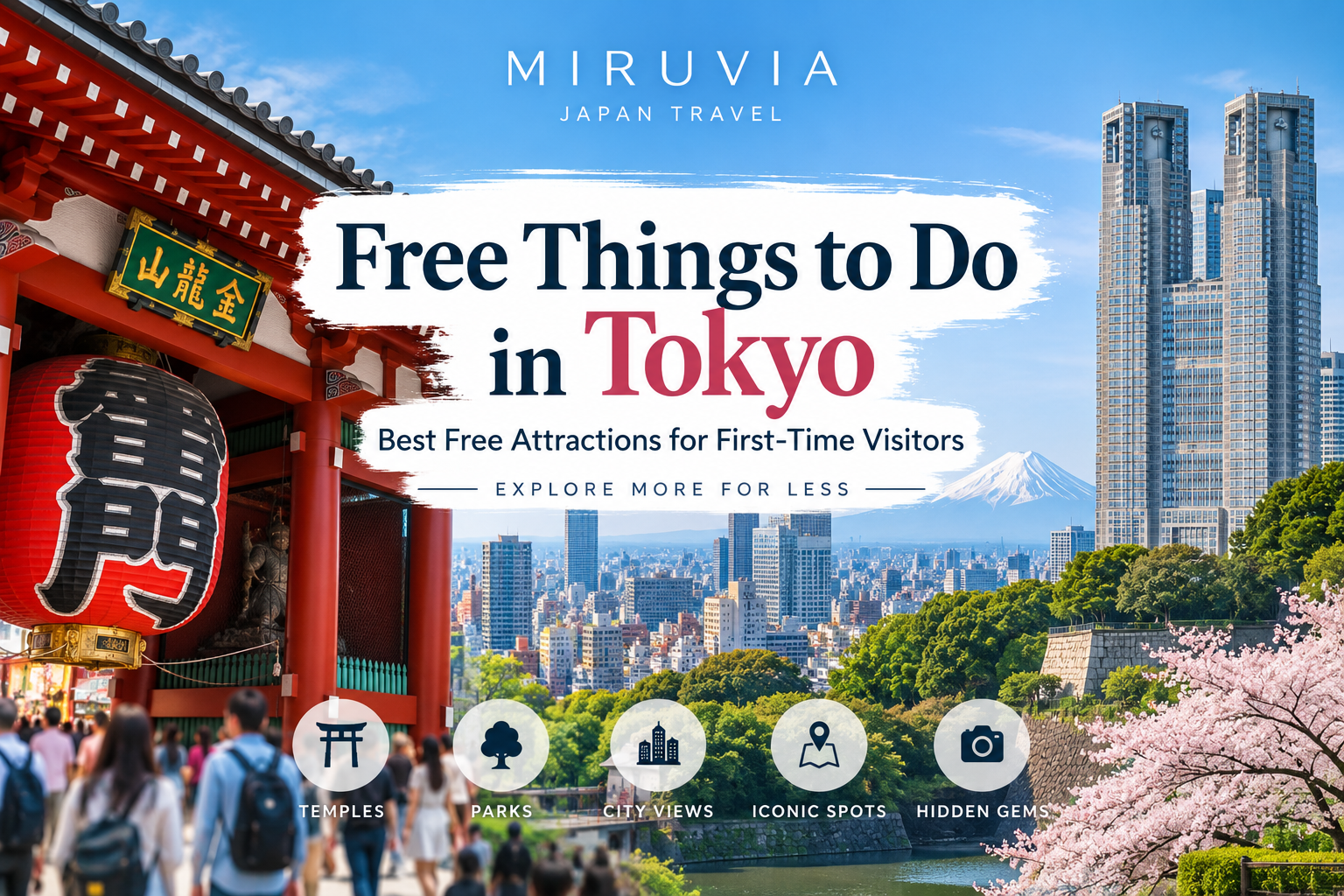
Tokyo has a reputation for being an expensive city, but some of its most memorable experiences cost nothing at all.
You can visit historic temples and shrines, explore famous neighborhoods, walk through beautiful parks, enjoy panoramic city views, and experience Tokyo’s unique atmosphere without paying an admission fee.
For first-time visitors, free attractions are also a great way to balance the cost of hotels, transportation, food, and paid experiences.
In this guide, we introduce some of the best free things to do in Tokyo, along with practical tips for adding them to your itinerary.
Planning your first visit? Read our complete Tokyo Travel Guide for practical advice on exploring the city.
Best Free Things to Do in Tokyo at a Glance
| Free Experience | Area | Best For |
|---|---|---|
| Cross Shibuya Crossing | Shibuya | Iconic Tokyo atmosphere |
| Visit Senso-ji Temple | Asakusa | Traditional culture |
| Visit Meiji Jingu | Harajuku | Shrines & nature |
| Enjoy the Tokyo Metropolitan Government Building views | Shinjuku | Free city views |
| Explore Ueno Park | Ueno | Parks & culture |
| Walk around the Imperial Palace area | Marunouchi | History & walking |
| Explore Odaiba | Tokyo Bay | Waterfront scenery |
| Walk through Yanaka | Yanaka | Old Tokyo atmosphere |
| Visit Tokyo Station & Marunouchi | Tokyo Station | Architecture & city walks |
| Experience Tokyo at night | Various areas | Night views & photography |
Many of these places can be combined with nearby attractions, making them easy to include in a first-time Tokyo itinerary.
1. Cross Shibuya Crossing
Few places represent modern Tokyo as instantly as Shibuya Crossing.
When the pedestrian lights turn green, people cross the intersection from several directions at once beneath giant screens and illuminated buildings.
Walking across the intersection is completely free, and the surrounding streets are worth exploring afterward.
Shibuya Center-gai and the streets around the station offer plenty of opportunities to experience the energy of the neighborhood without spending anything.
Best for
- First-time visitors
- Photography
- Modern Tokyo
- Evening walks
Tip: Visit after sunset if you want to see Shibuya at its most atmospheric.
2. Visit Senso-ji Temple
Senso-ji is one of Tokyo’s most famous temples and one of the best free cultural experiences in the city.
Your visit begins at the impressive Kaminarimon Gate before continuing along Nakamise Shopping Street toward the main temple grounds.
Although you may be tempted by the souvenirs and snacks along the way, simply exploring the temple and surrounding streets costs nothing.
The contrast between traditional architecture and modern Tokyo makes Asakusa particularly interesting for first-time visitors.
Best for
- Traditional Japan
- Temples
- Photography
- Historic atmosphere
Tip: Visit early in the morning if you prefer a quieter experience around the temple grounds.
3. Visit Meiji Jingu
Located next to Harajuku, Meiji Jingu feels surprisingly peaceful despite being in the middle of one of the world’s largest cities.
A wide path leads through a forested area toward the main shrine buildings, creating a completely different atmosphere from nearby Shibuya and Harajuku.
Entry to the main shrine area is free.
This makes Meiji Jingu an excellent place to experience Japanese shrine culture while also taking a break from Tokyo’s busier streets.
Best for
- Japanese culture
- Shrines
- Nature
- Peaceful walks
After your visit, you can continue toward Harajuku, Omotesando, or Shibuya.
4. See Tokyo from the Metropolitan Government Building
Tokyo has several famous observation decks, but many require an admission fee.
The Tokyo Metropolitan Government Building in Shinjuku provides an alternative for travelers who want to see the city from above without paying for a ticket.
From the observation areas, you can appreciate just how enormous Tokyo really is.
On clear days, distant landmarks may also be visible.
Best for
- City views
- Budget travelers
- Photography
- First-time visitors
Opening conditions and access procedures can change, so check the latest official information before visiting.
5. Explore Ueno Park
Ueno Park is one of Tokyo’s best-known public spaces and is free to explore.
The area contains museums, temples, cultural facilities, ponds, and walking paths.
While individual museums and attractions may charge admission, simply walking through the park is an enjoyable experience in itself.
During cherry blossom season, Ueno becomes especially popular as visitors gather beneath the flowering trees.
Best for
- Walking
- Parks
- Culture
- Cherry blossoms
You can also combine Ueno Park with nearby Ameyoko for a contrasting look at the neighborhood.
6. Walk Around the Imperial Palace Area
The Imperial Palace occupies a large area in central Tokyo, close to Tokyo Station and Marunouchi.
Although access to some parts of the palace grounds is restricted, the surrounding area provides spacious walking routes, historic scenery, stone walls, bridges, and views that feel very different from Tokyo’s dense commercial districts.
It is particularly convenient to combine this area with Tokyo Station.
Best for
- Walking
- Japanese history
- Architecture
- Central Tokyo sightseeing
The large open spaces around the palace also provide a welcome change of pace during a busy sightseeing day.
7. Explore Odaiba and Tokyo Bay
Odaiba offers wide waterfront spaces and views that are quite different from central Tokyo.
Walking around the area allows you to enjoy Tokyo Bay, modern architecture, public spaces, and views of Rainbow Bridge without needing to pay for an attraction.
The waterfront can be particularly pleasant around sunset and after dark.
Best for
- Waterfront views
- Couples
- Photography
- Evening walks
You may spend money on transportation, shopping, or attractions in the area, but simply exploring Odaiba itself can be a free experience.
8. Discover the Streets of Yanaka
If you want to see a quieter and more traditional residential side of Tokyo, consider walking through Yanaka.
The neighborhood is known for its narrow streets, temples, small shops, and older buildings.
Unlike Tokyo’s major entertainment districts, the appeal here comes from simply walking and observing everyday surroundings.
Yanaka Ginza is one of the best-known streets in the area and can be explored without an entrance fee.
Best for
- Old Tokyo atmosphere
- Street photography
- Walking
- Slow travel
Yanaka is a good choice when you want a break from the crowds of Shibuya and Shinjuku.
9. Explore Tokyo Station and Marunouchi
Tokyo Station is more than a transportation hub.
The historic Marunouchi side of the station is one of Tokyo’s most recognizable architectural landmarks.
Outside the station, the Marunouchi district offers broad streets, modern buildings, shops, and views toward the Imperial Palace area.
Walking around the neighborhood is free and particularly enjoyable in the evening when the buildings are illuminated.
Best for
- Architecture
- Photography
- City walks
- Evening sightseeing
This area is easy to combine with Ginza or the Imperial Palace during the same day.
10. Experience Tokyo After Dark
One of the easiest free experiences in Tokyo is simply exploring the city after sunset.
Tokyo changes dramatically at night.
Shibuya becomes surrounded by giant screens and illuminated signs, Shinjuku fills with neon, and Tokyo Station and Marunouchi offer a more elegant nighttime atmosphere.
You do not need to visit a bar, club, or paid attraction to enjoy Tokyo after dark.
Choose a neighborhood and spend some time walking through its streets.
Best for
- Night photography
- Couples
- City atmosphere
- First-time visitors
Seeing the same neighborhood during both the day and night can make it feel like two completely different places.
How to Combine Free Attractions in Tokyo
Tokyo is enormous, so grouping nearby attractions is one of the easiest ways to save both time and transportation costs.
For example:
Shibuya + Meiji Jingu + Harajuku
Start at Meiji Jingu, explore Harajuku, and continue toward Shibuya.
Asakusa + Ueno
Visit Senso-ji before continuing toward Ueno Park and Ameyoko.
Tokyo Station + Imperial Palace + Marunouchi
Explore the historic station building before walking toward the Imperial Palace area and returning through Marunouchi.
Planning your sightseeing geographically can prevent unnecessary trips across the city.
Need help organizing your sightseeing? Our Tokyo 3-day itinerary shows you how to explore several major areas efficiently.
How Much Money Do You Need for Tokyo?
Free attractions can reduce your sightseeing expenses considerably, but you should still budget for transportation, accommodation, food, and any paid attractions you want to experience.
Your total cost will depend heavily on your travel style.
A traveler using affordable restaurants and free attractions will have a very different daily budget from someone staying in luxury hotels and visiting multiple paid attractions.
For a more detailed breakdown, read our Tokyo travel budget guide before planning your trip.
Are Tokyo’s Free Attractions Worth Visiting?
Yes. Some of Tokyo’s most famous experiences do not require an admission ticket.
Shibuya Crossing, Senso-ji, Meiji Jingu, Tokyo’s neighborhoods, parks, and nighttime cityscapes are not simply alternatives for travelers on a tight budget.
They are major Tokyo experiences in their own right.
A good first-time itinerary usually combines free experiences with a smaller number of paid attractions that matter most to you.
Tips for Enjoying Tokyo on a Budget
Saving money in Tokyo does not mean trying to avoid every expense.
Instead, spend strategically.
- Group nearby attractions to reduce transportation costs.
- Use free observation areas when appropriate.
- Explore neighborhoods on foot.
- Mix free attractions with selected paid experiences.
- Check whether museums have free areas or special admission days.
- Avoid traveling across Tokyo repeatedly during the same day.
- Decide which paid attractions are genuinely important to you before your trip.
This approach can keep your budget under control without making your trip feel restrictive.
Accommodation can also have a major impact on your budget. Compare the best areas to stay in Tokyo before choosing your hotel.
Final Thoughts
You do not need a large sightseeing budget to experience Tokyo.
Some of the city’s most memorable places — from Shibuya Crossing and Senso-ji to Meiji Jingu and Tokyo’s nighttime streets — can be enjoyed without paying an admission fee.
For first-time visitors, combining these free experiences with a few carefully chosen paid attractions is an effective way to experience different sides of the city while keeping travel costs manageable.
Rather than focusing only on how much each attraction costs, think about the experiences you want from Tokyo.
Often, simply walking through the right neighborhood at the right time can become one of the highlights of your trip.
