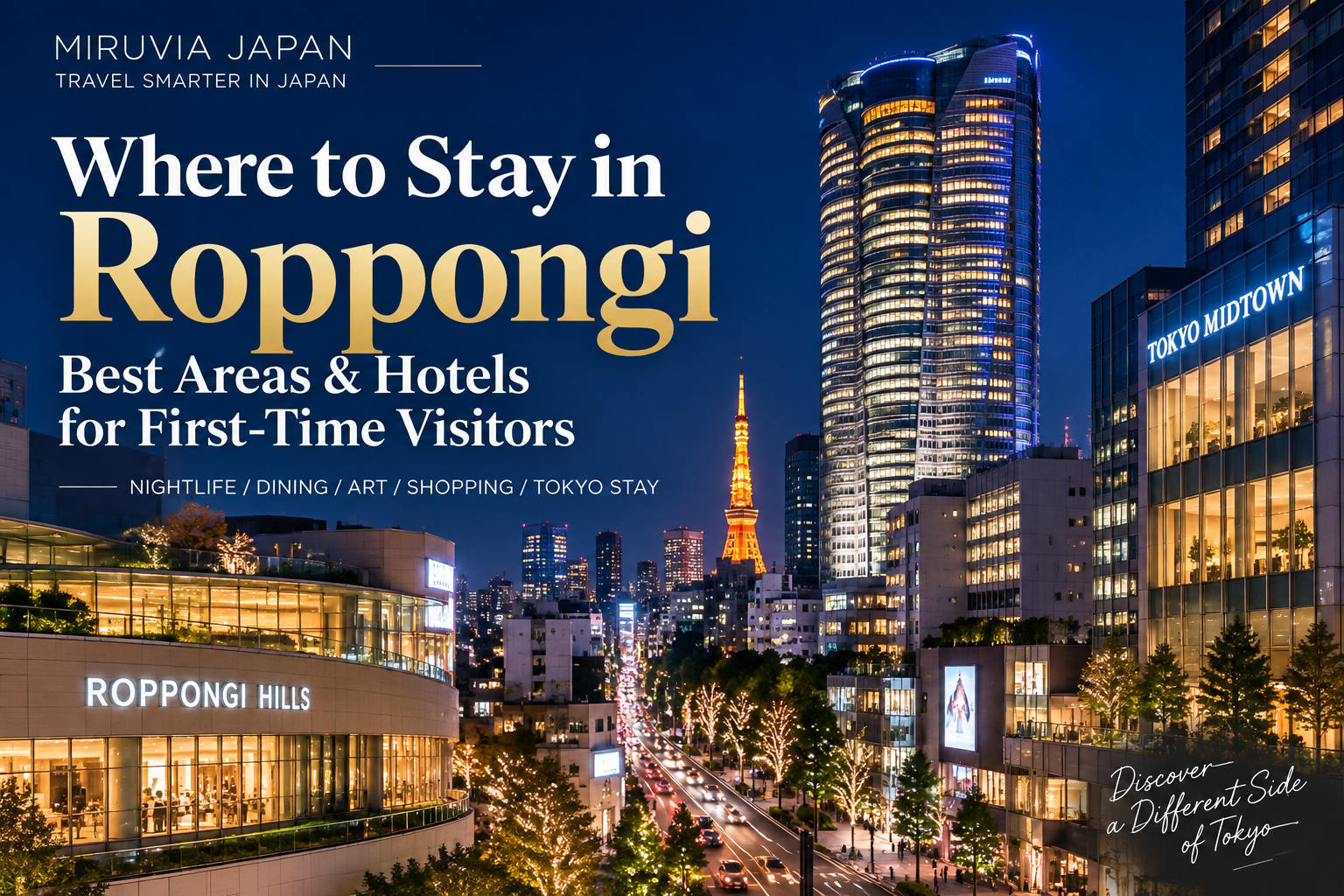
Roppongi is one of Tokyo’s best-known entertainment and nightlife districts, but the area offers much more than bars and clubs. Major developments such as Roppongi Hills and Tokyo Midtown bring together shopping, restaurants, museums, observation spots, and upscale hotels in a convenient central location.
Roppongi can be particularly attractive to couples, nightlife-focused travelers, art and architecture enthusiasts, and visitors who prefer an international atmosphere. Its central location also makes several parts of Tokyo relatively easy to reach by subway.
However, Roppongi is not the best base for every traveler. Hotel prices can be relatively high, and the area does not have a JR station, so travelers who expect to use JR lines or the Shinkansen frequently may find other neighborhoods more convenient.
This guide explains the best areas to stay in and around Roppongi, recommended hotels for first-time visitors, transportation and airport access, and practical tips to help you decide whether Roppongi is the right base for your Tokyo trip.
Is Roppongi a Good Place to Stay in Tokyo?
Yes, for the right type of traveler. Roppongi is a strong accommodation choice if you prioritize nightlife, restaurants, contemporary art, upscale shopping, and a central Tokyo location.
The neighborhood is served primarily by the Tokyo Metro Hibiya Line and Toei Oedo Line. These connections make it possible to reach many parts of Tokyo efficiently, although travelers who prefer direct access to the JR Yamanote Line may find Shinjuku, Shibuya, or Ueno more convenient.
One of Roppongi’s biggest advantages is the amount of entertainment available within walking distance. Roppongi Hills, Tokyo Midtown, museums, restaurants, and nightlife venues allow travelers to spend an entire evening close to their hotel.
Roppongi also has a more international atmosphere than many Tokyo neighborhoods, with a broad range of restaurants and services catering to international visitors.
The main disadvantages are accommodation costs and the nightlife atmosphere around certain streets. Travelers looking for traditional Tokyo scenery or a particularly quiet neighborhood may prefer areas such as Asakusa or Ueno.
Overall, Roppongi works best for travelers who value dining, nightlife, art, and central location more than JR transportation.
Best Areas to Stay in and Around Roppongi
The wider Roppongi area includes several neighborhoods with noticeably different atmospheres. Choosing the right location can determine whether your stay feels nightlife-focused, upscale and modern, or relatively quiet.
Central Roppongi
Staying close to Roppongi Station provides the easiest access to the neighborhood’s restaurants, bars, nightlife, and transportation.
Roppongi Hills and Tokyo Midtown are both within walking distance from much of central Roppongi, making this the most convenient option for travelers who want to experience the neighborhood without relying heavily on transportation in the evening.
Some streets can remain lively late at night, so travelers who prioritize quiet surroundings should check the exact hotel location.
Best for: First-time visitors to Roppongi, nightlife, dining, and convenience.
Roppongi Hills Area
The area around Roppongi Hills offers a more polished side of Roppongi, with shopping, restaurants, cultural attractions, offices, and modern architecture concentrated around the complex.
It is particularly attractive to couples and travelers interested in art, city views, dining, and an upscale urban environment.
Best for: Couples, art and architecture, dining, and higher-end stays.
Tokyo Midtown Area
Staying around Tokyo Midtown provides convenient access to shopping, restaurants, green spaces, cultural attractions, and Roppongi Station.
This part of the neighborhood can feel somewhat calmer than the streets immediately surrounding some of Roppongi’s nightlife venues while still keeping entertainment within walking distance.
Best for: Couples, shopping, art, upscale stays, and travelers seeking a balance between convenience and atmosphere.
Azabudai & Azabu Area
The areas toward Azabudai and Azabu offer a different experience from central Roppongi. Modern developments, residential streets, restaurants, and international influences create a more varied atmosphere.
Depending on the exact hotel location, transportation may be less straightforward than staying directly beside Roppongi Station, so check the nearest subway station before booking.
Best for: Couples, longer stays, dining, and travelers who prefer a more residential atmosphere.
Toward Akasaka
The area between Roppongi and Akasaka can be worth considering for travelers who want access to central Tokyo while staying outside Roppongi’s busiest nightlife streets.
Akasaka has its own concentration of restaurants, hotels, and subway connections, making it a practical alternative for travelers who want central convenience without making nightlife the focus of their stay.
Best for: Business travelers, dining, quieter evenings, and central Tokyo access.
Best Hotels in Roppongi for First-Time Visitors
Roppongi offers accommodation ranging from convenient city hotels near the subway to some of Tokyo’s best-known luxury properties. For first-time visitors, the best choice depends on whether you prioritize station access, nightlife, Roppongi Hills, or a higher-end hotel experience.
The following hotels offer useful options for different travel styles. Rates vary significantly depending on the season and booking date, so compare current prices before making a reservation.
remm Roppongi
remm Roppongi is one of the most convenient options for travelers who want to stay immediately beside Roppongi Station. Its location makes it easy to use both the Tokyo Metro Hibiya Line and Toei Oedo Line while keeping restaurants, nightlife, Tokyo Midtown, and Roppongi Hills within walking distance.
It is particularly practical for travelers who expect to spend most of their time sightseeing and want straightforward transportation rather than extensive hotel facilities.
Best for: First-time visitors, solo travelers, nightlife, and station access.
Mitsui Garden Hotel Roppongi Tokyo PREMIER
Mitsui Garden Hotel Roppongi Tokyo PREMIER is a strong mid-to-upper-range option for travelers who want a comfortable hotel in central Roppongi while remaining within walking distance of several major attractions.
The hotel provides access to both Roppongi Station and Roppongi-itchome Station, which can be useful depending on where you plan to travel in Tokyo.
Best for: Couples, first-time visitors, dining, and travelers looking for a more comfortable city-hotel experience.
Grand Hyatt Tokyo
Grand Hyatt Tokyo is a higher-end option located within the Roppongi Hills complex. This makes it particularly convenient for travelers who want restaurants, shopping, entertainment, art, and other Roppongi Hills attractions close to their hotel.
It is a strong choice for couples, special occasions, and travelers who want the hotel experience itself to be an important part of their stay.
Best for: Roppongi Hills, couples, luxury stays, dining, and special occasions.
The Ritz-Carlton, Tokyo
The Ritz-Carlton, Tokyo is one of the area’s premier luxury options and is located within the Tokyo Midtown complex. Its location combines a high-end hotel experience with convenient access to restaurants, shopping, cultural attractions, and Roppongi Station.
This is best suited to travelers with a larger accommodation budget who prioritize service, comfort, views, and a premium location rather than value.
Best for: Luxury travelers, couples, special occasions, and Tokyo Midtown.
Best Roppongi Hotels by Budget
Roppongi is not usually the first Tokyo neighborhood travelers choose when minimizing accommodation costs. Its central location and concentration of upscale hotels mean prices can be relatively high, particularly during busy travel periods.
However, comparing different parts of Roppongi and nearby neighborhoods can still reveal options across several price levels.
Budget
Travelers on a strict budget should compare compact hotels and accommodation outside the immediate Roppongi Hills and Tokyo Midtown areas.
If price is your main priority, also compare Roppongi with neighborhoods such as Ueno or Ikebukuro rather than assuming Roppongi will provide the best value.
Mid-Range
Mid-range accommodation can provide the best balance for many first-time visitors who specifically want to stay in Roppongi. Prioritize convenient access to Roppongi Station so you can easily use the Hibiya and Oedo lines.
A slightly higher room rate may be worthwhile if it reduces walking and keeps restaurants and attractions close to your hotel.
Higher-End
Roppongi is particularly strong for higher-end accommodation. Roppongi Hills and Tokyo Midtown offer premium hotels alongside restaurants, shopping, cultural attractions, and modern city environments.
This makes the neighborhood especially attractive for couples, special occasions, and travelers who want accommodation to be part of the overall Tokyo experience.
Where to Stay in Roppongi for Different Travelers
First-Time Visitors
First-time visitors who choose Roppongi should generally prioritize staying close to Roppongi Station. This provides the simplest combination of transportation, restaurants, sightseeing, and evening entertainment.
Recommended area: Central Roppongi
Couples
Couples have several strong options around Roppongi Hills and Tokyo Midtown, particularly if restaurants, art, city views, and a more upscale atmosphere are priorities.
Recommended area: Roppongi Hills or Tokyo Midtown
Nightlife Travelers
Travelers choosing Roppongi primarily for nightlife should stay within comfortable walking distance of central Roppongi. Being able to walk back to your hotel can be particularly useful after trains stop operating late at night.
Recommended area: Central Roppongi
Art and Culture Travelers
Roppongi is particularly attractive for travelers interested in contemporary art, museums, architecture, and modern Tokyo. Staying around Roppongi Hills or Tokyo Midtown provides convenient access to several major cultural destinations.
Recommended area: Roppongi Hills or Tokyo Midtown
Luxury Travelers
Travelers looking for a premium hotel experience should focus on Roppongi Hills and Tokyo Midtown, where some of the neighborhood’s best-known higher-end properties are located.
Recommended area: Roppongi Hills or Tokyo Midtown
Getting Around Tokyo from Roppongi
Roppongi is centrally located and provides useful subway connections to many parts of Tokyo. Roppongi Station is served by the Tokyo Metro Hibiya Line and the Toei Oedo Line.
The Hibiya Line is useful for reaching areas such as Ginza, while the Oedo Line provides connections toward destinations including Shinjuku. Depending on your hotel location, Roppongi-itchome Station on the Tokyo Metro Namboku Line may also be convenient.
One important difference from areas such as Shinjuku, Shibuya, Ueno, and Ikebukuro is that Roppongi does not have a JR station. This is not a major problem for most sightseeing itineraries, but travelers who expect to use JR services frequently should consider it when choosing where to stay.
For a complete explanation of trains, subways, IC cards, and transportation in the city, see our Tokyo Transportation Guide.
Getting to Roppongi from Haneda and Narita Airports
Roppongi can be reached from both Haneda and Narita airports, although the most convenient route depends on your hotel, luggage, arrival time, and current transportation services.
From Haneda Airport
Traveling from Haneda Airport to Roppongi by train generally requires at least one transfer. The exact route depends on which station is closest to your hotel.
Travelers with large luggage should compare routes based on the number and ease of transfers rather than travel time alone. Airport limousine bus services may also be useful for selected hotels when available.
Check current railway and airport bus information shortly before your trip.
From Narita Airport
Narita Airport is farther from Roppongi, and rail journeys generally involve traveling into central Tokyo before connecting to the Roppongi area.
Depending on your hotel and current schedules, an airport limousine bus may provide a more comfortable option, particularly when carrying large luggage.
Because airport transportation services and schedules can change, verify the latest information before traveling.
Things to Check Before Booking a Hotel in Roppongi
Roppongi offers an excellent central location, but the neighborhood varies considerably from street to street. Check these practical details before choosing your hotel.
Distance from the Nearest Subway Station
Since Roppongi does not have a JR station, convenient subway access is particularly important. Check whether Roppongi Station, Roppongi-itchome Station, or another nearby station is most useful for your hotel.
Also check the actual station exit and walking route, especially if you will be carrying luggage.
Nightlife and Noise
Some parts of central Roppongi remain active late into the night because of bars, clubs, restaurants, and entertainment venues.
This can be an advantage for nightlife-focused travelers but may be less suitable for visitors who prioritize quiet surroundings. Check the exact hotel location and recent guest reviews before booking.
Room Size
Hotel rooms in Tokyo can be compact. Check the room size in square meters, bed configuration, and luggage space before booking rather than relying only on photographs.
This is particularly important for couples with several suitcases or travelers planning longer stays.
Hotel Price
Roppongi can be relatively expensive compared with some other Tokyo neighborhoods. Compare the benefits of the location with your overall accommodation budget before booking.
If nightlife, dining, art, and central location are not major priorities, another neighborhood may provide better value for your itinerary.
Late-Night Transportation
Tokyo’s regular train and subway services do not operate throughout the entire night. If nightlife is an important part of your trip, staying within walking distance of the places you expect to visit can reduce the need for late-night taxis.
Always check current operating times for the transportation services you plan to use.
Check-In and Luggage Storage
Check your hotel’s check-in time and luggage storage policy, particularly if you arrive before your room is ready or plan to continue sightseeing after check-out.
Luggage storage can make arrival and departure days significantly easier.
Frequently Asked Questions About Staying in Roppongi
Is Roppongi a good place to stay for first-time visitors?
Yes, particularly for first-time visitors who prioritize nightlife, restaurants, contemporary art, upscale shopping, and a central location. Travelers who prefer direct JR access or a more traditional atmosphere may find other neighborhoods more suitable.
Which part of Roppongi is best to stay in?
For most first-time visitors choosing Roppongi, staying near Roppongi Station provides the best balance of transportation, restaurants, nightlife, and sightseeing. Roppongi Hills and Tokyo Midtown are particularly attractive for travelers seeking a more upscale experience.
Is it better to stay in Roppongi or Shinjuku?
Choose Roppongi if nightlife, dining, contemporary art, and a central international atmosphere are priorities. Shinjuku generally provides more extensive railway connections, a broader range of accommodation, and convenient access to western Tokyo.
For more information, see our Where to Stay in Shinjuku guide.
Is it better to stay in Roppongi or Shibuya?
Roppongi is particularly attractive for nightlife, higher-end dining, contemporary art, and upscale hotels. Shibuya is stronger for fashion, youth culture, shopping, and convenient access to areas such as Harajuku.
See our Where to Stay in Shibuya guide for a detailed look at staying in Shibuya.
Is Roppongi good for families?
Roppongi can work for families, particularly around Roppongi Hills and Tokyo Midtown, where shopping, dining, cultural attractions, and modern facilities are concentrated.
However, families who prioritize lower accommodation costs, traditional sightseeing, or a quieter overall atmosphere may prefer another part of Tokyo.
Can I use Roppongi as my base for my entire Tokyo trip?
Yes. Roppongi’s central location and subway connections make it practical to use one hotel throughout a Tokyo stay. The lack of a JR station is worth considering, but it does not prevent travelers from reaching major sightseeing areas efficiently.
Final Thoughts
Roppongi is a strong place to stay for travelers who prioritize nightlife, restaurants, contemporary art, upscale shopping, and a central Tokyo location.
For most first-time visitors choosing Roppongi, staying near Roppongi Station provides the easiest balance of transportation and entertainment. Roppongi Hills and Tokyo Midtown are particularly attractive for couples and travelers looking for a more upscale experience, while locations toward Azabu or Akasaka may suit travelers who prefer a different atmosphere.
Before booking, compare subway access, surrounding nightlife, room size, hotel price, and how well Roppongi fits your overall Tokyo itinerary.
If you are still comparing different parts of the city, see our Tokyo Accommodation Guide for a broader overview of where to stay in Tokyo.
